
AberturaOpening
A fonte que eu mais repitoThe source I repeat the most
A fonte que eu mais repito não é um filósofo. É um consenso médico de 2006, o mesmo que trocou o nome da condição com que eu nasci.The source I repeat the most is not a philosopher. It is a medical consensus from 2006, the same one that changed the name of the condition I was born with.
O nome dele é . Ele saiu de uma reunião de especialistas em Chicago, foi assinado por quatro médicos (Peter Lee, Christopher Houk, Faisal Ahmed e Ieuan Hughes) e publicado em duas revistas, a Pediatrics e a Archives of Disease in Childhood. Foi ali que o “hermafrodita verdadeiro” saiu dos manuais e entrou a sigla que a medicina usa até hoje, DSD, de disorders of sex development. Então, quando eu escrevo “DSD ovotesticular” do lado do meu nome, estou usando uma palavra que aquela reunião escolheu, com os argumentos daquela reunião, e com os problemas que ela deixou de herança, que a trilha do corpo vai abrir.It is called the . It came out of a meeting of specialists in Chicago, was signed by four physicians (Peter Lee, Christopher Houk, Faisal Ahmed and Ieuan Hughes) and published in two journals, Pediatrics and the Archives of Disease in Childhood. That is where “true hermaphrodite” left the manuals and the acronym medicine still uses today came in: DSD, for disorders of sex development. So when I write “ovotesticular DSD” next to my name, I am using a word that meeting chose, with that meeting’s arguments, and with the problems it left behind, which the body trail will open.
Ele entra formalmente em seis bibliografias do site: A identidade antes do corpo, Quem paga a conta, Intersexo 2, Matrix, Prova de Dissidência e o primeiro Intersexo. E aparece ainda no meio do texto do Ponto de Ruptura e do Faith and Belief. Nenhum autor chega nisso. Nem o , que é de longe o nome que mais aparece no corpo dos meus ensaios, está em tanta lista de fontes quanto esse documento técnico que quase ninguém fora da endocrinologia leu.It appears formally in six bibliographies on the site: Identity Before the Body, Who Pays the Bill, Intersex Part 2, The Name That Cannot Be Cut, Proof of Dissent and the first Intersex essay. It also shows up in the body of The Breaking Point and Faith and Belief. No author comes close. Not even , by far the name that appears most often inside my essays, sits in as many source lists as this technical document that almost nobody outside endocrinology has read.
Eu começo por ele porque ele desmonta a ideia que quase todo mundo tem do que é uma fonte. Na cabeça de muita gente, fonte é o nome bonito no rodapé: um filósofo alemão, um psiquiatra suíço, uma frase em latim que ninguém vai conferir. Funciona como um crachá pendurado no pescoço do texto, que avisa que alguém leu alguma coisa, ou que parece ter lido. O não está nas minhas bibliografias por esse motivo, porque ele não tem charme nenhum. Ele está lá porque faz um trabalho que nenhum outro texto faz: mostra quem decidiu o nome que o meu corpo carrega nos papéis, quando decidiu e com que argumento. Eu pego esse documento, uso pra uma tarefa específica e devolvo pro lugar. É uma ferramenta.I start with it because it takes apart the idea most people have of what a source is. In a lot of heads, a source is the pretty name in the footnote: a German philosopher, a Swiss psychiatrist, a Latin phrase nobody is going to check. It works like a badge hanging from the text’s neck, announcing that someone read something, or seems to have. The is not in my bibliographies for that reason, because it has no glamour at all. It is there because it does a job no other text does: it shows who decided the name my body carries on paper, when they decided it and with what argument. I pick that document up, use it for a specific task and put it back. It is a tool.
Essa matéria é sobre isso, sobre as fontes do Beyond Patterns e sobre o que cada uma delas faz lá dentro. A tese cabe numa linha: fonte não é oráculo, é ferramenta, e quem entende pra que eu uso cada uma entende o motor por trás dos meus pensamentos.This piece is about that: the sources of Beyond Patterns and what each one does inside them. The thesis fits in one line. A source is not an oracle, it is a tool, and whoever understands what I use each one for understands the engine behind my thinking.
Guarda a palavra motor, porque ela volta no fim.Hold on to the word engine. It comes back at the end.
Interativo 01 · Puxa o fioInteractive 01 · Pull the thread
o leitor puxa um nome e vê o que ele puxa nas sete trilhas.the reader pulls a name and sees what it pulls across the seven trails.
A estante vazia e o jeito de perguntarThe empty shelf and the way of asking
Logo depois de dizer isso, eu preciso te mostrar um dado que parece desmentir tudo.Right after saying that, I have to show you a fact that seems to contradict all of it.
A Régua e o Ruído tem quase 20 mil palavras e nenhum dos autores desta matéria aparece nele. Nem , nem , nem , nem o . E ele não é exceção. O site tem 32 ensaios sem bibliografia formal no fim; em 12 deles os nomes aparecem no meio do texto, e nos outros 20 quase não aparece nome nenhum. É o caso das duas Réguas, dos sete ensaios sobre K-pop e de onze ensaios sobre games e tecnologia. Quem olhasse só pra estante concluiria que esses textos rodam sem motor nenhum, que eu escrevo com fonte quando o assunto é corpo ou teologia e vou no improviso quando o assunto é uma música ou uma placa de vídeo.The Ruler and the Noise has almost twenty thousand words and none of the authors in this piece appear in it. Not , not , not , not the . And it is not an exception. The site has 32 essays without a formal bibliography at the end; in 12 of them the names appear inside the text, and in the other 20 almost no name appears at all. That is the case for both Ruler essays, the seven essays on K-pop and eleven essays on games and technology. Anyone looking only at the shelf would conclude that those texts run without an engine, that I write with sources when the subject is the body or theology and improvise when the subject is a song or a graphics card.
A conclusão parece óbvia e está errada, e o jeito de ver por que é fazer o teste ao contrário. Em vez de procurar nomes, procura perguntas. Quando a gente lê os ensaios em sequência, com e sem bibliografia, seis movimentos aparecem o tempo todo, sempre os mesmos, em ordem diferente e aplicados a objetos que não têm nada a ver entre si. São eles que fazem o trabalho. Os nomes vêm depois, quando vêm.The conclusion looks obvious and it is wrong, and the way to see why is to run the test backwards. Instead of looking for names, look for questions. When you read the essays in sequence, with and without bibliographies, six moves show up all the time, always the same ones, in a different order and applied to objects that have nothing to do with each other. They do the work. The names come later, when they come.
O primeiro movimento é perguntar em quantas camadas uma coisa se divide quando a gente para de arredondar. A primeira Bússola, o ensaio que abre a série Bússola ou Mapa, mostra que esquerda e direita começaram como uma convenção de assentos de 1789. O primeiro Intersexo separa o sexo em cinco camadas independentes, e a Errata acrescenta uma sexta. A segunda Régua mostra uma palavra só fundindo quatro coisas diferentes e apagando a proporção entre elas.The first move is to ask how many layers something splits into once we stop rounding. The first Compass, the essay that opens the Compass or Map series, shows that left and right began as a seating arrangement in 1789. The first Intersex essay separates sex into five independent layers, and The Errata No One Read adds a sixth. The second Ruler shows a single word fusing four different things and erasing the proportion between them.
O segundo é perguntar se o mapa está sendo confundido com o território. Todo modelo é útil até o dia em que alguém começa a tratar o modelo como se fosse a própria coisa, e a série Bússola ou Mapa foi construída em cima dessa diferença, assim como O Ponto de Ruptura, que é sobre o momento em que o mapa rasga.The second is to ask whether the map is being confused with the territory. Every model is useful until the day someone starts treating the model as if it were the thing itself, and the whole Compass or Map series was built on that difference, as was The Breaking Point, which is about the moment the map tears.
O terceiro é perguntar quem decide o que uma coisa é: quem tem o poder de dar o nome, e o que esse nome faz com quem recebe. É a pergunta da Errata, que quer saber quem define o corpo dos outros, e é a pergunta do Matrix, que o site lê como uma história sobre o poder de dar nome.The third is to ask who decides what something is: who holds the power to give the name, and what that name does to whoever receives it. It is the question of The Errata No One Read, which wants to know who defines other people’s bodies, and the question of The Name That Cannot Be Cut, which the site reads as a story about the power to name.
O quarto é perguntar o que uma coisa faz por baixo do que diz. A bandeira fala uma coisa e o mecanismo faz outra, e o ensaio A Bandeira e o Mecanismo resume isso numa frase: todo mundo discute a bandeira e ninguém audita a máquina.The fourth is to ask what something does underneath what it says. The flag says one thing and the mechanism does another, and The Flag and the Mechanism sums it up in a sentence: everyone argues about the flag and nobody audits the machine.
O quinto é perguntar quem paga a conta. Toda decisão tem um custo, e o custo quase nunca fica com quem decidiu. O Quem paga a conta leva essa pergunta pra mesa de família, pra rua e pra igreja, e o Intersexo 2 leva pra assinatura que vem antes de uma cirurgia.The fifth is to ask who pays the bill. Every decision has a cost, and the cost almost never stays with whoever decided. Who Pays the Bill takes that question to the family table, the street and the church, and Intersex Part 2 takes it to the signature that comes before a surgery.
O sexto é perguntar como se discute uma coisa honestamente. Nos ensaios, isso vira regra: o melhor argumento do outro lado entra inteiro antes da resposta, o que me faria mudar de ideia é dito antes, e lente nunca é vendida como dado.The sixth is to ask how to argue about something honestly. In the essays this becomes a rule: the best argument on the other side comes in whole before the answer, what would make me change my mind is said up front, and a lens is never sold as data.
Essas seis perguntas são o motor. Os autores são ferramentas que eu encaixo nelas, cada um onde serve. O entra quando a pergunta é por que a máscara não muda. O entra quando a pergunta é quem decide. O entra quando a pergunta é examinar, o quando a pergunta é o que me faria mudar de ideia, e a biologia quando a pergunta é camada. Quando o ensaio é sobre uma música de K-pop, as mesmas perguntas rodam sem nenhum desses nomes por perto, e é por isso que esta matéria não podia ser um catálogo. Um catálogo explicaria um terço do site e deixaria de fora justamente a prova mais forte de que o motor existe, que são os textos em que ele funciona sem crachá nenhum.Those six questions are the engine. The authors are tools I fit into them, each one where it works. comes in when the question is why the mask doesn’t change. comes in when the question is who decides. comes in when the question is examining, when the question is what would make me change my mind, and biology when the question is layers. When the essay is about a K-pop song, the same questions run without any of those names nearby, and that is why this piece could not be a catalog. A catalog would explain a third of the site and leave out exactly the strongest proof that the engine exists, the texts where it works without any badge at all.
O motor não mora na estante. Mora no jeito de perguntar.The engine doesn’t live on the shelf. It lives in the way of asking.
O que a contagem mostrouWhat the count showed
Pra escrever esta matéria eu precisava saber o que o site cita de verdade, e não o que eu acho que ele cita. Então as cinquenta páginas publicadas foram abertas no navegador, uma por uma, e lidas em três camadas: a seção de fontes, os links externos e uma contagem de nomes e conceitos no corpo do texto. Português e inglês foram contados separados, e ficou sempre o maior número, pra nenhuma menção contar duas vezes. As seções de fontes renderam umas 630 entradas. O Faith and Belief, que monta o texto por programação, foi lido pelo próprio código da página.To write this piece I needed to know what the site actually cites, not what I think it cites. So the fifty published pages were opened in the browser, one by one, and read in three layers: the source section, the external links and a count of names and concepts in the body of the text. Portuguese and English were counted separately, always keeping the larger number, so that no mention would count twice. The source sections yielded about 630 entries. Faith and Belief, which builds its text through code, was read through the page’s own script.
E a contagem trouxe uma surpresa logo de cara. No sexto capítulo do Quem paga a conta, eu nomeei o meu cânone: , e , as “três pessoas que eu cito o tempo todo”. O Jung confere, com 253 menções em sete ensaios (Quem paga a conta, Mulan, Alastor, a segunda Bússola, o Protocolo de Individuação, o TADC, sobre o desenho The Amazing Digital Circus, e o ensaio sobre KPop Demon Hunters). O Sócrates e o Kant, não. O Sócrates tem 37 menções, e 32 delas estão no próprio Quem paga a conta. O Kant tem 16, e 14 estão lá também. Fora desse ensaio, o Sócrates aparece cinco vezes e o Kant duas. Quando a régua mede o site todo, o pódio é outro: o Jung, a Bíblia de mãos dadas com o , e o .And the count brought a surprise right away. In the sixth chapter of Who Pays the Bill, I named my canon: , and , the “three people I quote all the time.” Jung checks out, with 253 mentions in seven essays (Who Pays the Bill, Mulan, Alastor, the second Compass, Individuation Protocol, TADC, on the cartoon The Amazing Digital Circus, and the essay on KPop Demon Hunters). Socrates and Kant don’t. Socrates has 37 mentions, and 32 of them are in Who Pays the Bill itself. Kant has 16, and 14 are there too. Outside that essay, Socrates appears five times and Kant twice. When the ruler measures the whole site, the podium is different: Jung, the Bible hand in hand with , and the .
Eu podia esconder essa diferença, mas ela explica alguma coisa, então ela fica. O cânone que eu declarei é o cânone do método. , e são três perguntas: examinar, sair da tutela e ver a máscara, e por isso eles moram justamente no ensaio que é sobre fontes. O cânone que o site mede é o cânone do assunto. A Bíblia, o e o são as ferramentas que os temas dos últimos meses pediram, porque os últimos meses foram de corpo, de teologia e de nome nos papéis.I could hide that difference, but it explains something, so it stays. The canon I declared is the canon of method. , and are three questions: examine, leave tutelage and see the mask, which is why they live precisely in the essay that is about sources. The canon the site measures is the canon of subject matter. The Bible, and the are the tools that the topics of recent months asked for, because recent months were about the body, theology and names on paper.
Um é o jeito como eu penso. O outro é o que eu precisei pra escrever.One is how I think. The other is what I needed in order to write.
E tem uma data no meio disso tudo. Desde 14 de setembro, todo ensaio do site sai com fontes no fim. Antes dessa data, a bibliografia era exceção. Essa data volta na trilha da régua, quando a ré for eu.And there is a date in the middle of all this. Since September 14, every essay on the site has gone out with sources at the end. Before that date, a bibliography was the exception. That date comes back on the ruler trail, when the defendant is me.
Como ler esta matéria, e o que derrubaria elaHow to read this piece, and what would bring it down
Daqui pra frente o texto anda em sete trilhas que se cruzam. Cada fonte entra porque a anterior puxou ela, e o puxão pode ser de quatro tipos. Às vezes é resposta, quando um autor escreve pra rebater outro. Às vezes é herança, quando um aluno leva a ideia do mestre pra um lugar onde o mestre nunca pisou. Às vezes é briga pura. E às vezes é teste, quando alguém pega a ideia de outro e leva pro laboratório pra ver se ela aguenta. Os pontos em que uma trilha encosta na outra são pontes, e o texto avisa sempre que passa por uma. Como tem nome demais pra caber no texto corrido, quem não ganhou espaço próprio mora no glossário do fim da página: tocou no nome, abre o verbete. E o nome de cada ensaio do site, quando aparece, leva direto pra ele, pra quem quiser conferir a fonte na origem.From here on the text moves along seven trails that cross. Each source comes in because the previous one pulled it, and the pull comes in four kinds. Sometimes it is a reply, when an author writes to rebut another. Sometimes it is inheritance, when a student carries the teacher’s idea to a place the teacher never set foot. Sometimes it is a plain fight. And sometimes it is a test, when someone takes another person’s idea to the lab to see whether it holds. The points where one trail touches another are bridges, and the text says so every time it crosses one. Since there are too many names to fit in the running text, whoever didn’t get a space of their own lives in the glossary at the end of the page: tap the name and the entry opens. And the name of each essay on the site, when it appears, takes you straight to it, for anyone who wants to check the source at its origin.
Antes da primeira trilha, porém, vêm as regras, que são as mesmas de todo o site, só que dessa vez apontadas pra mim.Before the first trail, though, come the rules, which are the same as on the whole site, except that this time they point at me.
Este texto não é a bibliografia completa do Beyond Patterns, que está nas próprias páginas e no glossário. Também não é uma lista de autores que eu endosso, porque usar a ferramenta de alguém não é assinar embaixo de tudo o que essa pessoa fez, e o primeiro exemplo disso aparece logo na trilha da máscara. E, como na abertura da Prova de Dissidência, eu digo antes o que derrubaria esta tese.This text is not the complete bibliography of Beyond Patterns, which lives on the pages themselves and in the glossary. Nor is it a list of authors I endorse, because using someone’s tool is not signing off on everything that person did, and the first example of that shows up right on the mask trail. And, as at the opening of Proof of Dissent, I say up front what would bring this thesis down.
Se os ensaios sem nome não mostrarem as mesmas seis perguntas que os ensaios com bibliografia mostram, a tese do motor cai. Se algum ensaio publicado usar uma fonte como oráculo, por exemplo diagnosticando uma pessoa real pelo , a tese cai naquele ensaio, e ele ganha errata. E se tu tirar as citações de um ensaio com bibliografia e o argumento continuar exatamente igual, as citações eram enfeite, e o réu que eu vou julgar na trilha da régua sou eu.If the essays without names do not show the same six questions that the essays with bibliographies show, the engine thesis falls. If any published essay uses a source as an oracle, for example by diagnosing a real person through , the thesis falls in that essay, and it gets an erratum. And if you remove the citations from an essay with a bibliography and the argument stays exactly the same, the citations were decoration, and the defendant I will judge on the ruler trail is me.
Três testes. Os três podem dar contra mim.Three tests. All three can go against me.
Trilha 1Trail 1
A máscaraThe mask
A primeira trilha começa numa praça de Atenas e termina num laboratório de psicologia, e no meio dela tem um psiquiatra suíço, um navio que troca de tábua, uma família inteira de psicanalistas brigando e um filósofo pessimista que descreveu, dois séculos antes, o que os psicólogos iam medir depois. Parece muita coisa pra uma trilha só, mas todas essas fontes estão respondendo a mesma pergunta, que é a mais pessoal do motor: por que a máscara não muda, mesmo quando quem usa sofre com ela?The first trail starts in a square in Athens and ends in a psychology lab, and in between there is a Swiss psychiatrist, a ship that swaps its planks, a whole family of psychoanalysts fighting and a pessimist philosopher who described, two centuries early, what psychologists would later measure. It sounds like a lot for one trail, but all these sources are answering the same question, the most personal one in the engine: why doesn’t the mask change, even when the person wearing it suffers for it?
Interativo 02 · Sombra na paredeInteractive 02 · Shadow on the wall
o leitor move a luz; a sombra muda, a coisa não.the reader moves the light; the shadow changes, the thing doesn’t.
Da pergunta à cavernaFrom the question to the cave
A trilha começa com alguém que nunca escreveu uma linha. Tudo o que a gente sabe do vem de quem andava com ele, principalmente do , e mesmo assim é dele a frase que abre esta trilha: uma vida sem exame não vale a pena ser vivida. Ela está na , o discurso de defesa no julgamento que terminou com a condenação dele à morte, e o Quem paga a conta cita esse discurso em quatro pontos diferentes, porque ele conta, de dentro, como nasceu o hábito de examinar.The trail begins with someone who never wrote a line. Everything we know about comes from the people who walked with him, mainly , and yet the sentence that opens this trail is his: an unexamined life is not worth living. It is in the , the defense speech at the trial that ended with his death sentence, and Who Pays the Bill cites that speech at four different points, because it tells, from the inside, how the habit of examining was born.
A história é boa demais pra pular. Um amigo do foi ao oráculo de Delfos e perguntou se havia alguém mais sábio que ele, e o oráculo disse que não. Sócrates achou a resposta absurda e saiu testando a profecia: foi atrás de políticos, poetas e artesãos com fama de sábios e fez perguntas até descobrir que todos eles achavam que sabiam o que não sabiam. A conclusão dele foi que a única vantagem que tinha sobre os outros era essa, saber que não sabia. O primeiro movimento dele foi conferir o oráculo, e não obedecer. No mesmo discurso, ele se compara a um moscardo que o deus colocou no lombo de Atenas, um cavalo grande e preguiçoso, pra não deixar a cidade dormir. E termina com uma frase que é a coisa mais calma já dita por um condenado: chegou a hora de ir embora, eu pra morrer e vocês pra viver, e quem vai pro melhor, só o deus sabe.The story is too good to skip. A friend of went to the oracle at Delphi and asked whether anyone was wiser than him, and the oracle said no. Socrates found the answer absurd and went out to test the prophecy: he sought out politicians, poets and craftsmen with a reputation for wisdom and asked questions until he discovered that all of them thought they knew what they didn’t. His conclusion was that his only advantage over the others was this: knowing that he didn’t know. His first move was to check the oracle, not to obey it. In the same speech, he compares himself to a gadfly the god placed on the back of Athens, a large and lazy horse, to keep the city from falling asleep. And he ends with the calmest sentence ever spoken by a condemned man: the hour has come to leave, I to die and you to live, and which of us goes to the better, only the god knows.
O que o inventou não foi a pergunta, porque grego perguntava muito. O que ele fez foi virar a pergunta pra dentro. Em vez de discutir o que é a justiça lá fora, ele pergunta se o que tu chama de justiça aguenta duas perguntas seguidas, e quase nunca aguenta. O melhor exemplo está no . Um sujeito chamado Eutífron está a caminho de processar o próprio pai e garante que sabe o que é piedade. Sócrates pergunta: uma coisa é piedosa porque os deuses amam ela, ou os deuses amam ela porque ela é piedosa? Se for a primeira, a piedade vira capricho dos deuses; se for a segunda, existe um critério acima dos deuses, e ninguém sabe dizer qual. Eutífron lembra de repente que tem um compromisso e vai embora no meio da conversa. A pergunta ficou, e ela ainda tira o sono de qualquer teologia, tanto que vai voltar na trilha de quem decide.What invented was not the question, because Greeks asked a lot. What he did was turn the question inward. Instead of discussing what justice is out there, he asks whether what you call justice survives two questions in a row, and it almost never does. The best example is in the . A man named Euthyphro is on his way to prosecute his own father and insists he knows exactly what piety is. Socrates asks: is something pious because the gods love it, or do the gods love it because it is pious? If the first, piety becomes the whim of the gods; if the second, there is a criterion above the gods, and nobody can say what it is. Euthyphro suddenly remembers an appointment and leaves in the middle of the conversation. The question stayed, and it still keeps every theology up at night, so much so that it returns on the trail of who decides.
No , que o Quem paga a conta também cita, há uma frase que resume o temperamento que a régua do site herda dele. diz que é do tipo de gente que fica feliz de ser refutada quando fala alguma coisa falsa, e feliz de refutar quando o outro fala, mas que prefere ser refutado, porque ser livrado de um erro é um bem maior do que livrar alguém de um erro. Quem pensa assim não discute pra ganhar. Discute pra sair da conversa sabendo mais do que entrou.In the , which Who Pays the Bill also cites, there is a sentence that sums up the temperament the site’s ruler inherits from him. says he is the kind of person who is glad to be refuted when he says something false, and glad to refute when someone else does, but who prefers being refuted, because being freed from an error is a greater good than freeing someone else from one. Whoever thinks like that doesn’t argue to win. They argue to leave the conversation knowing more than when they came in.
Só que quem examina a si mesmo com essa honestidade descobre uma coisa desconfortável: que enxerga mal, e que boa parte do que acha que vê é hábito, projeção, sombra. Quem transformou essa desconfiança numa imagem foi o aluno.But whoever examines themselves with that honesty discovers something uncomfortable: that they see poorly, and that much of what they think they see is habit, projection, shadow. The one who turned that suspicion into an image was the student.
escreveu o . Quase tudo o que ele deixou são diálogos em que o mestre conversa, pergunta e desmonta a certeza dos outros, e só o Quem paga a conta usa oito deles: a ; o ; o , que pergunta o que é coragem; o , sobre a retórica que convence sem saber; o , sobre o que é conhecimento; o , sobre dois sofistas que ganham qualquer discussão no grito; o , que conta os últimos dias do mestre; e a . É no livro VII da República que está a história mais copiada da filosofia. Gente acorrentada desde criança no fundo de uma caverna, de costas pra entrada, olhando pra parede. Atrás delas tem um fogo, e entre o fogo e as pessoas passam objetos, cujas sombras aparecem na parede. As pessoas passam a vida inteira dando nome às sombras, discutindo as sombras e premiando quem adivinha qual sombra vem depois. Um dia um deles é solto, sobe, vê o sol e entende o que era aquilo tudo. Volta pra contar, e os outros riem dele e, se pudessem, matariam. Platão escreveu essa cena depois de ver Atenas matar o Sócrates. wrote . Almost everything he left are dialogues in which the teacher talks, asks and takes apart other people’s certainty, and Who Pays the Bill alone uses eight of them: the ; the ; the , which asks what courage is; the , on rhetoric that persuades without knowing; the , on what knowledge is; the , on two sophists who win any argument by shouting; the , which tells of the teacher’s last days; and the . Book VII of the Republic holds the most copied story in philosophy. People chained since childhood at the bottom of a cave, their backs to the entrance, facing the wall. Behind them there is a fire, and between the fire and the people objects pass by, whose shadows appear on the wall. The people spend their whole lives naming the shadows, arguing about the shadows and rewarding whoever guesses which shadow comes next. One day one of them is set free, climbs out, sees the sun and understands what all that was. He comes back to tell them, and the others laugh at him and, if they could, would kill him. Plato wrote that scene after watching Athens kill Socrates.
Repara no que a história faz, porque ela é mais precisa do que parece. Ela não diz que as pessoas são burras. Diz que elas confundem a sombra com a coisa, e que confundem com convicção, a ponto de defender a sombra contra quem viu o sol. É o primeiro caso registrado da segunda pergunta do motor, o mapa confundido com o território. Por trás dela está a ideia que ficou conhecida como teoria das formas: o que a gente vê seriam cópias imperfeitas de modelos perfeitos que a gente não vê, e o cavalo na tua frente seria uma sombra do Cavalo. Dá pra discordar dessa ideia de ponta a ponta, e muita gente discorda, mas a desconfiança que veio junto, a de que o que aparece não é tudo o que existe, nunca mais saiu da filosofia.Notice what the story does, because it is more precise than it looks. It doesn’t say people are stupid. It says they confuse the shadow with the thing, and that they do so with conviction, to the point of defending the shadow against whoever has seen the sun. It is the first recorded case of the second question of the engine, the map confused with the territory. Behind it is the idea that became known as the theory of forms: what we see would be imperfect copies of perfect models we don’t see, and the horse in front of you would be a shadow of the Horse. You can disagree with that idea from end to end, and many people do, but the suspicion that came with it, that what appears is not all that exists, never left philosophy again.
No site, o aparece no Quem paga a conta, nas duas primeiras Bússolas e no Matrix, e a caverna em particular tem duas saídas nesta matéria. Uma leva à trilha da tela, porque o Matrix é a caverna com orçamento de Hollywood. A outra leva direto a um psiquiatra suíço que pegou a palavra sombra e deu a ela um sentido que o Platão nunca imaginou, e que, aliás, explicava a palavra arquétipo como uma paráfrase da ideia platônica. A caverna tinha as formas perfeitas lá fora. Ele foi procurar as formas aqui dentro.On the site, appears in Who Pays the Bill, in the first two Compass essays and in The Name That Cannot Be Cut, and the cave in particular has two exits in this piece. One leads to the screen trail, because The Matrix is the cave with a Hollywood budget. The other leads straight to a Swiss psychiatrist who took the word shadow and gave it a meaning Plato never imagined, and who, incidentally, explained the word archetype as a paraphrase of the Platonic idea. The cave had the perfect forms outside. He went looking for the forms inside.
O psiquiatra e a máscaraThe psychiatrist and the mask
viveu de 1875 a 1961 e foi, durante alguns anos, o herdeiro escolhido do , o homem que devia levar a psicanálise adiante. Os dois romperam em 1913, e o Jung passou o resto da vida construindo outra coisa, que ele chamou de psicologia analítica. A ruptura importa pra esta trilha porque ela explica o tom de tudo que vem depois: o Jung aprendeu cedo que uma teoria pode virar igreja, e passou a vida oscilando entre o cientista que queria evidência e o explorador que confiava nas imagens que encontrava. lived from 1875 to 1961 and was, for a few years, ’s chosen heir, the man who was supposed to carry psychoanalysis forward. The two broke in 1913, and Jung spent the rest of his life building something else, which he called analytical psychology. The break matters for this trail because it explains the tone of everything after it: Jung learned early that a theory can become a church, and spent his life swinging between the scientist who wanted evidence and the explorer who trusted the images he found.
Tu usa o vocabulário dele todo dia sem saber. Introvertido e extrovertido foi ele quem popularizou, no , de 1921, e o Quem paga a conta cita justamente o capítulo de definições desse livro, onde ele tenta fixar o que cada palavra quer dizer. Complexo, no sentido de “ela tem complexo de alguma coisa”, saiu dos testes de associação de palavras que ele fazia no começo da carreira: ele dizia uma palavra, a pessoa respondia a primeira que vinha à cabeça, e onde a resposta demorava, tropeçava ou se repetia havia um nó emocional. Ele chamou esse nó de complexo, e anos depois escreveu um ensaio de , que o Quem paga a conta também usa.You use his vocabulary every day without knowing it. Introvert and extrovert were popularized by him, in , from 1921, and Who Pays the Bill cites precisely that book’s chapter of definitions, where he tries to pin down what each word means. Complex, in the sense of “she has a complex about something,” came out of the word association tests he ran early in his career: he said a word, the person answered with the first one that came to mind, and wherever the answer took long, stumbled or repeated, there was an emotional knot. He called that knot a complex, and years later wrote an essay of general , which Who Pays the Bill also uses.
Das ideias dele, o site trabalha principalmente com três, e elas se encaixam umas nas outras.Of his ideas, the site works mainly with three, and they fit into each other.
A primeira é a persona, a máscara que a gente veste pra caber: o jeito de falar no trabalho, o jeito de rir na família, a versão de nós que dá menos trabalho pros outros. No , de 1928, nos parágrafos que o Quem paga a conta cita, o explica que a persona é um acordo entre a pessoa e a sociedade sobre como ela deve parecer. Persona não é mentira, e todo mundo precisa de uma. O problema começa quando a pessoa esquece que é máscara e passa a achar que é o rosto. O Jung descreve esse risco como uma identificação com o cargo, o título ou o papel: o médico que só sabe ser médico, a mãe que só sabe ser mãe, o militante que só sabe ser militante. Aí qualquer ameaça à máscara é sentida como ameaça à própria existência, e a pessoa defende o papel com a mesma força com que defenderia a vida.The first is the persona, the mask we put on to fit in: the way of speaking at work, the way of laughing with family, the version of us that gives others the least trouble. In , from 1928, in the paragraphs Who Pays the Bill cites, explains that the persona is a compromise between the person and society about how they should appear. A persona is not a lie, and everyone needs one. The problem starts when the person forgets it is a mask and starts thinking it is the face. Jung describes that risk as an identification with the office, the title or the role: the doctor who only knows how to be a doctor, the mother who only knows how to be a mother, the activist who only knows how to be an activist. Then any threat to the mask is felt as a threat to existence itself, and the person defends the role with the same force they would defend their life.
A segunda é a sombra, que o descreve no , de 1951, num capítulo com esse nome. A sombra é tudo o que a gente não reconhece em si mesmo, o que foi empurrado pra fora porque não cabia na persona. E a sombra não fica quieta: ela aparece no outro. Sabe aquele colega que não suporta gente arrogante e é o mais arrogante da sala? É isso. A gente enxerga no vizinho, com uma nitidez absurda, o mesmo defeito que não consegue ver no espelho, e o nome técnico disso é projeção. No parágrafo do Aion que o Quem paga a conta cita, o Jung descreve o efeito disso com uma imagem que gela: a projeção isola a pessoa do mundo, porque no lugar de uma relação real sobra uma relação ilusória, e o mundo inteiro vira uma réplica do nosso próprio rosto desconhecido. Guarda essa palavra, projeção, porque ela vai ser testada em laboratório no fim desta trilha.The second is the shadow, which describes in , from 1951, in a chapter with that name. The shadow is everything we don’t recognize in ourselves, what was pushed out because it didn’t fit the persona. And the shadow doesn’t stay quiet: it shows up in the other person. You know that colleague who can’t stand arrogant people and is the most arrogant person in the room? That’s it. We see in the neighbor, with absurd sharpness, the very defect we can’t see in the mirror, and the technical name for that is projection. In the paragraph of Aion that Who Pays the Bill cites, Jung describes its effect with a chilling image: projection isolates the person from the world, because in place of a real relationship there remains an illusory one, and the whole world turns into a replica of our own unknown face. Hold on to that word, projection, because it will be tested in a lab at the end of this trail.
A terceira é a individuação, o trabalho de integrar as duas, que tira a máscara do lugar de rosto e traz a sombra de volta pra casa. Pro , isso não acontece por força de vontade. Acontece quando a consciência e o inconsciente conseguem conversar, e dessa conversa sai uma terceira coisa, que não é nenhum dos dois. Ele chamou esse processo de , num texto que escreveu em 1916 e só publicou em 1957. Individuação não é ficar perfeito. É ficar inteiro, com a contradição dentro.The third is individuation, the work of integrating the two, which takes the mask out of the place of the face and brings the shadow back home. For , this doesn’t happen through willpower. It happens when consciousness and the unconscious manage to talk to each other, and from that conversation comes a third thing that is neither of them. He called that process the , in a text he wrote in 1916 and only published in 1957. Individuation is not becoming perfect. It is becoming whole, with the contradiction inside.
E o centro dessa inteireza, pro , tem nome: o Self, o si-mesmo, que ele descreve no mesmo , num capítulo que o Quem paga a conta também cita. O ego é o centro da consciência, o que tu chama de eu. O Self é o centro da pessoa inteira, consciente e inconsciente juntos, e a individuação é o caminho em que o ego para de achar que é o dono da casa e começa a conversar com quem mora no resto dela. É aí que o Protocolo de Individuação coloca o Jung pra conversar com . O anime de Hideaki Anno, de 1995, e o filme de 1997 que fecha a história giram em torno de um plano de fundir todos os seres humanos numa coisa só, um plano que apaga a fronteira entre uma pessoa e outra. É o avesso perfeito da individuação: em vez de ficar inteiro como indivíduo, dissolver o indivíduo no todo. O subtítulo do ensaio diz pra que lado ele vai, o abismo que te devolve inteira, e a frase que ele usa pra descrever a descida podia estar em qualquer manual junguiano: o abismo tem fundo, mas tu não consegue saber disso antes de ir.And the center of that wholeness, for , has a name: the Self, which he describes in the same , in a chapter Who Pays the Bill also cites. The ego is the center of consciousness, what you call I. The Self is the center of the whole person, conscious and unconscious together, and individuation is the path on which the ego stops thinking it owns the house and starts talking to whoever lives in the rest of it. That is where Individuation Protocol puts Jung in conversation with . Hideaki Anno’s anime, from 1995, and the 1997 film that ends the story revolve around a plan to fuse all human beings into a single thing, a plan that erases the border between one person and another. It is the perfect inverse of individuation: instead of becoming whole as an individual, dissolving the individual into the whole. The essay’s subtitle says which way it goes, the abyss that gives you back whole, and the sentence it uses to describe the descent could be in any Jungian manual: the abyss has a bottom, but you can’t know that before you go.
Em volta dessas três ideias tem uma obra enorme, e o Quem paga a conta cita onze títulos dela. Tem o ensaio , do começo dos anos 30, com a ideia de que não dá pra viver a tarde da vida com o programa da manhã, porque o que servia aos vinte vira prisão aos sessenta se ninguém revisar. Tem as , a autobiografia que ele montou com a Aniela Jaffé e que saiu em 1962, logo depois da morte dele. E tem o , o caderno em que ele registrou durante anos as próprias visões e que só foi publicado em 2009, organizado pelo historiador Sonu Shamdasani.Around those ideas there is an enormous body of work, and Who Pays the Bill cites eleven titles from it. There is the essay , from the early 1930s, with the idea that you cannot live the afternoon of life by the program of the morning, because what served at twenty becomes a prison at sixty if nobody revises it. There is , the autobiography he put together with Aniela Jaffé, published in 1962, just after his death. And there is The , the notebook in which he recorded his own visions for years and which was only published in 2009, edited by the historian Sonu Shamdasani.
Mas tem também a parte que ninguém gosta de citar, e o site cita. O Quem paga a conta usa o , de 1936, o ensaio em que o descreve a Alemanha como possuída por um deus germânico antigo que tinha acordado, e o , de 1945, em que ele escreve sobre a culpa coletiva do país depois da guerra. E usa um livro de 1957 sobre o homem massa, o indivíduo que se dissolve nas grandes entidades coletivas, que no Brasil circula com dois títulos: , na obra completa, e O Eu Não Descoberto, que é como o Alastor cita. É o mesmo livro.But there is also the part nobody likes to cite, and the site cites it. Who Pays the Bill uses , from 1936, the essay in which describes Germany as possessed by an ancient Germanic god that had woken up, and , from 1945, in which he writes about the country’s collective guilt after the war. And it uses a 1957 book about mass man, the individual who dissolves into large collective entities, which in Brazil circulates under two titles: Presente e Futuro, in the collected works, and O Eu Não Descoberto, which is how Alastor cites it. In English it is . Same book.
Foi no Alastor, aliás, que eu escrevi as duas frases que resumem como o site trata o , logo na nota sobre o método. A primeira: “Uso Jung como ferramenta de leitura, não como oráculo.” E logo depois: “Também não higienizo o autor. Jung produziu conceitos que continuam úteis e teve conduta indefensável no período nazista, e as duas coisas cabem na mesma frase.” O Alastor usa o Jung pela figura do trickster, pelo homem massa e pelo e a , onde o Jung recusa a doutrina de que o mal é só ausência de bem. E é nesse mesmo ensaio que fica escrito que a psicologia analítica não diagnostica pessoas reais através de tela, e muito menos personagens de animação.It was in Alastor, by the way, that I wrote the two sentences that sum up how the site treats , right in the note on method. The first: “I use Jung as a reading tool, not as an oracle.” And right after: “I also do not launder the author. Jung produced concepts that still work and he behaved indefensibly during the Nazi period, and both of those fit in one sentence.” Alastor uses Jung through the figure of the trickster, through mass man and through and , where Jung rejects the doctrine that evil is only the absence of good. And that same essay states that analytical psychology does not diagnose real people through a screen, let alone animated characters.
Uma régua feita por um homem de ideias problemáticas ainda mede um centímetro com precisão. Mas continua sendo régua, e régua não vira juiz.A ruler made by a man with problematic ideas still measures a centimeter precisely. But it remains a ruler, and a ruler doesn’t become a judge.
O site também não trata o vocabulário do como intocável. O Mulan, que é o segundo ensaio que mais usa ele, com 73 menções, para logo no começo pra avisar que as palavras feminino e masculino, do jeito que o Jung usava, são herança do vocabulário do começo do século 20, e que ele inscrevia categorias culturais da época dele como se fossem verdades da alma. É por isso que o ensaio lembra que pós-junguianos como a e o passaram anos descrevendo esses polos sem colar gênero neles. O vocabulário clássico fica no texto, porque é ele que aparece no debate, mas fica com a ressalva escrita do lado. E o resto do site segue o mesmo desenho: o Protocolo de Individuação usa o Jung pra ler um anime, a segunda Bússola usa o Jung 32 vezes, e o TADC usa o vocabulário dele, com o do Daryl Sharp como dicionário, com um aviso explícito de que aquilo é instrumento de leitura, usado criticamente.The site doesn’t treat ’s vocabulary as untouchable either. Mulan Is Not Empowered, the second essay that uses him most, with 73 mentions, stops right at the start to warn that the words feminine and masculine, as Jung used them, are a legacy of early twentieth-century vocabulary, and that he inscribed the cultural categories of his time as if they were truths of the soul. That is why the essay recalls that post-Jungians like and worked to describe those poles without gendering them. The classic vocabulary stays in the text, because it is the vocabulary that shows up in the debate, but it stays with the caveat written beside it. And the rest of the site follows the same design: Individuation Protocol uses Jung to read an anime, the second Compass uses Jung 32 times, and TADC uses his vocabulary, with ’s Jung Lexicon as a dictionary, with an explicit warning that it is an instrument of reading, used critically.
É por tudo isso que o anda no site com três travas. Ele nunca diagnostica gente real. Ele só entra quando três marcas aparecem juntas, como o Quem paga a conta mostra no interativo das três marcas: o excesso, a categoria e o inimigo pronto antes do encontro. E ele nunca é vendido como dado, porque Jung é lente, e lente serve pra ver melhor, não pra provar.That is why walks through the site with three locks. He never diagnoses real people. He only comes in when three marks appear together, as Who Pays the Bill shows in the interactive of the three marks: excess, category and an enemy ready before the encounter. And he is never sold as data, because Jung is a lens, and a lens is for seeing better, not for proving.
A imagem que o Quem paga a conta escolheu pra mostrar a individuação funcionando não vem do , e sim de um navio. conta que os atenienses guardaram por gerações o navio em que Teseu voltou de Creta, e que, conforme as tábuas apodreciam, eles trocavam por madeira nova, até que o navio virou exemplo entre os filósofos: depois de trocadas todas as tábuas, ainda é o mesmo navio? Quinze séculos depois, o , no De Corpore, conseguiu piorar a pergunta: imaginou alguém que recolhesse as tábuas velhas jogadas fora e montasse com elas um segundo navio. Qual dos dois seria o de Teseu?The image Who Pays the Bill chose to show individuation at work doesn’t come from but from a ship. tells that the Athenians kept for generations the ship in which Theseus returned from Crete, and that, as the planks rotted, they replaced them with new wood, until the ship became an example among philosophers: once every plank has been replaced, is it still the same ship? Fifteen centuries later, , in De Corpore, managed to make the question worse: he imagined someone collecting the old planks that had been thrown away and building a second ship with them. Which of the two would be Theseus’s?
No Quem paga a conta, esse navio é a imagem do medo de mudar, e o capítulo 9 abre com uma frase que é o ensaio inteiro acontecendo dentro de uma pessoa só: “Era como se uma parte de mim não quisesse deixar ir, por medo de eu não ser mais eu.” A resposta veio num interativo. O leitor troca as tábuas uma por uma e acompanha o diário de bordo, e no fim toda a madeira é nova e o diário continua o mesmo. A continuidade não mora na madeira. Mora em quem está no leme e lembra da viagem. É a individuação contada com tábuas: a persona pode trocar de peça, porque o que segura uma pessoa não é o material, e quem confunde a madeira com a viagem está confundindo, de novo, o mapa com o território.In Who Pays the Bill, that ship is the image of the fear of changing, and chapter 9 opens with a sentence that is the whole essay happening inside a single person: “It was as if one part of me didn’t want to let go, out of fear that I wouldn’t be me anymore.” The answer came in an interactive. The reader swaps the planks one by one and follows the logbook, and at the end all the wood is new and the logbook is the same. Continuity doesn’t live in the wood. It lives in whoever is at the helm and remembers the voyage. It is individuation told with planks: the persona can swap parts, because what holds a person together is not the material, and whoever confuses the wood with the voyage is confusing, once again, the map with the territory.
A família que brigouThe family that fought
Uma ferramenta boa cria família, e família briga. Em volta do cresceu um grupo de discípulos que herdou o vocabulário dele e passou a vida discutindo com ele, e do outro lado ficaram os vizinhos com quem ele tinha rompido. O site usa os dois lados, porque é na briga entre eles que a ferramenta mostra onde corta e onde não corta.A good tool creates a family, and families fight. Around grew a group of disciples who inherited his vocabulary and spent their lives arguing with him, and on the other side stood the neighbors he had broken with. The site uses both sides, because it is in the fight between them that the tool shows where it cuts and where it doesn’t.
se formou no instituto do , em Zurique, e criou o que chamou de psicologia arquetípica, menos interessada em curar sintoma e mais interessada em imagem. Pra ele, as figuras que aparecem num sonho não são problemas a resolver, e sim personagens a escutar, e a regra de trabalho dele cabia numa frase: fica com a imagem, em vez de traduzir a imagem em conceito. Ele gostava de uma expressão do poeta pra dizer o que a psicologia deveria fazer, fazer alma, no sentido de aprofundar a experiência em vez de consertar o paciente. O livro dele que entra no site é Anima, de 1985, sobre a figura que o Jung chamava de anima, a imagem do feminino dentro da psique de um homem. O subtítulo já diz o que o Hillman faz com ela: uma anatomia de uma noção personificada, quase uma pessoa que a teoria colocou dentro da cabeça dos outros. O Mulan explica por que ele importa: foi o Hillman quem levou a psicologia arquetípica pra fora do consultório e transformou ela numa ferramenta de leitura de cultura. trained at ’s institute in Zurich and created what he called archetypal psychology, less interested in curing symptoms and more interested in images. For him, the figures that appear in a dream are not problems to solve but characters to listen to, and his working rule fit in a sentence: stick with the image, instead of translating the image into a concept. He liked a phrase from the poet to say what psychology should do, soul-making, in the sense of deepening experience rather than fixing the patient. His book on the site is Anima, from 1985, about the figure Jung called the anima, the image of the feminine inside a man’s psyche. The subtitle already says what Hillman does with it: an anatomy of a personified notion, almost a person that the theory placed inside other people’s heads. Mulan Is Not Empowered explains why he matters: it was Hillman who took archetypal psychology out of the consulting room and turned it into a tool for reading culture.
A , colaboradora direta do , fez antes dele o caminho que o Mulan percorre. Ela passou décadas lendo contos de fadas e mitos com a psicologia analítica, em livros como A Sombra e o Mal nos Contos de Fada e O Feminino nos Contos de Fada, em que trata histórias populares como expressão simbólica de dinâmicas coletivas. É ela que dá ao Mulan o direito de ler um filme da Disney com o Jung sem fingir que está fazendo clínica, e o ensaio diz isso com todas as letras: aplicar essa ferramenta à Mulan não é fazer psicologia clínica nem diagnosticar ninguém. E a , analista canadense que escreveu sobre o corpo e o feminino, é quem o Mulan chama, junto com o , quando precisa corrigir o próprio Jung, como a gente viu um pouco antes., ’s direct collaborator, had walked the path Mulan Is Not Empowered walks before him. She spent decades reading fairy tales and myths through analytical psychology, in books like Shadow and Evil in Fairy Tales and The Feminine in Fairy Tales, in which she treats popular stories as symbolic expressions of collective dynamics. She is what gives the Mulan essay the right to read a Disney film with Jung without pretending to do clinical work, and the essay says so in so many words: applying this tool to Mulan is not doing clinical psychology or diagnosing anyone. And , the Canadian analyst who wrote about the body and the feminine, is the one the Mulan essay calls on, together with , when it needs to correct Jung himself, as we saw a little earlier.
O foi outro aluno, e o livro dele que aparece no Quem paga a conta tem uma curiosidade: o prefácio é do próprio . Chama Psicologia Profunda e Nova Ética e saiu em 1949, com a Europa ainda contando os mortos da guerra. A ideia central é simples e incômoda. A ética antiga, segundo o Neumann, funciona por exclusão: a gente decide o que é bom, empurra o resto pra fora de si e, como o resto não some, joga ele em alguém, num grupo, numa minoria, num inimigo. A sombra coletiva precisa de endereço, e o endereço tem nome, bode expiatório. A nova ética que ele propõe é o contrário: cada um assume a própria sombra em vez de despachar ela pro vizinho. Ninguém fica limpo, mas ninguém paga pela sujeira do outro. Com o Neumann, a máscara deixa de ser problema só de quem usa e vira a quinta pergunta do motor, quem paga a conta, e a resposta dele é a mesma que o vai dar no fim desta trilha, por um caminho completamente diferente. was another student, and his book that appears in Who Pays the Bill has a curious detail: the foreword is by himself. It is called Depth Psychology and a New Ethic and came out in 1949, with Europe still counting the dead of the war. The central idea is simple and uncomfortable. The old ethic, according to Neumann, works by exclusion: we decide what is good, push the rest out of ourselves and, since the rest doesn’t disappear, throw it onto someone, a group, a minority, an enemy. The collective shadow needs an address, and the address has a name, the scapegoat. The new ethic he proposes is the opposite: each person takes on their own shadow instead of shipping it off to the neighbor. Nobody comes out clean, but nobody pays for someone else’s dirt. With Neumann, the mask stops being only the wearer’s problem and becomes the fifth question of the engine, who pays the bill, and his answer is the same one will give at the end of this trail, by a completely different road.
Do outro lado da cerca ficaram os vizinhos. O é o ponto de partida de tudo isso: o inconsciente como depósito do que foi reprimido, o desejo como motor, a infância como cena do crime, e os sonhos, os esquecimentos e os atos falhos como as frestas por onde o reprimido escapa. Foi ele quem chamou o sonho de via régia pro inconsciente, em 1900. O achou que o Freud reduzia tudo a sexo e foi embora, e o Freud achou que o Jung tinha virado místico e deixou ir. O veio depois, relendo o Freud com duas ferramentas emprestadas de fora da psicanálise: a linguística de , que mostrou que o sentido de uma palavra vem da relação com as outras palavras, e a antropologia de , que procurava as estruturas por trás dos mitos e dos parentescos. Daí sai a frase que virou slogan, a de que o inconsciente é estruturado como uma linguagem. Pro Lacan, o sujeito não existe antes da linguagem; ele é formado ao entrar na ordem simbólica, nas palavras, nos nomes e nas regras que já estavam lá antes dele, e a experiência humana se organiza em três registros: o Simbólico, que é a ordem da linguagem e da lei; o Imaginário, que é a ordem das imagens com que a gente se identifica; e o Real, que é o que escapa dos dois e não se deixa dizer.On the other side of the fence stood the neighbors. is the starting point of all this: the unconscious as a store of what was repressed, desire as the engine, childhood as the crime scene, and dreams, slips and parapraxes as the cracks through which the repressed escapes. It was he who called the dream the royal road to the unconscious, in 1900. thought Freud reduced everything to sex and left, and Freud thought Jung had turned mystic and let him go. came later, rereading Freud with two tools borrowed from outside psychoanalysis: the linguistics of , who showed that a word’s meaning comes from its relation to other words, and the anthropology of , who looked for the structures behind myths and kinship. From that comes the sentence that became a slogan, that the unconscious is structured like a language. For Lacan, the subject doesn’t exist before language; it is formed by entering the symbolic order, the words, names and rules that were already there before it, and human experience is organized in three registers: the Symbolic, the order of language and law; the Imaginary, the order of the images we identify with; and the Real, what escapes both and cannot be said.
No site, os três sentam à mesma mesa no Mulan, com o somando 73 menções, o 22 e o seis, e o Lacan entra ali, em parte, por um motivo curioso. Um leitor respondeu ao ensaio atribuindo ao Lacan uma ideia que era do Jung, e o Mulan para pra separar os dois: são tradições diferentes, com vocabulários diferentes, que fazem perguntas diferentes, e confundir uma com a outra é sinal de que a resposta foi escrita sem conferir o que estava escrito. E tem um conceito do Lacan que conversa direto com um ensaio do site que nunca cita o nome dele, o estádio do espelho. O bebê, entre os seis e os dezoito meses, se reconhece no espelho e se apaixona por aquela imagem completa e organizada muito antes de conseguir controlar o próprio corpo, e o eu começa assim, como uma imagem vista de fora. O Crise de identidade gira todo em torno disso: um self frágil que usa o avatar como espelho pra existir, e o antídoto que sempre esteve no mesmo vidro, largar o espelho e pegar a janela. O nome do Lacan não aparece lá, mas a ferramenta está toda lá. E o ensaio faz essa leitura atravessando jogos que o leitor conhece, como , God of War e o James Sunderland, de Silent Hill 2. O ensaio sobre a Laufey do novo God of War leva a mesma lente pro fandom. Quando uma nova versão da personagem foi revelada, um canto da internet tratou aquilo como ataque pessoal, e o ensaio monta a taxonomia dessa reação e pergunta quem decide o que uma saga é, e por que a autonomia de uma personagem soa como ameaça. Dá pra ler ali a sombra do Jung funcionando em escala de comentário, sem que o Jung precise ser citado.On the site, the three sit at the same table in Mulan Is Not Empowered, with at 73 mentions, at 22 and at six, and Lacan comes in there partly for a curious reason. A reader replied to the essay attributing to Lacan an idea that was Jung’s, and the essay stops to separate the two: they are different traditions, with different vocabularies, asking different questions, and confusing one with the other is a sign the reply was written without checking what was written. And there is a concept of Lacan’s that speaks directly to an essay on the site that never mentions his name, the mirror stage. A baby, between six and eighteen months, recognizes itself in the mirror and falls in love with that complete, organized image long before it can control its own body, and the ego begins like that, as an image seen from outside. You Don’t Play the Character. You Are Them. revolves entirely around this: a fragile self that uses the avatar as a mirror in order to exist, and the antidote that was always made of the same glass, let go of the mirror and pick up the window. And the essay makes that reading through games the reader knows, like , God of War and James Sunderland from Silent Hill 2. The essay on the new Laufey in God of War takes the same lens to the fandom. When a new version of the character was revealed, a corner of the internet treated it as a personal attack, and the essay builds a taxonomy of that reaction and asks who decides what a saga is, and why a character’s autonomy reads as a threat. You can read Jung’s shadow working there at the scale of a comment section, without Jung needing to be cited. Lacan’s name doesn’t appear in those essays, but the tool is all there.
E é aí que a briga da família fica útil. O olha pra trás, pra ferida. O olha pra estrutura, pro nome que te deram antes de tu abrir a boca. O olha pra frente, pro que a pessoa ainda pode virar. São três lentes diferentes apontadas pra mesma máscara, e cada uma vê uma coisa que as outras deixam escapar.And that is where the family fight becomes useful. looks back, at the wound. looks at the structure, at the name they gave you before you opened your mouth. looks forward, at what the person can still become. Three different lenses pointed at the same mask, and each sees something the others miss.
Faltam dois nomes, e eles explicam juntos a tese do Mulan. O primeiro é o , que pegou os arquétipos do e saiu procurando eles nos mitos do mundo inteiro. O resultado é O Herói de Mil Faces, de 1949, e a ideia que ficou famosa, a jornada do herói: o chamado, a recusa, o mentor, a travessia, a provação, o retorno com o prêmio, em dezessete etapas que, segundo ele, se repetem com outras roupas em mitos que nunca se encontraram. O Mulan lembra que o citou o Campbell como referência pra Star Wars, e que a Disney usa estruturas junguianas em quase todos os filmes sem nunca nomear a tradição. Só que a jornada do herói é uma lente perigosa por um motivo simples: ela encaixa em tudo. Qualquer história com começo, meio e fim vira jornada se tu apertar um pouco, e quando uma explicação encaixa em tudo, a gente deveria desconfiar dela. Essa desconfiança tem dono, e ele aparece na próxima trilha.Two names remain, and together they explain the thesis of Mulan Is Not Empowered. The first is , who took ’s archetypes and went looking for them in myths all over the world. The result is The Hero with a Thousand Faces, from 1949, and the idea that became famous, the hero’s journey: the call, the refusal, the mentor, the crossing, the ordeal, the return with the prize, in seventeen stages that, according to him, repeat in other clothes in myths that never met. The Mulan essay recalls that cited Campbell as a reference for Star Wars, and that Disney uses Jungian structures in almost every film without ever naming the tradition. But the hero’s journey is a dangerous lens for a simple reason: it fits everything. Any story with a beginning, middle and end becomes a journey if you squeeze a little, and when an explanation fits everything, we should be suspicious of it. That suspicion has an owner, and he appears on the next trail.
O segundo nome não é da psicologia. É o , e ele entra no Mulan pela palavra que todo mundo usa pra elogiar a personagem. Segundo o ensaio, o conceito de empoderamento nasce na pedagogia crítica, e na Pedagogia do Oprimido, de 1968, o Freire descreve um processo coletivo: grupos marginalizados tomando consciência da estrutura que os exclui, lendo essa estrutura, nomeando os mecanismos e se organizando pra mudar. Não é a conquista individual de alguém que venceu dentro das regras do sistema. Repara no que acontece quando a jornada do herói, que é individual, encontra essa definição: a heroína que vence vestida de homem, dentro das regras do exército, vira o contrário do que a palavra queria dizer. É com essa distinção, a palavra tem história antes de virar legenda, que o Mulan chega na tese dele: ela não é empoderada, é apagada. E o ensaio guarda uma imagem pra isso: chamar a Mulan de empoderada é elogiar a prisão pela criatividade do prisioneiro.The second name is not from psychology. It is , and he enters the Mulan essay through the word everyone uses to praise the character. According to the essay, the concept of empowerment was born in critical pedagogy, and in Pedagogy of the Oppressed, from 1968, Freire describes a collective process: marginalized groups becoming aware of the structure that excludes them, reading that structure, naming the mechanisms and organizing to change it. Not the individual achievement of someone who won by the system’s rules. Notice what happens when the hero’s journey, which is individual, meets that definition: the heroine who wins dressed as a man, by the army’s rules, becomes the opposite of what the word meant. It is with that distinction, the word has a history before it becomes a caption, that the essay reaches its thesis: she is not empowered, she is erased. And the essay keeps an image for it: calling Mulan empowered is praising the prison for the prisoner’s creativity.
Da lente ao laboratórioFrom the lens to the lab
Até aqui a trilha andou entre lentes, jeitos de olhar que organizam o que a gente vê. A última parte dela faz uma coisa que o site faz questão de fazer sempre que pode: leva a lente pro laboratório e pergunta se ela aponta pra alguma coisa real.Until now the trail has moved among lenses, ways of looking that organize what we see. Its last part does something the site insists on doing whenever it can: it takes the lens to the lab and asks whether it points at something real.
O caminho começa num filósofo que não tinha laboratório nenhum. O era pessimista de profissão e defendia uma tese que, no começo do século 19, soou como heresia: a razão não manda. Quem manda é a vontade, uma força cega que vem antes de qualquer pensamento, e o intelecto chega depois, como empregado. No segundo volume de O Mundo como Vontade e Representação, no capítulo que o Quem paga a conta cita, ele usa uma imagem perfeita pra isso: a vontade é um homem forte e cego que carrega nos ombros um homem que enxerga mas não anda. Quem enxerga dá as direções, mas quem carrega decide se vai. E ele escreveu também um livrinho venenoso, publicado só depois da morte dele, chamado Dialética Erística, uma lista de truques pra ganhar uma discussão sem ter razão: mudar a definição no meio do caminho, exagerar o que o outro disse até ficar ridículo, apelar pra plateia quando o argumento acaba. São 38 estratagemas, e o primeiro já é um clássico de qualquer discussão de internet: pegar o que o outro disse e esticar além do limite, até a afirmação ficar tão ampla que qualquer exceção derruba. É um manual de desonestidade escrito pra que a gente reconheça os golpes quando eles vierem.The path starts with a philosopher who had no lab at all. was a professional pessimist and defended a thesis that, in the early nineteenth century, sounded like heresy: reason is not in charge. The will is, a blind force that comes before any thought, and the intellect arrives later, as an employee. In the second volume of The World as Will and Representation, in the chapter Who Pays the Bill cites, he uses a perfect image for it: the will is a strong blind man carrying on his shoulders a man who can see but cannot walk. The one who sees gives directions, but the one who carries decides whether to go. And he also wrote a venomous little book, published only after his death, called Eristic Dialectic, a list of tricks for winning an argument without being right. There are 38 stratagems, and the first is already a classic of any internet argument: take what the other person said and stretch it beyond its limit, until the claim is so broad that any exception knocks it down. It is a manual of dishonesty written so we can recognize the blows when they come.
O Quem paga a conta usa o treze vezes e define com precisão o papel dele, no capítulo 4: “Schopenhauer é lente, um jeito de olhar que organiza o que a gente vê.” Ele ilumina e dá a imagem, mas a imagem dele tem dois séculos e nenhum experimento por trás. Pra saber se a vontade realmente vem antes do argumento, eu preciso de outra coisa.Who Pays the Bill uses thirteen times and defines his role precisely, in chapter 4: “Schopenhauer is a lens, a way of looking that organizes what we see.” He illuminates and gives the image, but his image is two centuries old and has no experiment behind it. To know whether the will really comes before the argument, I need something else.
Preciso de dado, e o dado veio em dois artigos. Em 2001, o psicólogo publicou um texto com um título que parece piada, O cão emocional e sua cauda racional, cuja tese é a do com experimento. Quando a gente julga se uma coisa é certa ou errada, a intuição decide primeiro, num instante, e o raciocínio chega depois pra justificar o que já foi decidido. O Haidt mostrou isso com histórias desenhadas pra não ter vítima nenhuma, situações que dão aflição sem machucar ninguém. A mais famosa é a de dois irmãos adultos que, numa viagem, decidem transar uma única vez, com toda a proteção possível, nunca contam pra ninguém e saem da experiência mais próximos do que antes. As pessoas condenavam na hora, e quando o pesquisador desmontava cada justificativa, uma por uma, elas não mudavam de ideia: diziam que não sabiam explicar, mas que era errado. O cão abana a cauda, e a cauda não abana o cão. A imagem que o próprio Haidt usa conversa direto com a do Schopenhauer: o raciocínio moral trabalha mais como advogado do que como juiz, porque não está procurando a verdade, está defendendo o cliente.I need data, and the data came in two papers. In 2001, the psychologist published a paper with a title that sounds like a joke, The emotional dog and its rational tail, whose thesis is ’s with an experiment. When we judge whether something is right or wrong, intuition decides first, in an instant, and reasoning arrives afterwards to justify what was already decided. Haidt showed this with stories designed to have no victim at all, situations that make people squirm without hurting anyone. The most famous is about two adult siblings who, on a trip, decide to have sex once, with every possible protection, never tell anyone and come out of the experience closer than before. People condemned it immediately, and when the researcher dismantled each justification, one by one, they didn’t change their minds: they said they couldn’t explain it, but it was wrong. The dog wags the tail, and the tail doesn’t wag the dog. The image Haidt himself uses speaks directly to Schopenhauer’s: moral reasoning works more like a lawyer than like a judge, because it isn’t looking for the truth, it is defending the client.
Onze anos antes, a tinha mostrado a outra metade, num artigo chamado O caso do raciocínio motivado. A gente procura a conclusão que quer, sim, mas não de qualquer jeito: só até onde consegue montar uma defesa que pareça razoável, inclusive pra si mesmo. O desejo empurra e a plausibilidade freia. Num dos estudos dela, as pessoas liam um artigo científico falso dizendo que cafeína aumentava o risco de uma doença, e quem tomava muito café achava o artigo menos convincente do que quem tomava pouco. Ninguém mentiu. Cada um avaliou a evidência com o rigor que convinha. No Quem paga a conta, os dois aparecem logo depois do , e a frase que costura os três é esta: “A vontade não dispensa o advogado. Depende dele, porque ninguém sustenta por muito tempo uma crença que não consegue defender nem pra si mesmo.”Eleven years earlier, had shown the other half, in a paper called The case for motivated reasoning. We do look for the conclusion we want, but not just any way: only as far as we can build a defense that seems reasonable, even to ourselves. Desire pushes and plausibility brakes. In one of her studies, people read a fake scientific article saying caffeine increased the risk of a disease, and heavy coffee drinkers found the article less convincing than light ones. Nobody lied. Each one weighed the evidence with the rigor that suited them. In Who Pays the Bill, the two appear right after , and the sentence that stitches the three together is this: “The will doesn’t dispense with the lawyer. It depends on him, because nobody holds on for long to a belief they can’t defend even to themselves.”
Repara na divisão de trabalho, porque ela é a regra mais importante desta trilha. O é a lente. O e a são o dado: pesquisa publicada, que qualquer um pode conferir e que outra pesquisa pode derrubar. Eu faço questão de não misturar os dois, porque lente que finge ser dado vira oráculo, e dado sem lente vira planilha.Notice the division of labor, because it is the most important rule on this trail. is the lens. and are the data: published research that anyone can check and that other research can knock down. I insist on not mixing the two, because a lens pretending to be data becomes an oracle, and data without a lens becomes a spreadsheet.
O Quem paga a conta tem um exemplo de como essa mistura estraga uma conversa, e ele envolve um teste psicológico de verdade. Em 1948, publicaram um estudo com um jogo de cartas: a pessoa recebe cartas com símbolos de cores, formas e quantidades diferentes e precisa descobrir a regra pra separar as cartas, só que a regra muda no meio sem aviso, e o que se mede é quanto tempo a pessoa leva pra perceber e mudar junto. Quem continua separando pela regra velha está mostrando uma coisa que a psicologia chama de rigidez. Esse jogo virou o Teste Wisconsin de Classificação de Cartas, usado até hoje em neuropsicologia pra avaliar flexibilidade mental. O teste mede algo real. O problema começa quando a palavra sai do teste e vai pra briga, e alguém resolve a discordância chamando o outro de rígido. No capítulo 2 do Quem paga a conta, a “rigidez cognitiva” aparece assim, como rótulo que encerra a conversa, e o ensaio volta nela mais adiante pra dizer o que estava errado: em vez de responder, a gente diagnosticaria.Who Pays the Bill has an example of how that mixing spoils a conversation, and it involves a real psychological test. In 1948, published a study with a card game: the person receives cards with symbols in different colors, shapes and quantities and has to discover the rule for sorting them, except that the rule changes midway without warning, and what is measured is how long the person takes to notice and change along with it. Whoever keeps sorting by the old rule is showing something psychology calls rigidity. That game became the Wisconsin Card Sorting Test, still used in neuropsychology to assess mental flexibility. The test measures something real. The problem starts when the word leaves the test and goes into the fight, and someone settles a disagreement by calling the other person rigid. In chapter 2 of Who Pays the Bill, “cognitive rigidity” appears just like that, as a label that ends the conversation, and the essay comes back to it later to say what was wrong: instead of answering, we would be diagnosing.
E agora a parte boa. A sombra do , aquela ideia de que a gente vê no outro o defeito que não reconhece em si, tem versão de laboratório. Em 1997, publicaram um estudo chamado Um novo olhar sobre a projeção defensiva. Eles pegaram uma ideia que a psicanálise repetia havia quase um século sem medir e mediram. O resultado é humano até doer: quando uma pessoa se esforça pra não pensar num defeito próprio, esse defeito fica mais aceso na cabeça dela, e ela passa a enxergar o mesmo defeito nos outros com mais facilidade. Tentar não pensar mantém a ideia ligada, e ideia ligada procura onde pousar. É a sombra do Jung, medida, sem arquétipo e sem mitologia, com grupo de controle.And now the good part. ’s shadow, the idea that we see in others the defect we don’t recognize in ourselves, has a lab version. In 1997, published a study called A new look at defensive projection. They took an idea psychoanalysis had repeated for almost a century without measuring and measured it. The result is painfully human: when a person tries hard not to think about a defect of their own, that defect stays more active in their mind, and they start seeing the same defect in others more easily. Trying not to think keeps the idea switched on, and an idea that is switched on looks for somewhere to land. It is Jung’s shadow, measured, without archetypes and without mythology, with a control group.
No Quem paga a conta, esse estudo entra no capítulo 22, por um motivo que volta no fecho desta matéria. Ele é uma das duas travas que seguram o no site: enquanto a projeção que o Jung descreve tiver uma versão testada, a lente continua apontando pra alguma coisa real, e se essa versão cair, a lente cai junto. E o mesmo capítulo avisa contra o abuso da própria ferramenta: se toda discordância virar projeção, o argumento morre do mesmo jeito que morreu com a rigidez cognitiva do capítulo 2. Lente testada continua sendo lente.In Who Pays the Bill, that study comes in at chapter 22, for a reason that returns in the close of this piece. It is one of the two locks that hold on the site: as long as the projection Jung describes has a tested version, the lens keeps pointing at something real, and if that version falls, the lens falls with it. And the same chapter warns against abusing the tool itself: if every disagreement turns into projection, the argument dies the same way it died with the cognitive rigidity of chapter 2. A tested lens is still a lens.
Se a projeção usa o outro como tela, a pergunta óbvia é se dá pra tirar a tela, e o achava que sim. Em 1954, no livro A Natureza do Preconceito, ele formulou o que ficou conhecido como hipótese do contato: o preconceito diminui quando grupos diferentes convivem, desde que em certas condições, como status igual, objetivo comum, cooperação e apoio de quem manda. Não basta encostar, tem que dividir a tarefa. Durante meio século isso foi uma boa ideia com evidência espalhada, até que, em 2006, juntaram tudo numa meta-análise de 515 estudos, com mais de 250 mil pessoas em dezenas de países. O efeito apareceu: contato reduz preconceito, e reduz até quando as condições do Allport não estão todas presentes, embora reduza mais quando estão. Lembra das três marcas da lente do ? Uma delas é a categoria, o outro chegando sem nome e sem história, só como tipo. O contato desmonta justamente essa. A tela some quando o outro deixa de ser categoria e vira gente, e a resposta do contato a quem paga a conta é a mais barata que existe: alguém sentar do lado.If projection uses the other person as a screen, the obvious question is whether the screen can be removed, and thought so. In 1954, in The Nature of Prejudice, he formulated what became known as the contact hypothesis: prejudice decreases when different groups live together, under certain conditions, such as equal status, common goals, cooperation and support from those in charge. Brushing past each other is not enough; you have to share the task. For half a century this was a good idea with scattered evidence, until, in 2006, gathered everything in a meta-analysis of 515 studies, with more than 250,000 people in dozens of countries. The effect showed up: contact reduces prejudice, and reduces it even when Allport’s conditions are not all present, though it reduces it more when they are. Remember the three marks of ’s lens? One of them is category, the other arriving without a name or a story, only as a type. Contact takes apart exactly that one. The screen disappears when the other person stops being a category and becomes someone, and contact’s answer to who pays the bill is the cheapest there is: someone sitting down next to you.
A última fonte da trilha é onde a projeção deixa de ser coisa de uma pessoa e vira mecânica social. O era um crítico literário francês que virou antropólogo no caminho, e a obra dele gira em torno de duas ideias. A primeira é que a gente deseja o que os outros desejam, por imitação. A segunda é a consequência: quando todo mundo deseja a mesma coisa, a rivalidade cresce até ameaçar o grupo, e o grupo resolve a crise do jeito mais antigo que existe: escolhe uma vítima e despeja nela toda a culpa. A violência de todos contra todos vira a violência de todos contra um, e a paz volta, até a próxima crise. O livro dele que entra no Quem paga a conta é O Bode Expiatório, de 1982, citado sete vezes. É o sem o divã: onde o Neumann via a sombra coletiva procurando endereço, o Girard mostra a máquina social que entrega a encomenda. A resposta dele à pergunta de quem paga a conta é a mais dura da trilha, porque paga quem foi escolhido pra pagar, quase sempre o mais fraco e quase nunca o culpado.The last source on the trail is where projection stops being one person’s matter and becomes social machinery. was a French literary critic who became an anthropologist along the way, and his work revolves around two ideas. The first is that we desire what others desire, by imitation. The second is the consequence: when everyone desires the same thing, rivalry grows until it threatens the group, and the group resolves the crisis in the oldest way there is: it chooses a victim and dumps all the blame on it. The violence of all against all becomes the violence of all against one, and peace returns, until the next crisis. His book in Who Pays the Bill is The Scapegoat, from 1982, cited seven times. It is without the couch: where Neumann saw the collective shadow looking for an address, Girard shows the social machine that delivers the package. His answer to the question of who pays the bill is the hardest on the trail, because whoever was chosen to pay pays, almost always the weakest and almost never the guilty.
Um detalhe vai pesar mais adiante. O era católico e lia os Evangelhos como o texto que desmonta essa máquina por dentro: a história em que a multidão escolhe a vítima e, pela primeira vez, quem conta a história fica do lado dela e diz que ela era inocente. Quando a trilha de quem decide chegar, essa leitura vai estar esperando.A detail will weigh later. was Catholic and read the Gospels as the text that dismantles that machine from the inside: the story in which the crowd chooses the victim and, for the first time, whoever tells the story stands on the victim’s side and says the victim was innocent. When the trail of who decides arrives, that reading will be waiting.
A trilha da máscara começou com um homem perguntando se a própria vida aguentava exame e terminou com uma multidão escolhendo quem vai pagar pela crise de todo mundo. No caminho, a sombra virou imagem, virou conceito, virou ética e virou experimento, e cada fonte entrou porque a anterior deixou uma pergunta sem resposta. Sobrou a maior de todas, que puxa a próxima trilha: se a gente enxerga tão mal, se a vontade decide antes e o advogado justifica depois, e se a sombra sempre procura um endereço, como é que alguém consegue discutir qualquer coisa honestamente?The mask trail began with a man asking whether his own life could withstand examination and ended with a crowd choosing who will pay for everyone’s crisis. Along the way, the shadow became an image, a concept, an ethic and an experiment, and each source came in because the previous one left a question unanswered. The biggest one remains, and it pulls the next trail: if we see so poorly, if the will decides first and the lawyer justifies later, and if the shadow always looks for an address, how can anyone argue about anything honestly?
A resposta começa com o mesmo , só que agora ele não está olhando pra dentro. Está olhando pra régua.The answer starts with the same , except that now he isn’t looking inward. He is looking at the ruler.
A máscara não cai sozinha. Alguém precisa perguntar.The mask doesn’t fall on its own. Someone has to ask.
Trilha 2Trail 2
A réguaThe ruler
A trilha da máscara terminou numa pergunta ruim de responder: se a gente enxerga tão mal, se a vontade decide antes e o advogado justifica depois, como é que alguém discute qualquer coisa honestamente? Essa trilha é a resposta, montada por gente que passou vinte e cinco séculos tentando medir sem se enganar. Ela começa numa prisão em Atenas, passa por um ringue de sofistas, por um escocês que não conseguia provar que o sol vai nascer amanhã e por um tribunal romano, e termina no meu próprio rodapé, onde a ré sou eu.The mask trail ended in a hard question: if we see so poorly, if the will decides first and the lawyer justifies later, how can anyone argue about anything honestly? This trail is the answer, built by people who spent twenty-five centuries trying to measure without fooling themselves. It begins in a prison in Athens, passes through a ring of sophists, a Scot who couldn’t prove the sun will rise tomorrow and a Roman court, and it ends in my own footnotes, where the defendant is me.
Interativo 03 · Crachá ou ferramentaInteractive 03 · Badge or tool
o leitor tira a citação de um parágrafo; se o argumento continua de pé, a citação era enfeite.the reader removes the citation from a paragraph; if the argument holds, the citation was a badge, and if it falls, it was a tool.
A última aula e o ringueThe last lesson and the ring
A régua começa com o mesmo da trilha anterior, mas num momento diferente. Agora ele não está andando pela praça fazendo perguntas aos outros: está preso, esperando a execução. No , o conta que, nos últimos dias, o Sócrates começou a compor poemas. Um sonho que se repetia a vida inteira mandava ele fazer música, e ele sempre tinha achado que a filosofia era a música que o sonho pedia. Na prisão, com a data marcada, resolveu não arriscar e escreveu versos de verdade, um hino a Apolo e fábulas postas em verso. No Quem paga a conta eu resumi a cena assim: “A morte marcada não foi motivo pra parar de aprender. Foi a última aula.” O exame socrático, ali, não é uma técnica de debate. É uma disposição de revisar até o fim, inclusive a ideia que tu tinha sobre o próprio sonho.The ruler starts with the same from the previous trail, but at a different moment. Now he isn’t walking around the square asking other people questions: he is in prison, waiting for execution. In the , tells that in his last days Socrates started composing poems. A dream that had repeated his whole life told him to make music, and he had always thought philosophy was the music the dream was asking for. In prison, with the date set, he decided not to take the risk and wrote actual verses, a hymn to Apollo and fables put into verse. In Who Pays the Bill I summed up the scene like this: “A scheduled death was no reason to stop learning. It was the last lesson.” Socratic examination, there, is not a debating technique. It is a willingness to revise until the end, including the idea you had about your own dream.
O Quem paga a conta cita também um diálogo que quase ninguém lê, e que é uma comédia. No , dois irmãos, Eutidemo e Dionisodoro, chegam em Atenas vendendo uma arte nova: ganhar qualquer discussão. Qualquer resposta que o rapaz da roda dá, eles refutam; se ele diz sim, perdeu, e se diz não, perdeu também. O trecho que o ensaio cita vem antes do ringue, e é por isso que ele está lá. O Críton pergunta se o não está velho demais pra aprender uma coisa nova, e o Sócrates diz que não, porque os próprios irmãos aprenderam a arte quase velhos. E conta, rindo de si mesmo, que já faz aula de cítara no meio dos meninos, que zoam o professor dele chamando de mestre dos velhinhos. Depois começa o show. Num momento, o Dionisodoro prova pro Ctesipo que o pai dele é um cachorro: o cachorro é teu? É. Ele tem filhotes? Tem. Então ele é pai, e é teu, logo teu pai é um cachorro. É ridículo, e é a mesma família de truque que o catalogou na Dialética Erística: trocar o sentido de uma palavra no meio do caminho e torcer pra ninguém perceber. A diferença entre o Sócrates e os irmãos não está na habilidade. Está no objetivo. Eles querem a vitória, e ele quer saber.Who Pays the Bill also cites a dialogue almost nobody reads, and it is a comedy. In the , two brothers, Euthydemus and Dionysodorus, arrive in Athens selling a new art: winning any argument. Whatever answer the young man in the circle gives, they refute; if he says yes, he loses, and if he says no, he loses too. The passage the essay cites comes before the ring, and that is why it is there. Crito asks whether isn’t too old to learn something new, and Socrates says no, because the brothers themselves learned the art when they were almost old. And he tells, laughing at himself, that he already takes lyre lessons among the boys, who mock his teacher by calling him the old men’s master. Then the show begins. At one point, Dionysodorus proves to Ctesippus that his father is a dog: is the dog yours? Yes. Does he have puppies? Yes. Then he is a father, and he is yours, so your father is a dog. It is ridiculous, and it is the same family of trick that cataloged in Eristic Dialectic: change the meaning of a word halfway and hope nobody notices. The difference between Socrates and the brothers is not in skill. It is in the goal. They want victory, and he wants to know.
Tem ainda uma terceira passagem que o Quem paga a conta usa, e ela mostra o exame virando uma arma contra o relativismo. No , o discute a frase mais famosa do sofista , a de que o homem é a medida de todas as coisas, ou seja, de que é verdadeiro pra cada um aquilo que parece verdadeiro pra ele. O Sócrates puxa a consequência: se toda opinião é verdadeira pra quem a tem, então também é verdadeira a opinião de quem acha que o Protágoras está errado, e o próprio Protágoras teria que admitir que a sua tese é falsa pra essas pessoas. Uma régua que mede tudo como igualmente certo acaba medindo a si mesma como errada.There is a third passage Who Pays the Bill uses, and it shows examination becoming a weapon against relativism. In the , discusses the most famous sentence of the sophist , that man is the measure of all things, that is, that what seems true to each person is true for them. Socrates draws the consequence: if every opinion is true for whoever holds it, then the opinion of whoever thinks Protagoras is wrong is also true, and Protagoras himself would have to admit that his thesis is false for those people. A ruler that measures everything as equally right ends up measuring itself as wrong.
E no , outro diálogo que o ensaio cita, o leva o exame pra ética e sustenta, contra a plateia, que é pior cometer uma injustiça do que sofrer uma. Os interlocutores riem, porque a tese parece absurda, e passam o resto do diálogo descobrindo que não conseguem derrubar ela sem contradizer o que eles mesmos tinham admitido antes.And in the , another dialogue the essay cites, takes examination into ethics and maintains, against the audience, that it is worse to commit an injustice than to suffer one. The other speakers laugh, because the thesis seems absurd, and spend the rest of the dialogue discovering that they can’t bring it down without contradicting what they themselves had admitted earlier.
Erística é discutir pra ganhar. Dialética é discutir pra descobrir. A régua começa quando a gente sabe qual das duas está fazendo.Eristics is arguing to win. Dialectics is arguing to find out. The ruler begins when we know which of the two we are doing.
E tem um problema que o Quem paga a conta aponta, e que vai voltar no fim desta trilha. As frases do viraram enfeite. Estão em caneca, em bio de rede social, em abertura de palestra motivacional, e a frase mais famosa da história do exame virou a coisa menos examinada do mundo.And there is a problem Who Pays the Bill points out, and it comes back at the end of this trail. ’s sentences have become decoration. They are on mugs, in social media bios, at the start of motivational talks, and the most famous sentence in the history of examination has become the least examined thing in the world.
O hábito, a tutela e a teoria que pode cairHabit, tutelage and the theory that can fall
Se o ensinou a examinar o que os outros dizem, faltava alguém examinar a própria razão, e esse alguém foi um escocês do século 18. O fez uma pergunta que ninguém conseguiu responder direito até hoje: como tu sabe que o sol vai nascer amanhã? A resposta óbvia é que ele nasceu todos os dias até agora, e o Hume concorda que a gente acredita nisso. O que ele mostra é que essa crença não vem da razão. Nenhuma quantidade de manhãs passadas prova logicamente a próxima, e imaginar que amanhã o sol não nasce não tem contradição nenhuma. O que leva a gente do passado pro futuro é o hábito, e o Hume escreveu que o costume é o grande guia da vida humana. O exemplo dele é a sinuca. Uma bola bate na outra e a outra anda; tu vê a primeira chegar, vê o choque, vê a segunda sair, mas nunca vê a força passando de uma pra outra. Tu só viu aquilo acontecer muitas vezes, e a tua cabeça completou o resto.If taught us to examine what others say, someone still had to examine reason itself, and that someone was an eighteenth-century Scot. asked a question nobody has managed to answer properly to this day: how do you know the sun will rise tomorrow? The obvious answer is that it has risen every day until now, and Hume agrees that we believe it. What he shows is that this belief doesn’t come from reason. No number of past mornings logically proves the next one, and imagining that tomorrow the sun won’t rise involves no contradiction at all. What carries us from the past to the future is habit, and Hume wrote that custom is the great guide of human life. His example is billiards. One ball hits another and the other moves; you see the first arrive, you see the impact, you see the second leave, but you never see the force passing from one to the other. You have only seen it happen many times, and your head filled in the rest.
É o problema da indução, e ele é mais incômodo do que parece, porque boa parte do que a gente chama de conhecimento é expectativa treinada. E o tem uma outra frase que conversa direto com a trilha da máscara: a razão é, e deve ser, escrava das paixões. Quase um século antes do , alguém já desconfiava do mesmo patrão.That is the problem of induction, and it is more uncomfortable than it looks, because a good deal of what we call knowledge is trained expectation. And has another sentence that speaks directly to the mask trail: reason is, and ought only to be, the slave of the passions. Almost a century before , someone already suspected the same boss.
No site, o entra pela porta dos fundos, pela boca do , no Quem paga a conta, mas a passagem dele é obrigatória porque ele puxa os dois nomes que vêm em seguida: acordou o Kant e deu ao o problema que o Popper passou a vida tentando resolver.On the site, comes in through the back door, through ’s mouth, in Who Pays the Bill, but his passage is mandatory because he pulls in the two names that come next: he woke Kant and gave the problem Popper spent his life trying to solve.
O contou, nos , que foi a lembrança de que interrompeu o sono dogmático dele. O Hume tinha mostrado que a razão não garante o que a gente achava que ela garantia, e o Kant passou anos tentando entender o que, então, ela garante. A resposta está na , e, muito resumida, ela diz que a gente nunca conhece as coisas como elas são em si. Conhece as coisas como elas aparecem pra nós, já organizadas pelas formas da nossa própria cabeça, como o espaço, o tempo e a relação de causa e efeito. Não é que o mundo seja ilusão. É que todo conhecimento passa por um filtro, e o filtro somos nós, o que é a velha confusão entre mapa e território numa versão sofisticada: o mapa que a gente faz nunca cobre o território todo. told, in the , that it was the memory of that interrupted his dogmatic slumber. Hume had shown that reason doesn’t guarantee what we thought it guaranteed, and Kant spent years trying to understand what, then, it does guarantee. The answer is in the , and, in very short form, it says that we never know things as they are in themselves. We know things as they appear to us, already organized by the forms of our own mind, like space, time and the relation of cause and effect. It isn’t that the world is an illusion. It is that all knowledge passes through a filter, and the filter is us, which is the old confusion between map and territory in a sophisticated version: the map we make never covers the whole territory.
Mas o que mais trabalha no site é outro, o do texto curto de dezembro de 1784, . Ele começa com uma definição seca: esclarecimento é a saída da pessoa da menoridade pela qual ela mesma é culpada, e menoridade é não conseguir usar o próprio entendimento sem que alguém te guie. O lema dele é sapere aude, tem coragem de usar a tua própria cabeça. E por que tanta gente fica na menoridade a vida inteira, se ninguém está obrigando? O Kant responde sem anestesia, preguiça e covardia, e acrescenta, numa frase que eu cito no Quem paga a conta, que “é muito cômodo continuar menor”. Tem sempre um livro que pensa por ti, um pastor que tem consciência por ti, um médico que decide a tua dieta.But the who works hardest on the site is a different one, the Kant of the short text from December 1784, ? It begins with a dry definition: enlightenment is a person’s exit from the minority for which they themselves are to blame, and minority is the inability to use one’s own understanding without someone guiding you. His motto is sapere aude, have the courage to use your own head. And why do so many people stay in minority their whole lives, if nobody is forcing them? Kant answers without anesthesia, laziness and cowardice, and adds, in a sentence I cite in Who Pays the Bill, that “it is so comfortable to remain a minor.” There is always a book that thinks for you, a pastor who has a conscience for you, a doctor who decides your diet.
No Quem paga a conta, o aparece 14 vezes, e responde a uma ideia muito específica: a de que depois dos sessenta não dá mais pra mudar. Ele mesmo é a resposta. Tinha 57 anos quando publicou a , o livro que virou a filosofia dele do avesso, e 60 quando escreveu o texto sobre esclarecimento. No ensaio eu escrevi: “Mudar depois dos sessenta custa mais, sim. Mas custar mais não é a mesma coisa que ser impossível.” Fora dali, o Kant tem uma menção em cada uma das duas primeiras Bússolas, mas a pergunta dele aparece em todo canto do site: quem está pensando por ti nesse assunto?In Who Pays the Bill, appears 14 times, and answers a very specific idea: that after sixty a person can no longer change. He himself is the answer. He was 57 when he published the , the book that turned his philosophy inside out, and 60 when he wrote the text on enlightenment. In the essay I wrote: “Changing after sixty does cost more. But costing more isn’t the same as being impossible.” Outside that essay, Kant has one mention in each of the first two Compass essays, but his question shows up everywhere on the site: who is doing your thinking on this subject?
Preço alto não é porta trancada.A high price is not a locked door.
O terceiro nome desse movimento resolveu o problema do de um jeito que o Hume não esperava. O conta, no primeiro capítulo de , uma história de 1919, quando ele ainda era adolescente. Ele trabalhava com o , o psicólogo que tinha rompido com o , e um dia levou a ele um caso que não parecia encaixar na teoria do mestre. O Adler analisou o caso na hora, com toda a segurança, pelo sentimento de inferioridade, sem nunca ter visto a criança. O Popper perguntou como ele podia ter tanta certeza, e o Adler respondeu que era a experiência de mil casos. O Popper pensou: e agora, com esse, mil e um. O problema não era o Adler errar. Era o Adler não conseguir errar, porque qualquer caso confirmava a teoria, até o caso oposto. E o Popper percebeu que o mesmo valia pra psicanálise do Freud e pra teoria da história do : elas explicavam tudo o que acontecia, e por isso não arriscavam nada.The third name in this movement solved ’s problem in a way Hume didn’t expect. tells, in the first chapter of , a story from 1919, when he was still a teenager. He was working with , the psychologist who had broken with , and one day brought him a case that didn’t seem to fit the master’s theory. Adler analyzed the case on the spot, with complete confidence, through the feeling of inferiority, without ever having seen the child. Popper asked how he could be so sure, and Adler answered that it was his experience of a thousand cases. Popper thought: and now, with this one, a thousand and one. The problem wasn’t that Adler was wrong. It was that Adler couldn’t be wrong, because any case confirmed the theory, even the opposite case. And Popper realized the same was true of Freud’s psychoanalysis and of ’s theory of history: they explained everything that happened, and therefore risked nothing.
No mesmo ano, a teoria do fez o contrário. Ela previu que a luz das estrelas ia entortar ao passar perto do Sol, num valor exato, e o eclipse de 1919 podia ter desmentido a previsão. Não desmentiu, mas o que impressionou o foi que podia. Daí sai a régua dele, a falseabilidade: uma teoria só é científica se existir algum fato possível que a derrube, e teoria que nenhum fato consegue derrubar não é forte, é vazia. Lembra da jornada do herói, que encaixa em tudo? É exatamente o tipo de explicação que faria o Popper torcer o nariz. E foi assim que ele respondeu ao . A gente nunca prova que uma teoria é verdadeira, porque nenhuma pilha de casos prova, mas um único fato contrário prova que ela é falsa. A ciência não anda confirmando. Anda tentando derrubar e guardando o que sobrevive.That same year, 1919, ’s theory did the opposite. It predicted that starlight would bend when passing near the Sun, by an exact amount, and the eclipse of 1919 could have refuted the prediction. It didn’t, but what impressed was that it could have. From that comes his ruler, falsifiability: a theory is only scientific if there is some possible fact that could bring it down, and a theory no fact can bring down is not strong, it is empty. Remember the hero’s journey, which fits everything? It is exactly the kind of explanation that would make Popper wrinkle his nose. And that is how he answered . We never prove a theory is true, because no pile of cases proves it, but a single contrary fact proves it false. Science doesn’t move by confirming. It moves by trying to knock down and keeping what survives.
O outro livro dele que entra no site é , escrito durante a guerra. O primeiro volume é uma briga com o da trilha anterior: o lê a como projeto de uma sociedade fechada, governada por quem se acha dono da verdade. E é numa nota desse volume, a que o Quem paga a conta cita, que ele formula o paradoxo da tolerância, a ideia de que a tolerância sem limite nenhum acaba destruindo a própria tolerância. E a nota tem uma ressalva que quase sempre some quando ela é citada na internet: o Popper diz que, enquanto der pra enfrentar as ideias intolerantes com argumento e manter elas sob controle da opinião pública, suprimir seria um erro. O direito de não tolerar fica reservado pra quem se recusa a discutir e responde ao argumento com punho. Até o paradoxo da tolerância tem condição de mudança. No site, o Popper tem 26 menções: 18 no Quem paga a conta, e o resto entre A identidade antes do corpo, o Matrix e a primeira Bússola, onde a palavra falseabilidade aparece com todas as letras. Em A identidade antes do corpo ele ganhou um capítulo só dele, Popper no consultório, com uma frase que resume a régua dele aplicada à medicina: “Diagnóstico que nenhum exame derruba não é diagnóstico. É veredito.”His other book on the site is , written during the war. The first volume is a fight with the of the previous trail: reads the as the blueprint for a closed society, governed by people who think they own the truth. And it is in a note of that volume, the one Who Pays the Bill cites, that he formulates the paradox of tolerance, the idea that tolerance without any limit ends up destroying tolerance itself. And the note has a caveat that almost always disappears when it is quoted on the internet: Popper says that as long as intolerant ideas can be countered with argument and kept in check by public opinion, suppressing them would be a mistake. The right not to tolerate is reserved for those who refuse to argue and answer argument with fists. Even the paradox of tolerance has a condition for change. On the site, Popper has 26 mentions: 18 in Who Pays the Bill, and the rest spread among Identity Before the Body, The Name That Cannot Be Cut and the first Compass, where the word falsifiability appears spelled out. In Identity Before the Body he got a chapter of his own, Popper in the doctor’s office, with a sentence that sums up his ruler applied to medicine: “A diagnosis no exam can knock down isn’t a diagnosis. It’s a verdict.”
E tem uma ironia que fica guardada pro fecho desta matéria. O capítulo 1 de , o que eu cito, é justamente onde o usa a psicanálise como exemplo de teoria que não se deixa refutar. A régua que eu mais uso aponta direto pra ferramenta que eu mais uso.And there is an irony saved for the close of this piece. Chapter 1 of , the one I cite, is precisely where uses psychoanalysis as an example of a theory that won’t let itself be refuted. The ruler I use most points straight at the tool I use most.
Quem tem que provarWho has to prove it
Do sai a regra de jogo mais importante do site, que é dizer antes o que me faria mudar de ideia. Ela anda junto com uma outra, que tem nome em inglês e que o site usa mais do que nomeia: o steelman, o contrário do espantalho. Espantalho é responder a uma versão fraca e caricata do argumento do outro, fácil de derrubar. Steelman é montar a versão mais forte possível do argumento do outro antes de responder, e é por isso que, no site, o argumento mais forte do outro lado vem completo antes de qualquer resposta. A Bandeira e o Mecanismo usa as duas palavras, e a Prova de Dissidência transforma a segunda em regra escrita na abertura. Mas a condição de mudança é a mais exigente das duas, porque ela não pede só que eu leia bem o outro. Pede que eu diga antes onde ele poderia me derrubar. Não depois que alguém me encurralou, mas antes, no começo do texto, por escrito, onde qualquer um pode voltar e cobrar. Na Prova de Dissidência são cinco testes, e cada um diz que tipo de estudo ou de texto derrubaria uma perna da tese, até a frase que eu repeti no contrato desta matéria: “Cinco testes. Os cinco podem dar contra mim.” Em A identidade antes do corpo, a condição de mudança aparece no capítulo 2 e volta no 29. E tem a outra metade, que o Quem paga a conta nomeia: quem muda por argumento consegue nomear o argumento. Se eu mudei de posição, tenho que saber dizer o que me fez mudar, e lá eu nomeei as minhas três razões: a minha vivência, alguns trechos da Bíblia lidos no hebraico e os ritos rabínicos. Quem não consegue nomear o que o fez mudar não mudou por argumento. Mudou por cansaço, por pressão ou por moda. gives the site its most important rule of the game, which is saying up front what would make me change my mind. It walks together with another one, which has an English name and which the site uses more than it names: the steelman, the opposite of the straw man. The straw man is answering a weak, caricatured version of the other person’s argument, easy to knock down. The steelman is building the strongest possible version of the other person’s argument before answering, which is why, on the site, the strongest argument on the other side comes in complete before any answer. The Flag and the Mechanism uses both words, and Proof of Dissent turns the second into a written rule at its opening. But the condition for change is the more demanding of the two, because it doesn’t only ask that I read the other side well. It asks that I say beforehand where they could bring me down. Not after someone has cornered me, but before, at the start of the text, in writing, where anyone can come back and hold me to it. In Proof of Dissent there are five tests, and each one says what kind of study or text would knock out one leg of the thesis, down to the sentence I repeated in this piece’s contract: “Five tests. All five could go against me.” In Identity Before the Body, the condition for change appears in chapter 2 and comes back in 29. And there is the other half, which Who Pays the Bill names: whoever changes because of an argument can name the argument. If I changed my position, I have to be able to say what made me change, and there I named my three reasons: my lived experience, some passages of the Bible read in Hebrew and the rabbinic rites. Whoever can’t name what made them change didn’t change because of an argument. They changed out of fatigue, pressure or fashion.
Dizer o que me faria mudar puxa uma pergunta prática: quando duas pessoas discordam, quem tem que provar? A resposta tem quase dois mil anos e está escrita em latim. No , a grande compilação do direito romano, um trecho atribuído ao jurista Paulo diz que a prova cabe a quem afirma, e não a quem nega. O direito brasileiro diz a mesma coisa com outras palavras, no : quem pede prova o fato que sustenta o pedido, e quem se defende prova o fato que impede, muda ou extingue esse pedido. E o mesmo artigo tem uma válvula que diz muito sobre justiça: quando a prova é impossível ou difícil demais pra quem deveria produzir, e mais fácil pra outra parte, o juiz pode redistribuir o peso. O ônus não é um castigo pra quem acusa. É uma pergunta sobre quem tem acesso à verdade.Saying what would make me change pulls a practical question: when two people disagree, who has to prove it? The answer is almost two thousand years old and written in Latin. In the , the great compilation of Roman law, a passage attributed to the jurist Paul says that the burden of proof falls on the one who asserts, not on the one who denies. Brazilian law says the same thing in other words, in : the plaintiff proves the fact that supports the claim, and the defendant proves the fact that prevents, modifies or extinguishes it. And the same article has a valve that says a lot about justice: when proof is impossible or too hard for the side that should produce it, and easier for the other side, the judge may redistribute the weight. The burden is not a punishment for whoever accuses. It is a question about who has access to the truth.
O Quem paga a conta usa os dois, e usa a Bíblia junto, porque a Escritura tem a régua dela, e ela é mais exigente do que muita gente imagina. O nono mandamento, em , proíbe o falso testemunho. Deuteronômio 19:15 diz que uma testemunha só não basta pra condenar ninguém, que precisa de duas ou três, e os versículos seguintes mandam aplicar à testemunha mentirosa a pena que ela queria ver aplicada ao outro. Provérbios 18:17 lembra que quem fala primeiro sempre parece ter razão, até o outro chegar e examinar. Os bereanos de Atos 17:11 conferiam nas Escrituras até o que o apóstolo Paulo ensinava, e 1 Tessalonicenses 5:21 manda examinar tudo e ficar com o que é bom. O ônus da prova parece regra de tribunal, mas é regra de honestidade: quem afirma uma coisa sobre o mundo, ou sobre o corpo de alguém, carrega o peso de mostrar.Who Pays the Bill uses both, and uses the Bible alongside them, because Scripture has its own ruler, and it is more demanding than many people imagine. The ninth commandment, in , forbids false witness. Deuteronomy 19:15 says one witness alone is not enough to condemn anyone, that it takes two or three, and the following verses order that the lying witness receive the penalty he wanted applied to the other. Proverbs 18:17 recalls that whoever speaks first always seems right, until the other comes and examines him. The Bereans of Acts 17:11 checked in the Scriptures even what the apostle Paul taught, and 1 Thessalonians 5:21 says to examine everything and hold fast what is good. The burden of proof looks like a courtroom rule, but it is a rule of honesty: whoever asserts something about the world, or about someone’s body, carries the weight of showing it.
E esse peso tem um preço, que um programador italiano calculou em 2013. O escreveu uma frase que virou lei: a energia necessária pra refutar uma bobagem é uma ordem de grandeza maior do que a necessária pra produzir. Uma bobagem leva dez segundos pra ser dita, e desmontar leva uma tarde, três estudos e uma paciência que quase ninguém tem; enquanto tu desmonta, a próxima já está circulando. Na conversa pública, a lei de Brandolini responde quem paga a conta: paga quem tenta corrigir a bobagem. E ela tem uma consequência que leva direto pro último movimento desta trilha: se refutar é caro, quem afirma tem obrigação de entregar a fonte pronta, bem identificada, com a procedência dita, pra que ninguém precise fazer o trabalho de detetive que deveria ter sido de quem afirmou.And that weight has a price, which an Italian programmer calculated in 2013. wrote a sentence that became a law: the energy needed to refute nonsense is an order of magnitude greater than the energy needed to produce it. Nonsense takes ten seconds to say, and taking it apart takes an afternoon, three studies and a patience almost nobody has; while you take it apart, the next one is already circulating. In public conversation, Brandolini’s law answers who pays the bill: whoever tries to correct the nonsense pays. And it has a consequence that leads straight to the last movement of this trail: if refuting is expensive, whoever asserts has the duty to deliver the source ready, clearly identified, with its provenance stated, so that nobody has to do the detective work that should have been done by whoever made the claim.
O rodapé no banco dos réusThe footnote on trial
Antes de olhar as bibliografias, vale olhar os dois ensaios que levam o nome da ferramenta, porque eles são a prova de que a régua não depende de rodapé. A Régua e o Ruído e A Régua e o Ruído II são os ensaios do site em que nenhum nome desta matéria aparece, e os dois mais dedicados à própria ideia de medir. O primeiro é sobre o Estado desligando uma função que não protegeu ninguém, e descreve três réguas e um gesto só: arredondar o desvio em vez de aumentar a resolução. O segundo vira a mesma régua pra nós e trata do cancelamento como uma régua de duas marcas, em que uma palavra só funde quatro coisas diferentes e apaga a proporção entre elas. É a primeira pergunta do motor sem nenhum autor por perto, o que mostra, de novo, que a régua mora no jeito de perguntar.Before looking at the bibliographies, it is worth looking at the two essays that carry the tool’s name, because they are the proof that the ruler doesn’t depend on footnotes. The Ruler and the Noise and The Ruler and the Noise II are the essays on the site in which no name from this piece appears, and the two most devoted to the very idea of measuring. The first is about the State switching off a function that protected no one, and describes three rulers and a single gesture: rounding off the deviation instead of increasing the resolution. The second turns the same ruler on us and treats cancellation as a ruler with two marks, in which a single word fuses four different things and erases the proportion between them. It is the first question of the engine without any author nearby, which shows, once again, that the ruler lives in the way of asking.
É aqui que a régua aponta pro próprio site, porque as bibliografias do Beyond Patterns não são só listas. Elas têm marcas, e cada marca é uma regra de jogo virando etiqueta.This is where the ruler points at the site itself, because the bibliographies of Beyond Patterns are not just lists. They have marks, and each mark is a rule of the game turned into a label.
A primeira é a procedência escrita do lado da fonte. Na Prova de Dissidência, várias referências vêm com a indicação de onde vêm: “fonte ativista”, “fonte do campo crítico ao gênero”, “fonte contrária à existência trans”, “organização de defesa de direitos trans”. Em A identidade antes do corpo, os preprints aparecem com o aviso “sem revisão por pares”. Quem lê sabe o peso de cada coisa antes de usar. A segunda é a lente declarada como lente. O Alastor abre as notas dizendo que o é ferramenta de leitura, não oráculo, e o TADC usa o vocabulário junguiano “criticamente” e cita “sem equivalência de autoridade doutrinária”: a estrutura retórica do Paulo ajuda a ler a cena, mas o desenho animado não vira Escritura. A terceira é o que o texto escolheu não afirmar, anotado na própria lista, como nas notas de “cuidado mantido no texto” do Intersexo 2, que explicam o que o capítulo deixou de dizer de propósito. E tem uma variação dessa marca que aparece quando o ensaio inventa alguma coisa. O TADC, que lê o final de The Amazing Digital Circus como um diálogo sobre consentimento e sobre quem tem direito à próxima palavra, avisa na própria bibliografia que as cenas de palco do ensaio “são interpretações originais”, e que o diálogo de uma das páginas “é novo, não uma transcrição do episódio”. Separar o que foi criado do que foi citado é a mesma regra da lente e do dado, aplicada à ficção.The first is provenance written beside the source. In Proof of Dissent, several references come with an indication of where they come from: “activist source,” “source tied to the gender-critical camp,” “source opposed to trans existence,” “trans rights organisation.” In Identity Before the Body, preprints appear with the warning “not peer reviewed.” Whoever reads knows the weight of each thing before using it. The second is the lens declared as a lens. Alastor opens its notes saying that is a reading tool, not an oracle, and TADC uses Jungian vocabulary as “a critical interpretive vocabulary” and cites with “no claim of equivalent doctrinal authority”: Paul’s rhetorical structure helps read the scene, but the cartoon doesn’t become Scripture. The third is what the text chose not to assert, noted in the list itself, as in the notes of “caution kept in the text” in Intersex Part 2, which explain what the chapter deliberately left unsaid. And there is a variation of this mark that appears when the essay invents something. TADC, which reads the ending of The Amazing Digital Circus as a dialogue about consent and about who has the right to the next word, warns in its own bibliography that the essay’s stage scenes “are original interpretations,” and that the dialogue on one of the pages “is newly written, not a transcript of the episode.” Separating what was created from what was cited is the same rule of lens and data, applied to fiction.
A quarta é o caso marcado como caso. Quando um relato meu, ou o relato de uma amiga publicado com autorização, entra numa bibliografia, ele entra como relato, separado das fontes que sustentam padrão, porque um caso mostra que uma coisa existe e não mostra que ela é a regra. E a quinta é a mais difícil: os dois lados na mesma lista. A Prova de Dissidência cita e ao lado de e , e o Quem paga a conta cita a ao lado das críticas que e Noone fizeram a ela. Citar o outro lado não é concordar com ele. É mostrar que eu li o melhor argumento dele antes de responder.The fourth is the case marked as a case. When an account of mine, or a friend’s account published with permission, enters a bibliography, it enters as an account, separated from the sources that support a pattern, because a case shows that something exists and doesn’t show that it is the rule. And the fifth is the hardest: both sides on the same list. Proof of Dissent cites and alongside and , and Who Pays the Bill cites the alongside the critiques and Noone made of it. Citing the other side is not agreeing with it. It is showing that I read its best argument before answering.
A imprensa também aparece muito nas bibliografias, com um papel bem definido. Reportagem entra como registro do que aconteceu, com veículo e data, e A Moeda, por exemplo, lista a cobertura de cada promessa de campanha que confere. Quando a imprensa espalha uma lenda, entra a checagem: o Matrix usa as checagens do e do Snopes pra desmontar a história de que a teria ganhado bilhões, e o Quem paga a conta usa o Full Fact pra conferir um número que circulou sobre a . Notícia é fonte de fato. Não é fonte de interpretação.The press also appears a lot in the bibliographies, with a well-defined role. Reporting comes in as a record of what happened, with outlet and date, and The Coin, for example, lists the coverage of each campaign promise it checks. When the press spreads a legend, the fact-check comes in: The Name That Cannot Be Cut uses the fact-checks by and Snopes to dismantle the story that supposedly won billions, and Who Pays the Bill uses Full Fact to check a number that circulated about the . News is a source of fact. It is not a source of interpretation.
E agora o julgamento. O réu desta matéria é a citação usada como crachá, e tu já viu ela em todo lugar: a frase do em cima de uma foto de pôr do sol, o na bio, o “estudos dizem” sem estudo nenhum, o na caneca. É a citação que não está ali pra fazer trabalho nenhum, só pra avisar que a pessoa leu, ou que parece ter lido. O teste é o do interativo desta trilha: tira a citação do parágrafo. Se o argumento continua exatamente igual, ela era enfeite, e se o argumento cai, ela era ferramenta.And now the trial. The defendant in this piece is the citation used as a badge, and you have seen it everywhere: the quote over a sunset photo, in a bio, the “studies say” without any study, on a mug. It is the citation that isn’t there to do any work, only to announce that the person read something, or seems to have. The test is the one in this trail’s interactive: remove the citation from the paragraph. If the argument stays exactly the same, it was decoration, and if the argument falls, it was a tool.
O crachá tem um espelho, que o Quem paga a conta mostra. De um lado está quem afirma sem fonte nenhuma, como quem fala do púlpito e espera que a autoridade do lugar baste. Do outro está quem cita fonte sem ter lido, e espera que a autoridade do nome baste. Parecem opostos, mas são o mesmo erro, trocar argumento por autoridade: um empresta a autoridade do cargo, o outro, a do rodapé.The badge has a mirror, which Who Pays the Bill shows. On one side is whoever asserts without any source, like someone speaking from the pulpit and expecting the authority of the place to be enough. On the other is whoever cites a source without having read it, and expects the authority of the name to be enough. They look like opposites, but they are the same mistake, trading argument for authority: one borrows the authority of the office, the other, that of the footnote.
O terceiro teste do contrato desta matéria é esse, apontado pra mim, e aqui eu preciso ser honesta com o que a contagem mostrou. Lembra da data da abertura, 14 de setembro? Antes dela, a bibliografia era exceção no site. A régua que eu cobro dos outros demorou pra chegar no meu próprio rodapé, e é por isso que ela está lá agora.The third test in this piece’s contract is this one, pointed at me, and here I need to be honest about what the count showed. Remember the date from the opening, September 14? Before it, a bibliography was the exception on the site. The ruler I demand of others took a while to reach my own footnotes, and that is why it is there now.
E existe um ensaio no site dedicado a esse defeito específico de régua, a régua que só mede um lado. O Sexuality tem um título que já é a tese, O teste que só um lado precisa passar. Ele parte de uma pergunta que as pessoas fazem a pessoas trans e que ninguém nunca fez a um heterossexual, a pergunta sobre a origem, de onde veio isso, o que causou isso, e faz o que a régua manda fazer: aplica o mesmo teste de origem aos dois lados. Quando o teste é aplicado igual, ele para de separar quem quer que seja. O ensaio cita a Escritura quinze vezes, passa pelos versículos que sempre aparecem nesse debate, de Levítico a Romanos, e pelos nomes da liberdade de consciência que a trilha 3 vai apresentar, e o método dele é o mais simples desta trilha: antes de aceitar uma pergunta como neutra, confere se ela seria feita ao outro lado.And there is an essay on the site devoted to this specific defect of a ruler, the ruler that only measures one side. Sexuality has a title that is already the thesis, The Test Only One Side Has to Pass. It starts from a question people ask trans people and that nobody has ever asked a straight person, the question about origin, where did this come from, what caused it, and does what the ruler commands: it applies the same origin test to both sides. When the test is applied equally, it stops separating anyone. The essay cites Scripture fifteen times, goes through the verses that always appear in this debate, from Leviticus to Romans, and through the names of freedom of conscience that trail 3 will introduce, and its method is the simplest on this trail: before accepting a question as neutral, check whether it would be asked of the other side.
Uma régua que só serve pra medir o adversário não é régua. É torcida.A ruler that only works for measuring the opponent is not a ruler. It is cheering.
Um homem escrevendo versos na prisão, no começo, e uma bibliografia julgada por ela mesma, no fim: esse foi o arco da régua. No meio, a razão descobriu que é hábito, ganhou um filtro, aprendeu a ser derrubada e entendeu quem tem que provar. Só que medir não é decidir. A régua diz se uma coisa aguenta exame, mas não diz quem tem o direito de dar a palavra final, e essa é justamente a pergunta que o deixou no fim da primeira trilha, quando a multidão escolhia a vítima: quem decide de verdade?A man writing verses in prison at the start, and a bibliography judged by itself at the end: that was the arc of the ruler. In between, reason discovered that it is habit, gained a filter, learned to be knocked down and understood who has to prove it. But measuring is not deciding. The ruler says whether something withstands examination, but it doesn’t say who has the right to the final word, and that is precisely the question left at the end of the first trail, when the crowd chose the victim: who really decides?
Medir é com a régua. Decidir é outra trilha.Measuring is the ruler’s job. Deciding is another trail.
Trilha 3Trail 3
Quem decideWho decides
Duas perguntas ficaram penduradas no caminho até aqui. Uma é a do , lá no começo da trilha da máscara: uma coisa é boa porque Deus quer, ou Deus quer porque ela é boa? A outra é a do , no fim da mesma trilha: se a multidão escolhe a vítima, quem decide de verdade? A régua da trilha anterior ajuda a medir as respostas, mas não responde nenhuma das duas, e essa trilha tenta. Ela é a mais teológica da matéria e também a que mais explica o resto do site, porque a pergunta “quem decide o que isso é” atravessa tudo o que eu escrevo, do corpo à política. Começa com um cachorro amarrado numa carroça e termina com um ônibus que sai do inferno, faz turismo no céu e volta quase cheio.Two questions were left hanging along the way. One is the ’s, from the start of the mask trail: is something good because God wills it, or does God will it because it is good? The other is ’s, from the end of the same trail: if the crowd chooses the victim, who really decides? The previous trail’s ruler helps measure the answers, but it answers neither of them, and this trail tries. It is the most theological trail of this piece and also the one that explains most of the rest of the site, because the question “who decides what this is” runs through everything I write, from the body to politics. It begins with a dog tied to a cart and ends with a bus that leaves hell, takes a sightseeing trip to heaven and comes back almost full.
Interativo 04 · Causa primeira, causas segundasInteractive 04 · First cause, second causes
o leitor mexe nas causas segundas e vê o decreto se cumprir por elas, sem que elas deixem de ser causas.the reader moves the second causes and sees the first cause stay in place.
O cachorro, a carroça e a graçaThe dog, the cart and grace
O , um autor cristão do século 3, guardou numa obra contra as heresias uma imagem que ele atribui aos fundadores do estoicismo, . Um cachorro está amarrado a uma carroça. Se ele quiser seguir, segue, e vai junto, andando por vontade própria; se não quiser, vai do mesmo jeito, arrastado. No Quem paga a conta essa imagem virou o interativo do cachorro e da carroça, e a conclusão dele é a frase que resume o estoicismo inteiro: “Nas duas viagens a carroça chega ao fim. Muda o atrito, que só aparece quando o cachorro é arrastado.”, a Christian author of the third century, preserved in a work against heresies an image he attributes to the founders of Stoicism, . A dog is tied to a cart. If it wants to follow, it follows, and goes along, walking of its own will; if it doesn’t want to, it goes anyway, dragged. In Who Pays the Bill that image became the dog and cart interactive, and its conclusion is the sentence that sums up all of Stoicism: “On both trips the cart reaches the end. What changes is the strain, which only shows when the dog is dragged.”
Os estoicos de Roma repetiram a mesma ideia com outras palavras. O , numa das cartas a Lucílio, traduz uns versos de Cleantes e fecha com a fórmula que ficou famosa: o destino conduz quem aceita e arrasta quem resiste. O , que tinha sido escravo antes de virar filósofo, abre o Manual separando o que depende de nós do que não depende, e manda gastar a energia só com o primeiro grupo, porque a opinião, o desejo e a recusa são nossos, e o corpo, a fama e o cargo não são. E o , imperador de Roma, passou anos escrevendo pra si mesmo, nas Meditações, lembretes de que ia morrer e de que a raiva dele não mudava nada. Pros estoicos, quem decide é o destino, a razão que organiza o universo, e ela não é uma pessoa, é uma ordem. O que sobra pra nós é a atitude: andar ou ser arrastado.The Stoics of Rome repeated the same idea in other words. , in one of his letters to Lucilius, translates a few verses of Cleanthes and closes with the formula that became famous: destiny leads the willing and drags the unwilling. , who had been a slave before becoming a philosopher, opens the Handbook by separating what depends on us from what doesn’t, and says to spend our energy only on the first group, because opinion, desire and refusal are ours, and the body, reputation and office are not. And , emperor of Rome, spent years writing to himself, in the Meditations, reminders that he would die and that his anger changed nothing. For the Stoics, whoever decides is destiny, the reason that organizes the universe, and it is not a person, it is an order. What is left for us is the attitude: walk or be dragged.
O ensaio do site sobre Estoicismo, Arminianismo e Calvinismo, cujo subtítulo diz que três tradições responderam à mesma pergunta com seriedade radical e nenhuma chegou à mesma resposta, coloca essa ideia na mesa, com 28 menções aos estoicos, e o Matrix também passa por eles. E é aqui que entra a primeira distinção de que a trilha precisa: destino estoico não é a mesma coisa que providência. O destino é impessoal. A providência tem alguém por trás, e esse alguém, na tradição cristã, também precisa resolver o que fazer com uma vontade humana que não anda direito.The site’s essay on Stoicism, Arminianism and Calvinism, whose subtitle says that three traditions answered the same question with radical seriousness and none arrived at the same answer, puts that idea on the table, with 28 mentions of the Stoics, and The Name That Cannot Be Cut also passes through them. And this is where the first distinction the trail needs comes in: Stoic destiny is not the same thing as providence. Destiny is impersonal. Providence has someone behind it, and that someone, in the Christian tradition, also has to work out what to do with a human will that doesn’t walk straight.
Foi essa a briga que estourou em Roma por volta do ano 400. Um monge britânico chamado chegou à cidade escandalizado com a frouxidão moral dos cristãos e com uma oração das Confissões do que dizia, mais ou menos: dá o que ordenas e ordena o que quiseres. Pro Pelágio, isso era desculpa. Se Deus manda, é porque a gente consegue; a vontade humana é capaz de escolher o bem sozinha, e a graça ajuda, mas não é condição. O Agostinho, bispo de Hipona, respondeu que não. A vontade humana não é neutra: está torta desde a queda, e uma vontade torta escolhe livremente o que gosta, só que o que ela gosta está errado. Por isso a graça precisa chegar antes, não pra arrastar o cachorro, mas pra mudar o que o cachorro quer. A briga foi longa, e o Pelágio foi condenado em concílios, o de Cartago, em 418, entre eles, mas a pergunta nunca morreu e continua a mesma até hoje: quando alguém se volta pra Deus, quem deu o primeiro passo?That was the fight that broke out in Rome around the year 400. A British monk named arrived in the city scandalized by the moral laxity of the Christians and by a prayer from ’s Confessions that said, more or less: give what you command and command what you will. For Pelagius, that was an excuse. If God commands, it is because we can; the human will is capable of choosing the good on its own, and grace helps, but it is not a condition. Augustine, bishop of Hippo, answered no. The human will is not neutral: it has been bent since the fall, and a bent will freely chooses what it likes, except that what it likes is wrong. That is why grace has to come first, not to drag the dog, but to change what the dog wants. The fight was long, and Pelagius was condemned by councils, the Council of Carthage, in 418, among them, but the question never died and remains the same today: when someone turns to God, who took the first step?
No site, o aparece no Faith and Belief, ao lado do , que no século 13 organizou a teologia medieval em diálogo com o Aristóteles, e aparece também na minha , e o aparece no ensaio sobre Estoicismo e no ensaio sobre Hazbin Hotel, o que faz todo sentido, porque a acusação que esse ensaio faz à série é a de pedir obras melhores pra sair do inferno. São poucos números, e mesmo assim os dois estão na raiz de tudo o que vem a seguir, porque toda a discussão sobre predestinação que o site faz é o Agostinho e o Pelágio de roupa nova.On the site, appears in Faith and Belief, alongside , who in the thirteenth century organized medieval theology in dialogue with Aristotle, and he also appears in my , and appears in the essay on Stoicism and in the essay on Hazbin Hotel, which makes perfect sense, because the accusation that essay makes against the series is that it asks for better works to get out of hell. These are small numbers, and still the two are at the root of everything that follows, because the whole discussion of predestination the site carries on is Augustine and Pelagius in new clothes.
GenebraGeneva
O viveu de 1509 a 1564, era um francês formado em direito e virou o reformador de Genebra. A obra dele que o site usa é a , as Institutas, que ele publicou pela primeira vez em 1536 e foi reescrevendo até a edição final, de 1559, em quatro livros, um mapa completo da fé. lived from 1509 to 1564, was a Frenchman trained in law and became the reformer of Geneva. The work of his the site uses is the , which he first published in 1536 and kept rewriting until the final edition, of 1559, in four books, a complete map of the faith.
A primeira frase do livro já parece uma ponte com a trilha da máscara. Quase toda a sabedoria que temos, diz o , consiste em duas partes, o conhecimento de Deus e o conhecimento de nós mesmos, e as duas estão tão ligadas que não dá pra dizer qual vem primeiro. O Matrix cita esse começo. É o conhece-te a ti mesmo do , só que com uma segunda metade que o Sócrates não tinha. E ele tem uma frase que parece psicologia antes de a psicologia existir: no livro I, capítulo 11, diz que a natureza humana é uma fábrica permanente de ídolos. A gente não para de produzir coisas pra adorar, imagens, ideias, pessoas, a gente mesmo. O Quem paga a conta e o Matrix citam essa passagem, e ela é a sombra do vista de outro ângulo: a gente projeta pra baixo, no bode expiatório, e projeta pra cima, no ídolo.The book’s first sentence already looks like a bridge with the mask trail. Nearly all the wisdom we have, says , consists of two parts, the knowledge of God and the knowledge of ourselves, and the two are so bound together that you can’t say which comes first. The Name That Cannot Be Cut cites that beginning. It is ’s know thyself, only with a second half Socrates didn’t have. And he has a sentence that sounds like psychology before psychology existed: in book I, chapter 11, he says human nature is a perpetual factory of idols. We never stop producing things to worship, images, ideas, people, ourselves. Who Pays the Bill and The Name That Cannot Be Cut cite that passage, and it is ’s shadow seen from another angle: we project downward, onto the scapegoat, and we project upward, onto the idol.
O Quem paga a conta usa ainda duas passagens do segundo livro que explicam por que essa fábrica não para. No capítulo 1, o define o pecado original como uma corrupção herdada que se espalha por todas as partes da alma. No capítulo 2, mostra até onde a razão natural consegue ir sozinha em matéria de Deus, que é bem menos longe do que ela gostaria. É a versão teológica da descoberta do : a cabeça funciona, mas não é neutra.Who Pays the Bill also uses two passages from the second book that explain why that factory doesn’t stop. In chapter 1, defines original sin as an inherited corruption that spreads through every part of the soul. In chapter 2, he shows how far natural reason can go on its own in matters of God, which is much less far than it would like. It is the theological version of ’s discovery: the head works, but it isn’t neutral.
A peça das que mais trabalha no site é a providência, nos capítulos 16 a 18 do primeiro livro. Pro , Deus governa tudo, até o detalhe, mas governa por meio de causas segundas: a chuva, o médico, a decisão de uma pessoa. As causas são reais, continuam sendo causas, e mesmo assim nada escapa do governo dele. E isso tem consequências práticas que o site usa. O Intersexo 2, citando o capítulo 17, lembra que quem fixou os limites da vida também confiou o cuidado dela e deu os meios e os remédios pra preservá-la, de modo que usar remédio não é desconfiar de Deus, é usar a causa segunda que ele mesmo colocou ali. E no mesmo capítulo, numa seção que o Quem paga a conta cita, o Calvino responde a quem quer usar a providência como desculpa: ninguém pode alegar que cumpriu a vontade de Deus pra se livrar do mal que fez, porque quem peca age pela própria maldade.The piece of the that works hardest on the site is providence, in chapters 16 to 18 of the first book. For , God governs everything, down to the detail, but he governs through second causes: rain, the doctor, a person’s decision. The causes are real, they remain causes, and still nothing escapes his government. And this has practical consequences the site uses. Intersex Part 2, citing chapter 17, recalls that whoever set the limits of life also entrusted its care and gave the means and the remedies to preserve it, so that using medicine is not distrusting God, it is using the second cause he himself placed there. And in the same chapter, in a section Who Pays the Bill cites, Calvin answers those who want to use providence as an excuse: nobody can claim to have done God’s will to get off the hook for the evil they did, because whoever sins acts out of their own wickedness.
Tem mais uma passagem que diz muito sobre o jeito como o site lê a Escritura, e ela não está nas , e sim no , sobre o versículo dos dois grandes luminares. O observa que os astrônomos sabem que Saturno é maior que a Lua, e que Moisés chamou a Lua de grande luminar porque escreveu pro povo comum e descreveu as coisas como elas aparecem a olho nu. A Bíblia não é manual de astronomia. O Quem paga a conta cita esse trecho, e a ideia volta no fim da trilha do texto, no ponto em que Escritura e biologia se encontram.There is one more passage that says a lot about how the site reads Scripture, and it isn’t in the but in the , on the verse of the two great lights. observes that astronomers know Saturn is bigger than the moon, and that Moses called the moon a great light because he wrote for ordinary people and described things as they appear to the naked eye. The Bible is not an astronomy manual. Who Pays the Bill cites that passage, and the idea comes back at the end of the text trail, where Scripture and biology meet.
Com essas peças na mão, dá pra responder as duas perguntas penduradas. A do primeiro. A leitura reformada da cruz não deixa a multidão sem culpa nem Deus sem soberania: quem entregou, julgou e pregou agiu por vontade própria e responde por isso, e nada daquilo escapou do decreto. É a causa primeira e as causas segundas no ponto mais extremo possível, e é justamente por isso que a vítima pode ser chamada de inocente sem que ninguém seja chamado de inocente no lugar dela. Agora a do . A resposta clássica da teologia cristã, que a tradição reformada assina, recusa as duas pontas do dilema. O bem não é capricho de Deus, e também não é uma régua acima dele: o bem é o caráter de Deus. Ele quer o que é bom porque ele é bom.With these pieces in hand, it is possible to answer the two hanging questions. ’s first. The Reformed reading of the cross leaves neither the crowd without guilt nor God without sovereignty: those who handed him over, judged him and nailed him acted of their own will and answer for it, and none of it escaped the decree. It is the first cause and second causes at the most extreme point possible, and that is precisely why the victim can be called innocent without anyone else being called innocent in his place. Now the ’s. The classic answer of Christian theology, which the Reformed tradition signs, refuses both horns of the dilemma. The good is not God’s whim, and it is not a ruler above him either: the good is God’s character. He wills what is good because he is good.
Por último, a passagem que explica o resto desta matéria. No livro II, capítulo 2, seções 15 e 16, o diz que a verdade, onde quer que apareça, vem do Espírito, e que desprezar a verdade dita por um pagão é desprezar quem deu a verdade. Ele elogia os juristas antigos, os filósofos, os médicos e os matemáticos. Foi por essa porta que o e o entraram no site, como ferramenta e nunca como autoridade, e é por ela que esta matéria passa.Finally, the passage that explains the rest of this piece. In book II, chapter 2, sections 15 and 16, says that truth, wherever it appears, comes from the Spirit, and that despising truth spoken by a pagan is despising the one who gave the truth. He praises the ancient jurists, philosophers, physicians and mathematicians. It was through that door that and entered the site, as tools and never as authorities, and this piece passes through it.
No site, o tem 51 menções em três ensaios, 41 delas no Quem paga a conta, 7 no Matrix e 3 no Intersexo 2, mais 14 no Faith and Belief. E o calvinismo, como palavra, aparece em oito ensaios.On the site, has 51 mentions in three essays, 41 of them in Who Pays the Bill, 7 in The Name That Cannot Be Cut and 3 in Intersex Part 2, plus 14 in Faith and Belief. And Calvinism, as a word, appears in eight essays.
A resposta e as confissõesThe reply and the confessions
O era professor em Leiden, na Holanda, e morreu em 1609 sem ver a briga que o nome dele ia provocar. Ele tinha sido formado na tradição reformada e passou a discordar dela num ponto, a eleição. Pro Armínio, Deus elege quem ele sabe, de antemão, que vai crer; a eleição é condicionada à fé que Deus prevê. E a graça, que chega antes, como o dizia, pode ser recusada: ela capacita, mas não determina. Um ano depois da morte dele, os seguidores escreveram as teses que deram nome à corrente, os remonstrantes. was a professor in Leiden, in the Netherlands, and died in 1609 without seeing the fight his name would start. He had been trained in the Reformed tradition and came to disagree with it on one point, election. For Arminius, God elects those he knows, beforehand, will believe; election is conditioned on the faith God foresees. And grace, which comes first, as said, can be refused: it enables, but it doesn’t determine. A year after his death, his followers wrote the theses that gave the movement its name, the Remonstrants.
O ensaio sobre Estoicismo, Arminianismo e Calvinismo, com 22 menções ao , coloca os versículos de cada lado na mesa. e 1 João 2:2, que falam do amor de Deus pelo mundo inteiro, costumam ser o terreno do arminiano. Efésios 2:1, que diz que a gente estava morto em delitos e pecados, e Filipenses 1:6, que garante que quem começou a boa obra vai terminar, costumam ser o terreno do calvinista. E aqui a distinção que a trilha vinha preparando fica completa. Destino estoico é impessoal: ninguém decide, a ordem decide. Decreto, no e nas confissões que vêm a seguir, é pessoal e não depende de nada previsto: Deus decide. Eleição condicionada, no Armínio, é pessoal mas responde à fé prevista: Deus decide olhando pra decisão de cada um. São três respostas diferentes pra mesma pergunta, e quem confunde as três costuma chamar o calvinismo de estoicismo com Bíblia, que é exatamente o erro que a primeira distinção desta trilha evita.The essay on Stoicism, Arminianism and Calvinism, with 22 mentions of , puts each side’s verses on the table. and 1 John 2:2, which speak of God’s love for the whole world, are usually the Arminian’s ground. Ephesians 2:1, which says we were dead in trespasses and sins, and Philippians 1:6, which promises that he who began the good work will finish it, are usually the Calvinist’s ground. And here the distinction the trail had been preparing becomes complete. Stoic destiny is impersonal: nobody decides, the order decides. Decree, in and in the confessions that follow, is personal and depends on nothing foreseen: God decides. Conditional election, in Arminius, is personal but responds to foreseen faith: God decides by looking at each person’s decision. They are three different answers to the same question, and whoever confuses the three tends to call Calvinism Stoicism with a Bible, which is exactly the mistake the first distinction of this trail avoids.
A tradição reformada escreveu a resposta dela em documentos de igreja, e o site cita três famílias deles. A primeira saiu da Abadia de Westminster, em Londres, onde, entre 1643 e 1653, um grupo de teólogos convocado pelo Parlamento inglês escreveu a e dois catecismos, o Maior e o Breve, que até hoje são os documentos de referência das igrejas presbiterianas. O capítulo 3 da Confissão, que o Matrix e o Intersexo 2 citam, diz que Deus ordenou tudo o que acontece, mas de tal modo que ele não é autor do pecado, que nenhuma violência é feita à vontade das criaturas, e que a liberdade das causas segundas não é tirada, e sim estabelecida. Leia de novo essa última parte, porque ela é o interativo desta trilha em uma frase: o decreto não apaga as causas segundas, ele dá a elas o lugar delas.The Reformed tradition wrote its answer in church documents, and the site cites three families of them. The first came out of Westminster Abbey, in London, where, between 1643 and 1653, a group of theologians convened by the English Parliament wrote the and two catechisms, the Larger and the Shorter, which are still today the reference documents of Presbyterian churches. Chapter 3 of the Confession, which The Name That Cannot Be Cut and Intersex Part 2 cite, says that God ordained everything that comes to pass, but in such a way that he is not the author of sin, that no violence is done to the will of creatures, and that the liberty of second causes is not taken away, but rather established. Read that last part again, because it is this trail’s interactive in a single sentence: the decree doesn’t erase second causes, it gives them their place.
Os catecismos trabalham em lugares que tu não esperaria. O Quem paga a conta cita as perguntas 77 e 78 do , sobre o nono mandamento, não dirás falso testemunho: o que ele exige e o que ele proíbe. É a régua da trilha anterior escrita como dever religioso. O Intersexo 2 cita as perguntas 135 e 136 do , sobre o sexto mandamento, que colocam entre os deveres o uso sóbrio dos remédios e, entre os pecados, a negligência dos meios de preservar a vida. E o Matrix cita o capítulo 21 da Confissão, sobre o culto.The catechisms work in places you wouldn’t expect. Who Pays the Bill cites questions 77 and 78 of the , on the ninth commandment, thou shalt not bear false witness: what it requires and what it forbids. It is the previous trail’s ruler written as a religious duty. Intersex Part 2 cites questions 135 and 136 of the , on the sixth commandment, which list among the duties the sober use of medicine and, among the sins, the neglect of the means of preserving life. And The Name That Cannot Be Cut cites chapter 21 of the Confession, on worship.
A segunda família é batista. Os batistas particulares de Londres pegaram o texto de Westminster como base e mudaram o que precisavam mudar, principalmente o batismo, que pra eles é de quem professa a fé, e o governo da igreja. O texto circulou desde 1677 e foi publicado oficialmente em 1689, quando a lei inglesa passou a tolerar quem não pertencia à igreja oficial. O Quem paga a conta cita os capítulos 1, sobre a Escritura como regra, e 3, sobre o decreto. O TADC cita o capítulo 2, sobre Deus. E o 007 cita o capítulo 3, parágrafo 2, que traz uma distinção que vai reaparecer na trilha da tela: Deus sabe tudo o que poderia acontecer sob qualquer condição, mas não decretou nada porque previu que ia acontecer. Previsão não é decreto. As duas confissões, presbiteriana e batista, dizem quase a mesma coisa sobre quem decide, e as duas têm uma frase sobre consciência que vai pesar daqui a pouco: só Deus é Senhor da consciência.The second family is Baptist. The Particular Baptists of London took the Westminster text as a base and changed what they needed to change, mainly baptism, which for them belongs to those who profess the faith, and church government. The text circulated from 1677 and was officially published in 1689, when English law began to tolerate those who did not belong to the official church. Who Pays the Bill cites chapters 1, on Scripture as the rule, and 3, on the decree. TADC cites chapter 2, on God. And Licence to Finish cites chapter 3, paragraph 2, which holds a distinction that will reappear on the screen trail: God knows everything that could happen under any condition, but he did not decree anything because he foresaw it would happen. Foreknowledge is not decree. The two confessions, Presbyterian and Baptist, say almost the same thing about who decides, and both have a sentence about conscience that will weigh shortly: God alone is Lord of the conscience.
A terceira família é alemã e mais antiga. Em 1563, na região do Palatinado, saiu um catecismo em perguntas e respostas pra ensinar a fé reformada ao povo, encomendado pelo príncipe Frederico III e escrito principalmente por dois teólogos jovens, Zacarias Ursino e Gaspar Oleviano. O começa com uma pergunta que muita gente sabe de cor, qual é o teu único conforto na vida e na morte, e responde que tu não pertence a ti mesmo. O site cita uma pergunta bem menos famosa, a 44, que trata de uma frase do Credo Apostólico que incomoda muita gente, a de que Cristo desceu ao inferno. O Heidelberg responde que ela significa a angústia infernal que Cristo sofreu na cruz, por nós, e o Matrix cita essa pergunta junto com a passagem das em que o lê a descida do mesmo jeito. É o que acontece quando alguém pergunta a uma frase de mais de mil e quinhentos anos o que ela faz por baixo do que diz. A frase diz um lugar. O que ela faz, na leitura reformada, é nomear um sofrimento.The third family is German and older. In 1563, in the Palatinate, a catechism in questions and answers came out to teach the Reformed faith to ordinary people, commissioned by the prince Frederick III and written mainly by two young theologians, Zacharias Ursinus and Caspar Olevianus. The begins with a question many people know by heart, what is your only comfort in life and in death, and answers that you are not your own. The site cites a much less famous question, number 44, which deals with a sentence of the Apostles’ Creed that bothers many people, that Christ descended into hell. Heidelberg answers that it means the hellish anguish Christ suffered on the cross, for us, and The Name That Cannot Be Cut cites that question together with the passage of the in which reads the descent the same way. It is what happens when someone asks a sentence more than fifteen hundred years old what it does underneath what it says. The sentence names a place. What it does, in the Reformed reading, is name a suffering.
A dogmática, a tese e a consciênciaDogmatics, the thesis and conscience
Os documentos de igreja dizem o que a tradição confessa. Pra saber como ela pensa cada tema por dentro, com as distinções no lugar e as objeções respondidas, o site recorre à dogmática. O , teólogo holandês que viveu de 1854 a 1921, escreveu a Dogmática Reformada em quatro volumes, uma das sínteses mais completas da teologia reformada moderna. O , holandês radicado nos Estados Unidos, que viveu de 1873 a 1957, escreveu a Teologia Sistemática que virou livro-texto de seminário em meio mundo, inclusive no Brasil. Os dois aparecem no Matrix e na minha , Formados de Modo Assombroso, cujo título vem do . Dogmática não é palavra final. É o mapa do que já foi pensado, pra ninguém reinventar a roda quadrada.Church documents say what the tradition confesses. To know how it thinks each subject from the inside, with the distinctions in place and the objections answered, the site turns to dogmatics. , a Dutch theologian who lived from 1854 to 1921, wrote the Reformed Dogmatics in four volumes, one of the most complete syntheses of modern Reformed theology. , a Dutchman settled in the United States, who lived from 1873 to 1957, wrote the Systematic Theology that became a seminary textbook in half the world, Brazil included. Both appear in The Name That Cannot Be Cut and in my , Fearfully and Wonderfully Made, whose title comes from . Dogmatics is not the final word. It is the map of what has already been thought, so nobody reinvents the square wheel.
A tese tem outros cinco nomes que valem a apresentação, porque cada um é uma ferramenta diferente da mesma tradição. O foi professor no Seminário de Princeton no século 19 e escreveu uma Teologia Sistemática em três volumes que formou gerações de presbiterianos. O foi teólogo, fundou uma universidade, deu em Princeton, em 1898, as palestras que viraram o livro mais conhecido sobre o calvinismo como visão de mundo, e chegou a primeiro-ministro da Holanda, e é dele a frase mais citada da tradição sobre o alcance da fé: não existe um centímetro quadrado da existência humana sobre o qual Cristo não diga “é meu”. É dele também a grande obra sobre a graça comum, que é a porta do escancarada: se a verdade vem de Deus onde quer que apareça, a ciência, a arte e a política também são território dele. O , professor no Seminário de Westminster, na Filadélfia, criou o que ficou conhecido como apologética pressuposicional, a ideia de que ninguém raciocina do zero e de que a discussão honesta começa expondo os pressupostos dos dois lados, o que é a régua da trilha anterior aplicada à fé. O fundou o ministério Ligonier e passou a vida explicando teologia reformada pra quem não é teólogo. E o , pastor e escritor americano, é o nome do hedonismo cristão, a ideia de que Deus é mais glorificado em nós quando nós estamos mais satisfeitos nele. Um sistematiza, um amplia, um discute pressupostos, um traduz pro povo e um prega.The thesis has five other names worth introducing, because each one is a different tool from the same tradition. was a professor at Princeton Seminary in the nineteenth century and wrote a three-volume Systematic Theology that formed generations of Presbyterians. was a theologian, founded a university, gave at Princeton, in 1898, the lectures that became the best-known book on Calvinism as a worldview, and rose to prime minister of the Netherlands, and his is the tradition’s most quoted sentence about the reach of faith: there is not a square inch of human existence over which Christ does not say “mine.” His also is the great work on common grace, which is ’s door thrown wide open: if truth comes from God wherever it appears, science, art and politics are his territory too. , a professor at Westminster Seminary in Philadelphia, created what became known as presuppositional apologetics, the idea that nobody reasons from zero and that honest discussion starts by exposing the presuppositions of both sides, which is the previous trail’s ruler applied to faith. founded Ligonier Ministries and spent his life explaining Reformed theology to people who aren’t theologians. And , an American pastor and writer, is the name of Christian hedonism, the idea that God is most glorified in us when we are most satisfied in him. One systematizes, one expands, one argues presuppositions, one translates for ordinary people and one preaches.
Se só Deus é Senhor da consciência, como dizem as duas confissões, alguém teve que pagar pra provar isso na prática, e três nomes que aparecem no ensaio Sexuality pagaram. Em 1521, na Dieta de Worms, o foi intimado diante do imperador a retirar o que tinha escrito e respondeu que a consciência dele estava presa à Palavra de Deus e que não ia se retratar, porque agir contra a consciência não é seguro nem correto. A frase famosa, aqui estou e não posso fazer outra coisa, provavelmente foi acrescentada depois, mas o resto está nos registros. Em 1612, o , que fundou a primeira igreja batista em solo inglês, publicou um livro defendendo que o rei não tem poder sobre a alma de ninguém, nem de católicos, nem de judeus, nem de muçulmanos, e mandou um exemplar pro rei Jaime I com uma dedicatória escrita à mão. Morreu na prisão poucos anos depois. E o foi expulso da colônia de Massachusetts por pregar que o governo civil não podia punir crença religiosa, fundou Providence, em 1636, e a colônia de Rhode Island com liberdade religiosa no papel, e ali fundou a primeira igreja batista da América. Foi ele quem falou, antes de qualquer pai fundador americano, numa cerca separando o jardim da igreja do deserto do mundo.If God alone is Lord of the conscience, as both confessions say, someone had to pay to prove it in practice, and three names that appear in the essay Sexuality paid. In 1521, at the Diet of Worms, was summoned before the emperor to retract what he had written and answered that his conscience was captive to the Word of God and that he would not recant, because acting against conscience is neither safe nor right. The famous line, here I stand, I can do no other, was probably added later, but the rest is in the records. In 1612, , who founded the first Baptist church on English soil, published a book defending that the king has no power over anyone’s soul, not Catholics’, not Jews’, not Muslims’, and sent a copy to King James I with a handwritten dedication. He died in prison a few years later. And was expelled from the Massachusetts colony for preaching that civil government could not punish religious belief, founded Providence, in 1636, and the colony of Rhode Island with religious freedom on paper, and there founded the first Baptist church in America. It was he who spoke, before any American founding father, of a hedge separating the garden of the church from the wilderness of the world.
Aqui a trilha de quem decide encosta na trilha do mapa político, porque a pergunta deixa de ser só teológica e vira uma pergunta sobre o Estado: quem tem autoridade sobre o que uma pessoa crê? A resposta desses três foi que ninguém com espada.Here the trail of who decides touches the trail of the political map, because the question stops being only theological and becomes a question about the State: who has authority over what a person believes? The answer of these three was that no one with a sword does.
A última fonte da trilha muda a câmera de lugar, e ela é um ônibus. Em , de 1945, o C. S. Lewis imagina que os habitantes de uma cidade cinzenta, que é inferno pra quem fica e purgatório pra quem sai, ganham uma excursão até as margens do céu. Lá, tudo é mais real do que eles. A grama é tão sólida que machuca os pés, cada um encontra alguém que conheceu em vida e que veio buscá-lo, e quase todos escolhem voltar pro ônibus. O ensaio sobre Hazbin Hotel cita esse livro, e é fácil ver por quê: a premissa da série é a pergunta de se dá pra sair do inferno, e o Lewis responde que a porta não é o problema, que o problema é que a maioria não quer largar o que trouxe. No livro tem uma ideia, dita pelo guia do narrador, que fecha esta trilha melhor do que eu conseguiria: no fim, existem só dois tipos de pessoa, as que dizem a Deus “seja feita a tua vontade” e aquelas a quem Deus diz, no fim, “seja feita a tua vontade”.The trail’s last source moves the camera, and it is a bus. In , from 1945, C. S. Lewis imagines that the residents of a gray town, which is hell for those who stay and purgatory for those who leave, get an excursion to the outskirts of heaven. There, everything is more real than they are. The grass is so solid it hurts their feet, each one meets someone they knew in life who has come to fetch them, and almost all choose to go back to the bus. The essay on Hazbin Hotel cites that book, and it is easy to see why: the series’ premise is the question of whether you can get out of hell, and Lewis answers that the door isn’t the problem, the problem is that most people don’t want to let go of what they brought. In the book there is an idea, spoken by the narrator’s guide, that closes this trail better than I could: in the end, there are only two kinds of people, those who say to God “thy will be done,” and those to whom God says, in the end, “thy will be done.”
Repara que o não resolve o debate entre e . Ele muda a câmera de lugar. Em vez de perguntar quem decidiu primeiro, mostra o que a pessoa faz com o que recebeu, e escreve como quem leu a Escritura a vida toda, e é pra lá que a próxima trilha vai.Notice that doesn’t resolve the debate between and . He moves the camera. Instead of asking who decided first, he shows what the person does with what they received, and he writes like someone who has read Scripture all his life, and that is where the next trail goes.
Do cachorro amarrado na carroça ao ônibus que volta quase cheio, a pergunta de quem decide atravessou vinte séculos. No caminho, o destino virou providência, a providência ganhou causas segundas, a causa segunda virou remédio, a previsão se separou do decreto e a consciência ganhou uma cerca que nenhum rei podia pular. E todas essas respostas dizem seguir o mesmo livro. Westminster, 1689, , , e abrem a mesma Bíblia e chegam em lugares diferentes, o que leva à pergunta da próxima trilha: o que esse texto diz de verdade, quando a gente lê na língua em que ele foi escrito?From the dog tied to the cart to the bus that comes back almost full, the question of who decides crossed twenty centuries. Along the way, destiny became providence, providence gained second causes, the second cause became medicine, foreknowledge separated from decree and conscience gained a hedge no king could jump. And all these answers claim to follow the same book. Westminster, 1689, , , and open the same Bible and arrive at different places, which leads to the next trail’s question: what does this text really say, when we read it in the language in which it was written?
Na carroça, ninguém decide. No decreto, Alguém decide. No ônibus, cada um responde pelo que fez com isso.In the cart, nobody decides. In the decree, Someone decides. On the bus, each one answers for what they did with the ticket.
Trilha 4Trail 4
O textoThe text
A trilha anterior terminou com sete respostas diferentes saindo do mesmo livro, e essa trilha abre o livro. Ela é curta em nomes e longa em camadas, porque aqui a ferramenta principal não é um autor, é uma língua. O que o texto diz quando a gente lê na língua em que ele foi escrito, junto com a tradição que guardou esse texto por dois mil anos? E o que acontece quando um versículo que todo mundo cita pela metade é lido inteiro?The previous trail ended with seven different answers coming out of the same book, and this trail opens the book. It is short on names and long on layers, because here the main tool is not an author, it is a language. What does the text say when we read it in the language it was written in, together with the tradition that kept that text for two thousand years? And what happens when a verse everyone quotes by halves is read whole?
O Quem paga a conta tem um parágrafo que explica por que essa trilha existe. Ele descreve um debate sobre corpos intersexo em que o argumento vai trocando de roupa conforme cai. Começa com “é contra a natureza”; tu mostra que a natureza produz corpos intersexo, e vira “é contra a Bíblia”. Aí vem a frase: “Tu mostra que a tradição que guardou a Bíblia hebraica já registrava esses corpos.” E o argumento vira “é ideologia”, e depois “eu não vou discutir isso”, porque cada argumento novo aparece na hora exata em que o anterior cai. É o advogado da trilha da máscara trabalhando ao vivo. Essa trilha é aquela frase do meio, com as fontes na mão.Who Pays the Bill has a paragraph that explains why this trail exists. It describes a debate about intersex bodies in which the argument keeps changing clothes as it falls. It starts with “it’s against nature”; you show that nature produces intersex bodies, and it becomes “it’s against the Bible.” Then comes the sentence: “You show that the tradition that preserved the Hebrew Bible already recorded those bodies.” And the argument becomes “it’s ideology,” and then “I’m not going to discuss this,” because each new argument appears exactly when the previous one falls. It is the lawyer from the mask trail working live. This trail is that sentence in the middle, with the sources in hand.
Interativo 05 · Ler no originalInteractive 05 · Read it in the original
o leitor toca numa palavra da tradução e vê a palavra hebraica ou grega embaixo, com o que ela carrega.the reader taps a word in the translation and sees the Hebrew or Greek word beneath it, with what it carries.
Qual Bíblia, e em que línguaWhich Bible, and in what language
Começa pelo básico, que quase ninguém pergunta: qual Bíblia? As citações bíblicas em português do site saem da , a ACF, publicada pela Sociedade Bíblica Trinitariana do Brasil. Ela descende da tradução de João Ferreira de Almeida, um português do século 17 que se converteu ao protestantismo na Ásia e começou a primeira tradução da Bíblia pra nossa língua; o Novo Testamento dele saiu em 1681, e a Bíblia completa só ficou pronta depois da morte dele, terminada por outros. A ACF segue o mesmo texto grego que a seguiu, o chamado Texto Recebido, e mantém o português antigo que muita gente cresceu ouvindo na igreja. O Quem paga a conta, o Intersexo 2 e o 007 citam por ela, e o Intersexo 2 anota na bibliografia onde conferiu os versículos.It starts with the basics, which almost nobody asks about: which Bible? The site’s Portuguese Bible quotations come from the , the ACF, published by the Trinitarian Bible Society of Brazil. It descends from the translation by João Ferreira de Almeida, a seventeenth-century Portuguese man who converted to Protestantism in Asia and began the first translation of the Bible into Portuguese; his New Testament came out in 1681, and the complete Bible was only finished after his death, completed by others. The ACF follows the same Greek text the followed, the so-called Received Text, and keeps the old Portuguese many people grew up hearing in church, which is why the English version of this piece quotes the King James. Who Pays the Bill, Intersex Part 2 and Licence to Finish quote from it, and Intersex Part 2 notes in its bibliography where it checked the verses.
A exceção é o Matrix, que trabalha com várias traduções ao mesmo tempo: a , a King James, a ESV e fragmentos do próprio Texto Massorético, o texto hebraico que escribas judeus fixaram e vocalizaram na Idade Média, quando puseram os sinais de vogal num alfabeto que só tinha consoantes. A comparação não é capricho. A King James e a ESV partem de textos-base diferentes do Novo Testamento, e quando duas traduções discordam, a discussão honesta não é qual delas eu prefiro, é o que está escrito embaixo das duas. Tradução é a primeira lente, e toda tradução escolhe.The exception is The Name That Cannot Be Cut, which works with several translations at once: the , the King James, the ESV and fragments of the Masoretic Text itself, the Hebrew text that Jewish scribes fixed and vocalized in the Middle Ages, when they added vowel marks to an alphabet that had only consonants. The comparison is not a whim. The King James and the ESV start from different base texts of the New Testament, and when two translations disagree, the honest discussion is not which one I prefer, it is what is written underneath both. Translation is the first lens, and every translation chooses.
E essa regra não vale só pra Bíblia. Ela é o método da série de K-pop do site, que são os ensaios em que quase nenhum nome desta matéria aparece. Os sete ensaios sobre KPop Demon Hunters fazem com o coreano e com a dublagem brasileira o que esta trilha faz com o hebraico e com a : colocam a letra original do lado da versão dublada e perguntam o que a tradução escolheu. O primeiro deles já diz no subtítulo o que a dublagem apagou e o inglês confessa, e vai buscar no xamanismo coreano as figuras que o filme usa, as , as xamãs, e a Princesa Bari, a filha abandonada da lenda que desce ao mundo dos mortos e volta como a primeira delas. O How It’s Done compara verso por verso e acha uma lâmina no meio de uma lista de maquiagem e trechos em coreano que ninguém percebeu. O ensaio sobre Soda Pop mostra que uma localização perfeita pode apagar a única coisa que a música tinha: no original, os Saja Boys são predadores que confessam tudo, e em português eles só querem guaraná. E o ensaio sobre Your Idol, que o site chama de caso mais teológico da dublagem, encontra o estrago na segunda palavra do título, ídolo, e puxa o , a sequência medieval sobre o dia do juízo, pra ler o que a música faz por baixo do que diz. Os outros três fecham o arco da personagem principal: Golden é a canção de desejo que deseja a coisa errada, Takedown é a música que a Rumi não consegue cantar até o fim, porque não consegue terminar a frase que diz que um demônio sem sentimentos não merece viver, e What It Sounds Like é a faixa em que o grupo finalmente canta sem mentir.And this rule isn’t only for the Bible. It is the method of the site’s K-pop series, the essays in which almost no name from this piece appears. The seven essays on KPop Demon Hunters do with Korean and with the Brazilian dub what this trail does with Hebrew and the : they put the original lyrics beside the dubbed version and ask what the translation chose. The first of them already says in its subtitle what the dub erased and the English confesses, and it goes into Korean shamanism for the figures the film uses, the , the shamans, and Princess Bari, the abandoned daughter of the legend who descends to the world of the dead and comes back as the first of them. How It’s Done compares line by line and finds a blade in the middle of a makeup list and passages in Korean nobody noticed. The essay on Soda Pop shows that a perfect localization can erase the only thing the song had: in the original, the Saja Boys are predators who confess everything, and in Portuguese they just want guaraná. And the essay on Your Idol, which the site calls the most theological case of the dub, finds the damage in the second word of the title, idol, and pulls in the , the medieval sequence about the day of judgment, to read what the song does underneath what it says. The other three close the main character’s arc: Golden is the song of desire that desires the wrong thing, Takedown is the song Rumi can’t sing to the end, because she can’t finish the line that says a demon without feelings doesn’t deserve to live, and What It Sounds Like is the track in which the group finally sings without lying.
Repara que nenhum desses ensaios cita um teólogo, um linguista ou um filósofo, e mesmo assim o motor e a regra desta trilha trabalham neles do começo ao fim. Quando a palavra muda de língua, alguém escolhe o que ela vai carregar, e a pergunta honesta é sempre a mesma: o que estava escrito embaixo?Notice that none of these essays cites a theologian, a linguist or a philosopher, and still the engine and this trail’s rule work in them from beginning to end. When a word changes language, someone chooses what it will carry, and the honest question is always the same: what was written underneath?
O primeiro exemplo de escolha é a palavra que vai atravessar a trilha: . Em hebraico, saris quer dizer eunuco, mas não só. A palavra veio do acadiano, a língua da Assíria, onde a expressão de origem designava um oficial da corte, alguém de confiança do rei, e em hebraico ela guarda os dois sentidos. Potifar, o egípcio que comprou José, é chamado de saris do faraó em Gênesis 39:1, e Potifar era casado. Então, quando a Bíblia diz saris, a primeira pergunta do motor aparece sozinha: em quantas camadas essa palavra se divide? É o corpo, é o cargo, ou são os dois?The first example of choice is the word that will cross this trail: . In Hebrew, saris means eunuch, but not only that. The word came from Akkadian, the language of Assyria, where the original expression designated a court official, someone the king trusted, and in Hebrew it keeps both senses. Potiphar, the Egyptian who bought Joseph, is called Pharaoh’s saris in Genesis 39:1, and Potiphar was married. So when the Bible says saris, the first question of the engine appears on its own: how many layers does this word split into? Is it the body, the office, or both?
O segundo exemplo vem do primeiro capítulo da Bíblia. Em Gênesis 1:27, a diz “homem e mulher os criou”, e no hebraico está zakhar u-neqevah, macho e fêmea. Todo debate sobre sexo e Escritura passa por esse versículo, e quase sempre como se ele encerrasse a conversa. A trilha vai mostrar que a conversa continua, inclusive na boca de Jesus, mais adiante nesta trilha. E tem um verbo que vai virar chave daqui a pouco, karat, cortar. Guarda ele.The second example comes from the Bible’s first chapter. In Genesis 1:27, the King James says “male and female created he them,” and the Hebrew has zakhar u-neqevah. Every debate about sex and Scripture passes through this verse, and almost always as if it closed the conversation. The trail will show that the conversation continues, including in the mouth of Jesus, later on this trail. And there is a verb that will become a key shortly, karat, to cut. Hold on to it.
O que os rabinos já sabiamWhat the rabbis already knew
Depois que o Templo de Jerusalém foi destruído, no ano 70, os sábios judeus começaram a organizar por escrito a tradição oral que acompanhava a Escritura. Por volta do ano 200 saiu a , compilada sob o Rabi Judá, o Príncipe. A reúne material da mesma época que ficou de fora dela, e o , fechado séculos depois, é a discussão em cima da Mishná, linha por linha, com gerações de sábios discordando entre si na mesma página.After the Temple in Jerusalem was destroyed, in the year 70, the Jewish sages began to put in writing the oral tradition that accompanied Scripture. Around the year 200 the came out, compiled under Rabbi Judah the Prince. The gathers material from the same period that was left out of it, and the , closed centuries later, is the discussion on top of the Mishnah, line by line, with generations of sages disagreeing with each other on the same page.
No capítulo 28 do Quem paga a conta, que se chama O que os rabinos já sabiam, eu escrevi: “O corpo intersexo não é invenção moderna. A tradição que guardou as Escrituras hebraicas já registrava esse corpo e escrevia regras pra ele há quase dois mil anos.” E os nomes estão lá. A distingue o , o eunuco feito pela mão humana, do saris chamah, o eunuco “do sol”, que nasceu assim, e o chega a listar sinais físicos pra reconhecer o saris chamah. Os rabinos vão além e discutem o androginos, o corpo que tem as duas coisas, e o tumtum, palavra que quer dizer escondido, o corpo cujo sexo não dá pra ver.In chapter 28 of Who Pays the Bill, which is called What the Rabbis Already Knew, I wrote: “The intersex body isn’t a modern invention. The tradition that preserved the Hebrew Scriptures was already recording that body and writing rules for it almost two thousand years ago.” And the names are there. The distinguishes the , the eunuch made by human hands, from the saris chamah, the eunuch “of the sun,” who was born that way, and the goes as far as listing physical signs for recognizing the saris chamah. The rabbis go further and discuss the androginos, the body that has both, and the tumtum, a word that means hidden, the body whose sex can’t be seen.
O tratado Bikkurim, no capítulo 4 das edições impressas, é todo sobre o : em que ele é tratado como homem, em que é tratado como mulher, em que é tratado como os dois e em que não é tratado como nenhum. Ali aparece uma frase atribuída ao Rabi Yossi, a de que o androginos é uma criatura própria, e a registra que os sábios não conseguiram decidir se ele era homem ou mulher. Em outro tratado, Chaguigá, o tumtum e o androginos aparecem na lista de quem está dispensado da obrigação de subir ao Templo nas festas. Eles não eram invisíveis. Eles tinham artigo na lei.The tractate Bikkurim, in chapter 4 of the printed editions, is entirely about the : in which matters it is treated as a man, in which as a woman, in which as both and in which as neither. There appears a sentence attributed to Rabbi Yossi, that the androginos is a creature of its own, and the records that the sages could not decide whether it was a man or a woman. In another tractate, Chagigah, the tumtum and the androginos appear on the list of those exempt from the obligation to go up to the Temple at the festivals. They were not invisible. They had an article in the law.
A tradição tem ainda uma leitura do próprio Gênesis que surpreende quem só conhece a versão de escola dominical. No , uma coleção antiga de comentários rabínicos sobre o Gênesis, um sábio diz que, quando Deus criou o primeiro ser humano, criou andrógino, e o , nos tratados Berakhot e Eruvin, fala de um primeiro Adão com duas faces. Quem leu a trilha da máscara vai reconhecer uma imagem parecida, e os estudiosos notaram a semelhança faz tempo: no Banquete, o põe na boca do o mito dos primeiros seres humanos duplos, cortados ao meio pelos deuses. O Quem paga a conta, o Intersexo 2 e o Matrix usam esse material de jeitos diferentes: o Quem paga a conta confere no verbete Androgynos da , o Intersexo 2 parte da distinção entre os dois tipos de eunuco, e o Matrix cita o trabalho de , estudiosa que escreveu sobre andróginos e eunucos nos textos rabínicos.The tradition also has a reading of Genesis itself that surprises anyone who only knows the Sunday school version. In , an ancient collection of rabbinic commentaries on Genesis, a sage says that when God created the first human being, he created it androgynous, and the , in the tractates Berakhot and Eruvin, speaks of a first Adam with two faces. Whoever read the mask trail will recognize a similar image, and scholars noticed the resemblance long ago: in the Symposium, puts in ’s mouth the myth of the first double human beings, cut in half by the gods. Who Pays the Bill, Intersex Part 2 and The Name That Cannot Be Cut use this material in different ways: Who Pays the Bill checks it against the Androgynos entry of the , Intersex Part 2 starts from the distinction between the two kinds of eunuch, and The Name That Cannot Be Cut cites the work of , a scholar who wrote about androgynes and eunuchs in rabbinic texts.
Esse movimento muda o debate. A objeção “isso é invenção moderna” cai com uma consulta a textos de dezoito séculos, escritos por gente que não tinha nenhuma pauta contemporânea pra defender, e que estava tentando resolver um problema prático: como uma lei pensada pra dois tipos de corpo trata os corpos que não cabem nos dois.This movement changes the debate. The objection “this is a modern invention” falls with a look at texts eighteen centuries old, written by people who had no contemporary agenda to defend and who were trying to solve a practical problem: how a law designed for two kinds of body treats the bodies that don’t fit either.
O versículo inteiroThe whole verse
Agora a parte que quase ninguém lê inteira. Em , uns fariseus perguntam a Jesus se um homem pode se divorciar da mulher por qualquer motivo. Ele responde citando o Gênesis, o “macho e fêmea” do versículo 4, e conclui que o que Deus uniu o homem não separa. Os discípulos reagem assustados, dizendo que, se é assim, não convém casar, e Jesus responde que nem todos podem receber essa palavra. E então, oito versículos depois do “macho e fêmea”, na mesma conversa, ele fala de três tipos de eunuco: os que, na , “assim nasceram do ventre da mãe”, os que foram castrados pelos homens e os que se fizeram eunucos por causa do reino dos céus.Now the part almost nobody reads whole. In , some Pharisees ask Jesus whether a man may divorce his wife for any reason. He answers by quoting Genesis, the “male and female” of verse 4, and concludes that what God has joined together, let no man put asunder. The disciples react in alarm, saying that if that is so, it is not good to marry, and Jesus answers that not everyone can receive this saying. And then, eight verses after “male and female,” in the same conversation, he speaks of three kinds of eunuch: those who, in the King James, “were so born from their mother’s womb,” those who were made eunuchs by men and those who made themselves eunuchs for the kingdom of heaven’s sake.
O que nasceu assim, o que foi feito pela mão humana e o que escolheu essa vida por causa do reino: é a mesma divisão dos rabinos, e saris adam, com um terceiro acrescentado. No Intersexo 2 eu escrevi sobre as pessoas do primeiro grupo: ninguém fez aquilo com elas, e elas não fizeram aquilo consigo mesmas. Vieram assim do ventre. E o versículo fecha com uma frase que parece escrita pra este debate: quem pode receber isto, receba-o.The one born that way, the one made by human hands and the one who chose that life for the sake of the kingdom: it is the same division as the rabbis’, and saris adam, with a third added. In Intersex Part 2 I wrote about the people in the first group: nobody did that to them, and they didn’t do it to themselves. They came that way from the womb. And the verse closes with a sentence that seems written for this debate: he that is able to receive it, let him receive it.
Repara no que acontece. O mesmo Jesus que cita “macho e fêmea” nomeia, na mesma conversa, quem nasceu fora dessa divisão, e quem usa o versículo 4 pra encerrar o assunto está lendo metade do capítulo. É a régua com mais resolução dentro da própria Escritura: a pergunta das camadas respondida pelo próprio texto.Notice what happens. The same Jesus who quotes “male and female” names, in the same conversation, those born outside that division, and whoever uses verse 4 to close the subject is reading half the chapter. It is the ruler with the highest resolution inside Scripture itself: the question of layers answered by the text itself.
E o versículo puxa outros três textos que só fazem sentido juntos. O primeiro é , que exclui da congregação o homem com os órgãos esmagados ou cortados, e o verbo do corte é aquele que eu pedi pra guardar, karat. Séculos depois, Isaías 56 responde. O capítulo começa falando de dois grupos que tinham medo de ficar de fora, o estrangeiro e o eunuco, e diz que o eunuco não deve se chamar de árvore seca. Pros eunucos que guardam a aliança, Deus promete, dentro da casa dele e dos muros dele, um memorial e um nome melhor do que o de filhos e filhas, um nome eterno, que nunca se apagará. No hebraico, o memorial e o nome são yad vashem, a expressão que deu nome ao memorial do Holocausto em Jerusalém, e o “nunca se apagará” é lo yikkaret, não será cortado. É o mesmo verbo do Deuteronômio: o corte que excluía vira o nome que ninguém corta. O mesmo trecho termina dizendo que a casa de Deus será chamada casa de oração pra todos os povos, a frase que Jesus cita quando expulsa os vendilhões do Templo. E o Matrix, que cita Isaías 56, se chama O Nome que Não se Corta.And the verse pulls in three other texts that only make sense together. The first is , which excludes from the congregation the man with crushed or cut organs, and the verb of the cutting is the one I asked you to hold on to, karat. Centuries later, Isaiah 56 answers. The chapter begins by speaking of two groups who were afraid of being left out, the foreigner and the eunuch, and says the eunuch should not call himself a dry tree. To the eunuchs who keep the covenant, God promises, within his house and within his walls, a place and a name better than of sons and of daughters, “an everlasting name, that shall not be cut off.” In Hebrew, the place and the name are yad vashem, the expression that gave its name to the Holocaust memorial in Jerusalem, and “shall not be cut off” is lo yikkaret. It is the same verb as in Deuteronomy: the cut that excluded becomes the name no one cuts. The same passage ends by saying that God’s house shall be called a house of prayer for all people, the sentence Jesus quotes when he drives the money changers out of the Temple. And The Name That Cannot Be Cut, which cites Isaiah 56, is called exactly that.
O terceiro texto é . Um eunuco etíope, alto oficial da rainha Candace, que era o título das rainhas do reino de Cuxe, ao sul do Egito, volta de Jerusalém lendo o livro de Isaías na carruagem, na estrada que desce pra Gaza. Está no capítulo 53, o do servo levado como ovelha ao matadouro. Filipe se aproxima, explica o texto, e o eunuco pergunta: o que impede que eu seja batizado? Ninguém impede, e ele é batizado ali mesmo, à beira da estrada. A Bandeira e o Mecanismo volta a essa cena e responde a pergunta do eunuco com as duas palavras do próprio texto: nada impede. Três capítulos separam o que ele estava lendo da promessa de Isaías 56, e a trilha inteira cabe nesse intervalo.The third text is . An Ethiopian eunuch, a high official of Queen Candace, which was the title of the queens of the kingdom of Kush, south of Egypt, is returning from Jerusalem reading the book of Isaiah in his chariot, on the road that goes down to Gaza. He is at chapter 53, the one about the servant led as a sheep to the slaughter. Philip approaches, explains the text, and the eunuch asks: what doth hinder me to be baptized? Nobody hinders him, and he is baptized right there, by the side of the road. The Flag and the Mechanism comes back to this scene and answers the eunuch’s question with two words: nothing hinders. Three chapters separate what he was reading from the promise of Isaiah 56, and this whole trail fits in that interval.
O Intersexo 2 cita os três textos, e o Matrix cita e Atos 8. O Deuteronômio diz uma regra, e a história que a Bíblia conta depois dele faz outra coisa com ela.Intersex Part 2 cites all three texts, and The Name That Cannot Be Cut cites and Acts 8. Deuteronomy states a rule, and the story the Bible tells after it does something else with it.
Duas palavras pra carga, três leituras pro mesmo corpoTwo words for the burden, three readings of the same body
Do hebraico pro grego, e de volta pro título de um ensaio. Gálatas 6 tem dois versículos que parecem se contradizer: o 2 manda levar as cargas uns dos outros e cumprir assim a lei de Cristo, e o 5 diz que cada um levará a sua própria carga. O Quem paga a conta resolve a contradição com , um batista americano que foi um dos grandes gramáticos do grego do Novo Testamento, e com o comentário dele a Gálatas. No versículo 2, a palavra é baros, peso, e o Robertson explica que é o momento em que a carga de alguém está a ponto de esmagar a pessoa; aí tu ajuda. No versículo 5, a palavra é phortion, palavra antiga pra carga de navio, a carga normal que cada um transporta. E o Robertson observa que o Paulo faz a distinção de propósito. A tradução coloca a mesma palavra “carga” nos dois versículos e cria uma contradição que o grego não tem, o mapa engolindo o território numa escala de duas palavras. E o ensaio que cita o Robertson se chama Quem paga a conta. A pergunta é sempre essa, qual peso é teu e qual alguém jogou nas tuas costas.From Hebrew to Greek, and back to the title of an essay. Galatians 6 has two verses that seem to contradict each other: verse 2 says bear ye one another’s burdens, and so fulfill the law of Christ, and verse 5 says every man shall bear his own burden. Who Pays the Bill resolves the contradiction with , an American Baptist who was one of the great grammarians of New Testament Greek, and with his commentary on Galatians. In verse 2, the word is baros, weight, and Robertson explains that it is the moment when someone’s load is about to crush them; that is when you help. In verse 5, the word is phortion, an old word for a ship’s cargo, the normal load each one carries. And Robertson observes that Paul makes the distinction on purpose. The translation puts the same word “burden” in both verses and creates a contradiction the Greek doesn’t have, the map swallowing the territory on a scale of two words. And the essay that cites Robertson is called Who Pays the Bill. The question is always this one: which weight is yours and which did someone throw on your back.
O Sexuality, que a trilha da régua apresentou pelo teste que só um lado precisa passar, tem o mesmo cuidado com uma expressão grega. Do lado de , onde o Paulo fala de relações contra a natureza, ele cita Romanos 11:24, onde o mesmo Paulo usa exatamente a mesma expressão grega, para physin, contra a natureza, pra descrever uma ação de Deus: o enxerto dos ramos da oliveira selvagem na oliveira cultivada, que é a imagem dele pra entrada dos gentios no povo de Deus. Quem lê as duas passagens na língua original vê a mesma palavra fazendo dois trabalhos diferentes na mesma carta, e é por isso que versículo solto prova qualquer coisa e versículo lido com os outros prova muito menos do que a briga gostaria.Sexuality, which the ruler trail introduced through the test only one side has to pass, takes the same care with a Greek expression. Beside , where Paul speaks of relations against nature, it cites Romans 11:24, where the same Paul uses exactly the same Greek expression, para physin, against nature, to describe an act of God: the grafting of branches of the wild olive into the cultivated olive, which is his image for the entry of the Gentiles into the people of God. Whoever reads both passages in the original language sees the same word doing two different jobs in the same letter, and that is why a verse on its own proves anything and a verse read with the others proves much less than the fight would like.
O último movimento é o debate de hoje, e o Matrix coloca os três lados dele na mesma bibliografia. A teóloga escreveu Sex Difference in Christian Theology, de 2015, um livro que pergunta o que a teologia cristã faz com pessoas intersexo e usa justamente o eunuco bíblico como categoria. O escreveu Transforming, de 2018, sobre a Bíblia e a vida de cristãos trans, com uma leitura que ficou famosa: os pares do Gênesis, dia e noite, terra e mar, não apagam o que existe entre eles, o amanhecer, o mangue. Do outro lado está a , de 2017, do Council on Biblical Manhood and Womanhood, um documento evangélico conservador, de que o Matrix cita os artigos 6 e 7. O artigo 6 afirma a dignidade das pessoas nascidas com variações do desenvolvimento sexual, e aqui vem a surpresa: ele cita, pra isso, os eunucos que nasceram assim do ventre da mãe. , de novo. O artigo 7 nega que adotar uma identidade homossexual ou trans seja compatível com o propósito de Deus.The last movement is today’s debate, and The Name That Cannot Be Cut puts its three sides in the same bibliography. The theologian wrote Sex Difference in Christian Theology, from 2015, a book that asks what Christian theology does with intersex people and uses precisely the biblical eunuch as a category. wrote Transforming, from 2018, on the Bible and the lives of trans Christians, with a reading that became famous: the pairs of Genesis, day and night, land and sea, don’t erase what exists between them, the dawn, the mangrove. On the other side is the , from 2017, by the Council on Biblical Manhood and Womanhood, a conservative evangelical document, of which The Name That Cannot Be Cut cites articles 6 and 7. Article 6 affirms the dignity of people born with differences of sex development, and here comes the surprise: to do so, it cites the eunuchs who were so born from their mother’s womb. , again. Article 7 denies that adopting a homosexual or transgender self-conception is consistent with God’s purposes.
Os três textos discordam em quase tudo e mesmo assim leem o mesmo versículo e reconhecem o mesmo corpo. A discordância não é se o eunuco que nasceu assim existe. É o que fazer depois dele. Citar os três não é concordar com os três; é a quinta marca da bibliografia, os dois lados na mesma lista, aplicada à teologia. E é o mesmo espírito do Faith and Belief, o ensaio que monta a hermenêutica do site lendo corpos intersexo e identidade trans de dentro da tradição reformada, com a biologia, a Escritura e a história da igreja na mesma mesa, e que reúne vinte e seis tópicos e três teses acadêmicas completas, uma presbiteriana, uma batista e uma reformada geral.The three texts disagree on almost everything and still read the same verse and recognize the same body. The disagreement is not whether the eunuch born that way exists. It is what to do after him. Citing all three is not agreeing with all three; it is the fifth mark of the bibliography, both sides on the same list, applied to theology. And it is the same spirit as Faith and Belief, the essay that builds the site’s hermeneutics by reading intersex bodies and trans identity from inside the Reformed tradition, with biology, Scripture and church history at the same table, and that gathers twenty-six topics and three complete academic theses, one Presbyterian, one Baptist and one general Reformed.
Uma tradução abriu esta trilha, e três leituras do mesmo versículo fecharam. No meio, uma palavra com duas portas, rabinos dando nome a corpos que a gente acha que são assunto de 2026, um corte que virou nome e uma carga que era duas. E dela sai a regra que o site segue quando Escritura e biologia se encontram, que é a acomodação do levada a sério: o texto fala do jeito que o povo entende as coisas, e a natureza se mede com outra régua. O dado decide que corpos existem: a natureza produz corpos intersexo, e isso se confere em laboratório. A Escritura, lida no original e junto da tradição que a guardou, decide o que o texto diz. E a lente, o , o ou qualquer outra, organiza o que se vê e não decide nenhum dos dois. O texto já reconhecia o corpo que nasceu assim, e a próxima trilha vai no corpo.A translation opened this trail, and three readings of the same verse closed it. In between, a word with two doors, rabbis naming bodies we think are a 2026 topic, a cut that became a name and a burden that was two. And from it comes the rule the site follows when Scripture and biology meet, which is ’s accommodation taken seriously: the text speaks the way ordinary people understand things, and nature is measured with another ruler. The data decides which bodies exist: nature produces intersex bodies, and that is checked in the lab. Scripture, read in the original and together with the tradition that kept it, decides what the text says. And the lens, , or any other, organizes what is seen and decides neither. The text already recognized the body that was born that way, and the next trail goes to the body.
Quem lê o versículo pela metade não está defendendo a Bíblia. Está defendendo a metade que lhe convém.Whoever reads the verse by halves is not defending the Bible. They are defending the half that suits them.
Trilha 5Trail 5
O corpoThe body
A trilha do texto terminou numa regra: o dado decide que corpos existem. Essa trilha é o dado. É a trilha com mais fonte por página do site todo, e não por acaso, porque corpo é o assunto em que mais gente fala com certeza e menos gente abre o artigo. Por isso aqui cada camada entra com o mecanismo, e não com o slogan. Ela começa com uma pessoa do século 19 cujo aniversário virou data no calendário, passa por um psicólogo que errou com toda a convicção, desce até um gene no cromossomo Y e termina numa bibliografia que cita, de propósito, gente que discorda entre si.The text trail ended in a rule: the data decides which bodies exist. This trail is the data. It is the trail with the most sources per page on the whole site, and not by chance, because the body is the subject on which the most people speak with certainty and the fewest open the paper. That is why every layer here comes in with the mechanism, not the slogan. It begins with a nineteenth-century person whose birthday became a date on the calendar, passes through a psychologist who was wrong with complete conviction, goes down to a gene on the Y chromosome and ends in a bibliography that cites, on purpose, people who disagree with each other.
Interativo 06 · Seis camadasInteractive 06 · Six layers
o leitor liga e desliga cada camada do sexo e vê que nenhuma decide sozinha o que as outras fazem.the reader switches each layer of sex on and off and sees that none decides on its own what the others do.
O nome no cartórioThe name at the registry
A , que nas memórias se chama de Alexina, nasceu em 8 de novembro de 1838, na França, foi criada como menina, estudou em colégio de freiras e virou professora. Por volta dos vinte anos, depois de um exame médico, a lei mudou o registro dela pra masculino. Ela foi viver em Paris com outro nome, sozinha, e se matou em 1868. Deixou memórias, que um médico publicou poucos anos depois e que o reeditou em 1978. Na edição em inglês, dois anos depois, o Foucault abriu o livro com uma pergunta que podia servir de epígrafe pra esta trilha: a gente precisa mesmo de um sexo verdadeiro? O aniversário dela, 8 de novembro, virou o Dia da Memória Intersexo, e A identidade antes do corpo cita esse dia e cita ela. A história da Herculine não é a história de um corpo errado. É a de um papel que decidiu, de fora, o que o corpo era, e de uma pessoa que pagou a conta. A terceira pergunta do motor e a quinta, no mesmo registro de cartório., who calls herself Alexina in her memoirs, was born on November 8, 1838, in France, was raised as a girl, studied at a convent school and became a teacher. Around the age of twenty, after a medical exam, the law changed her registration to male. She went to live in Paris under another name, alone, and took her own life in 1868. She left memoirs, which a doctor published a few years later and which republished in 1978. In the English edition, two years later, Foucault opened the book with a question that could serve as the epigraph of this trail: do we truly need a true sex? Her birthday, November 8, became Intersex Day of Remembrance, and Identity Before the Body cites that day and cites her. Herculine’s story is not the story of a wrong body. It is the story of a piece of paper that decided, from outside, what the body was, and of a person who paid the bill. The third question of the engine and the fifth, in the same registry entry.
Um século depois, a decisão de fora ganhou método. O era psicólogo na Universidade Johns Hopkins e, a partir de 1955, publicou com colegas os estudos que fizeram dele a maior autoridade do mundo em crianças intersexo. Foi ele quem popularizou a expressão papel de gênero, e foi ele quem montou o protocolo que dominou a medicina por décadas: decidir o sexo cedo, operar cedo, criar a criança sem dúvida nenhuma e, se preciso, sem contar a ela o que tinha sido feito. Na teoria dele, a identidade se formava pela criação. O primeiro Intersexo cita o Money pra explicar de onde veio a lógica das cirurgias de “normalização”, e o Ponto de Ruptura cita duas vezes.A century later, deciding from outside gained a method. was a psychologist at Johns Hopkins University and, from 1955 on, published with colleagues the studies that made him the world’s greatest authority on intersex children. It was he who popularized the expression gender role, and it was he who built the protocol that dominated medicine for decades: decide the sex early, operate early, raise the child without any doubt and, if necessary, without telling them what had been done. In his theory, identity was formed by upbringing. The first Intersex essay cites Money to explain where the logic of “normalizing” surgeries came from, and The Breaking Point cites him twice.
O caso que ele usou pra provar a tese foi o de , um menino que perdeu o pênis num acidente de circuncisão, em 1966, e foi criado como menina sob orientação do . Durante anos o caso circulou como sucesso, até que, em 1997, Milton Diamond e Keith Sigmundson publicaram o que tinha acontecido de verdade: o Reimer nunca se reconheceu como menina e, adolescente, voltou a viver como homem. Ele se matou em 2004.The case he used to prove the thesis was that of , a boy who lost his penis in a circumcision accident, in 1966, and was raised as a girl under ’s guidance. For years the case circulated as a success, until, in 1997, Milton Diamond and Keith Sigmundson published what had really happened: Reimer never recognized himself as a girl and, as a teenager, went back to living as a man. He took his own life in 2004.
E aqui o da trilha da régua volta pra cobrar a conta, porque a teoria do fazia uma previsão que podia ser testada: se a identidade vem da criação, crianças criadas num sexo vão se identificar com ele. A Errata traz o teste. Em 2004, acompanharam crianças com cromossomos XY e uma malformação rara que, na época, levava à criação como menina, e mais da metade das que foram criadas como meninas se declararam meninos no correr do estudo. A revisão de , de 2020, que a Prova de Dissidência cita, mostra o mesmo padrão em escala mundial numa condição que deixa a genitália com aparência feminina no nascimento: boa parte de quem foi criado como menina mudou de identidade na adolescência. A teoria arriscou, e caiu.And here , from the ruler trail, comes back to collect the bill, because ’s theory made a prediction that could be tested: if identity comes from upbringing, children raised in one sex will identify with it. The Errata brings the test. In 2004, followed children with XY chromosomes and a rare malformation that, at the time, led to their being raised as girls, and more than half of those raised as girls declared themselves boys over the course of the study. The 2020 review by , which Proof of Dissent cites, shows the same pattern on a worldwide scale in a condition that leaves the genitalia looking female at birth: a good share of those raised as girls changed identity in adolescence. The theory took the risk, and it fell.
Quem escreve o nomeWho writes the name
Se o mostrou o estrago de decidir de fora, a pergunta seguinte é quem escreve as regras dessa decisão, e a resposta passa por três tipos de documento: um consenso médico, um relatório da ONU e as normas de um conselho profissional.If showed the damage of deciding from outside, the next question is who writes the rules for that decision, and the answer passes through three kinds of document: a medical consensus, a UN report and the rules of a professional council.
O abriu esta matéria, então aqui ele volta pro que faltou dizer. Ele foi organizado por duas sociedades de endocrinologia pediátrica, a americana e a europeia, e não trocou só os nomes; trocou o ponto de partida. Os termos antigos, hermafrodita verdadeiro e pseudo-hermafrodita, classificavam as pessoas pela gônada, como se o tecido decidisse quem a pessoa era. A nomenclatura nova classifica pela origem, com o DSD de cromossomos 46,XX, o de cromossomos 46,XY e o dos cromossomos sexuais, e o consenso pedia equipe com várias especialidades e cautela com cirurgia que não fosse necessária. Só que a sigla tem um problema que o site não esconde: o D é de disorders, distúrbios. A atualização de 2016, também assinada por Lee e colegas, já registrava o incômodo de muita gente com a palavra, e A identidade antes do corpo usa as duas versões e discute a palavra que o decidiu manter.The opened this piece, so here it comes back for what was left unsaid. It was organized by two pediatric endocrinology societies, the American and the European, and it didn’t only change the names; it changed the starting point. The old terms, true hermaphrodite and pseudohermaphrodite, classified people by the gonad, as if the tissue decided who the person was. The new nomenclature classifies by origin, with 46,XX DSD, 46,XY DSD and sex chromosome DSD, and the consensus called for teams with several specialties and caution with surgery that wasn’t necessary. But the acronym has a problem the site doesn’t hide: the D stands for disorders. The 2016 update, also signed by Lee and colleagues, already recorded many people’s discomfort with the word, and Identity Before the Body uses both versions and discusses the word Brazil’s decided to keep.
O segundo documento é de 2013. Em fevereiro daquele ano, , relator especial da ONU sobre tortura, entregou ao Conselho de Direitos Humanos um relatório sobre abusos em ambientes de saúde. No parágrafo 77, ele fala das crianças intersexo submetidas a cirurgias irreversíveis de “normalização” genital e a esterilização sem consentimento informado; no parágrafo 88, pede aos Estados que revoguem as leis que permitem tratamentos intrusivos e irreversíveis aplicados sem consentimento livre e informado. Foi um dos primeiros documentos desse peso a colocar essas cirurgias e a palavra tortura no mesmo texto. O primeiro Intersexo e o Intersexo 2 citam o relatório, com o número dele, A/HRC/22/53, e a fonte faz aqui o trabalho mais simples e mais pesado da trilha: mostrar que a crítica não é opinião de blog, é registro de um órgão internacional. O primeiro Intersexo junta a esse registro um dado local, o de que, numa cidade de doze milhões de habitantes como São Paulo, a única referência pública pra pessoas intersexo, quando o ensaio foi escrito, era um hospital só, o Hospital das Clínicas.The second document is from 2013. In February of that year, , the UN special rapporteur on torture, delivered to the Human Rights Council a report on abuses in health care settings. In paragraph 77, he speaks of intersex children subjected to irreversible genital “normalizing” surgeries and to sterilization without informed consent; in paragraph 88, he calls on States to repeal laws that allow intrusive and irreversible treatments applied without free and informed consent. It was one of the first documents of that weight to put these surgeries and the word torture in the same text. The first Intersex essay and Intersex Part 2 cite the report, with its number, A/HRC/22/53, and the source does the simplest and heaviest job on the trail here: showing that the criticism is not blog opinion, it is the record of an international body. The first Intersex essay adds a local fact to that record: in a city of twelve million people like São Paulo, the only public reference center for intersex people, when the essay was written, was a single hospital, the Hospital das Clínicas.
O terceiro documento é brasileiro. Quem escreve as regras da prática médica no país é o , o CFM, e durante mais de vinte anos valeu a Resolução 1.664, de 2003, sobre o que ela chamava de anomalias da diferenciação sexual. Em fevereiro de 2026, o CFM aprovou a Resolução 2.455, que revogou a de 2003, e o publicou uma nota contra ela, em que fala em patologização. A identidade antes do corpo destrincha essa resolução artigo por artigo, então aqui ela entra só com o link.The third document is Brazilian. The rules of medical practice in Brazil are written by the , the CFM, and for more than twenty years Resolution 1,664, from 2003, on what it called anomalies of sexual differentiation, was in force. In February 2026, the CFM approved Resolution 2,455, which revoked the 2003 one, and the published a note against it, speaking of pathologization. Identity Before the Body takes that resolution apart article by article, so here it comes in only as a link.
E tem a camada internacional, que é onde a palavra vira código. A , a classificação de doenças da Organização Mundial da Saúde, aprovada em 2019 e em vigor desde 2022, tirou a incongruência de gênero do capítulo dos transtornos mentais e mudou pra um capítulo sobre saúde sexual. O DSM-5, o manual da psiquiatria americana, mantém a disforia de gênero entre os transtornos e tem até um especificador pra quem também tem uma diferença do desenvolvimento sexual, e em 2015 a filósofa publicou uma crítica justamente a esse especificador. Quem decide o que isso é? Aqui a pergunta fica literal: quem escreve o código que vai no papel.Then there is the international layer, which is where the word becomes a code. , the World Health Organization’s classification of diseases, approved in 2019 and in force since 2022, removed gender incongruence from the chapter on mental disorders and moved it to a chapter on sexual health. The DSM-5, American psychiatry’s manual, keeps gender dysphoria among the disorders and even has a specifier for those who also have a difference of sex development, and in 2015 the philosopher published a critique of precisely that specifier. Who decides what this is? Here the question becomes literal: whoever writes the code that goes on the paper.
E o papel também é escrito por governos e tribunais, e aqui a Errata é o ensaio que mais trabalha. Ela começa examinando a , assinada pelo presidente dos Estados Unidos em janeiro de 2025, que define o sexo como uma classificação biológica imutável e chama de mulher quem pertence, desde a concepção, ao sexo que produz a célula reprodutiva grande. A Errata confronta essa definição com o que a trilha vai mostrar daqui a pouco, o , o gene que dá a partida no testículo, as camadas, e até o , e põe do lado dela as decisões da americana: Estados Unidos contra Skrmetti, de junho de 2025, que manteve a lei do Tennessee proibindo bloqueadores e hormônios pra menores com disforia, e o caso de West Virginia contra B. P. J., sobre a atleta adolescente Becky Pepper-Jackson, em que a mesma corte decidiu, em junho de 2026, que os estados podem separar as equipes esportivas escolares por sexo biológico. E faz a mesma coisa com o Brasil, num bloco que tem um título que já é uma tese, As duas fichas chegam à mesma mesa: compara a , de 2025, com a qual o CFM restringiu o atendimento a adolescentes trans, com a Resolução 2.455, de 2026, sobre diferenças do desenvolvimento sexual. A ficha da criança intersexo e a ficha do adolescente trans são escritas pelo mesmo conselho, com o mesmo vocabulário, e chegam à mesma mesa.And the paper is also written by governments and courts, and here The Errata No One Read is the essay that works hardest. It begins by examining , signed by the President of the United States in January 2025, which defines sex as an immutable biological classification and calls female whoever belongs, at conception, to the sex that produces the large reproductive cell. The Errata confronts that definition with what the trail will show shortly, the , the gene that starts the testis, the layers, and even , and sets beside it the decisions of the US : United States v. Skrmetti, from June 2025, which upheld the Tennessee law banning puberty blockers and hormones for minors with dysphoria, and West Virginia v. B.P.J., about the teenage athlete Becky Pepper-Jackson, in which the same court decided, in June 2026, that states may separate school sports teams by biological sex. And it does the same with Brazil, in a section whose title is already a thesis, Both files arrive at the same desk: it compares , from 2025, with which the CFM restricted care for trans adolescents, with Resolution 2,455, from 2026, on differences of sex development. The intersex child’s file and the trans adolescent’s file are written by the same council, with the same vocabulary, and arrive at the same desk.
O ensaio sobre Rocky Horror, Um Planeta Chamado Transexual, faz o passeio mais largo, país por país, porque cinquenta anos depois do filme o mundo resolveu de jeitos opostos a pergunta de quem escreve o sexo no documento. A criou em 1980 uma lei que exigia cirurgia e esterilização pra mudar o registro, viu o tribunal constitucional derrubar essas exigências em 2011 e, em 2024, passou a permitir a mudança por declaração no cartório. A fez isso em 2012, com uma das primeiras leis do mundo a reconhecer a identidade de gênero por simples declaração. O Brasil chegou lá em 2018 pelo Judiciário, quando o STF julgou uma ação direta de inconstitucionalidade, a , e o Conselho Nacional de Justiça regulamentou a mudança de nome e sexo direto no cartório, sem cirurgia e sem processo. Os Estados Unidos, que marcam o sexo no passaporte desde 1976, foram na direção contrária com a de 2025, e a permitiu, em novembro do mesmo ano, que a nova regra do passaporte valesse enquanto o processo corre. E no Reino Unido, em abril de 2025, a Suprema Corte decidiu, no caso , que sexo, na lei de igualdade britânica, quer dizer sexo biológico. Cinco países, cinco respostas pra mesma pergunta, e nenhuma delas saiu de um laboratório. Saíram de parlamentos, tribunais e gabinetes, que é exatamente onde a perdeu o nome.The essay on Rocky Horror, A Planet Called Transsexual, takes the widest tour, country by country, because fifty years after the film the world answered in opposite ways the question of who writes sex on the document. created a law in 1980 that required surgery and sterilization to change one’s registration, saw its constitutional court strike down those requirements in 2011 and, in 2024, began allowing the change by declaration at the registry office. did so in 2012, with one of the first laws in the world to recognize gender identity by simple declaration. Brazil got there in 2018 through the courts, when the Supreme Federal Court ruled on a direct action of unconstitutionality, , and the National Council of Justice regulated changes of name and sex directly at the registry office, without surgery and without a lawsuit. The United States, which has marked sex on passports since 1976, went in the opposite direction with the 2025 , and the allowed, in November of the same year, the new passport rule to take effect while the case proceeds. And in the United Kingdom, in April 2025, the Supreme Court decided, in , that sex, in British equality law, means biological sex. Five countries, five answers to the same question, and none of them came out of a lab. They came out of parliaments, courts and offices, which is exactly where lost her name.
Seis camadasSix layers
Agora a biologia, devagar, porque é aqui que mora o argumento do primeiro Intersexo: cromossomos, hormônios, receptores, gônadas e anatomia, cinco camadas independentes que não seguem o checkbox de ninguém.Now the biology, slowly, because this is where the argument of the first Intersex essay lives: chromosomes, hormones, receptors, gonads and anatomy, five independent layers that don’t follow anyone’s checkbox.
A história moderna dessas camadas começa num laboratório francês. Nos anos 1940, o fisiologista operou embriões de coelho dentro do útero e retirou as gônadas antes que elas começassem a trabalhar. Sem elas, todos os embriões desenvolviam estruturas internas femininas, fossem XX ou XY. A conclusão dele mudou o campo: o caminho masculino depende de sinais que o testículo produz, e sem esses sinais o corpo segue outro caminho. O Matrix cita esses experimentos.The modern history of these layers begins in a French lab. In the 1940s, the physiologist operated on rabbit embryos inside the uterus and removed the gonads before they started working. Without them, all the embryos developed female internal structures, whether XX or XY. His conclusion changed the field: the male pathway depends on signals the testis produces, and without those signals the body follows another path. The Name That Cannot Be Cut cites those experiments.
Faltava saber o que liga o testículo, e a resposta veio em 1990, quando uma equipe britânica identificou no cromossomo Y o , o gene que dá a partida no caminho do testículo. No ano seguinte, a mesma equipe colocou esse gene em camundongos XX, e eles desenvolveram testículos. O SRY age numa janela curta da gestação e liga outro gene, o SOX9, que entra num circuito com uma molécula chamada FGF9, e esse circuito se reforça sozinho. A janela é tão curta que, em camundongos, um estudo de , de 2009, que o Intersexo 2 cita, mostrou que o SRY tem uma janela de cerca de seis horas pra agir, e que, se ele chega depois disso, a gônada segue o caminho do ovário. O Intersexo 2 cita também a escala de , de 1995, que gradua a insensibilidade aos andrógenos em sete graus, do corpo quase sem alteração ao corpo de aparência feminina completa, porque até a resposta ao hormônio é uma camada com degraus, e a revisão de Krob e colegas, de 1994, sobre o DSD ovotesticular, a condição que antes se chamava hermafroditismo verdadeiro.What switched on the testis was still unknown, and the answer came in 1990, when a British team identified on the Y chromosome the , the gene that starts the testis pathway. The following year, the same team put that gene into XX mice, and they developed testes. SRY acts in a short window of gestation and switches on another gene, SOX9, which enters a circuit with a molecule called FGF9, and that circuit reinforces itself. The window is so short that, in mice, a 2009 study by , which Intersex Part 2 cites, showed that SRY has a window of about six hours to act, and that if it arrives after that, the gonad follows the ovarian path. Intersex Part 2 also cites the scale, from 1995, which grades androgen insensitivity in seven degrees, from a body almost unaltered to a fully female-looking body, because even the response to the hormone is a layer with steps, and the 1994 review by Krob and colleagues on ovotesticular DSD, the condition formerly called true hermaphroditism.
Só que tem um outro lado puxando a corda. O caminho do ovário depende de sinais como o WNT4 e o RSPO1, e em 2006 um estudo de mostrou que FGF9 e WNT4 se comportam como dois times num cabo de guerra, em que um empurra o outro pra fora. Tira o WNT4 de uma gônada XX e o SOX9 e o FGF9 sobem, mesmo sem nenhum. E a disputa não termina no nascimento. Dois estudos em camundongos, o de , em 2009, e o de Matson, em 2011, mostraram que, se um gene de manutenção é desligado na gônada adulta, o ovário começa a produzir células parecidas com as de testículo, e o testículo, células parecidas com as de ovário. A gônada é mantida a vida inteira por sinais que continuam trabalhando. O Intersexo 2 cita os três estudos, e o Matrix também cita o de 2009.But there is another side pulling the rope. The ovarian pathway depends on signals like WNT4 and RSPO1, and in 2006 a study by showed that FGF9 and WNT4 behave like two teams in a tug of war, each pushing the other out. Remove WNT4 from an XX gonad and SOX9 and FGF9 rise, even without any . And the contest doesn’t end at birth. Two studies in mice, ’s in 2009 and Matson’s in 2011, showed that if a maintenance gene is switched off in the adult gonad, the ovary starts producing testis-like cells, and the testis, ovary-like cells. The gonad is maintained for life by signals that keep working. Intersex Part 2 cites all three studies, and The Name That Cannot Be Cut also cites the 2009 one.
Depois vem o , o hormônio antimülleriano, um dos sinais que o tinha intuído. O testículo em formação produz esse hormônio, e ele faz regredir os ductos que virariam útero e trompas, só que age perto de onde é produzido. Por isso, num corpo com ovotestis, a estrutura pode regredir de um lado e ficar do outro. O Intersexo 2 cita esse mecanismo e conta, em primeira pessoa, como é viver com DSD ovotesticular.Then comes , anti-Müllerian hormone, one of the signals had intuited. The forming testis produces this hormone, and it makes the ducts that would become the uterus and tubes regress, but it acts close to where it is produced. That is why, in a body with an ovotestis, the structure can regress on one side and remain on the other. Intersex Part 2 cites this mechanism and tells, in the first person, what it is like to live with ovotesticular DSD.
Uma camada que quase ninguém conhece é a do estrogênio, que também é hormônio de homem. O corpo transforma testosterona em estradiol o tempo todo, com uma enzima chamada aromatase, e em 1994 descreveram um homem de 28 anos que não respondia ao estrogênio por uma mutação no receptor. Ele tinha dois metros e quatro e continuava crescendo, porque as placas de crescimento dos ossos dele nunca tinham fechado. No ano seguinte, Morishima e colegas descreveram o mesmo padrão em quem não tem aromatase. Quem fecha a placa de crescimento, em homens e mulheres, é o estrogênio. O Intersexo 2 cita esses estudos e a revisão de Bulun, de 2014, sobre a aromatase. Hormônio “masculino” e hormônio “feminino” são rótulos de conveniência, e a fisiologia não lê o rótulo.A layer almost nobody knows is estrogen, which is also a male hormone. The body converts testosterone into estradiol all the time, with an enzyme called aromatase, and in 1994 described a 28-year-old man who didn’t respond to estrogen because of a mutation in the receptor. He was six foot eight and still growing, because the growth plates in his bones had never closed. The following year, Morishima and colleagues described the same pattern in people without aromatase. What closes the growth plate, in men and women, is estrogen. Intersex Part 2 cites these studies and Bulun’s 2014 review on aromatase. “Male” hormone and “female” hormone are labels of convenience, and physiology doesn’t read the label.
E o Intersexo 2 vai além das gônadas e dos hormônios, porque o corpo que a gente vive tem camadas que nenhum formulário pergunta. Ele cita o estudo de e colegas, de 2009, que identificou as fibras nervosas que codificam o toque lento e suave, as fibras C-táteis, e um estudo de Ditzen e colegas, de 2007, em que mulheres que receberam uma massagem do parceiro antes de uma situação de estresse tiveram respostas menores de cortisol e de frequência cardíaca, enquanto só conversar com ele não teve o mesmo efeito. Cita o estudo de Huseynov e colegas, de 2016, segundo o qual a pelve feminina muda de rota na puberdade e chega à largura máxima nos anos de maior fertilidade, e o de Whitcome, Shapiro e Lieberman, de 2007, sobre a diferença entre os sexos na curvatura da coluna lombar, ligada ao peso de uma gestação. Cita o trabalho do neurocientista Bud Craig, de 2002, sobre a interocepção, o sentido que informa o cérebro sobre o estado do próprio corpo. E cita um estudo de 2014 sobre a voz, que mostra que a entonação pesa mais na percepção de gênero do que muita gente imagina. Toque, osso, coluna, sentido interno, voz: cada um é mais uma camada, e cada um mostra que o corpo sexuado é muito mais do que a pergunta que o formulário faz.And Intersex Part 2 goes beyond gonads and hormones, because the body we live in has layers no form asks about. It cites the 2009 study by and colleagues, which identified the nerve fibers that encode slow, gentle touch, the C-tactile fibers, and a 2007 study by Ditzen and colleagues in which women who received a massage from their partner before a stressful situation had smaller cortisol and heart rate responses, while just talking with him didn’t have the same effect. It cites the 2016 study by Huseynov and colleagues, according to which the female pelvis changes course at puberty and reaches its maximum width in the years of greatest fertility, and the 2007 study by Whitcome, Shapiro and Lieberman on the sex difference in the curvature of the lumbar spine, linked to the weight of a pregnancy. It cites the work of the neuroscientist Bud Craig, from 2002, on interoception, the sense that informs the brain about the state of the body itself. And it cites a 2014 study on voice showing that intonation weighs more in the perception of gender than many people imagine. Touch, bone, spine, inner sense, voice: each is one more layer, and each shows that the sexed body is much more than the question the form asks.
Outra camada pesa nas decisões médicas, o risco de tumor nas gônadas. Ele existe, e varia muito de uma condição pra outra. Os trabalhos que o Intersexo 2 cita, em 2006, Looijenga em 2007 e Manuel em 1976, mostram que o risco depende do tipo de diferença, da presença de material do cromossomo Y e da idade, e que existe uma lesão precursora, a GCNIS, que antecede o câncer. Em algumas condições o risco é alto o bastante pra justificar cirurgia; em outras, a vigilância resolve. Por isso a decisão não pode ser genérica, e por isso o Intersexo 2 fala de consentimento e da assinatura antes da cirurgia. O risco é dado. Quem decide o que fazer com ele, e quando, é a pergunta três outra vez.Another layer weighs on medical decisions, the risk of tumors in the gonads. It exists, and it varies a lot from one condition to another. The works Intersex Part 2 cites, in 2006, Looijenga in 2007 and Manuel in 1976, show that the risk depends on the type of difference, the presence of Y chromosome material and age, and that there is a precursor lesion, GCNIS, that comes before cancer. In some conditions the risk is high enough to justify surgery; in others, surveillance is enough. That is why the decision can’t be generic, and that is why Intersex Part 2 speaks of consent and of the signature before surgery. The risk is data. Who decides what to do with it, and when, is question three again.
No cérebro, a régua precisa medir os dois lados com o mesmo cuidado. Em 1995, , Dick Swaab e colegas publicaram na Nature um estudo sobre uma pequena região do cérebro, a BSTc, que costuma ser maior em homens; em seis mulheres trans, ela tinha o tamanho típico das mulheres. Em 2000, Kruijver e colegas, do mesmo grupo, chegaram a um resultado parecido contando neurônios, e em 2008 Garcia-Falgueras e Swaab encontraram um padrão semelhante em outra região, o INAH3. Só que, em 2002, e colegas mostraram que a diferença entre os sexos na BSTc só aparece na vida adulta, o que complica a leitura de que ela seria uma marca de nascença. E em 2015 e colegas analisaram mais de 1.400 cérebros e mostraram que quase nenhum é todo “masculino” ou todo “feminino”: a maioria é um mosaico de traços. O Matrix cita Zhou, Kruijver, Garcia-Falgueras e Swaab, e Joel, e cita junto a resposta de Marco Del Giudice e colegas, que contestaram a leitura do mosaico. O Quem paga a conta cita Chung, outros estudos de imagem e a grande análise conjunta de Mueller, de 2021. São dados, com amostras pequenas e perguntas em aberto, e entram como dado, com o limite escrito do lado. Nenhum desses estudos é usado pra decidir a identidade de ninguém. E o mesmo cuidado com camadas aparece num ensaio bem diferente, o Superdotação, que separa a inteligência em três anéis com o modelo do , habilidade acima da média, criatividade e envolvimento com a tarefa, e usa o trabalho do neurologista Adam Zeman sobre os extremos da imaginação visual. A mente também não é uma camada só.In the brain, the ruler needs to measure both sides with the same care. In 1995, , Dick Swaab and colleagues published in Nature a study on a small region of the brain, the BSTc, which tends to be larger in men; in six trans women, it had the size typical of women. In 2000, Kruijver and colleagues, from the same group, reached a similar result by counting neurons, and in 2008 Garcia-Falgueras and Swaab found a similar pattern in another region, INAH3. But in 2002, and colleagues showed that the sex difference in the BSTc only appears in adulthood, which complicates the reading that it would be a birthmark. And in 2015 and colleagues analyzed more than 1,400 brains and showed that almost none is entirely “male” or entirely “female”: most are a mosaic of traits. The Name That Cannot Be Cut cites Zhou, Kruijver, Garcia-Falgueras and Swaab, and Joel, and cites alongside them the reply by Marco Del Giudice and colleagues, who contested the mosaic reading. Who Pays the Bill cites Chung, other imaging studies and Mueller’s large pooled analysis from 2021. These are data, with small samples and open questions, and they come in as data, with the limit written beside them. None of these studies is used to decide anyone’s identity. And the same care with layers appears in a very different essay, No Silent Mode, on giftedness, which separates intelligence into three rings with ’s model, above-average ability, creativity and task commitment, and uses the neurologist Adam Zeman’s work on the extremes of visual imagination. The mind isn’t a single layer either.
Cada uma dessas peças é uma camada, e elas podem discordar entre si. A Errata acrescentou uma sexta, a identidade, e a Prova de Dissidência escreveu a regra dela: ninguém de fora chega na camada seis. O ensaio sobre disforia, irmão do primeiro Intersexo, faz o mesmo desenho com outra pergunta e separa cinco linhas de evidência independentes: hormônios pré-natais, estudos com gêmeos, estruturas do hipotálamo, conectividade funcional e epigenética. Cada linha entra com a fonte dela, do estudo de gêmeos feito com o registro populacional da Suécia, publicado em 2022, a um estudo de ressonância de 2025 com mulheres expostas a excesso de andrógeno antes de nascer, e o próprio ensaio descreve a arquitetura como a do Intersexo: camadas independentes, mecanismo biológico e honestidade sobre o que é certo e o que ainda é incerto. Tudo neste movimento é a pergunta das camadas. O sexo não é uma camada. São seis.Each of these pieces is a layer, and they can disagree with each other. The Errata added a sixth, identity, and Proof of Dissent wrote its rule: nobody from outside reaches layer six. The essay on dysphoria, a sibling of the first Intersex essay, does the same design with another question and separates five independent lines of evidence: prenatal hormones, twin studies, hypothalamic structures, functional connectivity and epigenetics. Each line comes in with its source, from the twin study built on Sweden’s population registry, published in 2022, to a 2025 imaging study of women exposed to excess androgen before birth, and the essay itself describes its architecture as Intersex’s: independent layers, biological mechanism and honesty about what is certain and what is still uncertain. Everything in this movement is the question of layers. Sex is not one layer. It is six.
Os dois lados, com nome e anoBoth sides, with name and year
O último movimento da trilha é o mais disputado, e é onde a quinta marca da bibliografia, os dois lados na mesma lista, trabalha mais.The trail’s last movement is the most disputed, and it is where the fifth mark of the bibliography, both sides on the same list, works hardest.
O foi um endocrinologista que, em 1966, publicou O Fenômeno Transexual, um dos primeiros livros médicos a tratar pessoas trans como pacientes a cuidar, e não como casos a corrigir. Em 1979, a associação que levava o nome dele publicou os primeiros Padrões de Cuidado; em 2007, ela virou a , a associação profissional mundial de saúde trans, e em 2022 publicou a oitava versão, o SOC 8. A Prova de Dissidência cita o SOC 8 e aquele primeiro documento de 1979, e ver os dois lado a lado é ver quanto a régua mudou em quarenta anos. was an endocrinologist who, in 1966, published The Transsexual Phenomenon, one of the first medical books to treat trans people as patients to care for, not cases to correct. In 1979, the association that bore his name published the first Standards of Care; in 2007, it became , the World Professional Association for Transgender Health, and in 2022 it published the eighth version, SOC 8. Proof of Dissent cites SOC 8 and that first 1979 document, and seeing the two side by side is seeing how much the ruler changed in forty years.
A , que a trilha da régua já usou como exemplo de dois lados na mesma lista, tem uma história que vale contar. Em 2020, o serviço público de saúde da Inglaterra encomendou à pediatra Hilary Cass uma revisão independente do atendimento a crianças e adolescentes com disforia de gênero. O relatório final saiu em abril de 2024, apoiado em revisões sistemáticas feitas pela Universidade de York, e concluiu que a evidência sobre bloqueadores da puberdade e hormônios nessa idade era fraca. As críticas vieram rápido. Em julho de 2024, um grupo ligado à Faculdade de Direito de publicou uma análise apontando falhas de método no relatório; em 2025, Noone e colegas publicaram outra, numa revista de metodologia de pesquisa; e o , serviço britânico de checagem, conferiu uma afirmação que circulou sobre quantos estudos a revisão teria descartado. O Quem paga a conta cita a Cass Review 17 vezes e cita junto as revisões de York, a crítica de Yale, a de Noone e a checagem do Full Fact, e A identidade antes do corpo também põe a Cass Review e a crítica de Yale lado a lado. Quem lê os ensaios encontra os dois lados com nome, ano e link, e pode conferir sozinho, que é exatamente o contrário de pedir que confiem em mim.The , which the ruler trail already used as an example of both sides on the same list, has a story worth telling. In 2020, England’s public health service commissioned the pediatrician Hilary Cass to carry out an independent review of care for children and adolescents with gender dysphoria. The final report came out in April 2024, supported by systematic reviews carried out by the University of York, and concluded that the evidence on puberty blockers and hormones at that age was weak. The criticism came quickly. In July 2024, a group linked to Law School published an analysis pointing to methodological flaws in the report; in 2025, Noone and colleagues published another, in a research methodology journal; and , the British fact-checking service, checked a claim that circulated about how many studies the review had supposedly discarded. Who Pays the Bill cites the Cass Review 17 times and cites alongside it the York reviews, the Yale critique, Noone’s and the Full Fact check, and Identity Before the Body also puts the Cass Review and the Yale critique side by side. Whoever reads the essays finds both sides with name, year and link, and can check on their own, which is exactly the opposite of asking people to trust me.
A é só a ponta de um debate maior, e o Quem paga a conta e a Prova de Dissidência montam esse debate do jeito que a régua manda, em pares: o estudo e a resposta ao estudo, lado a lado. O primeiro par é sobre o que acontece com crianças com disforia quando crescem. De um lado estão os estudos de acompanhamento mais citados, do livro do , de 1987, aos trabalhos de Wallien e Cohen-Kettenis e de Drummond e colegas, ambos de 2008, e de Steensma e colegas, de 2013, que acompanharam crianças diagnosticadas com critérios antigos e encontraram que muitas deixaram de ter disforia na adolescência. Do outro lado está o estudo de Kristina Olson e colegas, de 2022, que acompanhou por cinco anos crianças que já tinham feito a transição social e encontrou o contrário, a maioria mantendo a identidade. Os dois lados não estão necessariamente se contradizendo, porque mediram grupos diferentes, com critérios diferentes, e antes de comparar resultados é preciso conferir se a régua era a mesma. O Quem paga a conta põe junto a diretriz da , de 2017, e os documentos de um processo no , tornados públicos em 2024, sobre a retirada das idades mínimas do , com a negativa da autoridade americana acusada de pressionar a mudança. A Prova cita a carta de uma comissão do Congresso americano que reproduz as idades do rascunho, e os capítulos do SOC 8 sobre adolescentes, sobre pessoas não binárias e sobre pessoas intersexo. E o Quem paga a conta lembra que a conta da discussão também cai sobre quem está no meio dela, e cita um estudo de 2021 sobre o efeito da discriminação no uso do banheiro na saúde mental de jovens trans e não binários.The is only the tip of a larger debate, and Who Pays the Bill and Proof of Dissent set up that debate the way the ruler commands, in pairs: the study and the reply to the study, side by side. The first pair is about what happens to children with dysphoria when they grow up. On one side are the most cited follow-up studies, from ’s 1987 book to the work of Wallien and Cohen-Kettenis and of Drummond and colleagues, both from 2008, and of Steensma and colleagues, from 2013, which followed children diagnosed under older criteria and found that many stopped having dysphoria in adolescence. On the other side is the 2022 study by Kristina Olson and colleagues, which followed for five years children who had already socially transitioned and found the opposite, most of them keeping their identity. The two sides are not necessarily contradicting each other, because they measured different groups, with different criteria, and before comparing results you have to check whether the ruler was the same. Who Pays the Bill sets alongside them the guideline, from 2017, and documents from a case in , made public in 2024, about the removal of the minimum ages from , with the denial from the American authority accused of pressing for the change. Proof of Dissent cites the letter from a US congressional committee that reproduces the ages from the draft, and the SOC 8 chapters on adolescents, on nonbinary people and on intersex people. And Who Pays the Bill recalls that the bill of the argument also falls on whoever is caught in the middle of it, and cites a 2021 study on the effect of bathroom discrimination on the mental health of trans and nonbinary youth.
O segundo par é sobre o que vem depois da transição. A Prova cita a meta-análise de e colegas, de 2021, que estimou em torno de 1% o arrependimento depois de cirurgias de afirmação de gênero, e cita o outro lado do mesmo assunto, os estudos sobre destransição. O artigo de de 2018, sobre relatos de pais de adolescentes com início súbito de disforia, entra com a correção que a revista publicou em 2019 deixando claro que eram relatos de pais e uma hipótese a investigar. Entram também a pesquisa dela de 2021 com cem pessoas que destransicionaram, a análise de Jack Turban e colegas, em que a maioria das pessoas que destransicionaram apontou pressões externas como motivo, e a pesquisa de Elie Vandenbussche sobre o que essas pessoas precisam. O terceiro par é o mais áspero, a teoria da autoginefilia. A Prova cita o artigo de que propôs o conceito, em 1989, o livro de Anne Lawrence, de 2013, e o artigo de J. Michael Bailey e Kevin Hsu, de 2022, e cita junto as críticas de Charles Moser, de 2009 e 2010, a revisão da , de 2020, a resposta de Serano e Jaimie Veale a Bailey e Hsu, de 2023, a crítica brasileira de Beatriz Bagagli e a história da controvérsia escrita por Alice Dreger. Cada estudo com a resposta do lado, e cada fonte com a procedência escrita. O leitor que discorda de mim encontra na minha própria bibliografia os melhores argumentos contra mim.The second pair is about what comes after transition. Proof of Dissent cites the 2021 meta-analysis by and colleagues, which estimated regret after gender-affirming surgeries at around 1%, and cites the other side of the same subject, the studies on detransition. ’s 2018 article, on reports from parents of adolescents with sudden onset of dysphoria, comes in with the correction the journal published in 2019 making clear that these were parents’ reports and a hypothesis to investigate. Also included are her 2021 survey of one hundred people who detransitioned, the analysis by Jack Turban and colleagues, in which most people who detransitioned cited external pressures as the reason, and Elie Vandenbussche’s survey of what these people need. The third pair is the roughest, the theory of autogynephilia. Proof of Dissent cites ’s article that proposed the concept, in 1989, Anne Lawrence’s book, from 2013, and the 2022 article by J. Michael Bailey and Kevin Hsu, and cites alongside them Charles Moser’s critiques, from 2009 and 2010, ’s review, from 2020, the reply by Serano and Jaimie Veale to Bailey and Hsu, from 2023, the Brazilian critique by Beatriz Bagagli and the history of the controversy written by Alice Dreger. Each study with its reply beside it, and each source with its provenance written. The reader who disagrees with me finds the best arguments against me in my own bibliography.
Tem um lugar em que todas essas camadas se encontram em público, com cronômetro, e é o esporte. O Intersexo 2 cita a revisão de e colegas, de 2018, sobre a testosterona como base hormonal das diferenças de desempenho entre homens e mulheres, e cita do lado a crítica de Peter Sönksen e colegas, do mesmo ano, às evidências usadas pra regular o hiperandrogenismo no esporte feminino. O Quem paga a conta cita a revisão de Emma Hilton e Tommy Lundberg, de 2021, que concluiu que um ano de supressão de testosterona reduz pouco a massa e a força muscular, e o estudo de Timothy Roberts e colegas, também de 2021, com dados de aptidão física da Força Aérea americana, em que a vantagem na corrida diminuía mas ainda aparecia depois de dois anos de hormônios. Do lado, cita o estudo de e colegas, de 2024, feito em laboratório com atletas trans num único momento, que encontrou um quadro misto: as mulheres trans tinham força de preensão maior que a das mulheres cis, mas salto e capacidade aeróbica proporcionalmente menores quando se leva o peso em conta. E o esporte reencontra o gene desta trilha: o passou a exigir, em 2025, um teste do pra quem compete na categoria feminina, e o Quem paga a conta cita o artigo de 2026 em que Stéphane Bermon, Doriane Coleman e o próprio Handelsman explicam a justificativa e a implementação do teste. O gene que dá a partida no testículo virou porta de entrada de pista de atletismo. O Quem paga a conta cita ainda o julgamento do caso de contra a Suíça na Grande Câmara da Corte Europeia de Direitos Humanos, em julho de 2025, que reconheceu que ela não teve o direito a um julgamento justo garantido na Suíça, mas considerou fora da jurisdição do país as queixas de discriminação, e a Errata trata do mesmo exame de elegibilidade. É a terceira pergunta do motor com uniforme: quem decide quem corre em qual categoria, e com qual camada como critério.There is a place where all these layers meet in public, with a stopwatch, and it is sport. Intersex Part 2 cites the 2018 review by and colleagues on testosterone as the hormonal basis of performance differences between men and women, and cites beside it the critique by Peter Sönksen and colleagues, from the same year, of the evidence used to regulate hyperandrogenism in women’s sport. Who Pays the Bill cites the 2021 review by Emma Hilton and Tommy Lundberg, which concluded that a year of testosterone suppression reduces muscle mass and strength only slightly, and the study by Timothy Roberts and colleagues, also from 2021, with fitness data from the US Air Force, in which the running advantage decreased but still appeared after two years of hormones. Beside them, it cites the 2024 study by and colleagues, done in a lab with trans athletes at a single point in time, which found a mixed picture: trans women had greater grip strength than cis women, but proportionally lower jump and aerobic capacity once weight is taken into account. And sport meets this trail’s gene again: began requiring, in 2025, an test for anyone competing in the female category, and Who Pays the Bill cites the 2026 article in which Stéphane Bermon, Doriane Coleman and Handelsman himself explain the rationale and implementation of the test. The gene that starts the testis became the entry gate to an athletics track. Who Pays the Bill also cites the judgment in v. Switzerland by the Grand Chamber of the European Court of Human Rights, in July 2025, which recognized that she had not been guaranteed the right to a fair hearing in Switzerland, but considered the discrimination complaints outside the country’s jurisdiction, and the Errata deals with the same eligibility test. It is the third question of the engine in a uniform: who decides who runs in which category, and with which layer as the criterion.
A mesma lógica vale pra pergunta que mais circula sobre intersexo, a de quão raro é raro. Em 1993, a bióloga publicou um artigo provocador chamado Os Cinco Sexos, e em 2000, num estudo com Melanie Blackless e colegas, estimou que perto de 1,7% das pessoas nascem com algum desenvolvimento sexual fora do padrão, número que ela retomou no livro Sexing the Body e que correu o mundo. Em 2002, o médico respondeu que, se a conta incluir só os casos em que os cromossomos não batem com o corpo ou em que o corpo não pode ser classificado, o número cai pra cerca de 0,018%. A maior parte da diferença vem de condições que a Fausto-Sterling contou e o Sax tirou, como uma forma tardia de hiperplasia adrenal que muita gente nem sabe que tem. O primeiro Intersexo e o Matrix citam os dois, e os números não se contradizem: medem coisas diferentes, porque usam definições diferentes. Antes de perguntar quanto, pergunta onde tu pôs a régua.The same logic applies to the most circulated question about intersex, how rare is rare. In 1993, the biologist published a provocative article called The Five Sexes, and in 2000, in a study with Melanie Blackless and colleagues, estimated that about 1.7% of people are born with some sex development outside the standard, a number she took up again in the book Sexing the Body and that went around the world. In 2002, the physician answered that if the count includes only the cases in which the chromosomes don’t match the body or in which the body can’t be classified, the number drops to about 0.018%. Most of the difference comes from conditions Fausto-Sterling counted and Sax removed, such as a late-onset form of adrenal hyperplasia that many people don’t even know they have. The first Intersex essay and The Name That Cannot Be Cut cite both, and the numbers don’t contradict each other: they measure different things, because they use different definitions. Before asking how many, ask where you put the ruler.
E a bibliografia mais difícil do site fecha a trilha. A Prova de Dissidência é o lado B da Errata. Na Errata, nas palavras da própria Prova, eu examinei “a promessa que dois Estados escreveram em norma: existe um fato do corpo chamado sexo, legível, imutável e verificável, e uma letra no formulário basta pra registrá-lo”. A Prova vira a mesma lente pro outro lado e defende uma posição, a travessia completa como ideal, sem fazer dela condição pra direito nenhum. E abre com quatro limites. O ideal se argumenta em público e nunca pode virar condição pra documento, direito ou acesso. Desaprovar não é sancionar. A norma governa travessias, não nascimentos, e quem nasceu na categoria não deve nada a ela, “e isso inclui a mulher intersexo”. A escolha se discute, a identidade não.And the site’s hardest bibliography closes the trail. Proof of Dissent is the B side of the Errata. In the Errata, in Proof of Dissent’s own words, I examined “the promise that two states wrote into law: there is a fact of the body called sex, legible, immutable and verifiable, and a single letter on a form is enough to record it.” Proof of Dissent turns the same lens to the other side and defends a position, the complete crossing as an ideal, without making it a condition for any right. And it opens with four limits. The ideal is argued in public and can never become a condition for a document, a right or access. Disapproving is not sanctioning. The norm governs crossings, not births, and whoever was born in the category owes it nothing, “and that includes the intersex woman.” Choice can be discussed, identity cannot.
É nesse ensaio que está a lista que a trilha da régua usou como exemplo da quinta marca: a , autora de O Império Transexual, de 1979, que tratava a transexualidade como invenção médica; a , jornalista britânica do feminismo radical; a , que respondeu à Raymond num manifesto escrito em 1987, O Império Contra-Ataca; e a , autora de Whipping Girl, de 2007. Cada uma com a procedência escrita ao lado. Citar a Raymond não é concordar com a Raymond, e citar a Stone também não. É a regra que a própria Prova escreveu na abertura: antes de cada crítica, o melhor argumento do outro lado entra inteiro.It is in that essay that we find the list the ruler trail used as an example of the fifth mark: , author of The Transsexual Empire, from 1979, which treated transsexuality as a medical invention; , a British radical feminist journalist; , who answered Raymond in a manifesto written in 1987, The Empire Strikes Back; and , author of Whipping Girl, from 2007. Each with her provenance written beside her. Citing Raymond is not agreeing with Raymond, and neither is citing Stone. It is the rule Proof of Dissent itself wrote at its opening: before every criticism, the best argument on the other side comes in whole.
Do cartório que reescreveu a à bibliografia que põe adversários lado a lado, o corpo passou por todos os lugares onde alguém tenta escrever o nome dele. No meio, uma teoria caiu porque arriscou, uma sigla trocou o ponto de partida, um coelho sem gônada mostrou o caminho, um gene puxou uma corda, o estrogênio fechou ossos de homem e dois números brigaram por causa de uma definição. E sobrou a pergunta que puxa a próxima trilha: se o corpo tem seis camadas, por que a política só tem duas setas? Quem inventou que tudo cabe entre esquerda e direita?From the registry that rewrote to the bibliography that sets opponents side by side, the body passed through every place where someone tries to write its name. In between, a theory fell because it took a risk, an acronym changed the starting point, a rabbit without gonads showed the way, a gene pulled a rope, estrogen closed a man’s bones and two numbers fought over a definition. And the question that pulls the next trail remains: if the body has six layers, why does politics only have two arrows? Who decided that everything fits between left and right?
O corpo tem camadas. O formulário tem um quadradinho. Quem paga a diferença nunca é quem desenhou o formulário.The body has layers. The form has a little box. Whoever pays the difference is never whoever designed the form.
Trilha 6Trail 6
O mapa políticoThe political map
A trilha do corpo terminou numa pergunta meio debochada: se o corpo tem seis camadas, por que a política só tem duas setas? Essa trilha é a resposta da série Bússola ou Mapa, e ela começa por uma metáfora que vale pro site todo. Bússola é instrumento de orientação: aponta uma direção e deixa tu decidir o caminho. Mapa diz onde cada coisa está e manda seguir. Os grandes sistemas de pensamento político nasceram como bússolas, e quase todo desastre político começou no dia em que alguém resolveu tratar uma bússola como mapa. É a segunda pergunta do motor, só que com exército.The body trail ended in a slightly mocking question: if the body has six layers, why does politics only have two arrows? This trail is the answer of the Compass or Map series, and it starts with a metaphor that holds for the whole site. A compass is an instrument of orientation: it points a direction and lets you decide the path. A map says where each thing is and tells you to follow. The great systems of political thought were born as compasses, and almost every political disaster began the day someone decided to treat a compass as a map. It is the second question of the engine, only with an army.
Interativo 07 · Bússola ou mapaInteractive 07 · Compass or map
o leitor segura a mesma ideia como bússola e como mapa e vê o que muda no terreno quando ela vira ordem.the reader holds the same idea as a compass and as a map and sees what changes on the ground when it becomes an order.
Uma sala com cadeirasA room with chairs
A origem de esquerda e direita cabe numa sala. Na , em 1789, quem apoiava a autoridade do rei sentava à direita do presidente da sessão, e quem queria romper com o Antigo Regime sentava à esquerda. A primeira Bússola conta essa história no primeiro capítulo e chega a uma das frases mais secas do site: “Uma convenção de assento.” Uma decisão de logística, numa sala específica, com as brigas específicas daquele ano, que virou o modelo universal de classificar política, foi exportada pra culturas que não tinham as mesmas divisões, aplicada a questões que não existiam em 1789 e importada pelo Brasil sem ninguém perguntar se o instrumento servia. O ensaio fecha o raciocínio assim: “Houve uma sala com cadeiras e um hábito que o mundo inteiro herdou como se fosse lei natural.”The origin of left and right fits in a room. In the , in 1789, those who supported the king’s authority sat to the right of the session’s president, and those who wanted to break with the Old Regime sat to the left. The first Compass tells this story in its first chapter and arrives at one of the driest sentences on the site: “A seating convention.” A logistical decision, in a specific room, with that year’s specific fights, that became the universal model for classifying politics, was exported to cultures that didn’t have the same divisions, applied to questions that didn’t exist in 1789 and imported by Brazil without anyone asking whether the instrument worked. The essay closes the reasoning like this: “There was a room with chairs and a habit the entire world inherited as if it were natural law.”
O problema da régua de uma dimensão só não é a origem humilde, é o que ela obriga a fazer. Ela faz toda posição sobre economia, costume, religião e Estado andar junta, no mesmo pacote, que tu adota inteiro ou rejeita inteiro. Quem separa o que o pacote vende junto fica sem coordenada, e a primeira Bússola dá um exemplo que eu gosto muito: o anarquista que rejeita o Estado sem ser marxista é de esquerda demais pra direita, de direita demais pra esquerda, e invisível pra um modelo que só tem um eixo. É a pergunta das camadas aplicada à política, e o resto da série é a tentativa de dar ao terreno as camadas que a reta apagou.The problem with a one-dimensional ruler is not its humble origin, it is what it forces you to do. It makes every position on economics, customs, religion and the State move together, in the same bundle, which you adopt whole or reject whole. Whoever separates what the bundle sells together is left without coordinates, and the first Compass gives an example I really like: the anarchist who rejects the State without being a Marxist is too left for the right, too right for the left, and invisible to a model that has only one axis. It is the question of layers applied to politics, and the rest of the series is the attempt to give the terrain the layers the line erased.
Antes de chegar nas camadas, porém, a série faz uma coisa que define o tom dela: mostra que os dois lados são cegos do mesmo jeito. Dois capítulos seguidos da primeira Bússola se chamam A esquerda e o peso da causa e A direita também é cega, e antes deles vem um capítulo com o título que resume o problema, O ideólogo é cego por design. E é aí que entram os quatro pensadores que a série mais usa.Before reaching the layers, though, the series does something that defines its tone: it shows that both sides are blind in the same way. Two consecutive chapters of the first Compass are called The left and the weight of the cause and The right is also blind, and before them comes a chapter whose title sums up the problem, The ideologue is blind by design. And that is where the four thinkers the series uses most come in.
Quatro bússolas que viraram mapaFour compasses that became maps
O primeiro é o , que abriu O Contrato Social, em 1762, com uma frase que virou bandeira: o homem nasce livre e por toda parte está acorrentado. A saída que ele propõe é a vontade geral, a ideia de que existe um interesse comum do povo, diferente da soma dos interesses de cada um, e de que a lei legítima é a que expressa esse interesse. Trinta anos depois, o , admirador declarado dele, era a figura dominante do Comitê de Salvação Pública, que governava em nome da virtude e do povo, e o Terror mandava gente pra guilhotina em nome dos dois. Em 1794, os restos do Rousseau foram levados pro Panteão de Paris com honras de herói da Revolução.The first is , who opened The Social Contract, in 1762, with a sentence that became a banner: man is born free, and everywhere he is in chains. The way out he proposes is the general will, the idea that there is a common interest of the people, different from the sum of each person’s interests, and that legitimate law is the one that expresses that interest. Thirty years later, , an avowed admirer of his, was the dominant figure of the Committee of Public Safety, which governed in the name of virtue and of the people, and the Terror sent people to the guillotine in the name of both. In 1794, Rousseau’s remains were carried to the Panthéon in Paris with the honors of a hero of the Revolution.
A primeira Bússola coloca o numa lista que se repete no site: o não previa o Gulag, o não queria a Inquisição, o não escreveu pra Hitler, o Rousseau não planejou o Terror. O mecanismo é sempre o mesmo. Alguém pega um sistema construído como horizonte e declara que ele é o mapa literal do mundo, e a partir daí qualquer obstáculo entre a realidade e o ideal tem que ser eliminado, não contornado nem negociado. Por isso o ensaio diz que a convicção é mais perigosa que a maldade: a maldade tem limites práticos, e a convicção não tem.The first Compass places on a list that recurs on the site: did not foresee the Gulag, did not want the Inquisition, did not write for Hitler, Rousseau did not plan the Terror. The mechanism is always the same. Someone takes a system built as a horizon and declares that it is the literal map of the world, and from then on any obstacle between reality and the ideal has to be eliminated, not worked around or negotiated. That is why the essay says conviction is more dangerous than malice: malice has practical limits, and conviction doesn’t.
O segundo é o , o nome mais citado da série, com 17 menções na primeira Bússola e 7 na segunda, e ele é tratado do jeito que o site trata todo mundo. A primeira Bússola reconhece a precisão do diagnóstico: a tendência do capitalismo a concentrar riqueza como resultado natural, e não como anomalia; a alienação de quem trabalha em relação ao que produz; o jeito como as relações econômicas moldam o que uma sociedade acha natural ou justo. Até a frase famosa, a religião como ópio do povo, é lida pelo que ela descreve, sistemas de significado funcionando como anestesia pra condições que deveriam ser insuportáveis. E aí vem a frase que separa a bússola do mapa: “O diagnóstico envelheceu bem. A receita é outra questão.” Repara que o próprio Marx deixou escrita a frase em que a bússola vira mapa. Em 1845, na última das teses sobre Feuerbach, ele escreveu que os filósofos só tinham interpretado o mundo de diferentes maneiras, e que o que importava era transformá-lo. A segunda Bússola volta ao ponto na síntese: “A bússola aponta o problema com precisão. O mapa estava errado. As duas coisas podem ser verdade ao mesmo tempo.” É a régua da trilha 2 sem favor pra ninguém. Concordar com um diagnóstico não obriga a engolir a receita, e rejeitar a receita não apaga o diagnóstico.The second is , the most cited name in the series, with 17 mentions in the first Compass and 7 in the second, and he is treated the way the site treats everyone. The first Compass recognizes the precision of the diagnosis: capitalism’s tendency to concentrate wealth as a natural result, not an anomaly; the alienation of workers from what they produce; the way economic relations shape what a society finds natural or just. Even the famous sentence, religion as the opium of the people, is read for what it describes, systems of meaning working as anesthesia for conditions that should be unbearable. And then comes the sentence that separates the compass from the map: “The diagnosis aged well. The prescription is another matter.” Marx himself left in writing the sentence in which the compass becomes a map. In 1845, in the last of the theses on Feuerbach, he wrote that philosophers had only interpreted the world in various ways, and that the point was to change it. The second Compass comes back to this in its synthesis: “The compass points to the problem with precision. The map was wrong. Both things can be true at the same time.” It is trail 2’s ruler, with no favors for anyone. Agreeing with a diagnosis doesn’t oblige you to swallow the prescription, and rejecting the prescription doesn’t erase the diagnosis.
O terceiro é o . Na Gaia Ciência, de 1882, um louco entra na praça com uma lanterna acesa em pleno dia anunciando que Deus está morto e que nós o matamos, e o Nietzsche passou o resto da obra perguntando o que acontece com os valores de uma civilização quando o fundamento deles some. O nome do perigo é niilismo, e a resposta dele passa pela vontade de potência e pelo além-do-homem, a criação de valores próprios em vez de herdar sem examinar. A primeira Bússola cita o Nietzsche 13 vezes, e o conceito de vontade de potência aparece dez. A segunda mostra como usar a ferramenta sem a parte que apodreceu: dá pra ler a vontade de potência como critério de desenvolvimento pessoal, a recusa da estagnação, a superação do que tu era ontem, sem construir hierarquia racial e sem justificar dominação.The third is . In The Gay Science, from 1882, a madman enters the marketplace with a lantern lit in broad daylight announcing that God is dead and that we have killed him, and Nietzsche spent the rest of his work asking what happens to a civilization’s values when their foundation disappears. The name of the danger is nihilism, and his answer passes through the will to power and the overman, the creation of one’s own values instead of inheriting them unexamined. The first Compass cites Nietzsche 13 times, and the concept of the will to power appears ten. The second shows how to use the tool without the part that rotted: you can read the will to power as a criterion of personal development, the refusal of stagnation, the overcoming of who you were yesterday, without building a racial hierarchy and without justifying domination.
A parte que apodreceu tem um nome. A irmã dele, , antissemita casada com um antissemita, controlou o arquivo do irmão depois que ele adoeceu, montou a partir das anotações dele um livro chamado A Vontade de Poder e aproximou o nome dele do nazismo. O próprio desprezava os antissemitas do tempo dele, e o Nietzsche que serviu a Hitler foi, em boa parte, editado. Aqui a trilha de quem decide encosta nesta, porque o Nietzsche entra no site pela mesma porta das que deixou o entrar: a verdade, onde aparecer, vem de quem deu a verdade, como ferramenta e nunca como autoridade.The part that rotted has a name. His sister, , an antisemite married to an antisemite, controlled her brother’s archive after he fell ill, assembled from his notes a book called The Will to Power and brought his name close to Nazism. himself despised the antisemites of his time, and the Nietzsche who served Hitler was, to a large extent, edited. Here the trail of who decides touches this one, because Nietzsche enters the site through the same door in the that let in: truth, wherever it appears, comes from the one who gave truth, as a tool and never as an authority.
O quarto é o , que volta agora com a ideia que o mais odiava, a governada por filósofos. A segunda Bússola faz com ele o mesmo que fez com o . Dá pra ler a República como bússola pra uma sociedade que valorize conhecimento e competência no poder, que pergunte por que as decisões mais complexas de uma civilização são entregues a quem não as entende, e que note o que o ensaio chama de um problema que o Platão nomeou com precisão, o de a democracia ser estruturalmente agnóstica sobre competência, sem querer coroar um filósofo-rei de verdade e sem abrir mão da proteção contra a tirania que a democracia oferece.The fourth is , who returns now with the idea hated most, the governed by philosophers. The second Compass does with him what it did with . You can read the Republic as a compass for a society that values knowledge and competence in power, that asks why a civilization’s most complex decisions are handed to those who don’t understand them, and that notices what the essay calls a problem Plato named precisely, that democracy is structurally agnostic about competence, without wanting to crown an actual philosopher-king and without giving up the protection against tyranny that democracy offers.
E o último capítulo da segunda Bússola tem o título mais pessoal da série: Sapiocracia, a minha utopia. Todo sistema político responde à mesma pergunta, quem tem o direito de decidir, e a democracia responde que todos, a oligarquia que quem tem capital, a tecnocracia que quem tem diploma e o anarcocapitalismo que ninguém, que o mercado decide sozinho. A minha resposta, lá, é o governo dos sábios, não dos mais inteligentes, nem dos mais ricos, nem dos mais diplomados, e a distinção está escrita assim: “Inteligência é capacidade de processar informação dentro de um sistema dado. Sabedoria é a capacidade de escolher o sistema certo para o problema certo.” O título do capítulo diz utopia, e não programa. É a bússola assumida como bússola, a pergunta de quem decide respondida como direção, e não como mapa.And the last chapter of the second Compass has the most personal title in the series: Sapiocracy, my utopia. Every political system answers the same question, who has the right to decide, and democracy answers everyone, oligarchy those with capital, technocracy those with diplomas and anarcho-capitalism no one, the market decides on its own. My answer, there, is government by the wise, not by the most intelligent, nor the richest, nor the most credentialed, and the distinction is written like this: “Intelligence is the capacity to process information within a given system. Wisdom is the capacity to choose the right system for the right problem.” The chapter’s title says utopia, not program. It is the compass owned as a compass, the question of who decides answered as a direction, not as a map.
A crítica que também vira mapaThe critique that also becomes a map
Do outro lado do espectro estão três economistas, e a série aplica a eles a mesma régua. O mostrou, num artigo de 1945, que o conhecimento necessário pra organizar uma economia está espalhado em milhões de cabeças, e que nenhum planejador central consegue juntar tudo; o preço é o mecanismo que faz esse conhecimento circular. Um ano antes, em O Caminho da Servidão, ele tinha alertado que o planejamento econômico centralizado empurra as sociedades pra tirania. O , antes dele, em 1920, já tinha argumentado que, sem preço de mercado, o planejador nem consegue calcular. E o , da Universidade de Chicago, virou o rosto público do mercado livre no século 20. Os dois que a série mais usa ganharam o Nobel de Economia, o Hayek em 1974 e o Friedman em 1976, e é justamente esse prestígio que torna a tentação de transformar a crítica deles em mapa tão forte.On the other side of the spectrum stand three economists, and the series applies the same ruler to them. showed, in a 1945 article, that the knowledge needed to organize an economy is scattered across millions of heads, and that no central planner can gather it all; price is the mechanism that makes that knowledge circulate. A year earlier, in The Road to Serfdom, he had warned that centralized economic planning pushes societies toward tyranny. , before him, in 1920, had already argued that without market prices the planner can’t even calculate. And , of the University of Chicago, became the public face of the free market in the twentieth century. The two the series uses most won the Nobel in economics, Hayek in 1974 and Friedman in 1976, and it is precisely that prestige that makes the temptation to turn their critique into a map so strong.
A primeira Bússola chama as críticas do e do ao planejamento central de bússolas que apontam direções reais sobre os limites do conhecimento centralizado e os custos da interferência burocrática. E mostra o que acontece quando elas viram mapa: qualquer regulação passa a ser, por definição, um passo rumo ao totalitarismo, o mercado passa a resolver todos os problemas se for deixado completamente livre, e os custos que o modelo não enxerga, a degradação ambiental, a concentração, a exclusão de quem não tem capital pra começar, passam a ser ficção ou preço aceitável da liberdade. O exemplo do ensaio é o Chile de Pinochet, onde economistas formados em Chicago aplicaram o modelo com a força de uma ditadura militar por trás, com alguns resultados que o modelo previa e uma série de consequências que ele não tinha resolução pra capturar.The first Compass calls ’s and ’s critiques of central planning compasses that point to real directions about the limits of centralized knowledge and the costs of bureaucratic interference. And it shows what happens when they become maps: any regulation becomes, by definition, a step toward totalitarianism, the market becomes the solution to every problem if left completely free, and the costs the model doesn’t see, environmental degradation, concentration, the exclusion of those without starting capital, become fiction or an acceptable price of freedom. The essay’s example is Pinochet’s Chile, where economists trained in Chicago applied the model with the force of a military dictatorship behind them, with some results the model predicted and a series of consequences it didn’t have the resolution to capture.
E a segunda Bússola tem uma frase sobre o que é o espírito desta matéria. Contando como cheguei à minha posição política, eu escrevi: “Não li Mises e me converti.” Cheguei por indução, observando o Estado funcionar em casos concretos. Primeiro o fenômeno, depois o nome.And the second Compass has a sentence about that is the spirit of this piece. Telling how I arrived at my political position, I wrote: “I didn’t read Mises and convert.” I arrived by induction, watching the State operate in concrete cases. First the phenomenon, then the name.
O terceiro eixo e a planilhaThe third axis and the spreadsheet
Se uma reta só não serve, o que serve? A primeira Bússola passa capítulos inteiros no , o modelo que ficou famoso com o Political Compass: um eixo pra economia, do controle estatal ao mercado livre, e outro pra autoridade, do controle social à liberdade individual. Com dois eixos, coisas que a reta jogava em pontas opostas aparecem no mesmo quadrante, como o comunismo de Estado e o fascismo econômico dividindo o alto do plano, e gente que a reta não conseguia ver ganha lugar. O anarquista do começo desta trilha, por exemplo, deixa de ser invisível.If a single line doesn’t work, what does? The first Compass spends whole chapters on the , the model that became famous with the Political Compass: one axis for economics, from state control to free market, and another for authority, from social control to individual liberty. With two axes, things the line threw to opposite ends appear in the same quadrant, like state communism and economic fascism sharing the top of the plane, and people the line couldn’t see get a place. The anarchist from the start of this trail, for example, stops being invisible.
Mas a segunda Bússola diz que nem dois eixos bastam e desenha um terceiro, o eixo Z, que nenhum plano desenha. Ele não mede o que tu pensa; mede como tu chegou lá. Numa ponta estão o fenômeno antes da teoria e o método antes da identidade, e na outra, a conclusão antes da análise. Um libertário e um marxista com Z baixo são, nas palavras do ensaio, epistemicamente idênticos: “Ambos têm uma conclusão que chegou antes da análise.” Leia de novo, porque o eixo Z é a sexta pergunta do motor com nome de coordenada. Dois interlocutores de lados opostos com Z alto conseguem se entender, mesmo sem concordar, porque os dois estão processando informação. Dois com Z baixo só trocam certezas. Os títulos dos capítulos da segunda Bússola contam esse caminho quase sozinhos: Empirismo antes de teoria, O eixo Z que nenhum plano desenha, O que sobra quando você para de ser cego.But the second Compass says that not even two axes are enough and draws a third, the Z axis, which no plane draws. It doesn’t measure what you think; it measures how you got there. At one end are the phenomenon before the theory and the method before the identity, and at the other, the conclusion before the analysis. A libertarian and a Marxist with low Z are, in the essay’s words, epistemically identical: “Both have a conclusion that arrived before the analysis.” Read it again, because the Z axis is the sixth question of the engine with the name of a coordinate. Two people from opposite sides with high Z can understand each other, even without agreeing, because both are processing information. Two with low Z only exchange certainties. The chapter titles of the second Compass tell that path almost on their own: Empiricism before theory, The Z axis no compass draws, What remains when you stop being blind.
O eixo Z tem um inimigo descrito em pesquisa, e a segunda Bússola cita ele no capítulo sobre mente de colmeia. Nos anos 50, o psicólogo e dois colegas se infiltraram num pequeno grupo americano que esperava o fim do mundo numa data marcada de dezembro de 1954, quando, segundo mensagens que a líder dizia receber de seres de outro planeta, um dilúvio ia destruir o continente e os fiéis seriam resgatados por um disco voador. Eles queriam ver o que acontece quando a profecia falha, e o livro que saiu disso, When Prophecy Fails, de 1956, mostra o contrário do que o bom senso espera. Quando a data passou e nada aconteceu, a líder do grupo anunciou uma nova mensagem, segundo a qual a fé deles tinha salvado o mundo, e os membros mais comprometidos, em vez de abandonar a crença, passaram a pregar mais. Pouco depois, o Festinger formulou a teoria da dissonância cognitiva. A segunda Bússola resume o mecanismo assim: quanto mais alguém investiu numa crença, mais resistente fica à evidência contrária. E crava: “Abandonar a crença não é mudar de ideia; é perder quem você é.” É o e a da trilha da máscara de novo, só que em grupo, e é o mesmo medo que abre o capítulo 9 do Quem paga a conta, o de mudar e não ser mais eu.The Z axis has an enemy described in research, and the second Compass cites it in the chapter on hive mind. In the 1950s, the psychologist and two colleagues infiltrated a small American group that was waiting for the end of the world on a set date in December 1954, when, according to messages the leader said she received from beings from another planet, a flood would destroy the continent and the faithful would be rescued by a flying saucer. They wanted to see what happens when prophecy fails, and the book that came out of it, When Prophecy Fails, from 1956, shows the opposite of what common sense expects. When the date passed and nothing happened, the group’s leader announced a new message, according to which their faith had saved the world, and the most committed members, instead of abandoning the belief, started preaching more. Shortly afterwards, Festinger formulated the theory of cognitive dissonance. The second Compass sums up the mechanism like this: the more someone has invested in a belief, the more resistant they become to contrary evidence. And it nails it: “Abandoning the belief is not changing your mind; it’s losing who you are.” It is and from the mask trail again, only in a group, and it is the same fear that opens chapter 9 of Who Pays the Bill, the fear of changing and no longer being me.
O último ensaio desta trilha é aquele em que quase nenhum filósofo aparece. A terceira Bússola, A Moeda, saiu antes do segundo turno de 2026, e a tese dela cabe no subtítulo: os dois lados vendem o mesmo medo. O ensaio pega as profecias da esquerda e as da direita e confere uma por uma contra o dado, da promessa de 2018 de isentar do imposto de renda quem ganhasse até cinco salários mínimos, conferida contra a lei que saiu em 2025, à discussão sobre armas e homicídios, conferida contra a nota técnica do . As 36 fontes dele são resultado do , pesquisa eleitoral, IBGE, as taxas de desmatamento do INPE, decisões do STF, o Fórum Brasileiro de Segurança Pública, os dossiês da Associação Nacional de Travestis e Transexuais, a ANTRA, leis, decretos e orçamento. É o ao contrário: em vez de estudar o que o grupo faz quando a profecia falha, o ensaio confere a profecia antes de a urna abrir. E ele não é o único. O ensaio sobre a escala 6x1, Quando um país de soja quer trabalhar como se fosse um país de software, faz o mesmo com a economia, com dados de produtividade e do , e mostra que não dá pra decretar a jornada de uma economia do conhecimento num país que ainda gera pouco mais de vinte dólares de valor por hora trabalhada. São os ensaios em que o motor roda quase sem crachá nenhum. A régua está toda ali, só que o nome dela é planilha pública.The last essay on this trail is the one in which almost no philosopher appears. The third Compass, The Coin, came out before the second round of the 2026 election, and its thesis fits in the subtitle: both sides sell the same fear. The essay takes the prophecies of the left and the right and checks them one by one against the data, from the 2018 promise to exempt from income tax anyone earning up to five minimum wages, checked against the law that came out in 2025, to the debate on guns and homicides, checked against the technical note of the . Its 36 sources are election results from the , Brazil’s electoral court, polling, IBGE census data, INPE’s deforestation rates, rulings of the Supreme Federal Court, the Brazilian Public Security Forum, the dossiers of the National Association of Travestis and Transsexuals, ANTRA, laws, decrees and budget. It is in reverse: instead of studying what the group does when the prophecy fails, the essay checks the prophecy before the ballot box opens. And it isn’t the only one. The essay on the 6x1 work schedule, When a Soy Country Wants to Work Like Software, does the same with the economy, with productivity data and figures, and shows that you can’t decree the working hours of a knowledge economy in a country that still generates little more than twenty dollars of value per hour worked. These are the essays where the engine runs with almost no badge at all. The ruler is all there, except its name is public spreadsheet.
Dois outros ensaios políticos do site levam a trilha pra fora da eleição. O Ponto de Ruptura junta, no mesmo ano de 2026, três ondas que costumam ser discutidas separadas, a governança global, a singularidade da inteligência artificial e o que ele chama de revolução dos corpos, e pergunta o que acontece no momento em que o mapa rasga, e quem decide o que o território passa a significar. Ele cita a ONU dez vezes, e cita o e o , porque pra ele o corpo é uma das frentes da mesma ruptura. E A Bandeira e o Mecanismo é o ensaio mais longo dessa família, com quase 25 mil palavras e uma tese em quatro provas: o Estado, o contrato, o corpo e a igreja são quatro brigas que parecem não ter nada em comum e funcionam com o mesmo mecanismo. A briga acontece em volta da bandeira, e a máquina segue sem auditoria. Uma das legendas do ensaio resume a diferença entre as duas coisas melhor do que qualquer teoria política: “Corrupção é a máquina funcionando com apetite. Golpe é a tentativa de desligar o mecanismo.” É a quarta pergunta do motor, o que isso faz por baixo do que diz, transformada no princípio de um ensaio, e é por isso que ele aparece nesta trilha e também na trilha do texto, onde a Escritura volta com força nele.Two other political essays on the site take the trail beyond the election. The Breaking Point brings together, in the same year of 2026, three waves usually discussed separately, global governance, the singularity of artificial intelligence and what it calls the revolution of bodies, and asks what happens at the moment the map tears, and who decides what the territory comes to mean. It cites the UN ten times, and cites and the , because for it the body is one of the fronts of the same rupture. And The Flag and the Mechanism is the longest essay in this family, with almost twenty-five thousand words and a thesis in four proofs: the State, the contract, the body and the church are four fights that seem to have nothing in common and work with the same mechanism. The fight happens around the flag, and the machine goes on unaudited. One of the essay’s captions sums up the difference between the two better than any political theory: “Corruption is the machine running with an appetite. A coup is the attempt to switch off the mechanism.” It is the fourth question of the engine, what this does underneath what it says, turned into the principle of an essay, and that is why it appears on this trail and also on the text trail, where Scripture comes back strongly in it.
A trilha do mapa político começou numa sala com cadeiras e terminou numa planilha de dados públicos. No meio, quatro pensadores grandes viraram desculpa pra quatro desastres, três economistas viraram dogma, a reta virou plano, o plano ganhou um terceiro eixo e uma seita mostrou que a profecia que falha pode deixar a crença mais forte. Sobrou uma pergunta, que a caverna do deixou na trilha 1 e que agora volta com tela de LED: e se o problema não for a direção da bússola, mas a parede onde a gente projeta o mundo?The political map trail began in a room with chairs and ended in a spreadsheet of public data. In between, four great thinkers became excuses for four disasters, three economists became dogma, the line became a plane, the plane gained a third axis and a sect showed that a prophecy that fails can make the belief stronger. One question remains, which ’s cave left on trail 1 and which now returns with an LED screen: what if the problem isn’t the compass’s direction, but the wall onto which we project the world?
A bússola orienta. O mapa obedece. Quase todo desastre político começou no dia em que alguém confundiu os dois.The compass orients. The map obeys. Almost every political disaster began the day someone confused the two.
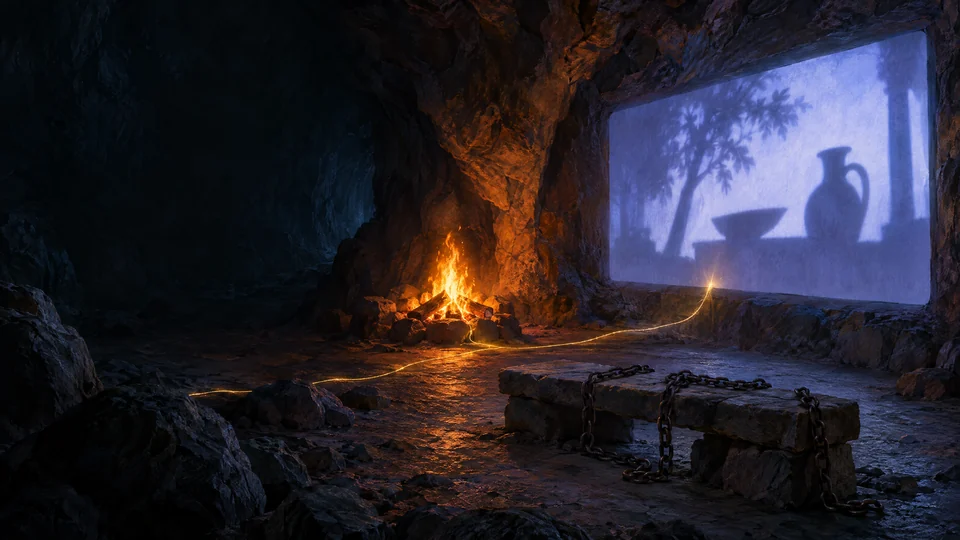
Trilha 7Trail 7
A telaThe screen
A caverna do abriu a trilha da máscara com gente acorrentada olhando sombras numa parede, e essa trilha é a mesma parede, só que agora ela tem resolução 4K, trilha sonora e um botão de pular introdução. É a trilha dos filmes, dos jogos, dos desenhos e da internet, e o lugar onde o site mais mistura cânone com cultura pop: Platão e Matrix na mesma bibliografia, e 007, e Hazbin Hotel. Ela existe pra mostrar que o motor não muda de marcha quando o objeto é um desenho animado. As seis perguntas que valem pra uma resolução do valem pra uma cena com um bife.’s cave opened the mask trail with people in chains watching shadows on a wall, and this trail is the same wall, except now it has 4K resolution, a soundtrack and a skip intro button. It is the trail of films, games, cartoons and the internet, and the place where the site mixes canon and pop culture the most: Plato and The Matrix in the same bibliography, and 007, and Hazbin Hotel. It exists to show that the engine doesn’t change gear when the object is a cartoon. The six questions that apply to a resolution of the apply to a scene with a steak.
Interativo 08 · A paredeInteractive 08 · The wall
o leitor troca o objeto projetado, da caverna à tela do celular, e vê que a pergunta sobre a sombra continua a mesma.the reader swaps the projected object, from the cave to a phone screen, and sees that the question about the shadow stays the same.
A dúvida e o desertoDoubt and the desert
A tela começa com um filósofo que resolveu duvidar de tudo. Em 1641, nas Meditações, o decidiu derrubar toda crença que desse pra derrubar: duvidou dos sentidos, que às vezes enganam; duvidou da diferença entre estar acordado e sonhar; e, no limite, levantou a hipótese de um gênio maligno, poderoso e enganador, dedicado a fazer ele acreditar num mundo que não existe. O que sobrou foi uma coisa só, que ele já tinha formulado poucos anos antes, no Discurso do Método: se estou duvidando, estou pensando, e se estou pensando, existo. Três séculos e meio depois, essa hipótese ganhou nome de filme. O Matrix cita as Meditações porque o gênio maligno do Descartes é a máquina das com outra roupa.The screen begins with a philosopher who decided to doubt everything. In 1641, in the Meditations, decided to tear down every belief that could be torn down: he doubted the senses, which sometimes deceive; he doubted the difference between being awake and dreaming; and, at the limit, he raised the hypothesis of an evil genius, powerful and deceitful, devoted to making him believe in a world that doesn’t exist. What remained was a single thing, which he had already formulated a few years earlier, in the Discourse on Method: if I am doubting, I am thinking, and if I am thinking, I exist. Three and a half centuries later, that hypothesis got the name of a film. The Name That Cannot Be Cut cites the Meditations because Descartes’s evil genius is the ’ machine in other clothes.
O aparece também nas duas primeiras Bússolas e no ensaio A IA pensa?, onde divide a mesa com o . Em 1980, o Searle propôs um experimento mental famoso, o quarto chinês: uma pessoa trancada num quarto recebe perguntas em chinês e devolve respostas perfeitas seguindo um manual de regras, sem entender uma palavra de chinês. Pro Searle, isso é o que um computador faz, manipular símbolos sem entender nada, porque sintaxe não produz significado. O ensaio pergunta se esse tipo de argumento é filosofia honesta ou protecionismo cognitivo com vocabulário de filosofia, e usa um conceito da trilha da máscara pra fazer a pergunta, o raciocínio motivado. Quando a definição de pensar muda toda vez que uma máquina chega perto dela, vale perguntar quem está movendo a trave. also appears in the first two Compass essays and in Does AI Think?, where he shares the table with . In 1980, Searle proposed a famous thought experiment, the Chinese room: a person locked in a room receives questions in Chinese and returns perfect answers by following a rulebook, without understanding a word of Chinese. For Searle, that is what a computer does, manipulating symbols without understanding anything, because syntax doesn’t produce meaning. The essay asks whether this kind of argument is honest philosophy or cognitive protectionism with philosophical vocabulary, and uses a concept from the mask trail to ask it, motivated reasoning. When the definition of thinking changes every time a machine gets close to it, it is worth asking who is moving the goalposts.
Do quarto do pra caverna digital é um passo. Em 1981, o filósofo francês publicou Simulacros e Simulação, um livro sobre um mundo em que as cópias vêm antes do original. E o livro abre com uma fábula do escritor argentino sobre cartógrafos que fizeram um mapa tão detalhado que ele ficou do tamanho do império. Pro Baudrillard, nós vivemos o contrário: é o território que apodrece aos pedaços em cima do mapa. A imagem não representa mais uma realidade, ela passa a ser a realidade, e o real que sobra é um deserto. A expressão é dele, o deserto do real. É o mapa tomando o lugar do território, levado ao extremo.From ’s room to the digital cave is one step. In 1981, the French philosopher published Simulacra and Simulation, a book about a world in which copies come before the original. And the book opens with a fable by the Argentine writer about cartographers who made a map so detailed that it became the size of the empire. For Baudrillard, we live the opposite: it is the territory that rots in pieces on top of the map. The image no longer represents a reality, it becomes reality, and the real that remains is a desert. The expression is his, the desert of the real. It is the map taking the place of the territory, carried to the extreme.
Em , o Neo esconde os discos piratas que vende dentro de um exemplar oco de , e quando o Morpheus mostra a ele o mundo de verdade, destruído, diz: bem-vindo ao deserto do real. O Matrix, que lê a franquia toda, dos quatro filmes ao Animatrix e aos jogos, cita o livro e cita uma entrevista de 2003 em que o Baudrillard disse que o filme não tinha entendido o que ele escreveu. É raro uma fonte reclamar do uso que fizeram dela, e o ensaio registra a reclamação. E a pergunta vira de lado: o que o filme fez com a ideia, por baixo do que diz que fez com ela?In , Neo hides the pirated discs he sells inside a hollowed-out copy of , and when Morpheus shows him the real world, destroyed, he says: welcome to the desert of the real. The Name That Cannot Be Cut, which reads the whole franchise, from the four films to The Animatrix and the games, cites the book and cites a 2003 interview in which Baudrillard said the film had not understood what he wrote. It is rare for a source to complain about how it was used, and the essay records the complaint. And the question turns sideways: what did the film do with the idea, underneath what it says it did with it?
Antes do filme, a ficção científica já tinha chegado lá. Numa palestra em Metz, na França, em 1977, o disse que talvez a gente viva numa realidade programada por computador, e em 1984 o publicou Neuromancer, o romance que popularizou a palavra matriz pra um espaço de dados e descreveu o ciberespaço como uma alucinação consensual. E depois do filme veio o . O livro dele Bem-vindo ao Deserto do Real, de 2002, pega a frase do Morpheus pra falar do mundo depois do 11 de setembro, e no documentário O Guia Pervertido do Cinema, de 2006, dirigido por Sophie Fiennes, ele diz que não quer nem a pílula azul nem a vermelha: quer uma terceira, a que mostre a realidade que existe dentro da própria ilusão. O Matrix cita os três, e o desenho é claro: o filme não inventou a ideia, herdou do Dick e do Gibson e devolveu a ideia pro mundo, onde o Žižek pegou e levou pra outro lugar. É herança e resposta, as duas setas desta matéria, numa trilha só.Before the film, science fiction had already gotten there. In a talk in Metz, France, in 1977, said that perhaps we live in a computer-programmed reality, and in 1984 published Neuromancer, the novel that popularized the word matrix for a data space and described cyberspace as a consensual hallucination. And after the film came . His book Welcome to the Desert of the Real, from 2002, takes Morpheus’s line to talk about the world after September 11, and in the documentary The Pervert’s Guide to Cinema, from 2006, directed by Sophie Fiennes, he says he wants neither the blue pill nor the red one: he wants a third, the one that shows the reality that exists within the illusion itself. The Name That Cannot Be Cut cites all three, and the design is clear: the film didn’t invent the idea, it inherited it from Dick and Gibson and gave it back to the world, where Žižek picked it up and took it somewhere else. It is inheritance and reply, the two arrows of this piece, on a single trail.
O Matrix tem ainda uma camada clássica que quase ninguém nota. O nome Morpheus vem das do Ovídio, livro XI, onde Morfeu é o filho do Sono, o deus que entra nos sonhos imitando a forma humana; o líder que acorda as pessoas tem nome de quem fabrica sonho. E tem o Cypher, sentado num restaurante dentro da simulação, mastigando um bife que ele sabe que não existe e decidindo trair os amigos pra voltar pra ilusão. A frase dele é que a ignorância é uma bênção, e o Matrix cita a origem, uma ode do poeta inglês , de 1742, que termina dizendo que, onde a ignorância é bênção, é loucura ser sábio. É a caverna do vista do lado de quem prefere a sombra, e é a quinta pergunta do motor feita pelo personagem mais honesto do filme: quanto custa saber, e quem paga.The Name That Cannot Be Cut also has a classical layer almost nobody notices. The name Morpheus comes from ’s Metamorphoses, book XI, where Morpheus is the son of Sleep, the god who enters dreams imitating human form; the leader who wakes people up is named after the one who manufactures dreams. And there is Cypher, sitting in a restaurant inside the simulation, chewing a steak he knows doesn’t exist and deciding to betray his friends to go back to the illusion. His line is that ignorance is bliss, and the essay cites its origin, an ode by the English poet , from 1742, which ends by saying that where ignorance is bliss, ’tis folly to be wise. It is ’s cave seen from the side of whoever prefers the shadow, and it is the fifth question of the engine asked by the film’s most honest character: how much does knowing cost, and who pays.
Quem assinaWho signs
A pergunta sobre a realidade puxa outra, sobre a autoria, e ela também tem fonte. Em 1967, o publicou um texto curto chamado A Morte do Autor, com a tese de que o sentido de um texto não pertence a quem escreveu, mas a quem lê, e de que a figura do autor como dono do significado é uma invenção que atrapalha a leitura; o nascimento do leitor, dizia ele, se paga com a morte do autor.The question about reality pulls another, about authorship, and it has a source too. In 1967, published a short text called The Death of the Author, with the thesis that a text’s meaning doesn’t belong to whoever wrote it but to whoever reads it, and that the figure of the author as owner of the meaning is an invention that gets in the way of reading; the birth of the reader, he said, must be paid for by the death of the author.
O Matrix cita o e passa um capítulo inteiro nos créditos, o lugar onde o filme decide, por escrito, quem fez o quê. A chuva verde de caracteres, a imagem mais copiada da saga, tem um autor que quase ninguém conhece, o designer , que atribuiu o desenho a livros de culinária japonesa da esposa, que as matérias que espalharam a curiosidade nunca nomearam. Do outro lado está a escritora Sophia Stewart, que diz que a história inteira é dela, e a lenda de que ela ganhou bilhões num processo, quando na verdade o caso foi arquivado em 2005. E os próprios créditos de 1999 assinam o filme como obra de dois irmãos. As duas autoras saíram do armário depois, a em 2012 e a Lilly em 2016, e em 2020 a Lilly confirmou que a leitura trans do filme era a intenção original. A bibliografia do Matrix junta aqui o , que escreveu um livro sobre as Wachowski e a estética trans, a e uma observação da pesquisadora , citada pela Netflix: o agente Smith insiste em chamar o Neo de senhor Anderson.The Name That Cannot Be Cut cites and spends a whole chapter on the credits, the place where the film decides, in writing, who did what. The green rain of characters, the most copied image of the saga, has an author almost nobody knows, the designer , who attributed the design to his wife’s Japanese cookbooks, a wife the articles that spread the curiosity never named. On the other side is the writer Sophia Stewart, who says the whole story is hers, and the legend that she won billions in a lawsuit, when in fact the case was dismissed in 2005. And the 1999 credits themselves sign the film as the work of two brothers. Both directors came out later, in 2012 and Lilly in 2016, and in 2020 Lilly confirmed that the trans reading of the film was the original intention. The bibliography of The Name That Cannot Be Cut brings together here , who wrote a book on the Wachowskis and trans aesthetics, and an observation by the researcher , cited by Netflix: Agent Smith insists on calling Neo Mr. Anderson.
A pergunta sobre quem tem o poder de dar nome aparece no lugar mais inesperado, e o subtítulo do ensaio responde: Matrix não é um filme sobre acordar, é um filme sobre quem tem o poder de nomear. E o ajuda a pensar essa mistura: o que as autoras disseram sobre a intenção é fonte, e das boas, e a leitura continua sendo de quem lê. O ensaio guarda as duas coisas na mesma bibliografia, a entrevista da e as leituras críticas, uma do lado da outra.The question of who has the power to give a name appears in the most unexpected place, and the essay’s subtitle answers it: The Matrix is not a film about waking up, it is a film about who has the power to name. And helps think through the mix: what the directors said about their intention is a source, and a good one, and the reading still belongs to whoever reads. The essay keeps both in the same bibliography, ’s interview and the critical readings, one beside the other.
O caso mais curioso de autor contra obra no site, porém, está no ensaio sobre Rocky Horror, Um Planeta Chamado Transexual, que pergunta o que o filme de 1975 prometeu, quem ele puniu e o que o mundo fez com ele cinquenta anos depois. O filme virou culto nas sessões da meia-noite que começaram num cinema de Nova York em 1976, e o criador dele, , deu ao longo dos anos declarações que não cabem na mesma pessoa: em 2009, que a sociedade não deveria ditar gênero; em 2013, que se sentia setenta por cento homem e trinta por cento mulher; em 2016, que mulheres trans não podiam ser mulheres; e em 2020, quando defendeu a frase de 2016. O ensaio cita as quatro, com data e veículo. É a Morte do Autor do funcionando ao contrário: o autor está vivo e falando, e a obra continua dizendo coisas que ele já não diz. O leitor fica com as duas, e com a régua pra separar o que é do filme e o que é do homem.The most curious case of author against work on the site, though, is in the essay on Rocky Horror, A Planet Called Transsexual, which asks what the 1975 film promised, whom it punished and what the world did with it fifty years later. The film became a cult in the midnight screenings that began at a New York cinema in 1976, and its creator, , made statements over the years that don’t fit in the same person: in 2009, that society shouldn’t dictate gender; in 2013, that he felt seventy percent man and thirty percent woman; in 2016, that trans women could not be women; and in 2020, when he defended the 2016 line. The essay cites all four, with date and outlet. It is ’s Death of the Author working in reverse: the author is alive and talking, and the work keeps saying things he no longer says. The reader keeps both, and the ruler to separate what belongs to the film from what belongs to the man.
E a pergunta sobre quem assina vale também pra imagem que a máquina inventa, que é o assunto dos ensaios de tecnologia do site. Ali a régua tem outro nome, medição. O ensaio sobre o 007, Licence to Finish, se apoia na análise técnica do , o canal que mede a imagem dos jogos quadro a quadro, num teste de desempenho com mais de trinta placas de vídeo e nas notas de atualização do próprio estúdio, e chega a uma conclusão que só dá pra sustentar com dado: o path tracing, a técnica que simula o caminho da luz em cada cena, chegou atrasado e não entregou o que a Capcom já tinha provado ser possível entregar. O ensaio sobre Pragmata, também apoiado no Digital Foundry, nota que o DLSS, a tecnologia da NVIDIA que refaz a imagem com inteligência artificial, reconstrói a imagem do mesmo jeito que a ficção do jogo reconstrói o mundo, uma Nova York lunar impressa a partir de dados. E o ensaio sobre o DLSS 5 pergunta, como o e o perguntariam, quem é o dono da imagem final quando ela é convencida por uma rede neural em vez de renderizada. Os dois ensaios sobre a NVIDIA levam a mesma régua pro mercado: um mostra que em 2026 a rasterização, o jeito tradicional de desenhar a imagem, virou plano B, e o outro, que a distância entre NVIDIA e AMD virou um volante que se alimenta sozinho.And the question of who signs also applies to the image the machine invents, which is the subject of the site’s technology essays. There the ruler has another name, measurement. The essay on 007, Licence to Finish, relies on the technical analysis of , the channel that measures game images frame by frame, on a performance test with more than thirty graphics cards and on the studio’s own patch notes, and reaches a conclusion that can only be sustained with data: path tracing, the technique that simulates the path of light in each scene, arrived late and didn’t deliver what Capcom had already proven possible to deliver. The essay on Pragmata, also supported by Digital Foundry, notes that DLSS, NVIDIA’s technology that rebuilds the image with artificial intelligence, reconstructs the image the same way the game’s fiction reconstructs the world, a lunar New York printed from data. And the essay on DLSS 5 asks, as and would, who owns the final image when it is persuaded by a neural network instead of rendered. The two essays on NVIDIA take the same ruler to the market: one shows that in 2026 rasterization, the traditional way of drawing the image, became plan B, and the other, that the gap between NVIDIA and AMD became a flywheel that feeds itself.
Deuses, infernos e favoresGods, hells and favors
Em 007 First Light, as duas inteligências artificiais do MI6 se chamam THEIA e HYPERION, e o ensaio sobre o jogo, Licence to Finish, leva os nomes a sério. Na do Hesíodo, Theia é uma das Titãs, filha do Céu e da Terra, que se une ao irmão Hyperion e dá à luz o Sol, a Lua e a Aurora. O nome dela vem de visão, e o jogo se chama, literalmente, pela filha dos dois: First Light, a primeira luz, a aurora. Daí o ensaio puxa o , que descreve os ídolos como obra de mãos humanas, com olhos que não veem, e fecha com um golpe que o próprio ensaio cita na : “A eles se tornem semelhantes os que os fazem.” A máquina tem nome de deusa da visão e não enxerga o que importa. O capítulo 3 tem um título que encosta direto na trilha de quem decide, Previsão não é decreto, com a explicando que Deus não decreta as coisas porque previu que elas iam acontecer. E tem uma frase nesse ensaio que podia ser o subtítulo desta matéria: o MI6 está, literalmente, consultando um oráculo com nome de Titã pra decidir quem deve morrer.In 007 First Light, MI6’s two artificial intelligences are called THEIA and HYPERION, and the essay on the game, Licence to Finish, takes the names seriously. In ’s Theogony, Theia is one of the Titans, daughter of Sky and Earth, who unites with her brother Hyperion and gives birth to the Sun, the Moon and the Dawn. Her name comes from sight, and the game is named, literally, after the daughter of the two: First Light, the dawn. From there the essay pulls in , which describes idols as the work of human hands, with eyes that do not see, and closes with a blow the essay itself quotes in the King James: “They that make them are like unto them.” The machine has the name of a goddess of sight and doesn’t see what matters. Chapter 3 has a title that touches the trail of who decides directly, Foreknowledge is not decree, with the explaining that God does not decree things because he foresaw they would happen. And there is a sentence in that essay that could be this piece’s subtitle: MI6 is, literally, consulting an oracle named after a Titan to decide who should die.
Ferramenta ou oráculo. Quem transforma uma ferramenta em oráculo não fica mais esperto. Fica parecido com ela, com olhos que não veem, que é a fábrica de ídolos do funcionando com processador.Tool or oracle. Whoever turns a tool into an oracle doesn’t get smarter. They become like it, with eyes that don’t see, which is ’s factory of idols running on a processor.
Do oráculo grego pro inferno cristão. O ensaio sobre Hazbin Hotel, A régua que ninguém leu, tem um subtítulo que já é uma tese: a série diagnostica com precisão o colapso da justiça por obras e, sem perceber o que descobriu, passa duas temporadas pedindo obras melhores. Pra ler um inferno de desenho animado, o ensaio vai no inferno mais famoso da literatura. A , que o Dante escreveu no começo do século 14, desenha o inferno em círculos, guiado pelo poeta Virgílio, com cada pecado recebendo a punição que lhe corresponde, e coloca na porta a inscrição mais conhecida de todas: deixai toda esperança, vós que entrais. Do lado dele está do C. S. Lewis, que já apareceu na trilha 3, com a porta aberta e quase ninguém querendo sair. E o ensaio cita uma fonte que pouca gente conhece. Em 798, o monge escreveu a Carlos Magno, e é dessa carta a primeira citação registrada do ditado a voz do povo é a voz de Deus. Só que ela aparece como aviso: não se deve dar ouvidos a quem diz isso, porque o tumulto da multidão está sempre perto da loucura. O ditado mais usado pra justificar a maioria nasceu como alerta contra ela, e o da primeira trilha teria gostado.From the Greek oracle to the Christian hell. The essay on Hazbin Hotel, The ruler nobody read, has a subtitle that is already a thesis: the series diagnoses with precision the collapse of justice by works and, without noticing what it discovered, spends two seasons asking for better works. To read a cartoon hell, the essay goes to the most famous hell in literature. The , which Dante wrote in the early fourteenth century, draws hell in circles, guided by the poet Virgil, with each sin receiving the punishment that corresponds to it, and places at the gate the best-known inscription of all: abandon all hope, ye who enter here. Beside him is ’s The Great Divorce, which already appeared on trail 3, with the door open and almost nobody wanting to leave. And the essay cites a source few people know. In 798, the monk wrote to Charlemagne, and it is from that letter that the first recorded citation of the saying the voice of the people is the voice of God comes. Except it appears as a warning: people who say this should not be listened to, because the tumult of the crowd is always close to madness. The saying most used to justify the majority was born as a warning against it, and the of the first trail would have liked that.
O mesmo universo rende outro ensaio, e ele traz o contrato pra perto de casa. O Alastor lê o personagem que comprou poder e assinou a própria liberdade, e depois leva o mesmo contrato pras relações, pras instituições e pra ideia de independência, e é aí que entram dois brasileiros. O escreveu, nos anos 70, As ideias fora do lugar, o ensaio que abre o estudo dele sobre o Machado de Assis: no Brasil do século 19, o liberalismo europeu convivia com a escravidão, e o que fazia a ponte entre os dois era o favor. Quem não era senhor nem escravo vivia de favor, e o favor tinha preço. O , em Carnavais, Malandros e Heróis, de 1979, analisou a pergunta mais brasileira que existe, você sabe com quem está falando?, a frase que transforma o cidadão comum em pessoa importante, acima da regra que vale pros outros. O Alastor usa os dois pra trazer o contrato do personagem pra perto de casa. O favor do Schwarz e a hierarquia do DaMatta não são exotismo de desenho, e o demônio do rádio dos anos 30 sabe disso. A pergunta de quem paga a conta ganha sotaque brasileiro: quem paga o favor, e quando a conta chega.The same universe yields another essay, and it brings the contract close to home. Alastor reads the character who bought power and signed away his own freedom, and then takes the same contract to relationships, institutions and the idea of independence, and that is where two Brazilians come in. wrote, in the 1970s, Misplaced Ideas, the essay that opens his study of Machado de Assis: in nineteenth-century Brazil, European liberalism coexisted with slavery, and what bridged the two was the favor. Whoever was neither master nor slave lived on favors, and the favor had a price. , in Carnivals, Rogues and Heroes, from 1979, analyzed the most Brazilian question there is, do you know who you’re talking to?, the line that turns an ordinary citizen into an important person, above the rule that applies to everyone else. Alastor uses both to bring the character’s contract close to home. Schwarz’s favor and DaMatta’s hierarchy are not cartoon exoticism, and the radio demon from the 1930s knows it. The question of who pays the bill gets a Brazilian accent: who pays for the favor, and when the bill arrives.
Dois ensaios sobre animação e games fazem perguntas de teologia sem precisar de um teólogo no centro. O TADC lê o final de The Amazing Digital Circus como um diálogo jogável sobre quem tem direito à próxima palavra: o Caine, o apresentador do circo, pode dar a vez a todo mundo e ainda assim decidir o que conta como resposta. O ensaio usa a estrutura de pergunta e resposta antecipada de como referência retórica, com o aviso de que não dá ao desenho autoridade de Escritura, e usa o capítulo 2 da pra separar quem existe por si mesmo de quem depende de outro pra existir. E o ensaio sobre Beast of Reincarnation, o primeiro jogo grande da Game Freak fora de Pokémon, lê uma protagonista cuja doença é o próprio poder, com o budismo e a reencarnação no fundo, e chega a uma frase que resume o que um jogo pode fazer que um texto não pode: a maldição é a arma, e tu executa a tese com o polegar.Two essays on animation and games ask theological questions without needing a theologian at the center. TADC reads the ending of The Amazing Digital Circus as a playable dialogue about who has the right to the next word: Caine, the circus host, can give everyone a turn and still decide what counts as an answer. The essay uses the question and anticipated answer structure of as a rhetorical reference, with the warning that it does not give the cartoon the authority of Scripture, and uses chapter 2 of the to separate the one who exists by himself from those who depend on another to exist. And the essay on Beast of Reincarnation, Game Freak’s first big game outside Pokémon, reads a protagonist whose illness is her power itself, with Buddhism and reincarnation in the background, and arrives at a sentence that sums up what a game can do that a text can’t: the curse is the weapon, and you execute the thesis with your thumb.
O que a tela apagaWhat the screen erases
Os últimos ensaios da trilha são sobre perda, de sentido, de memória e de boca.The trail’s last essays are about loss, of meaning, of memory and of a mouth.
O What Got Left Behind tem 35 capítulos e 35 peças jogáveis sobre uma ideia só: o gesto atravessou o mundo e o sentido não. Um verso sobre um assassinato que virou interjeição, uma função ritual na proa de um barco na Indonésia que virou pose de rede social, e nenhum dos dois era vazio na origem. Uma das fontes é de 1854. No fim de , o Henry David Thoreau pergunta por que a Inglaterra se esforça tanto pra curar a podridão da batata e ninguém tenta curar a podridão do cérebro, que é muito mais espalhada e mais fatal. Brain rot. Cento e setenta anos depois, a Oxford University Press elegeu brain rot a palavra do ano de 2024. O ensaio também tem um contra-exemplo, e ele é a resposta ao problema: a lei da Nova Zelândia, de 2014, que reconhece a autoria do haka , composto no século 19 pelo chefe Te Rauparaha. Um gesto que tem dono e tem história escrita em lei não perde o sentido no caminho. É a quarta pergunta do motor no seu habitat natural: o gesto é o mesmo, e o que ele faz mudou por completo.What Got Left Behind has 35 chapters and 35 playable pieces about a single idea: the gesture crossed the world and the meaning didn’t. A line about a murder that became an interjection, a ritual function at the bow of a boat in Indonesia that became a social media pose, and neither was empty at its origin. One of the sources is from 1854. At the end of , Henry David Thoreau asks why England works so hard to cure potato rot and nobody tries to cure brain rot, which is far more widespread and more fatal. Brain rot. A hundred and seventy years later, Oxford University Press chose brain rot as its word of the year for 2024. The essay also has a counterexample, and it is the answer to the problem: New Zealand’s 2014 law that recognizes the authorship of the haka , composed in the nineteenth century by the chief Te Rauparaha. A gesture that has an owner and a history written into law doesn’t lose its meaning along the way. It is the fourth question of the engine in its natural habitat: the gesture is the same, and what it does has changed completely.
O ensaio sobre Marvel’s Wolverine tem um subtítulo que dói, ele morreu duas vezes no jogo e só uma das mortes foi cruel, e a cruel é a da memória. A bibliografia, que cita até o , o jogo que tem a morte dupla no próprio título, é uma pequena história da memória e da identidade. O descreveu, em 1889, a dissociação, partes da experiência que ficam separadas da consciência. O contou, em 1890, o caso de Ansel Bourne, um pregador que sumiu de casa e viveu dois meses em outra cidade, com outro nome, sem lembrar de quem tinha sido. Em 1995, a e a Jacqueline Pickrell mostraram que dá pra implantar numa pessoa a lembrança de algo que nunca aconteceu, a de ter se perdido num shopping quando criança, e o ensaio cita também a replicação desse estudo, feita em 2023, e um estudo de 2001 sobre a capacidade de suprimir lembranças, que conversa com a projeção no laboratório da trilha 1. E cita o , cuja cena mais famosa em Peer Gynt é a do personagem descascando uma cebola à procura do miolo, a essência de quem ele é, e descobrindo que é só casca, camada sobre camada, até o fim. Lembra do navio de Teseu? No Quem paga a conta, a continuidade morava em quem está no leme e lembra da viagem. O Wolverine pergunta o que sobra quando tiram o diário de bordo, e é a mesma trilha da máscara, agora com garras.The essay on Marvel’s Wolverine has a subtitle that hurts, he died twice in the game and only one of the deaths was cruel, and the cruel one is the death of memory. The bibliography, which even cites , the game with a double death in its very title, is a small history of memory and identity. described, in 1889, dissociation, parts of experience that remain separated from consciousness. told, in 1890, the case of Ansel Bourne, a preacher who disappeared from home and lived two months in another city, under another name, without remembering who he had been. In 1995, and Jacqueline Pickrell showed that it is possible to implant in a person the memory of something that never happened, of having been lost in a mall as a child, and the essay also cites the 2023 replication of that study and a 2001 study on the ability to suppress memories, which speaks to the lab version of projection on trail 1. And it cites , whose most famous scene in Peer Gynt is the character peeling an onion in search of its core, the essence of who he is, and discovering it is only layers, layer upon layer, to the end. Remember the ship of Theseus? In Who Pays the Bill, continuity lived in whoever is at the helm and remembers the voyage. Wolverine asks what remains when they take away the logbook, and it is the same mask trail, now with claws.
O ensaio sobre Resident Evil Requiem chega na mesma pergunta por outro caminho, e quase sem fonte nenhuma além do próprio jogo e das notas da crítica. Ele lê o vírus no corpo do Leon como uma metáfora do trauma de longo prazo que se manifesta no corpo, e lê a normalidade da Grace, num universo de armas biológicas, como o jogo afirmando que ser comum também é uma forma de força. No fim, o ensaio diz pra que serve tudo isso: o jogo usa ficção científica pra fazer perguntas reais sobre identidade, sobre o que permanece de alguém quando o corpo muda. E fecha com uma nota curta, em que eu conto que joguei às três da manhã perguntando a senha do cofre e terminei entendendo que a senha sempre foi a mesma. O navio de Teseu, de novo, dessa vez em Raccoon City.The essay on Resident Evil Requiem reaches the same question by another road, with almost no source other than the game itself and the critics’ scores. It reads the virus in Leon’s body as a metaphor for long-term trauma manifesting in the body, and reads Grace’s normality, in a universe of bioweapons, as the game affirming that being ordinary is also a form of strength. At the end, the essay says what all this is for: the game uses science fiction to ask real questions about identity, about what remains of someone when the body changes. And it closes with a short note in which I say that I played at three in the morning asking for the vault password and finished understanding that the password had always been the same. The ship of Theseus, again, this time in Raccoon City.
E os games também têm o mapa político deles, que dois ensaios curtos e um longo levam a sério. O Jogo que o Brasil Não Sabe Jogar descreve um ecossistema em que a percepção pessoal substitui a análise, e usa dados da , a maior conferência de desenvolvedores do mundo, e o caso do estúdio que a Microsoft fechou depois de fazer um dos jogos mais elogiados do ano, pra mostrar a lógica de negócio que a conversa brasileira ignora. E o ensaio sobre por que chamar um jogo de “o GTA brasileiro” machuca quem faz jogos no Brasil fala de propriedade intelectual, do , de 2024, e de uma frase que fecha portas antes que a gente saiba que elas existiam. Quem paga a conta de uma comparação preguiçosa é uma indústria inteira.And games have their own political map too, which two short essays and a long one take seriously. The Game Brazil Doesn’t Know How to Play describes an ecosystem in which personal perception replaces analysis, and uses data from , the world’s largest game developers conference, and the case of the studio Microsoft closed after it made one of the most acclaimed games of the year, to show the business logic the Brazilian conversation ignores. And the essay on why calling a game “the Brazilian GTA” hurts the people who make games in Brazil talks about intellectual property, the 2024 and a phrase that closes doors before we know they exist. Who pays the bill for a lazy comparison is an entire industry.
E um dos ensaios mais curtos do site fecha a trilha com poucas fontes, que bastam. A Hello Kitty, criada pela Sanrio em 1974, não tem boca, e a explicação que a própria empresa costuma dar é que assim cada pessoa pode colocar no rosto dela o sentimento que estiver sentindo. Quem leu a trilha da máscara reconhece a operação: um rosto sem boca é uma tela perfeita pra projeção. A designer que cuida dela há décadas, , aparece no ensaio, e o filósofo Simon May, do King’s College de Londres, autor de um livro sobre o poder do fofo, dá a ferramenta principal: o fofo moderno não é só inocente, ele mistura vulnerabilidade com algo inquietante e indefinido. O , que em 1938 escreveu Homo Ludens, sobre o jogo como algo mais antigo que a própria cultura, e o , que pensou o que acontece com a aura de uma obra quando ela pode ser reproduzida sem fim, aparecem uma vez cada. O subtítulo do ensaio diz que não é um pacto com o diabo, que é uma coisa mais quieta, e a pergunta é a quarta: o que um rosto sem boca faz com quem olha pra ele, por baixo da fofura que ele diz ter.And one of the shortest essays on the site closes the trail with few sources, which are enough. Hello Kitty, created by Sanrio in 1974, has no mouth, and the explanation the company itself usually gives is that this way each person can put on her face whatever feeling they are feeling. Whoever read the mask trail recognizes the operation: a face without a mouth is a perfect screen for projection. The designer who has looked after her for decades, , appears in the essay, and the philosopher Simon May, of King’s College London, author of a book on the power of cute, supplies the main tool: modern cuteness isn’t only innocent, it mixes vulnerability with something unsettling and undefined. , who in 1938 wrote Homo Ludens, on play as something older than culture itself, and , who thought about what happens to a work’s aura when it can be reproduced endlessly, appear once each. The essay’s subtitle says it isn’t a pact with the devil, it is something quieter, and the question is the fourth: what does a face without a mouth do to whoever looks at it, underneath the cuteness it claims to have.
De um filósofo duvidando de tudo a uma gatinha sem boca: esse foi o arco da tela. No meio, um mapa engoliu o território, um filme herdou a ideia de dois escritores e foi corrigido por um filósofo, os créditos esconderam quem fez, uma máquina com nome de deusa virou oráculo, um ditado nasceu como aviso, o favor ganhou sotaque, um gesto perdeu o sentido e um homem perdeu a memória. Nenhuma dessas fontes é menos fonte por estar perto de um videogame. A régua que mede o mede o Cypher.From a philosopher doubting everything to a kitten without a mouth: that was the arc of the screen. In between, a map swallowed the territory, a film inherited the idea of two writers and was corrected by a philosopher, the credits hid who made what, a machine with a goddess’s name became an oracle, a saying was born as a warning, the favor got an accent, a gesture lost its meaning and a man lost his memory. None of these sources is any less of a source for being close to a video game. The ruler that measures the measures Cypher.
A parede mudou. A sombra é a mesma, e a pergunta também.The wall changed. The shadow is the same, and so is the question.
FechoClose
A régua apontada pra mimThe ruler pointed at me
Lá no contrato, antes da primeira trilha, eu escrevi três testes que podiam derrubar esta matéria, e sete trilhas depois é hora de rodar os três, na ordem.Back in the contract, before the first trail, I wrote three tests that could bring this piece down, and seven trails later it is time to run all three, in order.
O primeiro perguntava se os ensaios sem nome mostram as mesmas seis perguntas que os ensaios com bibliografia, e tu viu a resposta espalhada pelo caminho. A Moeda confere profecia contra dado sem citar um filósofo. O ensaio sobre a escala 6x1 faz o mesmo com a economia. O What Got Left Behind faz a quarta pergunta, o que o gesto faz por baixo do que diz, em 35 capítulos. O Crise de identidade usa o espelho do sem nunca escrever o nome dele. O motor roda sem crachá, e, pra quem não quiser acreditar em mim, o interativo que fecha a matéria deixa tu rodar ele sozinho.The first asked whether the essays without names show the same six questions as the essays with bibliographies, and you saw the answer scattered along the way. The Coin checks prophecy against data without citing a single philosopher. The essay on the 6x1 schedule does the same with the economy. What Got Left Behind asks the fourth question, what the gesture does underneath what it says, across 35 chapters. You Don’t Play the Character. You Are Them. uses ’s mirror without ever writing his name. The engine runs without a badge, and, for anyone who doesn’t want to take my word for it, the interactive that closes this piece lets you run it yourself.
O segundo perguntava se algum ensaio usa uma fonte como oráculo, e aqui eu devo uma resposta que deixei guardada desde a trilha da régua. O que eu cito usa, no mesmo capítulo, a psicanálise como exemplo de teoria que nada consegue derrubar. A minha régua principal mira a minha lente principal, e a resposta precisa sair da mesma régua.The second asked whether any essay uses a source as an oracle, and here I owe an answer I have been holding since the ruler trail. The I cite uses, in that same chapter, psychoanalysis as an example of a theory nothing can bring down. My main ruler aims at my main lens, and the answer has to come from the same ruler.
O tem razão sobre teoria que explica tudo, e é exatamente por isso que o , no site, nunca é teoria de tudo. Ele anda com duas travas, e as duas estão no Quem paga a conta. A primeira é que, onde o Jung afirma alguma coisa que dá pra testar, o site prende a afirmação na versão testada. A projeção, a sombra vista no outro, tem versão de laboratório, a de , de 1997, e é ela que segura a lente. A segunda é que a lente só entra quando as três marcas que a trilha da máscara apresentou aparecem juntas. Uma marca sozinha não autoriza leitura nenhuma, e gente real nunca é diagnosticada através de tela. Onde o Jung não afirma nada testável, ele fica no lugar dele, que é o de lente: ajuda a ver, e não prova nada. is right about theories that explain everything, and that is precisely why , on the site, is never a theory of everything. He walks with two locks, and both are in Who Pays the Bill. The first is that wherever Jung asserts something testable, the site ties the assertion to the tested version. Projection, the shadow seen in the other, has a lab version, ’s, from 1997, and that is what holds the lens. The second is that the lens only comes in when the three marks the mask trail introduced appear together. One mark alone authorizes no reading at all, and real people are never diagnosed through a screen. Where Jung asserts nothing testable, he stays in his place, which is that of a lens: it helps you see, and it proves nothing.
E aqui vai a condição de mudança, dita antes, como manda a régua. Se a versão testada da projeção cair, a lente perde a âncora e eu paro de usar o pra isso. Se algum ensaio publicado usar o Jung sem as três marcas, ou pra diagnosticar uma pessoa, esse ensaio ganha errata.And here is the condition for change, said up front, as the ruler commands. If the tested version of projection falls, the lens loses its anchor and I stop using for that. If any published essay uses Jung without the three marks, or to diagnose a person, that essay gets an erratum.
O terceiro teste perguntava se as citações são enfeite, e esse a trilha da régua já julgou. Tira a citação do parágrafo, e se o argumento continuar igual, ela era crachá. A contagem mostrou uma coisa que eu não escondi: antes de 14 de setembro, a bibliografia era exceção no site. A régua chegou atrasada no meu rodapé. Mas chegou.The third test asked whether the citations are decoration, and the ruler trail already judged that one. Remove the citation from the paragraph, and if the argument stays the same, it was a badge. The count showed something I didn’t hide: before September 14, a bibliography was the exception on the site. The ruler arrived late to my footnotes. But it arrived.
A regra e a frase de maioThe rule and the sentence from May
Falta a objeção mais forte contra esta matéria, e a regra do site manda que ela entre inteira antes da resposta. Se fonte não é oráculo, a Bíblia é o quê? Uma reformada que cita a dizendo que a Escritura é a regra não está, no fundo, tratando um livro como oráculo?The strongest objection against this piece is still missing, and the site’s rule demands that it come in whole before the answer. If a source is not an oracle, what is the Bible? A Reformed woman who cites the saying that Scripture is the rule, isn’t she, deep down, treating a book as an oracle?
A resposta está na própria tradição, e passa por uma distinção. Oráculo é o que tu consulta pra que ele decida por ti, sem examinar, como o MI6 consultando a máquina com nome de Titã. Regra é outra coisa: é o que tu lê, na língua em que foi escrito, junto com quem guardou o texto, comparando passagem com passagem, e é exatamente o que a trilha do texto fez. Os bereanos, que a trilha da régua apresentou, conferiam até o que o apóstolo ensinava; a carta aos manda examinar tudo; e o lembrou que Moisés falou pro povo comum, e não pros astrônomos. Na tradição em que eu escrevo, a Escritura é a régua que mede as outras, e justamente por ser régua ela é lida com todas as ferramentas na mão: o hebraico, o grego do , os rabinos, a biologia que diz que corpos existem. O que o site nunca faz é pegar um versículo solto e usar como sentença. Isso, sim, seria transformar o texto em oráculo, e a trilha 4 mostrou o que acontece quando alguém lê pela metade.The answer is in the tradition itself, and it passes through a distinction. An oracle is what you consult so it decides for you, without examining, like MI6 consulting the machine named after a Titan. A rule is something else: it is what you read, in the language it was written in, together with those who kept the text, comparing passage with passage, and that is exactly what the text trail did. The Bereans, whom the ruler trail introduced, checked even what the apostle taught; the letter to the says to examine everything; and recalled that Moses spoke to ordinary people, not to astronomers. In the tradition I write in, Scripture is the ruler that measures the others, and precisely because it is a ruler it is read with every tool in hand: the Hebrew, ’s Greek, the rabbis, the biology that says bodies exist. What the site never does is take a verse on its own and use it as a verdict. That would indeed turn the text into an oracle, and trail 4 showed what happens when someone reads by halves.
E esta matéria tem um título novo, mas a tese não é nova. Em maio, na segunda Bússola, explicando como eu penso, eu escrevi que estudo , , , e Bacon como ferramentas de análise, e não como identidades a defender, que nenhum deles é o meu time, e que todos são “instrumentos que pego e largo conforme o problema exige”. No mesmo trecho, eu descrevi a camada de método assim: “a realidade não pede permissão para contradizer o modelo que você tem de si mesmo”, e quando isso acontece, quem cede é o modelo. E descrevi a camada teológica dizendo que mantive a fé calvinista depois de estudar a fundo o niilismo, o gnosticismo, o budismo e as filosofias que a contradizem, não por ignorar as contradições, mas porque a experiência espiritual sobreviveu ao escrutínio de todos os modelos alternativos. É a régua apontada pra fé, e é a resposta mais honesta que eu tenho pra pergunta sobre a Bíblia: ela não ficou de pé porque eu proibi a pergunta. Ficou de pé depois da pergunta.And this piece has a new title, but the thesis isn’t new. In May, in the second Compass, explaining how I think, I wrote that I study , , , and Bacon as analytical tools, not as identities to defend, that none of them is my team, and that all of them are “instruments I pick up and set down as the problem requires.” In the same passage, I described the layer of method like this: “reality doesn’t ask permission to contradict the model you have of yourself,” and when that happens, it is the model that yields. And I described the theological layer by saying that I kept the Calvinist faith after deeply studying nihilism, gnosticism, Buddhism and the philosophies that contradict it, not because I ignored the contradictions, but because the spiritual experience survived the scrutiny of every alternative model. It is the ruler pointed at faith, and it is the most honest answer I have to the question about the Bible: it didn’t stay standing because I forbade the question. It stayed standing after the question.
Seis meses e quase trinta ensaios depois, a contagem confirma o que aquela frase prometia. O trabalha na máscara e sai de cena quando o assunto é o corpo. O trabalha em quem decide e não tem nada a dizer sobre o . O trabalha no nome. Nenhum deles responde por mim. Cada um faz o trabalho dele e volta pro lugar.Six months and almost thirty essays later, the count confirms what that sentence promised. works on the mask and leaves the stage when the subject is the body. works on who decides and has nothing to say about . The works on the name. None of them answers for me. Each does its job and goes back to its place.
Rode o motorRun the engine
Agora é contigo.Now it’s your turn.
Interativo 09 · Rode o motorInteractive 09 · Run the engine
o leitor escolhe um de três objetos, Golden, o gabinete de pensamentos de Disco Elysium e Mateus 19:12, e roda as seis perguntas nele. Cada pergunta acende o que encontra, e a ferramenta que o site usaria aparece do lado, com o link pra trilha onde ela mora.the reader picks one of three objects, Golden, the Thought Cabinet from Disco Elysium and Matthew 19:12, and runs the six questions on it. Each question lights up what it finds, and the tool the site would use appears beside it, with the link to the trail where it lives.
Os três objetos não estão ali por acaso, porque cada um vem de um canto diferente do site. Golden, que passou pela trilha do texto junto com a série de K-pop, é a canção de desejo que deseja a coisa errada, e a análise do site fala dos padrões de que a personagem tem vergonha. Ninguém é citado ali, e mesmo assim a quarta pergunta, o que isso faz por baixo do que diz, e a máscara da primeira trilha estão todas na página. O gabinete de pensamentos é uma mecânica de , o jogo que aparece no Crise de identidade: o jogador adota uma ideia, carrega ela por um tempo e pode esquecer, pra abrir espaço pra outra. É a condição de mudança virando botão, a prova de que uma ideia pode ser largada. E é o versículo que já separava em camadas o que nasceu assim, o que foi feito pela mão humana e o que escolheu esse caminho, a primeira pergunta do motor feita dois mil anos antes desta matéria. Uma música, um jogo e um versículo: se as seis perguntas funcionam nos três, a tese se sustenta, e se não funcionam, o contrato diz o que acontece.The three objects aren’t there by chance, because each comes from a different corner of the site. Golden, which passed through the text trail with the K-pop series, is the song of desire that desires the wrong thing, and the site’s analysis talks about the standards the character is ashamed of. Nobody is cited there, and still the fourth question, what this does underneath what it says, and the mask of the first trail are all on the page. The Thought Cabinet is a mechanic from , the game that appears in You Don’t Play the Character. You Are Them.: the player adopts an idea, carries it for a while and can forget it, to make room for another. It is the condition for change turned into a button, proof that an idea can be set down. And is the verse that already separated into layers the one born that way, the one made by human hands and the one who chose that path, the first question of the engine asked two thousand years before this piece. A song, a game and a verse: if the six questions work on all three, the thesis holds, and if they don’t, the contract says what happens.
Lá no começo eu pedi pra tu guardar a palavra motor, e agora tu sabe o que ela quer dizer. São seis perguntas que rodam com ou sem nome famoso por perto: em quantas camadas isso se divide, o mapa está sendo confundido com o território, quem decide o que isso é, o que isso faz por baixo do que diz, quem paga a conta, como se discute isso honestamente. E é uma caixa de ferramentas que muda conforme o problema: um psiquiatra suíço com passado indefensável, um reformador de Genebra, um consenso médico de 2006, um gramático do grego, um gene no cromossomo Y, uma sala com cadeiras em 1789, uma gatinha sem boca. Os nomes entram, trabalham e saem. As perguntas ficam.At the very beginning I asked you to hold on to the word engine, and now you know what it means. It is six questions that run with or without a famous name nearby: how many layers does this split into, is the map being confused with the territory, who decides what this is, what does this do underneath what it says, who pays the bill, how do we argue about this honestly. And it is a toolbox that changes with the problem: a Swiss psychiatrist with an indefensible past, a reformer from Geneva, a medical consensus from 2006, a Greek grammarian, a gene on the Y chromosome, a room with chairs in 1789, a kitten without a mouth. The names come in, work and leave. The questions stay.
Oráculo responde por ti. Ferramenta te obriga a perguntar. O site inteiro é uma aposta na segunda.An oracle answers for you. A tool makes you ask. The whole site is a bet on the second.