
She asked what she was. They told her what to do.Ela perguntou o que era. Responderam o que fazer.
The mapO mapa
The essay, chapter by chapterO ensaio, capítulo por capítulo
Every chapter opens on a scene from the film. The color tells you what the chapter is about.Todo capítulo abre numa cena do filme. A cor diz do que o capítulo trata.
the marka marca the promisea promessa the voicea voz the friendsas amigas the mirroro espelho guilta culpa the abysso abismo Logos personal threadfio pessoal interactiveinterativo
- 0Cover ThatCobre issopersonal thread, interactivefio pessoal, interativo
- 1What Everyone KnowsO que todo mundo sabe
- 2The MantraO mantrainteractiveinterativo
- 3The ThroatA gargantapersonal thread, interactivefio pessoal, interativo
- 4The Mark Is Not the SentenceA marca não é a sentençainteractiveinterativo
- 5The RewriteA reescritainteractiveinterativo
- 6Everyone's PatternsOs patterns de todo mundointeractiveinterativo
- 7Dysphoria as an ImageA disforia como imagempersonal thread, interactivefio pessoal, interativo
- 8Different Origins, Holding HandsOrigem diferente, mãos dadasinteractiveinterativo
- 9MirrorsEspelhosinteractiveinterativo
- 10What I Saw in the Broken GlassO que eu vi no vidro quebradopersonal thread, interactivefio pessoal, interativo
- 11The Friendship and the SecretA amizade e o segredointeractiveinterativo
- 12Freeinteractiveinterativo
- 13Celine: The Love That Teaches HidingCeline: o amor que ensina a esconder
- 14The StructuresAs estruturaspersonal thread, interactivefio pessoal, interativo
- 15Jinu: GuiltJinu: culpa
- 16Fate and ChoiceDestino e escolhapersonal thread, interactivefio pessoal, interativo
- 17The Spiral and the AbyssA espiral e o abismopersonal thread, interactivefio pessoal, interativo
- 18FixingConsertar
- 19The BathhouseO banho
- 20Logospersonal threadfio pessoal
Chapter 0Capítulo 0
Cover ThatCobre isso
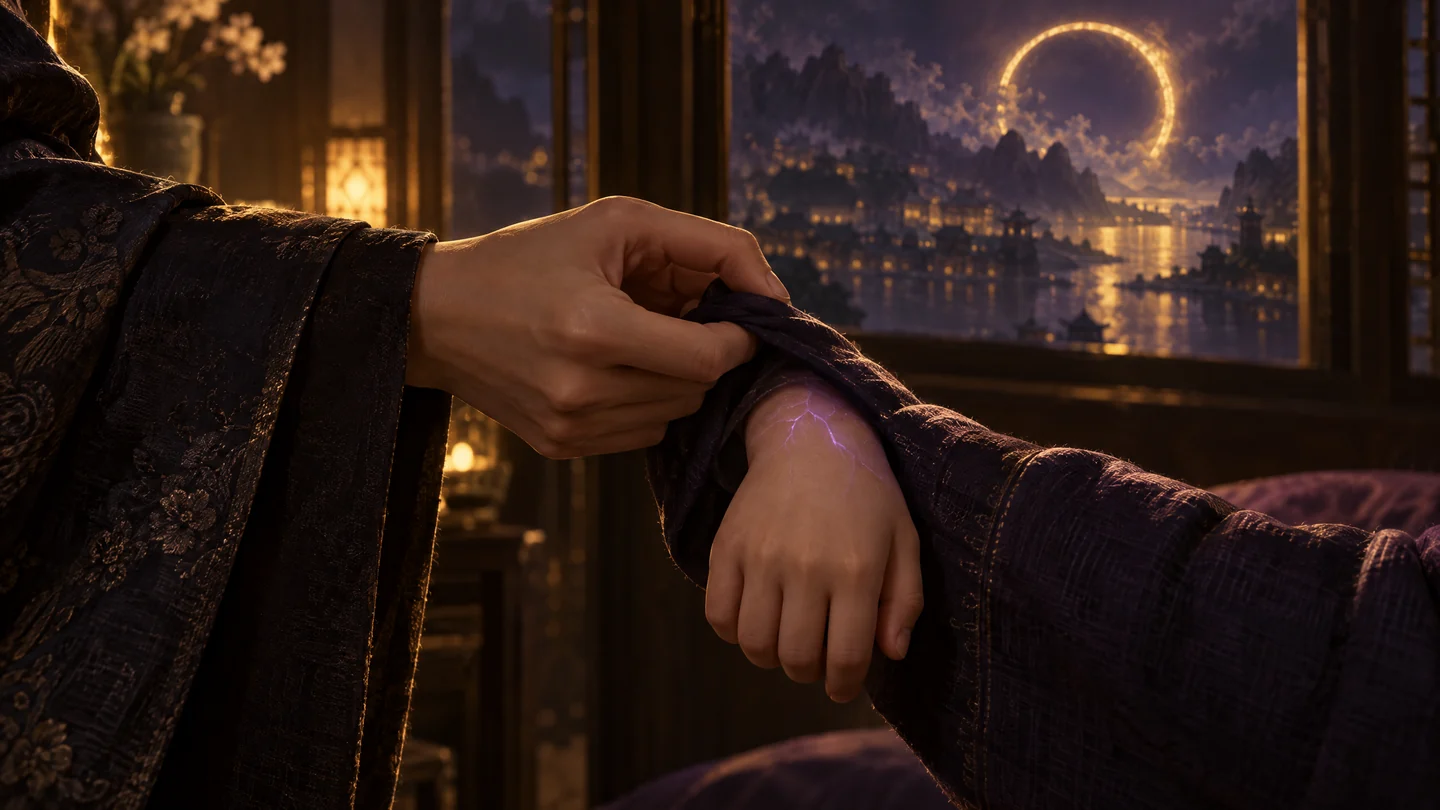
Rumi is small in this memory. She asks whether hunters kill all demons, and Celine says yes. So the girl asks again, the way that matters to her: all of them? Everything that has ?
A Rumi é pequena nessa lembrança. Ela pergunta à se as caçadoras matam todos os demônios, e a Celine diz que sim. A menina então refaz a pergunta do jeito que importa pra ela: todos? Tudo que tem ?
Celine doesn't answer. She tells her to cover them.
A Celine não responde. Manda cobrir.
Notice the order. The question was about what Rumi is. The answer was about what Rumi should do with what she is. Before any explanation, before anyone tells her what those purple lines mean, comes the instruction: hide them. The explanation arrives later, and only halfway. It's the girl herself who finishes the sentence Celine left hanging, that she has them because her father was a demon, and Celine steers the conversation away: she is not one of them, she is a hunter, like her mother was. When the is sealed, the demons will be gone from the world. And so will the patterns.
Repare na ordem das coisas. A pergunta era sobre o que a Rumi é. A resposta foi sobre o que a Rumi deve fazer com o que é. Antes de qualquer explicação, antes de alguém contar o que aquelas linhas roxas significam, vem a instrução: tapa. A explicação chega depois, e chega pela metade. É a própria menina quem completa a frase que a Celine deixou no ar, a de que tem aquilo porque o pai era um demônio, e a Celine corrige o rumo da conversa: ela não é um deles, é caçadora, como a mãe foi. Quando o for selado, os demônios vão sumir do mundo. E os patterns também.
It's the first lesson Rumi ever gets about her own body. It isn't anatomy. It's logistics.
É a primeira lição que a Rumi recebe sobre o próprio corpo. Não é anatomia. É logística.
And the lesson comes with a deadline. Celine doesn't say "hide them forever." She says "hide them until." Until the Honmoon turns gold, until the world is fixed, until the mark is gone. The hiding place is presented as a waiting room, not a home, and that's the cruelest part of the promise, because a child can bear almost anything if she believes it's temporary. The whole film will collect on that debt. Rumi spends her life in long sleeves, waiting for the day she won't need the sleeves anymore, and her body, which never heard any promise, does what bodies do. It keeps going.
E a lição vem com prazo. A Celine não diz "esconde pra sempre". Diz "esconde até". Até o Honmoon ficar dourado, até o mundo estar consertado, até a marca sumir. O esconderijo é apresentado como sala de espera, não como casa, e essa é a parte mais cruel da promessa, porque uma criança aguenta quase qualquer coisa se acreditar que é temporária. O filme inteiro vai cobrar essa conta. A Rumi passa a vida de manga comprida esperando o dia em que não vai mais precisar da manga, e o corpo dela, que não ouviu promessa nenhuma, faz o que corpos fazem. Segue em frente.
Interactive 1Interativo 1
The sleeveA manga
45 seconds · cover them whenever you like45 segundos · cubra quando quiserPress Space or Enter to cover or uncover the patterns. Arrow keys move the sleeve.Aperte Espaço ou Enter pra cobrir ou descobrir os patterns. As setas movem a manga.
Personal threadFio pessoal
I am an intersex woman, and this film mattered to my self-acceptance. Rumi is not intersex, and this essay will not pretend she is. But it was watching her gather her own pieces that I understood I needed to gather mine.
Eu sou uma mulher intersexo, e esse filme foi importante pra minha aceitação. A Rumi não é intersexo, e este texto não vai fingir que é. Mas foi assistindo a ela juntar os próprios pedaços que eu entendi que precisava juntar os meus.
This is not another essay about me. That job already belongs to my two essays on intersex, part 1 and part 2. This one is about the film, scene by scene. I step in when my story helps you see a scene, and I step out right after. Rumi runs this show.
Isto não é mais um texto sobre mim. Esse papel já é dos meus dois ensaios sobre intersexo, a parte 1 e a parte 2. Este é sobre o filme, cena por cena. Eu entro quando a minha história ajuda a enxergar uma cena, e saio logo depois. Quem manda aqui é a Rumi.
This essay argues one thingEste ensaio defende uma coisa só
The mark does not define who you are, but it becomes part of the person you become.
A marca não define quem você é, mas entra na pessoa que você se torna.
The idea in the second half of that sentence isn't mine. It's more than two thousand years old: it runs through Pindar and reaches Nietzsche, who in The Gay Science has conscience say one short sentence: become who you are. He liked the formula so much that he put it in the subtitle of Ecce Homo, "How One Becomes What One Is." What interests me in it is the verb. Becoming isn't building from scratch, and it isn't standing still, waiting for the mark to fade. It's the path Celine never offered: the mark stays, and the person goes on.
A ideia da segunda metade dessa frase não é minha. Ela tem mais de dois mil anos, passa por Píndaro e chega a Nietzsche, que na Gaia Ciência faz a consciência dizer uma frase curta: torna-te quem tu és. Ele gostou tanto da fórmula que a colocou no subtítulo do Ecce Homo, "como alguém se torna o que é". O que me interessa nela é o verbo. Tornar-se não é fabricar do zero, nem ficar parada esperando a marca sumir. É o caminho que a Celine nunca ofereceu: a marca fica, e a pessoa continua.
Covering is one answer. The whole film is the search for another.
Cobrir é uma resposta. O filme inteiro é a procura por outra.
Chapter 1Capítulo 1
What Everyone KnowsO que todo mundo sabe
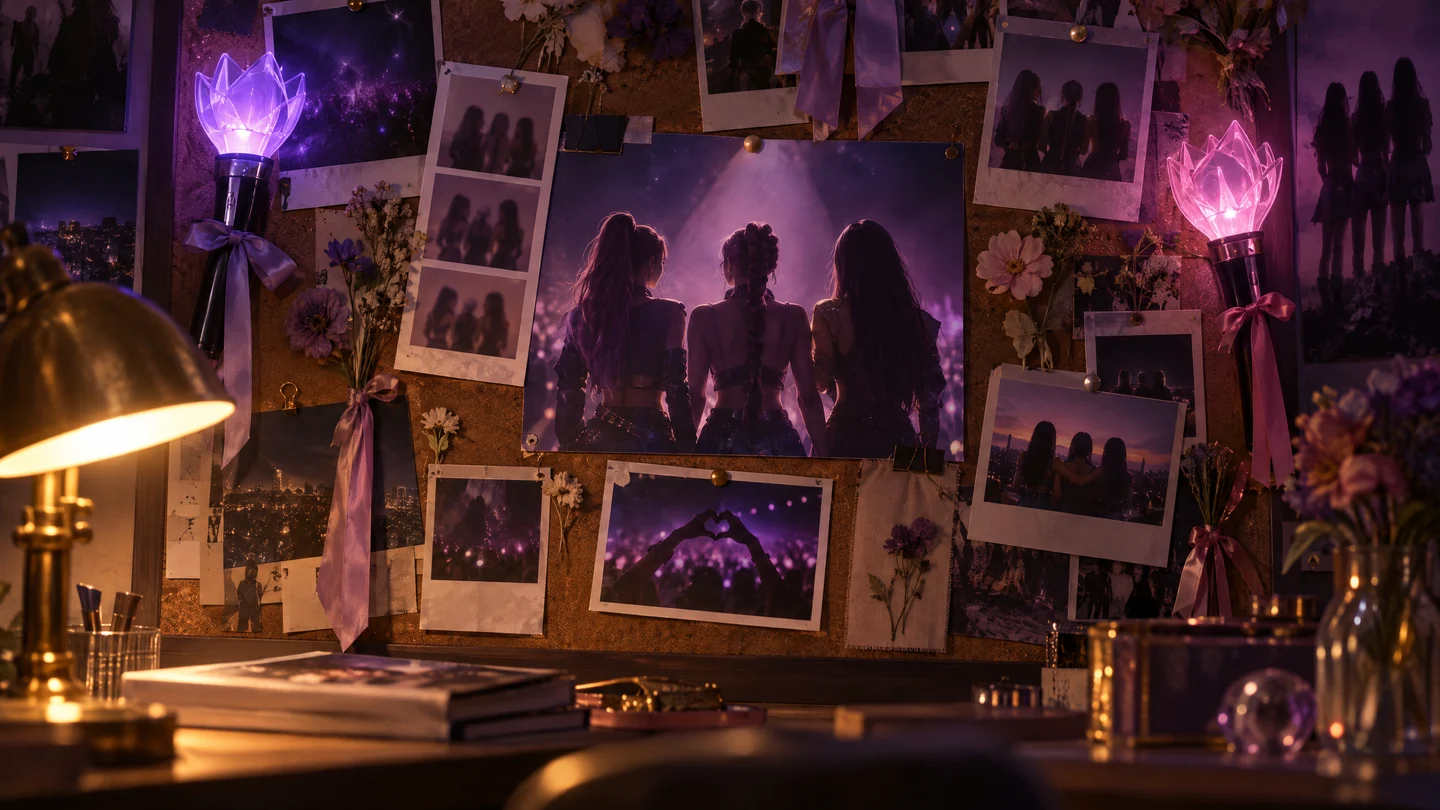
Before the first song, the film hands the mic to the fans. They recite what everyone knows about each member, with the authority of people who have memorized it: Mira is the black sheep of her family, Zoey grew up in Burbank, in the United States, Rumi's mother died when she was a baby, and it was who raised her and built the group around her. It's a complete dossier. And there's nothing wrong with it.
Antes da primeira música, o filme dá a palavra às fãs. Elas recitam o que todo mundo sabe sobre cada integrante, com a autoridade de quem decorou: a Mira é a ovelha negra da família, a Zoey cresceu em Burbank, nos Estados Unidos, a mãe da Rumi morreu quando ela era bebê, e foi a quem a criou e montou o grupo em volta dela. É um dossiê completo. E não tem nada de errado nele.
It's only missing what matters. No fan knows about the . None of them knows that Mira spent her life thinking her temper was a problem, or that Zoey, before , thought her own notebooks were useless and weird. What everyone knows is true, and it's no use at all.
Só falta o que importa. Nenhuma fã sabe dos . Nenhuma sabe que a Mira passou a vida achando que o próprio temperamento era um problema, nem que a Zoey, antes da , achava os próprios cadernos inúteis e esquisitos. O que todo mundo sabe é verdade, e não serve pra nada.
In 1944, imprisoned by the Nazis, Dietrich Bonhoeffer wrote a poem called "Who Am I?" Others said he stepped out of his cell calm and steady, talking to the guards as if he were the one giving orders. He himself felt restless, short of breath, hungry for a kind word, too tired even to pray. The poem stays between the two versions without choosing either, and ends by handing the question to God, the only one who knows the answer, and to whom he says he belongs either way. The fans' montage is the first stanza of Rumi's poem. The rest of the film is the second.
Em 1944, preso pelos nazistas, Dietrich Bonhoeffer escreveu um poema chamado "Quem sou eu?". Os outros diziam que ele saía da cela calmo, firme, falando com os guardas como quem manda. Ele mesmo se sentia inquieto, sufocado, faminto de uma palavra gentil, cansado até de rezar. O poema fica entre as duas versões sem escolher nenhuma, e termina entregando a pergunta a Deus, o único que sabe a resposta, e a quem ele diz pertencer de qualquer jeito. A montagem das fãs é a primeira estrofe do poema da Rumi. O resto do filme é a segunda.
This site has written about this film before. It was one of the first subjects of Beyond Patterns, in a series of seven pieces published between March and April 2026. Those analyses read the songs track by track, almost always comparing the original lyrics to the Brazilian dub. This essay reads the film through its scenes. Where a question was already settled there, I link instead of repeating.
Este site já falou desse filme. Ele foi um dos primeiros assuntos do Beyond Patterns, numa série de sete textos publicada entre março e abril de 2026. Aquelas análises leram as músicas faixa por faixa, quase sempre comparando a letra original com a dublagem brasileira. Este texto lê o filme pelas cenas. Onde o assunto já foi resolvido lá, eu linko em vez de repetir.
Some people think this is too heavy for a children's animation. The director disagrees. Maggie Kang told Consequence that she wanted to take on a hard theme like shame head-on, and that at one of the first public screenings she saw a seven-year-old girl understanding what Rumi was going through. At a press conference in Seoul, she told the same story with one more detail: the child understood Rumi's fear because she, too, hid things from her friends, afraid of being judged. And she summed up the film in a single line: at heart, it's about shame. If a child that age can read it, an essay can too.
Tem quem ache que isso é peso demais pra uma animação infantil. A diretora discorda. A Maggie Kang contou à Consequence que quis encarar de frente um tema difícil como a vergonha, e que numa das primeiras sessões públicas viu uma menina de sete anos entendendo o que a Rumi estava passando. Numa coletiva em Seul, ela contou a mesma cena com um detalhe a mais: a criança entendia o medo da Rumi porque também escondia coisas dos amigos, com medo de ser julgada. E resumiu o filme numa frase: no fundo, ele é sobre vergonha. Se uma criança dessa idade lê, um ensaio pode ler também.
One last thing before we go in. The thesis talks about becoming, and many readers will hear Simone de Beauvoir in it: one is not born, but rather becomes, a woman. That is not the becoming of this essay. My female identity has been firm since I was eight, and nothing that follows touches it. The becoming here is Pindar's and Nietzsche's: becoming what you already are. No one is building an identity out of nothing. What becomes is the whole person, with everything that came along, the mark included.
Uma última coisa, antes de entrar. A tese fala em tornar-se, e muita gente vai ouvir aí a Simone de Beauvoir: ninguém nasce mulher, torna-se. Não é esse o tornar-se deste texto. A minha identidade feminina está firme desde os oito anos, e nada do que vem a seguir mexe nela. O tornar-se aqui é o de Píndaro e de Nietzsche, tornar-se o que já se é. Ninguém está construindo uma identidade do nada. O que se torna é a pessoa inteira, com tudo que veio junto, a marca inclusive.
Identity doesn't become. The person does.
A identidade não se torna. A pessoa, sim.
Chapter 2Capítulo 2
The MantraO mantra

On the day Rumi's voice fails, a scene the next chapter reads up close, the show is canceled and the three of them try to decide what to tell the fans. Someone suggests calling . Mira cuts in: everyone already knows what she'd say. And Zoey, with no rehearsal needed, does the impression. She straightens up, changes her voice, and recites the hunters' creed, with the closing line Celine has always repeated: "Your faults and fears must never be seen."
No dia em que a voz da Rumi falha, cena que o próximo capítulo lê de perto, o show é cancelado e as três tentam decidir o que dizer pras fãs. Alguém sugere ligar pra . A Mira corta: todo mundo já sabe o que ela diria. E a Zoey, sem precisar de ensaio, faz a imitação. Endireita a postura, muda a voz e recita o credo das caçadoras, com o fecho que a Celine repete desde sempre: "Your faults and fears must never be seen". Suas falhas e seus medos nunca podem ser vistos.
All three laugh. Mira says she sounds just like her. Zoey answers that that's just how Celine says it.
As três riem. A Mira diz que ela fala igualzinho. A Zoey responde que é assim mesmo que a Celine fala.
And right after laughing, they obey. They agree they have to hide the problem and fix it.
E logo depois de rir, elas obedecem. Concordam que é preciso esconder o problema e consertar.
A rule you can imitate with your eyes closed is a rule that already lives in you. This scene is the lightest and saddest proof in the film. The joke frees no one, because laughing at an order is not the same as disobeying it. The mantra has become an accent. Nobody needs Celine in the room anymore for it to work.
Uma regra que você consegue imitar de olho fechado é uma regra que já mora em você. Essa cena é a prova mais leve e mais triste do filme. A piada não liberta ninguém, porque rir de uma ordem não é a mesma coisa que desobedecer a ela. O mantra virou sotaque. Ninguém mais precisa que a Celine esteja na sala pra ele funcionar.
The rest of their lives is already organized around it. Mira and Zoey keep inviting Rumi to the , and Rumi keeps saying no. Her friends think she's shy, call it modesty, and give up laughing. In one of the memories, Rumi even wonders whether they might understand, and Celine's voice answers for her: nothing can change until the are gone. Look at what that does to a friendship. Rumi's secret doesn't stay locked inside her. It turns into one of her traits in the others' eyes. Whoever hides doesn't hide only the mark. She also hides the reason she's hiding, and in its place people put whatever explanation comes to hand.
O resto da vida das três já está organizado em volta dele. A Mira e a Zoey vivem convidando a Rumi pra , e a Rumi vive recusando. As amigas acham que é timidez, chamam de modéstia, desistem rindo. Numa das lembranças, a Rumi chega a cogitar que talvez elas entendessem, e a voz da Celine responde por ela: nada pode mudar enquanto os não sumirem. Olhe o que isso faz com a amizade. O segredo da Rumi não fica guardado dentro dela. Ele vira uma característica dela aos olhos das outras. Quem esconde não esconde só a marca. Esconde também o motivo de estar escondendo, e no lugar dele as pessoas colocam uma explicação qualquer.
The film even has someone say it out loud, only somewhere nobody takes seriously. , in a comedy scene, looks at Rumi and sees walls. He says that focusing too much on one part makes you ignore the others, and that this separates and isolates. Her friends crack up because he nailed the bathhouse thing. Rumi insists she has no walls. The scene sells the diagnosis as a joke, and the diagnosis is right.
O filme até manda alguém dizer isso em voz alta, só que num lugar onde ninguém leva a sério. O , numa cena de comédia, olha pra Rumi e enxerga muros. Diz que focar demais numa parte faz a gente ignorar as outras, e que isso separa e isola. As amigas gargalham porque ele acertou em cheio sobre a recusa do banho. A Rumi garante que não tem muro nenhum. A cena vende o diagnóstico como piada, e o diagnóstico está certo.
Interactive 2Interativo 2
The wallsOs muros
40 seconds · decline or accept40 segundos · recuse ou aceiteYour friends send invitations one at a time. Tab reaches Decline and Accept; Enter or Space chooses.As amigas mandam convites, um de cada vez. O Tab chega em Recusar e Aceitar; Enter ou Espaço escolhem.
Sartre has a description of shame that works as a lens for this scene. In Being and Nothingness, he imagines someone peeping through a keyhole, so absorbed in what he sees that he forgets himself. Then he hears footsteps in the hallway. In that instant he stops being only a gaze and becomes a thing being looked at, and that is where shame is born. For Sartre, shame is always shame of oneself before someone. It needs a gaze, even a merely possible one.
O Sartre tem uma descrição da vergonha que serve como lente pra essa cena. No Ser e o Nada, ele imagina alguém espiando pelo buraco de uma fechadura, tão absorvido no que vê que esquece de si. Então escuta passos no corredor. Nesse instante a pessoa deixa de ser só olhar e vira coisa olhada, e é aí que a vergonha nasce. Pro Sartre, a vergonha é sempre vergonha de si diante de alguém. Ela precisa de um olhar, nem que seja um olhar possível.
Celine's mantra is a whole life organized to escape that gaze. Until the , no one catches Rumi. Even so, she lives like someone hearing footsteps in the hallway all the time.
O mantra da Celine é uma vida inteira organizada pra fugir desse olhar. Até o , ninguém flagra a Rumi. Mesmo assim, ela vive como quem escuta passos no corredor o tempo todo.
The Bible tells the same scene before any philosopher. In Genesis 3, as soon as Adam and Eve's eyes are opened, the first thing they do is neither ask forgiveness nor run. They sew: "they sewed fig leaves together, and made themselves aprons." The first human work after the fall is a covering. And when God calls, Adam explains why he disappeared: "I was afraid, because I was naked; and I hid myself." The question that comes next is the one that matters here: "Who told thee that thou wast naked?" No one is born knowing they have something to hide. Someone tells them.
A Bíblia conta a mesma cena antes de qualquer filósofo. Em Gênesis 3, assim que os olhos de Adão e Eva se abrem, a primeira coisa que eles fazem não é pedir perdão nem fugir. É costurar: "coseram folhas de figueira, e fizeram para si aventais". A primeira obra humana depois da queda é uma cobertura. E quando Deus chama, Adão explica por que sumiu: "temi, porque estava nu, e escondi-me". A pergunta que vem em seguida é a que interessa aqui: "Quem te mostrou que estavas nu?". Ninguém nasce sabendo que tem algo a esconder. Alguém conta.
In Rumi's life, that someone has a name.
Na vida da Rumi, esse alguém tem nome.
There's a difference, and it will come back in chapter 15. Adam hid after doing something. Rumi hides for having been born.
Tem uma diferença, e ela vai voltar no capítulo 15. Adão se escondeu depois de fazer alguma coisa. A Rumi se esconde por ter nascido.
Chapter 3Capítulo 3
The ThroatA garganta
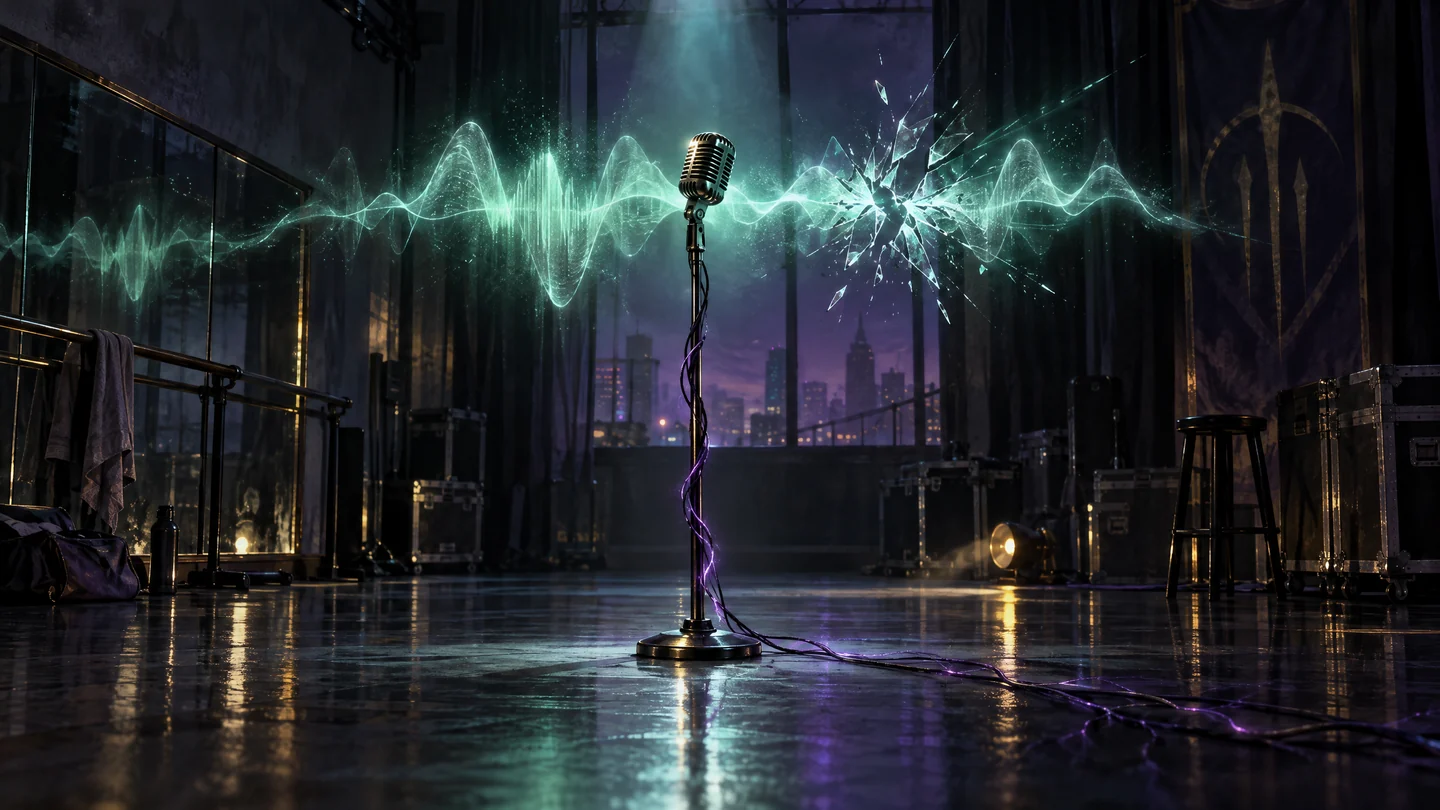
Ten minutes before a live performance, with ten thousand fans screaming at the door, Rumi rehearses . Her voice stumbles. She starts again and stumbles again, and not just anywhere: right on the line where she sings that she's done hiding. She asks for five minutes and shuts herself away. It's in this gap that the film shows where the problem comes from, with the memories of telling her to cover up, the one from chapter 0, and of the she always refused. Then Rumi tries again, with no audience now. Her voice holds up to the line about hunters with strong voices and breaks right after, on the line where she says she believes. That's when she lets out the question she'll carry to the end: how is she supposed to fix the world, and fix herself, without her own voice?
Faltam dez minutos pra uma apresentação ao vivo, com dez mil fãs gritando na porta, e a Rumi ensaia . A voz tropeça. Ela retoma e tropeça de novo, e não em qualquer lugar: justamente no verso em que canta que parou de se esconder. Pede cinco minutos e se tranca sozinha. É nesse intervalo que o filme mostra de onde vem o problema, com as lembranças da mandando cobrir, a do capítulo 0, e do recusado. Depois a Rumi tenta outra vez, já sem plateia. A voz aguenta até a frase das caçadoras de voz forte e quebra logo em seguida, no verso em que ela diz que acredita. É aí que ela solta a pergunta que vai carregar até o fim: como é que ela vai consertar o mundo, e consertar a si mesma, sem a própria voz?
Meanwhile, the climb. They spent years on her arms, hidden by her sleeves, and now they're reaching her neck.
Enquanto isso, os sobem. Passaram anos nos braços, escondidos pela manga, e agora estão chegando ao pescoço.
The film could have put the mark anywhere. It chose the throat. fights by singing, the is made of voice, and Rumi is the group's lead voice. So shame moves into the instrument itself. The body records what a person hides, and it collects the debt right where she needs it most.
O filme podia ter colocado a marca em qualquer lugar. Escolheu a garganta. A luta cantando, o é feito de voz, e a Rumi é a voz principal do grupo. Então a vergonha vai morar no próprio instrumento. O corpo registra o que a pessoa esconde, e cobra no lugar onde ela mais precisa dele.
In my analysis of Golden I read this through the lyrics: the voice fails because the song is a lie, a declaration that she has stopped hiding, sung by someone who is still hiding. Here the same fact shows up from the other side. It's not only the lyric that lies. It's the body refusing to sing the lie.
Na análise de Golden eu li isso pela letra: a voz falha porque a música é uma mentira, uma declaração de que ela parou de se esconder cantada por alguém que continua escondida. Aqui o mesmo fato aparece pelo outro lado. Não é só a letra que mente. É o corpo que se recusa a cantar a mentira.
Nietzsche has a chapter of Zarathustra for this: "On the Despisers of the Body." He calls the body a great reason. What we usually call reason, the spirit, would be only the small reason, a tool of the body. Behind your thoughts and feelings, he says, there is a mightier lord, an unknown sage, and that sage lives in the body. It is the body.
O Nietzsche tem um capítulo do Zaratustra pra isso: "Dos desprezadores do corpo". Ele chama o corpo de grande razão. O que a gente costuma chamar de razão, o espírito, seria só a razão pequena, uma ferramenta do corpo. Por trás dos pensamentos e dos sentimentos, diz ele, existe um senhor mais poderoso, um sábio desconhecido, e esse sábio mora no corpo. É o corpo.
The Rumi of Golden is a despiser of the body. She treats her own body as an opponent to be outlasted: she endures, she covers, she waits for the golden Honmoon to erase the problem. And it's the body that tells the truth first. Before she admits anything to anyone, her throat already has.
A Rumi de Golden é uma desprezadora do corpo. Ela trata o próprio corpo como um adversário que precisa ser vencido pelo cansaço: aguenta, cobre, espera o Honmoon dourado apagar o problema. E é o corpo quem diz a verdade primeiro. Antes de ela admitir qualquer coisa pra alguém, a garganta já admitiu.
Personal threadFio pessoal
My voice barely deepened in puberty, but frequency doesn't tell the whole story. What sometimes gives me away is the combination: prosody, resonance and, above all, punch and loudness, which make my voice sound deeper than it is. Full control of that still depends on surgery. That's why the film's choice is so precise. Rumi's shame doesn't show up first on her skin, which a sleeve can cover. It shows up in sound, which has no sleeve at all.
A minha voz quase não engrossou na puberdade, mas a frequência não conta a história toda. O que às vezes me entrega é o conjunto: a prosódia, a ressonância e, principalmente, o punch e o volume, que fazem a voz soar mais grave do que ela é. O controle completo disso ainda depende de cirurgia. Por isso a escolha do filme é tão precisa. A vergonha da Rumi não aparece primeiro na pele, que dá pra cobrir com uma manga. Aparece no som, que não tem manga nenhuma.
Interactive 3Interativo 3
The noteA nota
hold the notesegure a notasinging that I've stopped hidingcanto que parei de esconder
Press and hold the HOLD button, or hold Space on it, to sustain the note up to the 4.0 s mark; letting go early stops the note. Enter, or a single activation without holding, sustains it on its own. After two tries, a NOW, UNCOVERED button appears.Pressione e segure o botão SEGURAR, ou segure Espaço nele, pra sustentar a nota até a marca de 4,0 s; soltar antes para a nota. Enter, ou uma ativação simples sem segurar, sustenta a nota sozinha. Depois de duas tentativas, aparece o botão AGORA À MOSTRA.
You can hide your skin. Not your voice.
A pele você esconde. A voz, não.
A few minutes before the show, the question Rumi asked alone still has no answer: how do you fix the world, and fix yourself, without your own voice? The film only answers it at .
Faltam poucos minutos pro show, e a pergunta que a Rumi fez sozinha continua sem resposta: como consertar o mundo, e consertar a si mesma, sem a própria voz? O filme só responde em .
Chapter 4Capítulo 4
The Mark Is Not the SentenceA marca não é a sentença
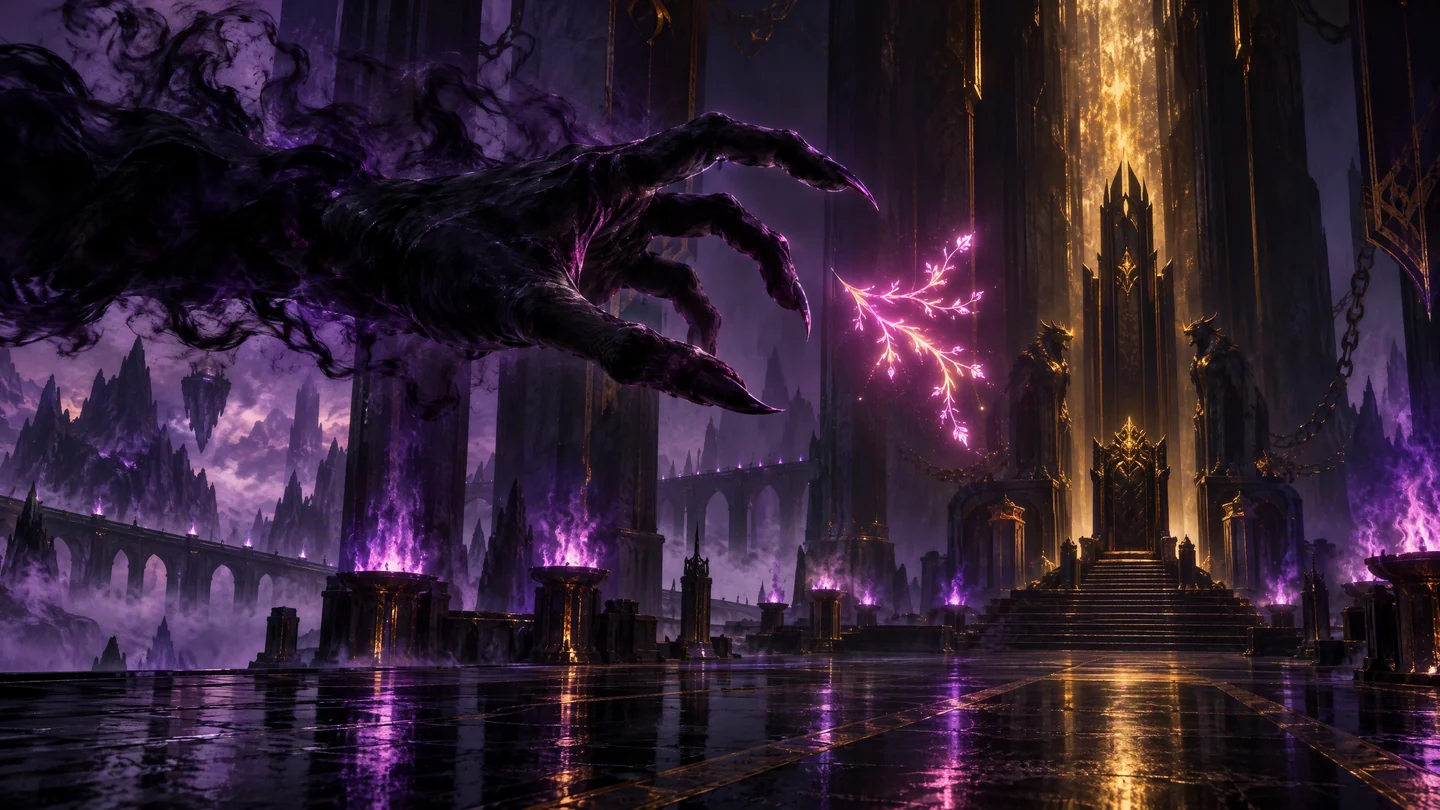
Soda Pop has become a craze, and in the demon realm is pleased with the soul harvest. But there's one thing he doesn't understand. One of the hunters carries his mark, and he has no control over her at all. The one who cracks the riddle is , and he cracks it with the calm of someone who knows the mechanism from the inside: that's good, because it means she has shame. He'll find out what it is, and they'll use it to destroy her. Gwi-Ma approves. He taught him well.
Soda Pop virou febre, e no reino dos demônios o está satisfeito com a colheita de almas. Mas tem uma coisa que ele não entende. Uma das caçadoras carrega a marca dele, e ele não tem controle nenhum sobre ela. Quem decifra o enigma é o , e decifra com a calma de quem conhece o mecanismo por dentro: isso é bom, porque quer dizer que ela tem vergonha. Ele vai descobrir do quê, e com isso vão destruí-la. O Gwi-Ma aprova. Ensinou bem.
Read that exchange again, slowly, because the film's whole mechanism is in it. The mark is there, and the control isn't. Between the two there is a bridge, and the bridge is called shame.
Leia de novo essa troca, devagar, porque o mecanismo do filme está todo nela. A marca está lá, e o controle não está. Entre uma coisa e outra existe uma ponte, e a ponte se chama vergonha.
Jinu explains the rule to Rumi soon after, on the rooftop. She thinks demons don't feel anything. He turns the idea upside down: feeling is all they do. They feel shame, they feel misery, and that's how Gwi-Ma controls them. Then he asks whether she doesn't hear Gwi-Ma's voice in her ear. She has no idea what he's talking about. He tells her she's lucky.
O Jinu explica a regra pra Rumi pouco depois, no telhado. Ela acha que demônios não sentem nada. Ele vira a ideia de cabeça pra baixo: sentir é tudo o que eles fazem: sentem vergonha, sentem miséria, e é assim que o Gwi-Ma os controla. Então ele pergunta se ela não ouve a voz do Gwi-Ma no ouvido. Ela não sabe do que ele está falando. Ele diz que ela tem sorte.
Put the two scenes together and the mechanism appears whole. The mark is a fact, and Rumi was born with it. The voice in the head is something else: it's the sentence, the whispered verdict that turns the fact into a condemnation. And the voice only comes in through one door. Rumi has the mark and doesn't have the voice, yet. What separates her from the demons isn't skin. It's the fact that her shame hasn't turned into obedience.
Junte as duas cenas e o mecanismo aparece inteiro. A marca é um fato, e a Rumi nasceu com ela. A voz na cabeça é outra coisa: é a sentença, o veredito sussurrado que transforma o fato em condenação. E a voz só entra por uma porta. A Rumi tem a marca e não tem a voz, ainda. O que a separa dos demônios não é a pele. É o fato de que a vergonha dela ainda não virou obediência.
Along the way, Jinu knocks down before the song is even finished. The lyrics Mira and Zoey are about to write condemn the demon without feelings, as if feeling were the criterion for deserving to live. Jinu has just said that feeling is what demons have most. The song's criterion collapses, and the analysis of Takedown already showed what that criterion does to Rumi when she has to sing it.
De quebra, o Jinu derruba antes mesmo de a música estar pronta. A letra que a Mira e a Zoey vão escrever condena o demônio sem sentimentos, como se o critério pra merecer viver fosse sentir. O Jinu acabou de dizer que sentimento é o que os demônios mais têm. O critério da música desmorona, e a análise de Takedown já mostrou o que esse critério faz com a Rumi quando ela precisa cantá-lo.
Paul Ricoeur has a distinction that gives an exact name to what the film does. In Oneself as Another, he separates two senses of identity. One is identity, sameness: what stays the same over time, character, the traits by which someone is recognized, like a fingerprint. The other is ipse identity, selfhood: the self that holds on even while changing, that answers for its own acts, that keeps its word, that tells its own story.
O Paul Ricoeur tem uma distinção que dá nome exato ao que o filme faz. Em O si-mesmo como outro, ele separa dois sentidos de identidade. Um é a identidade , a mesmidade: aquilo que continua igual com o tempo, o caráter, os traços pelos quais alguém é reconhecido, como uma impressão digital. O outro é a identidade ipse, a ipseidade: o si que se mantém mesmo mudando, que responde pelos próprios atos, que cumpre a palavra, que se conta.
Rumi's mark is idem in its purest form. It's the trait that doesn't change and by which anyone can recognize her, and that's why it's dangerous: whoever sees the mark thinks they already know who she is. Gwi-Ma's project is to reduce Rumi to that trait. You have my mark, so you're one of mine. The film's answer is on the ipse side. Rumi will not erase the mark, and the film never promises she will. What she does is decide who the person carrying it is.
A marca da Rumi é idem em estado puro. É o traço que não muda e pelo qual qualquer um pode reconhecê-la, e é por isso que ela é perigosa: quem vê a marca acha que já sabe quem ela é. O projeto do Gwi-Ma é reduzir a Rumi a esse traço. Você tem a minha marca, então você é dos meus. A resposta do filme está do lado ipse. A Rumi não vai apagar a marca, e o filme nunca promete que vai. O que ela faz é decidir quem é a pessoa que carrega aquilo.
It's the thesis in a philosopher's vocabulary. The mark is the part of you that stays the same. Who you become is the part that answers for it.
É a tese em vocabulário de filósofo. A marca é a parte de você que continua igual. Quem você se torna é a parte que responde por ela.
Interactive 4Interativo 4
Mark and controlMarca e controle
connect the nodesligue os nósThe mark stays. The control doesn't.A marca continua. O controle, não.
Drag a line from one node to another, or tap two nodes in turn. With the keyboard: Tab picks a node, Enter starts the line, Tab picks the destination, Enter connects, Escape cancels.Arraste uma linha de um nó a outro, ou toque em dois nós, um depois do outro. No teclado: Tab escolhe um nó, Enter começa a linha, Tab escolhe o destino, Enter liga, Esc cancela.
Gwi-Ma has the mark. He doesn't have Rumi. To have her, he needs her to feel shame.
O Gwi-Ma tem a marca. Não tem a Rumi. Pra ter, ele precisa que ela sinta vergonha.
Chapter 5Capítulo 5
The RewriteA reescrita

Rumi is alone in her room, rehearsing with the lyrics her friends wrote. She reaches the pre-chorus, the part where the show and hatred grows in the veins of whoever sees them. And she stops. Breathes. Sings it again, but differently: when the patterns show, she sees a pain hidden underneath.
A Rumi está sozinha no quarto, ensaiando com a letra que as amigas escreveram. Chega no pré-refrão, aquele em que os aparecem e o ódio cresce nas veias de quem vê. E para. Respira. Canta de novo, só que diferente: quando os patterns aparecem, ela vê uma dor escondida por baixo.
No one asked for this version. No one will hear it. She changes the lyric alone, for herself.
Ninguém pediu essa versão. Ninguém vai ouvir. Ela troca a letra sozinha, pra si mesma.
Right after, Mira knocks on the door. She heard Rumi singing, compliments her voice, and wants to know why she's changing their lyrics. Rumi asks whether that's really the right song to beat , because it's so full of hate. Mira answers with hunter logic: it's full of hate because they hate demons.
Logo depois a Mira bate na porta. Ouviu a Rumi cantando, elogia a voz, e quer saber por que ela está mudando a letra delas. A Rumi pergunta se aquela é mesmo a música certa pra vencer o , porque é cheia de ódio. A Mira responde com a lógica das caçadoras: é cheia de ódio porque elas odeiam os demônios.
What Rumi doesn't do in the rewrite says as much as what she does. She doesn't deny the patterns. In her version, they still show, they're still visible. What changes is what happens after someone sees them. In the original lyric, seeing the mark produces hatred, almost as a reflex. In Rumi's version, seeing the mark produces attention: there's pain under there.
O que a Rumi não faz na reescrita diz tanto quanto o que ela faz. Ela não nega os patterns. Na versão dela, eles continuam aparecendo, continuam visíveis. O que muda é o que acontece depois que alguém os vê. Na letra original, ver a marca produz ódio, quase como reflexo. Na versão da Rumi, ver a marca produz atenção: tem uma dor ali embaixo.
Rumi's identity begins with this line. And it begins by a curious route: she learns to read other people's marks with compassion before she can read her own. Her version of Takedown is about the demons, about , about the pain under his lines. She still can't say it about herself. But the sentence already exists, and a sentence that exists can be sung again, one day, about herself.
A identidade da Rumi começa nesse verso. E começa por um caminho curioso: ela aprende a ler a marca dos outros com compaixão antes de conseguir ler a própria. A versão dela de Takedown é sobre os demônios, sobre o , sobre a dor por baixo das linhas dele. Ela ainda não consegue dizer isso de si mesma. Mas a frase já existe, e uma frase que existe pode ser cantada de novo, um dia, sobre ela mesma.
Ricoeur, who appeared in chapter 4, has a whole book on this, The Symbolism of Evil. He shows that the oldest symbol of evil is neither sin nor guilt: it's the stain. Something almost physical, that sticks to a person through contact, from the outside in, and defiles even someone who wanted none of it. Guilt, which chapter 15 will separate from shame, is the end of the story he tells. The stain is the beginning. The original Takedown lyric reads the patterns as a stain: saw it, hated it. Rumi's rewrite does what Ricoeur calls interpreting. The same sign, read again, stops being contagion and becomes news of someone who is suffering. At the end of the book, he sums up the method in a phrase that could fit this line: the symbol gives rise to thought.
O Ricoeur, que apareceu no capítulo 4, tem um livro inteiro sobre isso, A simbólica do mal. Ele mostra que o símbolo mais antigo do mal não é o pecado nem a culpa: é a mancha. Uma coisa quase física, que gruda na pessoa por contato, de fora pra dentro, e contamina até quem não quis nada daquilo. A culpa, que o capítulo 15 vai separar da vergonha, é o fim da história que ele conta. A mancha é o começo. A letra original de Takedown lê os patterns como mancha: viu, odiou. A reescrita da Rumi faz o que o Ricoeur chama de interpretar. O mesmo sinal, lido de novo, deixa de ser contágio e vira notícia de alguém que sofre. No fim do livro, ele resume o método numa frase que caberia nesse verso: o símbolo dá o que pensar.
The analysis of Takedown read the song Rumi can't sing. This scene is the song she can, and can't show anyone.
A análise de Takedown leu a música que a Rumi não consegue cantar. Esta cena é a música que ela consegue, e que não pode mostrar pra ninguém.
Interactive 5Interativo 5
The same markA mesma marca
complete the sentencecomplete a frase
When the mark shows, I seeQuando a marca aparece, eu vejo
Tab to a word; Enter puts it in the blank.Tab até uma ficha; Enter coloca a palavra na lacuna.
The mark didn't move. Its meaning did.
A marca não mudou de lugar. Mudou de sentido.
Chapter 6Capítulo 6
Everyone's PatternsOs patterns de todo mundo

Han the healer finishes reading Rumi, finds the walls, and moves on. He looks at Zoey and sees an eagerness to please, maybe too much of it. Zoey laughs nervously, swears she's not like that, and asks her friends whether they'd tell her if she were. Nobody answers. With Mira, the reading turns into a staring contest that ends in a growl. The scene is pure comedy. And it's the first time the film shows, without saying it, that Rumi isn't the only one with something to hide.
O curandeiro Han termina de ler a Rumi, encontra os muros e passa pra próxima. Olha pra Zoey e enxerga vontade de agradar, talvez vontade demais. A Zoey ri nervosa, jura que não é assim e pergunta pras amigas se elas contariam caso fosse. Ninguém responde. Com a Mira, a leitura vira um duelo de olhares que termina em rosnado. A cena é pura comédia. E é a primeira vez que o filme mostra, sem dizer, que a Rumi não é a única com alguma coisa pra esconder.
He reads everyone. The difference is that only Rumi's mark shows on the skin.
Ele lê todo mundo. A diferença é que só a marca da Rumi aparece na pele.
The film will come back to this on the night before the , when Mira and Zoey tell what they carry. For now, what the consultation lets slip is enough: in Zoey, an eagerness to please that is really a hunger to belong; in Mira, a temper that picks a fight even with the healer. Neither one has a color or a shape. Both work like .
O filme vai voltar a isso numa noite antes do , quando a Mira e a Zoey contam o que carregam. Por enquanto basta o que a consulta deixa escapar: na Zoey, uma vontade de agradar que é fome de pertencer; na Mira, um temperamento que vira briga até com o curandeiro. Nenhum dos dois tem cor nem forma. Os dois funcionam como .
This is where the film steps off the screen. Think of everything someone can spend a lifetime covering. There are the marks that are literally on the skin: a scar, a burn, vitiligo, acne, stretch marks, a birthmark. There's the body that doesn't match what's expected of it: weight, body hair, voice, baldness that came early, the facial feature that became a nickname at school. There's the body that changes without asking permission: a chronic illness, a disability that came later, the aftermath of an accident. And there are the patterns no sleeve can cover, because they aren't on the skin: a stutter, an accent, a poor background, a family someone is ashamed of, the diagnosis no one at work knows about.
Aqui o filme sai da tela. Pense em tudo que alguém pode passar a vida cobrindo. Tem as marcas que estão literalmente na pele: uma cicatriz, uma queimadura, o vitiligo, a acne, as estrias, uma marca de nascença. Tem o corpo que não bate com o que esperam dele: o peso, os pelos, a voz, a calvície que chegou cedo, o traço do rosto que virou apelido na escola. Tem o corpo que muda sem pedir licença: uma doença crônica, uma deficiência que veio depois, a sequela de um acidente. E tem os patterns que nenhuma manga cobre porque não estão na pele: a gagueira, o sotaque, a origem pobre, a família de que a pessoa se envergonha, o diagnóstico que ninguém no trabalho conhece.
Anyone who has ever chosen clothes for what they cover knows Rumi in her long sleeves.
Todo mundo que já escolheu uma roupa pelo que ela tapa conhece a Rumi de manga comprida.
The sociologist Erving Goffman wrote the manual on this in 1963. In Stigma, he divides stigmas into three types, and the classification looks tailor-made for the film. Those of the body, which he calls, in the harsh vocabulary of his time, abominations of the body. Those of character, which he calls blemishes of individual character. And those of lineage, which he calls tribal: the ones passed down through families along with ethnicity or religion. Mira and Zoey belong to the second type. Rumi carries the first and the third: the mark is on her body, and it came from her father.
O sociólogo Erving Goffman escreveu o manual disso em 1963. Em Estigma, ele divide os estigmas em três tipos, e a classificação parece feita pro filme. Os do corpo, que ele chama, com o vocabulário duro da época, de abominações do corpo. Os de caráter, que ele chama de defeitos de caráter individual. E os de linhagem, que ele chama de tribais, os que passam de geração em geração junto com a família, a etnia ou a religião. A Mira e a Zoey estão no segundo tipo. A Rumi acumula o primeiro e o terceiro: a marca está no corpo, e veio do pai.
Goffman's sharpest distinction, though, is another one. He separates the discredited from the discreditable. The discredited person's stigma is in plain sight, and the problem is handling the tension of being seen. The discreditable person's stigma is hidden, and the problem is a different one: managing information. Every situation becomes a calculation: show it or not, tell or not, lie or not, and if so, to whom, how, when, where. For the discreditable, life turns into the management of a secret.
A distinção mais afiada do Goffman, porém, é outra. Ele separa quem é desacreditado de quem é desacreditável. O desacreditado tem o estigma à vista, e o problema dele é lidar com a tensão de ser visto. O desacreditável tem o estigma escondido, e o problema dele é outro: administrar informação. Mostrar ou não mostrar, contar ou não contar, mentir ou não mentir, e em cada caso pra quem, como, quando e onde. Pra quem é desacreditável, a vida vira gestão de segredo.
That is the Rumi of the first two acts. She's discreditable. Everything we've seen so far, the sleeves, the refused , the voice that fails on the wrong line, is the cost of that management. Goffman even has a name for the strategy: passing, being taken for someone who carries no stigma at all. 's mantra is a manual for passing.
É exatamente a Rumi dos dois primeiros atos. Ela é desacreditável. Tudo o que a gente viu até aqui, a manga, o recusado, a voz que falha no verso errado, é o custo dessa administração. O Goffman tem nome até pra estratégia: passar, ou seja, ser tomada por quem não carrega estigma nenhum. O mantra da é um manual de passar.
Interactive 6Interativo 6
Who knowsQuem sabe
choose a patternescolha um patternwho knowsquem sabe
tap whoever already knowstoque em quem já sabe
CHOOSEESCOLHER
Nothing you choose here is saved.Nada do que você escolhe aqui é guardado.
Choose a pattern. Each person asks once: Tell or Hide. Then the people come back together in mixed places: Tab reaches them, and Enter marks whoever already knows, or Nobody here knows when nobody does, before the time runs out.Escolha um pattern. Cada pessoa pergunta uma vez: Contar ou Esconder. Depois as pessoas voltam juntas em lugares misturados: Tab chega até elas, e Enter marca quem já sabe, ou Ninguém aqui sabe quando ninguém sabe, antes de o tempo acabar.
Everyone has a long sleeve. What changes is what's underneath, and who knows.
Todo mundo tem uma manga comprida. O que muda é o que está embaixo, e quem sabe.
At the end of the consultation, Han hands over the tonics the three came for. Later, when Mira compliments her voice, Rumi says they worked. They didn't, and chapter 12 tells what did. Nobody took home what Han said for free. The walls are still there.
No fim da consulta, o Han entrega os tônicos que as três foram buscar. Mais tarde, quando a Mira elogia a voz dela, a Rumi diz que eles funcionaram. Não foram eles, e o capítulo 12 conta o que foi. Ninguém levou pra casa o que o Han disse de graça. Os muros continuam lá.
Chapter 7Capítulo 7
Dysphoria as an ImageA disforia como imagem

Alone, Rumi takes off her jacket and looks at her arms. The have climbed again. She didn't ask them to grow, and covering them didn't make them stop. Her face, in that moment, isn't the face of someone looking at her own body. It's the face of someone checking on a problem.
Sozinha, a Rumi tira a jaqueta e olha os próprios braços. Os subiram de novo. Ela não pediu que eles crescessem, e cobrir não fez eles pararem. O rosto dela, nesse momento, não é o de quem vê o próprio corpo. É o de quem confere um problema.
This is where I propose an image, and I want to say plainly that it is an image. Rumi's patterns work as a portrait of what many people with feel about their own bodies: a part of oneself treated as something wrong, hidden, managed, until the person understands that the way out isn't hiding, but going through transition. Rumi wasn't written as a trans character, and the film doesn't talk about that. Whoever reads her that way is using the film as a mirror, as chapter 9 will show. The image is here to light up the scene, not to explain a condition. The explanation lives elsewhere on this site, in the essay on what neurobiology knows about gender dysphoria.
É aqui que eu proponho uma imagem, e quero dizer com todas as letras que é uma imagem. Os patterns da Rumi servem como retrato do que muita gente com sente em relação ao próprio corpo: uma parte de si tratada como coisa errada, escondida, administrada, até a pessoa entender que a saída não é esconder, e sim passar pela transição. A Rumi não foi escrita como personagem trans, e o filme não fala disso. Quem lê assim está usando o filme como espelho, como o capítulo 9 vai mostrar. A imagem serve pra iluminar a cena, não pra explicar uma condição. A explicação está em outro lugar do site, no ensaio sobre o que a neurobiologia sabe da disforia de gênero.
The image has a limit, and I'd rather show it before someone points it out. In the film, Rumi's answer isn't to change her body. It's to stop hiding the body she has, mark and all. In dysphoria, the answer goes through transition, which changes the body. What the two share comes before that: in both stories, hiding is not a way out. And in both, what a person has gone through becomes part of who she becomes, which is the thesis of this essay.
A imagem tem um limite, e prefiro mostrar antes que alguém aponte. No filme, a resposta da Rumi não é mudar o corpo. É parar de esconder o corpo que ela tem, com a marca e tudo. Na disforia, a resposta passa pela transição, que muda o corpo. O ponto em comum está antes disso: nas duas histórias, esconder não é saída. E nas duas, o que a pessoa atravessou entra em quem ela se torna, que é a tese deste texto.
Some say that using dysphoria as an image reduces a clinical experience to a metaphor. It would, if the essay stopped here and treated the image as an explanation. It doesn't. The image says what Rumi does in front of the mirror, and the next chapter carefully separates what is similar from what is different.
Tem quem diga que usar a disforia como imagem reduz uma experiência clínica a metáfora. Reduziria, se o texto parasse aqui e tratasse a imagem como explicação. Não trata. A imagem diz o que a Rumi faz diante do espelho, e o capítulo seguinte separa com cuidado o que é parecido do que é diferente.
What the image captures best is a distance. Merleau-Ponty spent the Phenomenology of Perception trying to show that the body isn't an object we own, but the way we exist in the world. For him, we don't stand in front of our own body: we're inside it, and more than that, we are it. When that unity breaks, the body becomes a thing: something looked at from outside, checked, covered. Rumi, in that moment, lives inside that break. She looks at her arms as if they belonged to someone else, a problem somebody left with her.
O que a imagem captura melhor é uma distância. O Merleau-Ponty passou a Fenomenologia da percepção tentando mostrar que o corpo não é um objeto que a gente possui, é o jeito pelo qual a gente está no mundo. Pra ele, a gente não está diante do próprio corpo: está dentro dele, e mais do que isso, é ele. Quando essa unidade quebra, o corpo vira coisa: algo que se olha de fora, que se confere, que se cobre. A Rumi, ali, vive dentro dessa quebra. Ela olha os braços como se fossem de outra pessoa, um problema que alguém deixou com ela.
Personal threadFio pessoal
In my case, which is that of an intersex woman, the dysphoria had a strange pattern. It would show up in one region of my body and, about two weeks later, my body would change exactly there, and it would disappear. Today, what remains is social: being read ambiguously. The comparison with the film is almost an inverted mirror. In Rumi, the mark advances as shame grows. In me, the discomfort retreated as my body changed.
No meu caso, que é o de uma mulher intersexo, a disforia tinha um padrão estranho. Aparecia numa região do corpo e, umas duas semanas depois, o corpo mudava exatamente ali, e ela sumia. Hoje, o que sobra é social: ser lida de um jeito ambíguo. A comparação com o filme é quase um espelho invertido. Na Rumi, a marca avança à medida que a vergonha cresce. No meu, o desconforto recuava à medida que o corpo mudava.
Interactive 7Interativo 7
The mapO mapa
tap the regions that light uptoque nas regiões que acendemIn Rumi, checking fed the mark. In my case, the discomfort left when the shape changed. What remains is outside the map.Na Rumi, conferir alimentou a marca. No meu caso, o desconforto saiu quando a forma mudou. O que sobrou está fora do mapa.
Tab moves between the two maps, RUMI and MY CASE. The arrow keys move through the lit regions of a map. Enter or Space taps a region.O Tab passa de um mapa para o outro, RUMI e O MEU CASO. As setas percorrem as regiões acesas de um mapa. Enter ou Espaço tocam uma região.
Rumi, alone with her arms, doesn't know yet that there's a way out other than the sleeve. The film takes a whole act to show what it is.
A Rumi, sozinha com os próprios braços, ainda não sabe que existe outra saída além da manga. O filme leva mais um ato inteiro pra mostrar qual é.
And that's exactly why I need to stop and separate things, before anyone joins together what isn't the same.
E é exatamente por isso que eu preciso parar e separar as coisas, antes que alguém junte o que não é igual.
Chapter 8Capítulo 8
Different Origins, Holding HandsOrigem diferente, mãos dadas

At the , in the middle of the fight, sees Rumi's bare arm. In that first second, his reaction is surprise, not attack: a hunter who's part demon? The question hangs in the air like a category that won't close. Later, on the rooftop, he comes back to it, and Rumi answers with half the truth: just a hunter, not a demon. Then where did the come from, he wants to know. She tells him it's none of his business.
Na , no meio da luta, o vê o braço da Rumi descoberto. Nesse primeiro segundo, a reação dele é de espanto, não de ataque: uma caçadora que é parte demônio? A pergunta fica no ar como uma categoria que não fecha. Mais tarde, no telhado, ele volta ao assunto, e a Rumi responde com metade da verdade: só caçadora, não demônio. Então de onde vieram os , ele quer saber. Ela diz que não é da conta dele.
The film's world rests on a two-sided division. On one side, the hunters. On the other, the demons. is the song that turns that division into a sentence, and Rumi fits on neither side. She is both, and so, in the eyes of the rule, she is neither.
O mundo do filme se apoia numa divisão de dois lados. De um, as caçadoras. Do outro, os demônios. é a música que transforma essa divisão em sentença, e a Rumi não cabe em nenhum dos lados. Ela é as duas coisas, e por isso, aos olhos da regra, não é nenhuma.
That is the image of . And it's different from the image in the previous chapter, which is why this chapter exists.
Essa é a imagem do . E ela é diferente da imagem do capítulo anterior, por isso o capítulo existe.
The difference is in the origin. In intersex, what's in question is the body. An intersex body may be neither in F nor in M, because the layers that define sex don't all point the same way. In my first essay on intersex I laid those layers out one by one: chromosomes, hormones, receptors, gonads and anatomy, five levels that obey nobody's checkbox. In , when it comes on its own, the body may sit entirely on one side, and the lives in the distance between that body and the person's gender identity.
A diferença está na origem. No intersexo, o que está em questão é o corpo. Um corpo intersexo pode não estar nem em F nem em M, porque as camadas que definem o sexo não seguem todas na mesma direção. No primeiro ensaio sobre intersexo eu mostrei essas camadas uma por uma: cromossomos, hormônios, receptores, gônadas e anatomia, cinco níveis que não obedecem ao formulário de ninguém. Na , quando ela vem pura, o corpo pode estar inteiramente de um lado, e a mora na distância entre esse corpo e a identidade de gênero da pessoa.
When dysphoria is present, the two experiences hold hands. In both cases, these are people in bodies that don't match their own gender identity, and in the end, for the person living it, the difference in origin changes little.
Quando a disforia aparece, as duas experiências andam de mãos dadas. Nos dois casos, são pessoas em corpos que não batem com a própria identidade de gênero, e no fim, pra quem vive, a diferença de origem muda pouco.
But dysphoria isn't always present, and I won't let the reader leave thinking every intersex body is at war with the person living in it. Most aren't. In a 2005 review, the psychologist Tom Mazur gathered 156 people with , CAIS, and found not a single documented case of gender change; dysphoria appeared to be rare. A British study of 22 women with CAIS found psychological development and gender identity typical of women. A more recent German study, with eleven participants, showed more variation than used to be claimed, but the rule holds. Among people, most identify as men, although the rate of dysphoria is higher than in the general population. Intersex is not a synonym for dysphoria. It's a condition of the body that sometimes, and only sometimes, comes with it.
Mas a disforia não aparece sempre, e eu não vou deixar o leitor sair daqui achando que todo corpo intersexo vive em guerra com a pessoa que mora nele. A maioria não vive. Numa revisão de 2005, o psicólogo Tom Mazur reuniu 156 pessoas com , a CAIS, e não encontrou nenhum caso documentado de mudança de gênero; a disforia aparecia como rara. Um estudo britânico com 22 mulheres com CAIS encontrou desenvolvimento psicológico e identidade de gênero típicos de mulheres. Um estudo alemão mais recente, com onze participantes, mostrou que a variação é maior do que se costumava dizer, mas a regra continua. Entre pessoas , a maioria se identifica como homem, embora a taxa de disforia seja maior que na população geral. Intersexo não é um sinônimo de disforia. É uma condição do corpo, que às vezes, e só às vezes, vem acompanhada dela.
Foucault asked the right question about this in 1980, when he published the memoirs of Herculine Barbin. Herculine was raised as a girl in a nineteenth-century French boarding school, until a medical exam found what it didn't expect, and doctors and judges decided to correct the civil record. In the introduction, Foucault asks whether we truly need a . The medicine and the law of that era did: every body had to be one thing only, even if that meant rewriting the person.
O Foucault fez a pergunta certa sobre isso em 1980, quando publicou as memórias de Herculine Barbin. Herculine foi criada como menina num internato francês do século XIX, até que um exame médico encontrou o que não esperava, e médicos e juízes decidiram corrigir o registro civil. Na introdução, Foucault pergunta se precisamos mesmo de um . A medicina e a lei daquela época precisavam: cada corpo tinha de ser uma coisa só, mesmo que pra isso fosse preciso reescrever a pessoa.
It's the logic of Takedown applied to real people. Rumi is what happens when an entire world needs a true sex, and someone is born without one.
É a lógica de Takedown aplicada a gente de verdade. A Rumi é o que acontece quando um mundo inteiro precisa de um sexo verdadeiro, e alguém nasce sem ele.
Interactive 8Interativo 8
Two circlesDois círculos
bring the circles togetheraproxime os círculosOrigin in the body (intersex)Origem no corpo (intersexo)
five layerscinco camadas
- chromosomescromossomos
- hormoneshormônios
- receptorsreceptores
- gonadsgônadas
- anatomyanatomia
most without dysphoriaa maioria sem disforia
Origin in identityOrigem na identidade
a body wholly on one sidecorpo inteiramente de um lado
the gap between body and identitya distância entre corpo e identidade
They meet, but they don't merge.Eles se encontram, mas não se fundem.
CAIS: in a review of 156 people, no documented case of gender change (Mazur, 2005).
CAIS: numa revisão de 156 pessoas, nenhum caso documentado de mudança de gênero (Mazur, 2005).
XXY: most identify as men, with a higher rate of dysphoria than the general population (Cai and Yap, 2022).
XXY: a maioria se identifica como homem, com taxa de disforia maior que na população geral (Cai e Yap, 2022).
Tab switches between the two circles. The left and right arrow keys move the circle in focus. Enter or Space takes one step.Tab alterna entre os dois círculos. As setas para a esquerda e para a direita movem o círculo em foco. Enter ou Espaço dão um passo.
Different origins aren't distance. Holding hands doesn't make them one hand.
Origem diferente não é distância. Mãos dadas não é a mesma mão.
On the rooftop, when Jinu asks where the patterns came from, Rumi tells him it's none of his business. It's the answer of someone who still has no word for herself. The film doesn't give one either. Maybe that's why so many people were able to see themselves in her.
No telhado, quando o Jinu pergunta de onde vieram os patterns, a Rumi diz que não é da conta dele. É a resposta de quem ainda não tem palavra pra si mesma. O filme também não dá uma. Talvez seja por isso que tanta gente conseguiu se ver nela.
Chapter 9Capítulo 9
MirrorsEspelhos

At the autograph session, when the two bands share the same table, a girl comes up to with a handmade gift. He's taken aback. Is it really for him? Beside him, Rumi says that maybe he should listen to those voices instead of the ones in his head. The fan sees something in him that he can't see. She knows nothing about what he is. And still she got something right.
Na sessão de autógrafos, quando as duas bandas dividem a mesma mesa, uma menina chega até o com um presente feito à mão. Ele estranha. É pra ele mesmo? Ao lado, a Rumi diz que talvez ele devesse escutar aquelas vozes, e não as que estão na cabeça dele. A fã está vendo nele uma coisa que ele não consegue ver. Ela não sabe nada do que ele é. E mesmo assim acertou alguma coisa.
That's what happened to the film off the screen. Many people looked at Rumi and saw themselves, and each group pointed to a different scene.
Foi isso que aconteceu com o filme fora da tela. Muita gente olhou pra Rumi e viu a si mesma, e cada grupo apontou pra uma cena diferente.
The most common reading was the queer one: the shame of hiding and the relief of coming out. Maggie Kang herself has compared Rumi's story to coming out of the closet. And one of the writers, Hannah McMechan, told Attitude that working on the film helped her realize she was bisexual, at a time when she didn't want to tell anyone and felt ashamed of it. She didn't write the story as a queer allegory, but she recognized her own journey in Rumi's. In Salon Futura, a speculative fiction criticism magazine edited by Cheryl Morgan, the film was read as a trans allegory, even though the subject never comes up on screen: Rumi believes she'd be rejected if the truth came out, and in the end authenticity wins. Some extended the reading to mixed-race, LGBTQ and neurodivergent people, pointing to Rumi claiming a side of herself she had hidden for so long. And there's even an academic article, by the researcher Chloe T. Rattray, reading the film through : the arc from shame to acceptance, and the refusal of the old cure narrative. It makes sense. By the end of the film, nothing about Rumi is cured.
A leitura mais comum foi a queer: a vergonha de esconder e o alívio de sair do armário. A própria Maggie Kang já comparou a história da Rumi a sair do armário. E uma das roteiristas, Hannah McMechan, contou à Attitude que trabalhar no filme a ajudou a perceber que era bissexual, num tempo em que ela não queria contar pra ninguém e sentia vergonha disso. Ela não escreveu a história como alegoria queer, mas reconheceu na jornada da Rumi a própria. Na Salon Futura, revista de crítica de ficção especulativa editada pela Cheryl Morgan, o filme foi lido como alegoria trans, mesmo sem o assunto aparecer na tela: a Rumi acredita que seria rejeitada se a verdade viesse à tona, e no fim a autenticidade vence. Teve quem estendesse a leitura pra pessoas mestiças, LGBTQ e neurodivergentes, apontando pra Rumi assumindo um lado de si escondido por tanto tempo. E saiu até um artigo acadêmico, da pesquisadora Chloe T. Rattray, lendo o filme pelos : o arco que vai da vergonha à aceitação, e a recusa da velha narrativa de cura. Faz sentido. No fim do filme, nada na Rumi é curado.
A piece on the film's queer legacy sums up what all these readings have in common: Rumi doesn't need a label for the metaphor to work. The healing the film imagines makes noise: it's collective, sung together.
Um texto sobre o legado queer do filme resume o que todas essas leituras têm em comum: a Rumi não precisa receber rótulo nenhum pra metáfora funcionar. A cura que o filme imagina faz barulho: é coletiva, cantada em grupo.
The film doesn't decide who's right, and that's its strength. It works as an open mirror. Each person sees their own mark in Rumi, and no reading cancels another, because none of them says Rumi is only that. The girl at the autograph session didn't know what Jinu was. She saw enough.
O filme não decide quem tem razão, e essa é a força dele. Ele funciona como um espelho aberto. Cada pessoa vê a própria marca na Rumi, e nenhuma leitura cancela a outra, porque nenhuma delas diz que a Rumi é só aquilo. A menina da sessão de autógrafos não sabia o que o Jinu era. Viu o suficiente.
My reading is one more of these, only told from the inside.
A minha leitura é mais uma dessas, só que contada de dentro.
Interactive 9Interativo 9
The mirrorO espelho
turn the mirrorgire o espelhoFive readings. None cancelled another.Cinco leituras. Nenhuma cancelou a outra.
Arrow keys or Space turn the mirror one angle at a time. At the fifth angle, Enter goes to chapter 10.As setas ou o Espaço giram o espelho um ângulo por vez. No quinto ângulo, Enter leva ao capítulo 10.
A mirror doesn't tell you who you are. It shows what you brought in front of it.
Um espelho não diz quem você é. Mostra o que você trouxe pra frente dele.
Chapter 10Capítulo 10
What I Saw in the Broken GlassO que eu vi no vidro quebrado

The song starts with no rehearsal. No choreography, no stage set up, no one approving anything. Rumi stands before at and, for the first time in the film, sings without armor. And she does the thing she spent her whole life avoiding: she lets her marks show. Not because someone tore off her sleeve, as at the . Because she chooses to.
A música começa sem ensaio. Não tem coreografia, não tem palco montado, não tem ninguém aprovando nada. A Rumi está diante do em e, pela primeira vez no filme, canta sem armadura. E faz a coisa que passou a vida inteira evitando: deixa as marcas à mostra. Não porque alguém arrancou a manga, como no . Porque ela escolhe.
That difference is the whole film. At the Idol Awards, the mark was exposed. At Namsan, it is shown. The skin is the same. What changed is who decides.
Essa diferença é o filme inteiro. No Idol Awards, a marca foi exposta. Em Namsan, ela é mostrada. A pele é a mesma. Mudou quem decide.
Personal threadFio pessoal
In my case, the difference between being exposed and showing myself has a date. It was when I created Beyond Patterns and started appearing on Instagram. Now a YouTube channel is coming, to raise awareness among more people, without unnecessary activism. No one tore off my sleeve. I took it off.
No meu caso, a diferença entre ser exposta e me mostrar tem data. Foi quando eu criei o Beyond Patterns e comecei a aparecer no Instagram. Agora vem um canal no YouTube, pra conscientizar mais gente, sem militância desnecessária. Ninguém arrancou a minha manga. Eu tirei.
I watched the film twice, in two countries. The first time was in Brazil, at its release, when I was still my old self. I felt peace. The second time was in Japan, in December, in the middle of everything: finding out I was intersex, and needing to come out about my gender identity for the treatment to work. It was the second time that I understood what I had felt: I didn't need to hide who I was from the world. I only had to accept it, and gather the million broken pieces.
Eu vi o filme duas vezes, em dois países. A primeira foi no Brasil, no lançamento, quando eu ainda era o meu antigo eu. Senti paz. A segunda foi no Japão, em dezembro, no meio de tudo: a descoberta de que eu era intersexo e a necessidade de assumir a minha identidade de gênero pro tratamento funcionar. Foi na segunda que eu entendi o que tinha sentido: eu não precisava esconder do mundo quem eu era. Bastava aceitar, e juntar os milhões de pedaços quebrados.
The lyrics of begin right with the pieces. Rumi sings of shattering into countless pieces, with no way back, and then sees something beautiful in the shards. Notice what she doesn't say. She doesn't promise to glue the shards until the piece looks the way it did before. She says there's no going back. It's the exact answer to the promise in chapter 0. taught Rumi to wait for the day the mark would vanish, the "hide them until." Namsan is the day Rumi stops waiting. There's no until. There's now, as it is.
A letra de começa justamente pelos pedaços. A Rumi canta que se partiu em um milhão de pedaços e que não tem como voltar atrás, e logo depois acha beleza no vidro quebrado. Repare no que ela não diz. Ela não promete colar os cacos até a peça ficar como era antes. Diz que não tem volta. É a resposta exata à promessa do capítulo 0. A ensinou a Rumi a esperar o dia em que a marca sumiria, o "esconde até". Namsan é o dia em que a Rumi para de esperar. Não tem até. Tem agora, do jeito que está.
The site's series already read this image through kintsugi, the Japanese art of mending ceramics with gold and leaving the crack visible, in the analysis of What It Sounds Like and in section 07 of the hub essay. Here I read it from the other side of the glass.
A série do site já leu essa imagem pelo kintsugi, a arte japonesa de consertar cerâmica com ouro e deixar a rachadura à mostra, na análise de What It Sounds Like e na seção 07 da matéria-mãe. Aqui eu leio do outro lado do vidro.
Personal threadFio pessoal
My pieces have names: the psyche, identity, acceptance, a side of me no one had ever seen, and the decision to go out into the world and live against the binary status quo. Jung calls the process of bringing the parts of the psyche together, including the ones we rejected, into a whole . I wrote about it in the Individuation Protocol.
Os meus pedaços têm nome: a psique, a identidade, a aceitação, um lado meu que ninguém nunca tinha visto, e a decisão de ir pro mundo e viver contra o status quo binário. O Jung chama de o processo de juntar as partes da psique, inclusive as que a gente rejeitou, num inteiro. Eu escrevi sobre isso no Protocolo de Individuação.
My individuation wasn't gradual. It was forced: I had to rewrite twenty-five years of life in a month. Along the way there was a dissociative fugue, and in practice that meant I had split myself in two. Giving my feminine side full access was, literally, telling my subconscious that I would stop forcing things. Whatever came and changed, I would accept. Whatever surfaced from what I had repressed, I would accept too. The fugue stopped, and I made it. What surfaced, before anything else, was a hunger for affection: wanting sweetness, wanting tenderness.
A minha individuação não foi gradual. Foi forçada: eu precisei reescrever vinte e cinco anos de vida em um mês. No meio do caminho teve uma fuga dissociativa, e na prática isso queria dizer que eu tinha me dividido em duas. Dar acesso total ao meu lado feminino foi, literalmente, avisar ao meu subconsciente que eu ia parar de forçar. O que viesse e mudasse, eu aceitaria. O que aflorasse daquilo que eu tinha reprimido, eu aceitaria também. A fuga parou, e eu consegui. O que aflorou foi, antes de tudo, carência: vontade de fofura, de carinho.
Augustine writes in the Confessions that at one point he had become a great question to himself. Individuation is what happens when that question stops being only a question and starts demanding an answer.
O Agostinho conta nas Confissões que, num certo momento, se tornou pra si mesmo uma grande questão. A individuação é o que acontece quando essa questão para de ser só pergunta e passa a exigir resposta.
Further on, Rumi sings that the scars belong to her, and that darkness and harmony fit in the same voice. It's this essay's thesis sung by someone else. The mark doesn't disappear. It moves in.
Mais adiante, a Rumi canta que as cicatrizes fazem parte dela, e que cabem escuridão e harmonia na mesma voz. É a tese deste ensaio cantada por outra pessoa. A marca não some. Entra.
Personal threadFio pessoal
My body took this literally. I was born with an intersex body: ovotesticular, XY, and partial androgen insensitivity. In November 2025, puberty started on its own, without anyone asking: my skin thinned, my smell changed, fat moved to my hips, my breasts grew, my muscle strength dropped. My skeleton is still changing. My growth plates are still open, my pelvis tilted, and I lost two centimeters of height, from 2.08 to 2.06 meters (about 6'10" to 6'9"). My bone densitometry already shows a female pattern. Of all the changes, the ones that marked me most were the pelvic tilt, the widening of my hips and the gynoid fat together with my breasts, because they literally break any possible trace of a testosterone-driven body. None of it was a choice. My body decided first, and I decide along with it. The details are in Intersex part 1 and Intersex part 2, and here is a public correction: in part 2 I wrote that the surgery would be in January. It was moved to after March.
O meu corpo levou isso ao pé da letra. Eu nasci com um corpo intersexo: ovotesticular, XY, e insensibilidade parcial aos andrógenos. Em novembro de 2025, a puberdade começou sozinha, sem ninguém pedir: a pele afinou, o cheiro mudou, a gordura foi pro quadril, as mamas cresceram, a força muscular caiu. O esqueleto ainda está mudando. As placas de crescimento seguem abertas, a pelve inclinou, e eu perdi dois centímetros de altura, de 2,08 metros pra 2,06. A densitometria já dá padrão feminino. Das mudanças, as que mais me marcaram foram a inclinação da pelve, o alargamento da bacia e a gordura ginoide junto com os seios, porque elas quebram, literalmente, qualquer traço possível de um corpo movido a testosterona. Nada disso foi escolha. O corpo decidiu primeiro, e eu decido junto com ele. Os detalhes estão no Intersex parte 1 e no Intersex parte 2, e aqui vai uma correção pública: no parte 2 eu escrevi que a cirurgia seria em janeiro. Ela ficou pra depois de março.
Rumi ends the film with the same marks she started with. The difference is that now they show. I'm going through this year in a body no one planned. Not even me.
A Rumi termina o filme com as mesmas marcas com que começou. A diferença é que agora elas aparecem. Eu atravesso este ano com um corpo que ninguém planejou. Nem eu.
There's a detail that closes chapter 3. In , the voice failed because Rumi sang that she had stopped hiding while she was still hiding. In What It Sounds Like, she sings of a voice without lies, and the voice doesn't fail. The throat was never sick. It was refusing to lie.
Tem um detalhe que fecha o capítulo 3. Em , a voz falhava porque a Rumi cantava que tinha parado de se esconder enquanto continuava escondida. Em What It Sounds Like, ela canta uma voz sem mentiras, e a voz não falha. A garganta nunca esteve doente. Estava se recusando a mentir.
Personal threadFio pessoal
I stopped singing lyrics that weren't mine, too. The masculine persona I used to wear is gone for good, and I want nothing it brought with it. Beyond that, I don't fake anything.
Eu também parei de cantar uma letra que não era minha. A persona masculina que eu usava sumiu de vez, e eu não quero mais nada do que ela trazia. De resto, eu não finjo nada.
And then the song stops being Rumi's alone. Mira and Zoey arrive and join in, each singing her own flaws as part of the harmony. What was one woman's confession becomes a choir of three.
E então a música deixa de ser só da Rumi. A Mira e a Zoey chegam e entram na canção, cada uma cantando os próprios defeitos como parte da harmonia. O que era confissão de uma vira coro de três.
Personal threadFio pessoal
I had people join my song, too. My parents, above all, supporting me. And my friends from the band, who stayed by my side when almost everyone else left.
Eu também tive quem entrasse na música. Os meus pais, principalmente, me apoiando. E os meus amigos da banda, que ficaram do meu lado quando quase todo mundo foi embora.
At Namsan, all three are dressed in white, and the colors of the run through the fabric and through Rumi's marks. It was a rebirth of the Self. Mine, and hers.
Em Namsan, as roupas das três estão brancas, e as cores do atravessam o tecido e as marcas da Rumi. Foi um renascimento do Self. O meu, e o dela.
Interactive 10Interativo 10
The piecesOs pedaços
gather the shardsjunte os cacosWhole. Not the same.Inteira. Não igual.
Tab picks a shard. Arrow keys move it, R turns it, Enter or Space puts it in the nearest place that takes it.Tab escolhe um caco. As setas movem, R gira, Enter ou Espaço encaixa no lugar mais próximo que aceita.
But that harmony didn't begin at Namsan. It began the night before the Idol Awards, on a night when the three of them tried to tell one another what they carried, and one of them didn't.
Só que essa harmonia não começou em Namsan. Começou na véspera do Idol Awards, numa noite em que as três tentaram contar umas às outras o que carregavam, e uma delas não contou.
Chapter 11Capítulo 11
The Friendship and the SecretA amizade e o segredo

It's the night before the . Rumi admits the last few weeks have been hard and that isn't the right song, and her friends agree: it's not a song that connects the fans, it doesn't even connect the three of them. Then Mira does something no one in the film has done until now. She quotes the mantra, the faults and fears that must never be seen, and confesses anyway. She says she's a difficult person: too blunt, short-fused, aggressive. Her whole life, that was a problem. With the two of them, somehow, it isn't.
É a véspera do . A Rumi admite que as últimas semanas foram difíceis e que não é a música certa, e as amigas concordam: não é uma música que conecta os fãs, não conecta nem elas. Então a Mira faz uma coisa que ninguém no filme tinha feito até ali. Cita o mantra, as falhas e os medos que nunca podem ser vistos, e confessa mesmo assim. Diz que é uma pessoa difícil: direta demais, pavio curto, agressiva. A vida inteira, isso foi um problema. Com as duas, de algum jeito, não é.
Zoey says she feels the same way. Before , she thought her own thoughts, her lyrics and her notebooks were useless and weird. With the two of them, they mean something. She means something. And she's afraid of losing her friends.
A Zoey responde que sente a mesma coisa. Antes da , achava os próprios pensamentos, as letras e os cadernos inúteis e esquisitos. Com as duas, eles significam alguma coisa. Ela significa alguma coisa. E tem medo de perder as amigas.
Rumi listens. And when her turn comes, she doesn't confess. She answers with the plan: that's why they have to finish what they started. These fears are the demons talking, tomorrow they win, the gets sealed, and they'll be free of all this forever. And she suggests, excited, that afterward they all go to the together.
A Rumi escuta. E quando chega a vez dela, não confessa. Responde com o plano: é por isso que elas precisam terminar o que começaram. Esses medos são os demônios falando, amanhã elas vencem, o fica selado e elas ficam livres disso pra sempre. E propõe, animada, que depois vão juntas à .
That suggestion says everything. Rumi is inviting her friends to the one place she could never go, because she's counting on the being gone the next day. Her confession has been scheduled for after the cure.
Essa proposta diz tudo. A Rumi está convidando as amigas pro único lugar aonde nunca pôde ir, porque conta que no dia seguinte os vão sumir. A confissão dela foi marcada pra depois da cura.
C.S. Lewis wrote, in The Four Loves, that friendship is born at the moment one person says to another: "What! You too? I thought that no one but myself..." The night before the Idol Awards is that birth. Mira confesses her temper, Zoey says she feels the same, and each discovers that the flaw she thought was solitary has company. It's the most beautiful moment in the film before , and Rumi watches it from the outside. She can't say "me too." Her "too" has a color and a shape, and it lives on her arm.
O C.S. Lewis escreveu, em Os quatro amores, que a amizade nasce no momento em que alguém diz pro outro: o quê, você também? Eu achava que era só eu. A véspera do Idol Awards é esse nascimento. A Mira confessa o temperamento, a Zoey diz que sente o mesmo, e cada uma descobre que o defeito que achava solitário tem companhia. É o momento mais bonito do filme antes de , e a Rumi assiste a ele de fora. Ela não pode dizer "eu também". O "também" dela tem cor e forma, e mora no braço.
Aristotle, in the Nicomachean Ethics, calls a friend another self, and says that complete friendship takes time, because, as the proverb he quotes puts it, no one knows another until the two have eaten a good amount of salt together. The friendship of the three is real. They want each other's good, they fight together, they defend each other. What's missing is the other half of what Aristotle asks for: to know and to be known. Rumi knows her friends. Her friends don't know Rumi.
O Aristóteles, na Ética a Nicômaco, chama o amigo de outro eu, e diz que a amizade completa leva tempo, porque, como diz o provérbio que ele cita, ninguém conhece o outro antes de os dois comerem juntos uma boa quantidade de sal. A amizade das três é real. Elas querem o bem umas das outras, lutam juntas, se defendem. O que falta é a outra metade do que o Aristóteles pede: conhecer e ser conhecida. A Rumi conhece as amigas. As amigas não conhecem a Rumi.
That's why acceptance, in this film, can't be a solitary act. Rumi doesn't heal alone in front of a mirror. Healing goes through being seen by someone who stays. Chapter 10 told the end of this story, with Mira and Zoey joining the song and singing their own flaws. This night is the beginning, and what keeps the beginning from reaching the end is a secret.
É por isso que a aceitação, no filme, não pode ser um ato solitário. A Rumi não se cura sozinha diante de um espelho. A cura passa por ser vista por alguém que fica. O capítulo 10 contou o fim dessa história, com a Mira e a Zoey entrando na música e cantando os próprios defeitos. Esta noite é o começo, e o que impede o começo de chegar ao fim é um segredo.
The film knows that this is exactly where the enemy works. After the Idol Awards, 's voices go after Mira and Zoey, and each one hears her own fear. Mira hears that she doesn't deserve a family, and never did. Zoey hears that she's too much and, at the same time, not enough, and that she'll never belong anywhere. His voice knows where it hurts, because it aims at what the two of them confessed the night before. Confessing didn't make the fear go away. But it gave them both a place to come back to, and that's where they come back to at .
O filme sabe que o inimigo trabalha exatamente aí. Depois do Idol Awards, as vozes do vão atrás da Mira e da Zoey, e cada uma ouve o próprio medo. A Mira ouve que não merece uma família, e que nunca mereceu. A Zoey ouve que é demais e, ao mesmo tempo, não é o bastante, e que nunca vai pertencer a lugar nenhum. A voz dele sabe onde dói, porque mira no que as duas confessaram na véspera. Confessar não fez o medo sumir. Mas deu às duas um lugar pra onde voltar, e é pra lá que elas voltam em .
Interactive 11Interativo 11
The voicesAs vozes
tap the bubblestoque nas bolhasBubbles carrying whispers rise around three lights: Mira, Zoey and Rumi. Tab reaches the bubbles on screen; Enter or Space confesses.Bolhas com sussurros sobem em volta de três luzes: Mira, Zoey e Rumi. O Tab chega nas bolhas da tela; Enter ou Espaço confessam.
A secret doesn't destroy a friendship. It leaves it half done.
Um segredo não destrói uma amizade. Deixa ela pela metade.
Chapter 12Capítulo 12
Free

The tiger and the bird in the little hat are nearby when says he wants to believe in Rumi's crazy plan, but doesn't think he's the right person to help. She answers that he already has. She spent her whole life keeping the secret, the shame of what she is, and the more she hid that shame, the more it grew, until it started to destroy the one thing that gave her life purpose: her voice. Since she met Jinu, the more she talks to him, the more her voice heals. She doesn't understand how.
O tigre e o pássaro de chapéu estão por perto quando o diz que quer acreditar no plano maluco da Rumi, mas que não acha que é a pessoa certa pra ajudar. Ela responde que ele já ajudou. Passou a vida inteira guardando o segredo, a vergonha do que é, e quanto mais escondia essa vergonha, mais ela crescia, até começar a destruir a única coisa que dava propósito à vida dela: a voz. Desde que conheceu o Jinu, quanto mais conversa com ele, mais a voz se cura. Ela não entende como.
The film has just said, in so many words, what chapter 3 read in her throat. Hidden shame grows, and it grows until it reaches the instrument. Now comes the other half. To Mira, Rumi said it was the healer's tonics. To Jinu, she tells the truth: it was him.
O filme acabou de dizer, com todas as letras, o que o capítulo 3 leu na garganta. A vergonha escondida cresce, e cresce até chegar no instrumento. Agora vem a outra metade. Pra Mira, a Rumi disse que tinham sido os tônicos do curandeiro. Pro Jinu, ela conta a verdade: foi ele.
Then comes , their duet, which Beyond Patterns had never read before. Maggie Kang describes the song as the two of them confessing to each other how much each has changed the other. The lyrics move through almost everything this essay has been following. Hiding until something gives way. Reaching for the notes and feeling the throat close around the words. Smiling while out of air, and only breathing again near the other person. Secrets that work like chains. Voices in the head that leave no room to choose, a line chapter 16 will come back to. And, in the middle of it all, the idea that matters most: being seen by this one person as no one else sees you.
Aí vem , o dueto dos dois, que o Beyond Patterns ainda não tinha lido. A Maggie Kang descreve a música como os dois confessando um ao outro o quanto um mudou o outro. A letra passa por quase tudo o que este ensaio vem acompanhando. Esconder até alguma coisa quebrar. Tentar cantar e sentir as palavras travarem na garganta. Sorrir sufocando, e só conseguir respirar perto do outro. Os segredos como correntes. As vozes na cabeça que não deixam escolha, um verso ao qual o capítulo 16 vai voltar. E, no meio disso, a frase que importa: ninguém me vê do jeito que você vê.
Jinu didn't arrive at this scene clean, and the film doesn't hide it. When he first saw Rumi's mark, in the fight at the , he saw a weapon: in front of , he was the one who concluded that she had shame and that she could be destroyed through it. But in the conversation on the rooftop, when she tried to deny it, he said he knows what it's like to have . It was the first time anyone looked at Rumi's mark without telling her to cover it.
O Jinu não chegou nessa cena limpo, e o filme não esconde isso. Quando viu a marca da Rumi pela primeira vez, na luta da , ele enxergou uma arma: diante do , foi ele quem concluiu que ela tinha vergonha e que dava pra destruí-la por ali. Mas na conversa do telhado, quando ela tentou negar, ele disse que sabe como é ter os . Foi a primeira vez que alguém olhou pra marca da Rumi sem mandar cobrir.
The first gaze that sees without condemning gives the voice back. That's what Free sings. And there's an irony chapter 11 set up. On the same night she can't say "me too" to her friends, Rumi has already managed to say it to Jinu, because his "too" is literal. He has marks. In the lyrics, each admits a darkness to the other, and finds the other has one too. The friendship was born in the right place, only with the wrong person.
O primeiro olhar que vê sem condenar devolve a voz. É isso que Free canta. E tem uma ironia que o capítulo 11 deixou preparada. Na mesma véspera em que não consegue dizer "eu também" pras amigas, a Rumi já tinha conseguido dizer pro Jinu, porque o "também" dele é literal. Ele tem marcas. Na letra, um diz ao outro que tem um lado escuro e que não é o único. A amizade nasceu no lugar certo, só que com a pessoa errada.
Interactive 12Interativo 12
Two wavesDuas ondas
align the wavesalinhe as ondasDrag sideways, tap either side of the handle, or use the Left and Right arrow keys to move Jinu's wave until its crests meet Rumi's before each bar reaches the mark. Shift with the arrows takes bigger steps.Arraste na horizontal, toque num dos lados da alça ou use as setas esquerda e direita pra mover a onda do Jinu até as cristas encontrarem as da Rumi antes de cada compasso chegar à marca. Shift com as setas dá passos maiores.
When the song ends, Jinu says he no longer hears Gwi-Ma's voice. Rumi promises that the will lose the next day, and that this way they'll both win. She turns to leave, and he calls out: Rumi, wait. I... And he swallows it. He only says he can't wait to see her on that stage.
Quando a música acaba, o Jinu diz que não ouve mais a voz do Gwi-Ma. A Rumi promete que os vão perder no dia seguinte, e que assim os dois vão vencer. Ela vira pra ir embora, e ele chama: Rumi, espera. Eu... E engole. Diz só que mal pode esperar pra ver ela no palco.
Right after, Gwi-Ma throws it in his face: if Jinu really believed he could be free, he would have told her the truth. The song about secrets as chains ends with him keeping his. On the same night, two people kept their own secrets: Rumi, in front of her friends, and Jinu, in front of Rumi.
Logo depois, o Gwi-Ma joga isso na cara dele: se o Jinu acreditasse mesmo que podia ser livre, teria contado a verdade pra ela. A música sobre segredos como correntes termina com ele guardando o dele. Na mesma véspera, duas pessoas guardaram o próprio segredo: a Rumi, diante das amigas, e o Jinu, diante da Rumi.
Chapter 13Capítulo 13
Celine: The Love That Teaches HidingCeline: o amor que ensina a esconder
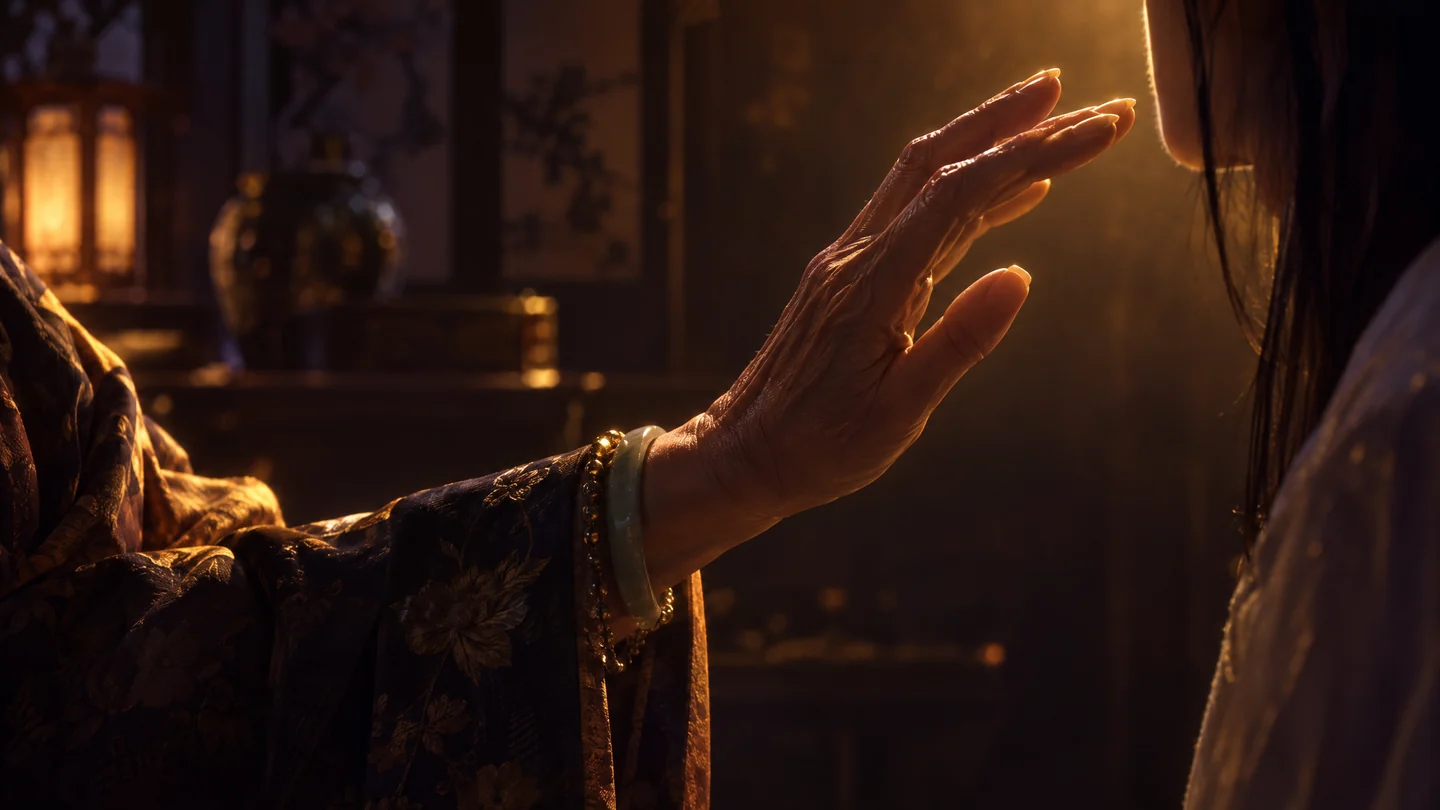
Rumi goes to already transformed, with the taking over her body and her voice coming out with the timbre of the demons. She thought she could fix everything, fix herself, but time ran out. Her friends saw. Now everyone knows. And Celine, who spent her life telling her to cover up, stands before the one thing that can no longer be covered.
A Rumi vai até a já transformada, com os tomando o corpo e a voz saindo com o timbre dos demônios. Achou que conseguiria consertar tudo, consertar a si mesma, mas o tempo acabou. As amigas viram. Agora todo mundo sabe. E a Celine, que passou a vida mandando cobrir, está diante da única coisa que não dá mais pra cobrir.
What comes next is the darkest moment in the film. Rumi asks Celine to do what she should have done a long time ago, before she destroys what she swore to protect. Maggie Kang said this was the hardest scene to make, and it isn't hard to see why. This essay won't linger on it. What matters is the answer: Celine says she can't.
O que vem em seguida é o momento mais escuro do filme. A Rumi pede à Celine que faça o que deveria ter feito há muito tempo, antes que ela destrua aquilo que jurou proteger. A Maggie Kang contou que essa foi a cena mais difícil de fazer, e não é difícil entender por quê. O texto não vai se demorar nela. O que importa é a resposta: a Celine diz que não consegue.
Then she explains herself. When they lost Rumi's mother, she swore to protect all that was left of her friend, and she never imagined that what was left would be a child like this. Everything she had been taught told her Rumi was wrong. But she had made a promise, so she did her best to accept the girl and help her.
Então ela se explica. Quando perderam a mãe da Rumi, ela jurou proteger tudo o que restava da amiga, e nunca imaginou que o que restava seria uma criança como aquela. Tudo o que tinha aprendido dizia que a Rumi era errada. Mas ela tinha feito uma promessa, e por isso fez o melhor que podia pra aceitar a menina e ajudá-la.
Rumi hands the word back like a broken object. Accept her? Celine told her to cover up, to hide. And Celine confirms it, without noticing what she's confirming: yes, until they can fix everything.
Ela devolve a palavra como quem devolve um objeto quebrado. Aceitar? A Celine mandou ela se cobrir, se esconder. E a Celine confirma, sem perceber o que está confirmando: sim, até elas conseguirem consertar tudo.
It's the "hide them until" of chapter 0, said out loud, years later. The promise hasn't changed. It has only grown more desperate. Celine offers to cover the patterns again, to tell Mira and Zoey that it was all an illusion by to tear the three of them apart, to put everything back in place. Rumi refuses: no more hiding, no more lies. And she asks for the one thing she never asked for. That Celine look at her. Why can't she look at her? Why couldn't she love her? Celine says she does. And Rumi finishes the sentence: all of me.
É o "esconde até" do capítulo 0, dito em voz alta, anos depois. A promessa não mudou. Só ficou mais desesperada. A Celine oferece cobrir os patterns de novo, contar pra Mira e pra Zoey que tudo tinha sido uma ilusão do pra separar as três, pôr tudo no lugar. A Rumi recusa: chega de esconder, chega de mentira. E pede a única coisa que nunca pediu. Que a Celine olhe pra ela. Por que ela não consegue olhar? Por que não conseguiu amá-la? A Celine diz que ama. E a Rumi completa: inteira.
Maggie Kang told 3DVF about a detail of this scene that took many versions to get right. As she explains that she loves Rumi, Celine raises her hand to touch her face, and can't. And the writer Hannah McMechan told People that, after she came out, it was precisely this scene, the "all of me," that changed meaning for her from one screening to the next.
A Maggie Kang contou à 3DVF um detalhe dessa cena que levou muitas versões até ficar certo. Enquanto explica que ama a Rumi, a Celine levanta a mão pra tocar o rosto dela, e não consegue. E a roteirista Hannah McMechan contou à revista People que, depois de sair do armário, foi justamente essa cena, a do "inteira", que mudou de sentido pra ela, de uma sessão pra outra.
Emmanuel Levinas built an entire ethics on the face. In Totality and Infinity, he says that the face of the other is not something we see, but a call we receive, and that the first word of that call is: thou shalt not kill. In chapter 2, Sartre described the gaze that turns a person into an object. Levinas describes the opposite. The face won't let itself be reduced to an object. It asks.
O Emmanuel Levinas construiu uma ética inteira em cima do rosto. Em Totalidade e Infinito, ele diz que o rosto do outro não é uma coisa que a gente vê, é um chamado que a gente recebe, e que a primeira palavra desse chamado é: não matarás. No capítulo 2, o Sartre descrevia o olhar que transforma a pessoa em objeto. O Levinas descreve o contrário. O rosto não se deixa reduzir a objeto. Ele pede.
Celine's scene is that call in two parts, and she can only answer the first. When Rumi asks her to end it all, Celine can't: the face beats the doctrine. But when the face asks to be looked at and touched, the hand stops in midair. Celine obeys the commandment and fails at tenderness.
A cena da Celine é esse chamado em duas partes, e ela só consegue atender a primeira. Quando a Rumi pede que ela acabe com tudo, a Celine não consegue: o rosto venceu a doutrina. Mas quando o rosto pede pra ser olhado e tocado, a mão para no ar. A Celine obedece ao mandamento e falha no carinho.
Then she goes back to the only ground she knows. That's why they have to hide it: "Our faults and fears must never be seen." It's the only way to protect the .
Aí ela volta pro único chão que conhece. É por isso que elas precisam esconder: as nossas falhas e os nossos medos nunca podem ser vistos, é o único jeito de proteger o .
Now, listen to the pronoun. When Zoey imitated Celine in chapter 2, the mantra came with "your faults." In Celine's own mouth, it comes with "our." She includes herself. She didn't invent the mantra. It was taught to her, by a tradition that said Rumi was wrong before Rumi even existed. Celine is that doctrine's most faithful student, and also one of its victims.
Agora, ouça o pronome. Quando a Zoey imitava a Celine no capítulo 2, o mantra vinha com "suas falhas". Na boca da própria Celine, ele vem com "nossas". Ela se inclui. O mantra não foi inventado por ela. Foi ensinado a ela, por uma tradição que dizia que a Rumi estava errada antes mesmo de a Rumi existir. A Celine é a aluna mais fiel dessa doutrina, e também uma das vítimas.
That's why calling Celine the villain misses the target. She admits she tried to accept Rumi against everything she had learned. Her love is real. It was the doctrine that taught that love to hide.
É por isso que dizer que a Celine é a vilã é errar o alvo. Ela admite que tentou aceitar a Rumi contra tudo o que aprendeu. O amor dela é verdadeiro. Foi a doutrina que ensinou esse amor a esconder.
Rumi's answer is the line that turns the film: if this is the Honmoon she's supposed to protect, she's glad to see it destroyed. Chapter 17 comes back to that line.
A resposta dela é a frase que vira o filme: se esse é o Honmoon que ela deveria proteger, ela fica feliz de vê-lo destruído. O capítulo 17 volta a essa frase.
Chapter 14Capítulo 14
The StructuresAs estruturas
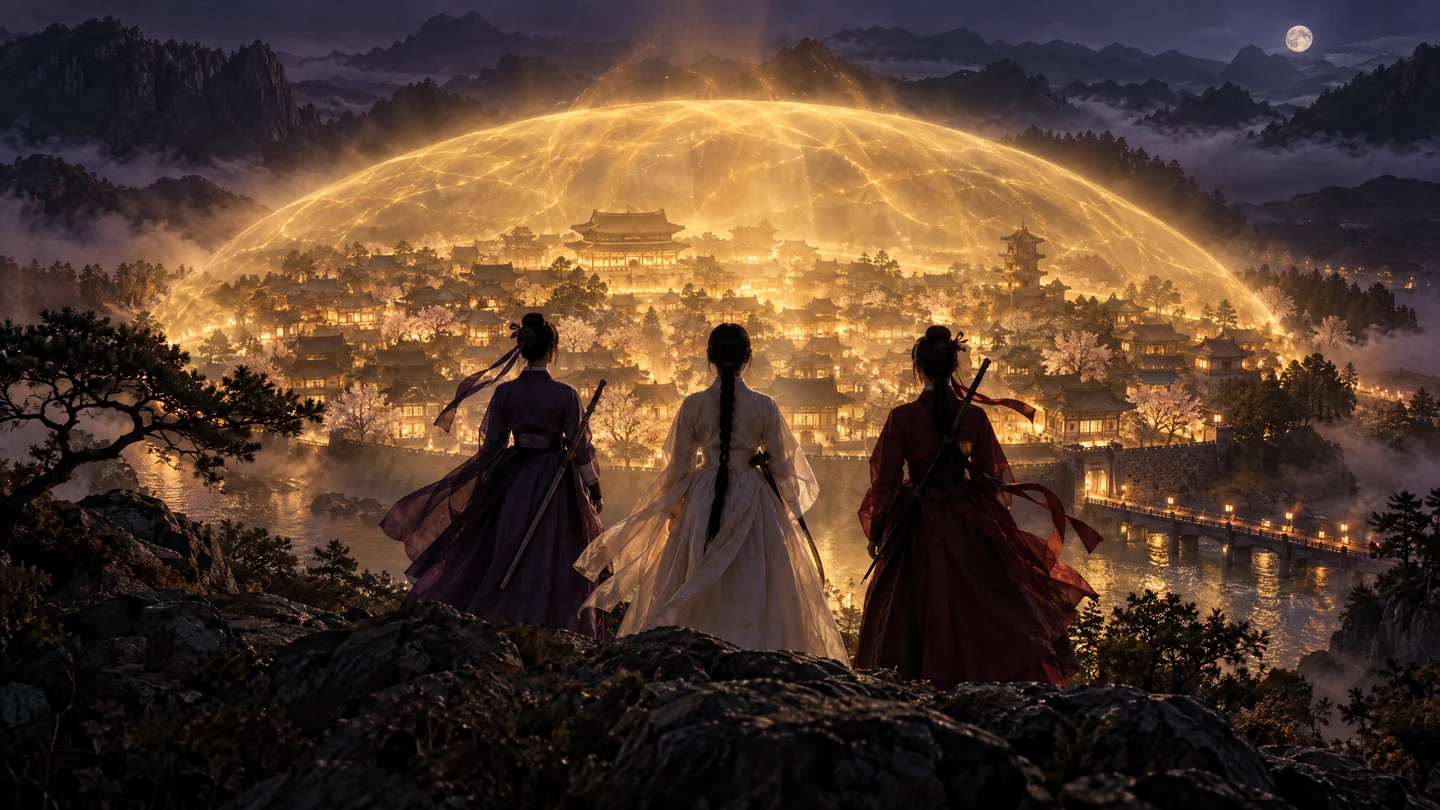
The film doesn't open with Rumi. It opens with 's voice telling an origin story. Demons have always haunted the world, stealing souls for their king, until heroines arose, born with voices that could drive back the darkness. Their music set souls alight and brought people together, and through that connection the first hunters created a shield, the . In every generation, a new trio takes up the duty. Now that duty is theirs. And the three answer in unison: yes, Celine.
O filme não começa com a Rumi. Começa com a voz da contando uma história de origem. Os demônios sempre assombraram o mundo, roubando almas pro rei deles, até que surgiram heroínas nascidas com vozes capazes de afastar a escuridão. A música delas acendia as almas e unia as pessoas, e com essa conexão as primeiras caçadoras criaram um escudo, o . A cada geração, um novo trio assume o dever. Agora esse dever é delas. E as três respondem em uníssono: sim, Celine.
The film's first voice is an institution's. The hunters have a history, a doctrine (demons are wrong), training, a mantra, and a goal, the golden Honmoon, whose promise justifies everything else. The logic of "cover it until it's fixed" isn't Celine's quirk. It's house policy. Celine is just its most loyal employee.
A primeira voz do filme é a de uma instituição. As caçadoras têm história, têm doutrina (os demônios são errados), têm treino, têm um mantra e têm uma meta, o Honmoon dourado, cuja promessa justifica todo o resto. A lógica de "cobre até consertar" não é uma mania da Celine. É o regulamento da casa. A Celine só é a funcionária mais leal.
The philosopher Byung-Chul Han, who was born in Seoul and writes in German, has a name for how this kind of power works today. In Psychopolitics, he shows that the most efficient power doesn't forbid. It seduces. It doesn't need a guard at the door, because the person starts watching herself and calls it freedom. In chapter 2, the mantra became an accent, and no one needed Celine in the room anymore. It's the same mechanism. In The Burnout Society, Han completes the picture: the achievement-subject exploits herself without anyone giving orders, and takes pride in it. Her friends call Rumi a workaholic who doesn't know how to relax, and when someone suggests skipping the so she can rest her voice, the answer is immediate: absolutely not, it's the most important show of the year. The analysis of Your Idol already read as a drug rather than a kidnapper. Han explains why the drug works better than the chain.
O filósofo Byung-Chul Han, que nasceu em Seul e escreve em alemão, tem um nome pro jeito como esse tipo de poder funciona hoje. Em Psicopolítica, ele mostra que o poder mais eficiente não proíbe. Seduz. Ele não precisa de guarda na porta, porque a pessoa passa a se vigiar sozinha e chama isso de liberdade. No capítulo 2, o mantra virou sotaque, e ninguém precisava mais da Celine na sala. É o mesmo mecanismo. Em Sociedade do cansaço, o Han completa o retrato: o sujeito do desempenho se explora sem que ninguém mande, e se orgulha disso. As amigas chamam a Rumi de workaholic que não sabe relaxar, e quando alguém sugere pular o pra ela descansar a voz, a resposta é imediata: de jeito nenhum, é o show mais importante do ano. A análise de Your Idol já tinha lido o como droga e não como sequestrador. O Han explica por que a droga funciona melhor que a corrente.
Off the screen, the same logic shows up in four places everyone knows.
Saindo da tela, a mesma lógica aparece em quatro lugares que todo mundo conhece.
In the family, it takes the shape of Celine's final offer: cover it up again and lie to your friends, for everyone's good. In Who Pays the Bill, I followed the price the persona doesn't pay and who ends up paying it instead, at the family table, in the street and in the church.
Na família, ela tem a forma da oferta final da Celine: cobrir de novo e mentir pras amigas, pelo bem de todo mundo. No Quem paga a conta, eu segui o preço que a persona não paga e quem acaba pagando no lugar dela, à mesa de família, na rua e na igreja.
In the church, it takes the shape of Celine's sentence: everything I was taught told me you were wrong. A doctrine that decides in advance that certain bodies are wrong doesn't need to know the person to condemn her. I wrote from inside the , in Faith and Belief: why it is not a sin, about why that condemnation holds up neither in biology, nor in Scripture, nor in the history of the Church itself.
Na igreja, ela tem a forma da frase da Celine: tudo o que eu aprendi dizia que você era errada. Uma doutrina que decide de antemão que certos corpos estão errados não precisa conhecer a pessoa pra condená-la. Eu escrevi de dentro da , no Fé e Crença: por que não é pecado, por que essa condenação não se sustenta nem na biologia, nem nas Escrituras, nem na história da própria Igreja.
In school, it takes the shape of the prologue: duty handed down from generation to generation, the mantra as curriculum, three students answering "yes, Celine" at the same time. School teaches what may be shown and what must stay put away, and almost never explains why.
Na escola, ela tem a forma do prólogo: o dever passado de geração em geração, o mantra como currículo, três alunas respondendo "sim, Celine" ao mesmo tempo. A escola ensina o que pode aparecer e o que precisa ficar guardado, e quase nunca explica por quê.
Personal threadFio pessoal
In medicine, the film offers both models side by side. On one side, Han the healer, who examines all of Rumi before prescribing anything, because to treat the part you have to understand the whole. On the other, the medicine that covers until it can fix. I've known the second one. In Japan, the first protocol tried to stop my body's feminization with testosterone, and it lost. Since then, I refuse any method of stopping what my body started. It's Foucault's question from chapter 8, again: the demand for a true sex, applied to a body that had already decided otherwise.
Na medicina, o filme oferece os dois modelos lado a lado. De um lado, o curandeiro Han, que examina a Rumi inteira antes de receitar qualquer coisa, porque pra tratar a parte é preciso entender o todo. Do outro, a medicina que cobre até consertar. Eu conheci a segunda. No Japão, o primeiro protocolo tentou parar a feminização do meu corpo com testosterona, e perdeu. Desde então, eu recuso qualquer método de parar o que o corpo começou. É a pergunta do Foucault no capítulo 8, de novo: a exigência de um sexo verdadeiro, aplicada a um corpo que já tinha decidido outra coisa.
Interactive 13Interativo 13
Cover it until it's fixedCobre até consertar
open the doorsabra as portas
Tab moves between the doors and the options. Enter opens a door or chooses an option.Tab passa pelas portas e pelas opções. Enter abre uma porta ou escolhe uma opção.
The film opens with three girls answering "yes, Celine" in unison. It ends with the three of them singing in harmony, which is something else: different voices, together by choice.
O filme começa com três meninas respondendo "sim, Celine" em uníssono. Termina com as três cantando em harmonia, que é outra coisa: vozes diferentes, juntas por escolha.
Chapter 15Capítulo 15
Jinu: GuiltJinu: culpa

After the betrayal, Rumi goes after and still tries to save him. She says she knows his story, that he was a good person and still is, that he only made a mistake. And he explodes. He abandoned his family. He lied to her about it. He made the deal with only to get out of that miserable life, and left his mother and sister alone while he lived in the palace in silk and plenty. He repeats it like someone passing sentence on himself: he left them.
Depois da traição, a Rumi vai atrás do e ainda tenta salvá-lo. Diz que conhece a história dele, que ele era uma boa pessoa e continua sendo, que só cometeu um erro. E ele explode. Ele abandonou a família. Mentiu pra ela sobre isso. Fez o pacto com o só pra sair daquela vida miserável, e deixou a mãe e a irmã sozinhas enquanto dormia em lençóis de seda no palácio, de barriga cheia, toda noite. Repete como quem se condena: ele deixou as duas.
She insists that this isn't all he is, that it's the demon talking, that he has to fight it. Jinu answers that it doesn't work that way. They're both demons, and all that's left for them is to live with the pain and the misery. That's all they deserve.
Ela insiste que isso não é tudo o que ele é, que é o demônio falando, que ele precisa lutar. O Jinu responde que não é assim que funciona. Os dois são demônios, e tudo o que resta pra eles é viver com a dor e a miséria. É só isso que eles merecem.
In chapter 2, I left a difference hanging: Adam hid after doing something, and Rumi hides for having been born. Jinu is the Adam of this story. His mark comes from an act. Rumi's doesn't.
No capítulo 2 eu deixei uma diferença em suspenso: o Adão se escondeu depois de fazer alguma coisa, e a Rumi se esconde por ter nascido. O Jinu é o Adão dessa história. A marca dele tem origem num ato. A da Rumi, não.
And the film knows it, because it puts the confusion in Jinu's own mouth. On the rooftop, when he told the first version of his story, he said his were a constant reminder of his shame, and that Rumi's were also the reminder of a shame of her own. She answered that she was nothing like him. She was in denial, and at the same time she was right.
E o filme sabe disso, porque coloca a confusão na boca do próprio Jinu. No telhado, quando contou a primeira versão da história, ele disse que os eram um lembrete constante da vergonha dele, e que os da Rumi também eram o lembrete de uma vergonha dela. Ela respondeu que não era nada como ele. Estava negando, e ao mesmo tempo estava certa.
The philosopher Bernard Williams separated the two with precision in Shame and Necessity. Guilt looks toward the one who was harmed. It comes from the act, imagines the victim's anger, and asks for reparation. Shame looks inward, at who the person is, before an other she carries in her head, and it asks for something else: that the person remake herself. Guilt says "I did." Shame says "I am."
O filósofo Bernard Williams separou as duas coisas com precisão em Vergonha e Necessidade. A culpa olha pra quem foi ferido. Ela nasce do ato, imagina a raiva da vítima e pede reparação. A vergonha olha pra dentro, pra quem a pessoa é, diante de um outro que ela carrega na cabeça, e pede outra coisa: que a pessoa se refaça. A culpa diz "eu fiz". A vergonha diz "eu sou".
Jinu carries both, and his begins in guilt. He did it, and the victims have names: his mother and his sister. Rumi carries only the second, and she shouldn't even carry that, because she did nothing. Her shame was taught, as chapter 2 showed, by someone who told her there was something to hide.
O Jinu carrega as duas, e a dele começa na culpa. Ele fez, e as vítimas têm nome: a mãe e a irmã. A Rumi carrega só a segunda, e nem deveria carregar, porque não fez nada. A vergonha dela foi ensinada, como o capítulo 2 mostrou, por alguém que contou pra ela que havia algo a esconder.
The March hub essay already explained that Gwi-Ma personifies what calls ak-gwi, spirits that feed on people who have given in to shame and regret. The Jinu of this scene shows what giving in looks like. He doesn't try anymore. He says demons deserve nothing but pain. And the price of the betrayal was already settled: in exchange for handing over the hunters, Gwi-Ma would silence the voices of the family that haunt Jinu, and later he offers exactly that: to forget it all. Nietzsche had a name for this stance, in a fragment from the autumn of 1887: , the weary nihilism that no longer attacks anything and only wants anesthesia. Erasing memory is the perfect anesthesia. Instead of answering for what he did, Jinu accepted the promise of not remembering.
A matéria-mãe de março já contou que o Gwi-Ma personifica o que o chama de ak-gwi, espíritos que se alimentam de gente que sucumbiu à vergonha e ao arrependimento. O Jinu de agora mostra o que é sucumbir. Ele não tenta mais. Diz que demônios só merecem a dor. E o preço da traição já estava combinado: em troca de entregar as caçadoras, o Gwi-Ma faria sumir as vozes da família que assombram o Jinu, e depois oferece isso mesmo: esquecer tudo. O Nietzsche tinha um nome pra essa postura, num fragmento do outono de 1887: , o niilismo cansado, que já não ataca nada e só quer anestesia. Apagar a memória é a anestesia perfeita. Em vez de responder pelo que fez, o Jinu aceitou a promessa de não lembrar.
Some readers complain about the film right here. In a review published by the Christian Research Institute, Alexa Cramer points out that the film blends the shame that comes from a sin, Jinu's, with the shame of a condition one is born with, Rumi's, and gives both the same solution: acceptance. And she adds that shame that comes from sin calls for repentance, not acceptance. The objection is serious, and her criterion is right. Only the film itself meets that criterion, because the ways out aren't the same. Jinu repents: in the end, he gives up his soul to save Rumi, and that is reparation, the only kind still within his reach. Rumi has nothing to repent of. Her way out isn't forgiveness. It's acceptance.
Tem quem leia o filme e reclame justamente daqui. Numa resenha publicada pelo Christian Research Institute, Alexa Cramer aponta que o filme mistura a vergonha que vem de um pecado, a do Jinu, com a vergonha de uma condição de nascença, a da Rumi, e dá às duas a mesma solução: aceitação. E completa que vergonha que vem de pecado pede arrependimento, não aceitação. A objeção é séria, e o critério dela está certo. Só que o próprio filme passa nesse critério, porque as saídas não são iguais. O Jinu se arrepende: no fim, entrega a alma pra salvar a Rumi, e isso é reparação, a única que ainda estava ao alcance dele. A Rumi não tem do que se arrepender. A saída dela não é perdão. É aceitação.
Jinu chose. Rumi was born. And that's where the next chapter's question comes in: how much of a life is choice?
O Jinu escolheu. A Rumi nasceu. E é aí que entra a pergunta do próximo capítulo: quanto de uma vida é escolha?
Chapter 16Capítulo 16
Fate and ChoiceDestino e escolha

Jinu's story begins with a sentence about luck. His family was poor and miserable, he owned a single thing, an old instrument, and he played on the street without getting anywhere. Then he heard 's voice, telling him he wasn't good enough for his family and that he could help him become so. And overnight, his luck turned: praised for his voice, even by the king, living in the palace with his family, fed at last. Then the spread until they consumed him, and he was condemned to the demon world forever.
A história do começa com uma frase sobre sorte. A família dele era pobre e miserável, ele tinha uma única posse, um instrumento velho, e tocava na rua sem chegar a lugar nenhum. Então ouviu a voz do , dizendo que ele não era bom o bastante pra família e que podia ajudá-lo a ser. E da noite pro dia, a sorte dele mudou: elogiado pela voz, até pelo rei, morando no palácio com a família, de barriga cheia. Depois os se espalharam até consumi-lo, e ele foi condenado ao mundo dos demônios pra sempre.
One deal, and a whole life decided in a night. It's fate as a contract.
Um pacto, e uma vida inteira decidida numa noite. É o destino como contrato.
The film talks about fate all the time. The prologue says that in every generation a trio of hunters is chosen, and no one asks the girls whether they want it. Rumi inherits two things she never asked for, a hunter mother and a demon father, and spends her life believing she's been a mistake since the day she was born. And when the film answers all of this, it answers in the language of the Stoics. In the bracelet scene, it's Rumi who tells the line that sums up that lens: hope is the one thing nobody can assign you, and whether you feel it is up to you. He answers that he doesn't think she's a mistake.
O filme fala de destino o tempo todo. O prólogo diz que a cada geração um trio de caçadoras é escolhido, e ninguém pergunta às meninas se elas querem. A Rumi herda duas coisas que não pediu, a mãe caçadora e o pai demônio, e passa a vida achando que é um erro desde o dia em que nasceu. E quando o filme responde a tudo isso, responde com a língua dos estoicos. Na cena da pulseira, é a Rumi quem diz ao Jinu a frase que resume essa lente: ninguém decide por você se você sente esperança, essa escolha é sua. Ele responde que não acha que ela seja um erro.
Epictetus opens the Enchiridion with the same division. Some things are up to us: what we judge, what we desire, what we refuse. Others are not: the body, property, reputation, office. The body is on the list of what is not up to us. Rumi's mark is beyond her reach. Her response isn't. That's why I say the film speaks Stoic.
O Epicteto abre o Manual com a mesma divisão. Algumas coisas dependem de nós: o que julgamos, o que desejamos, o que recusamos. Outras não dependem: o corpo, os bens, a reputação, os cargos. O corpo está na lista do que não depende de nós. A marca da Rumi está fora do alcance dela. A resposta, não. É por isso que eu digo que o filme fala estoico.
Personal threadFio pessoal
But I answer as a . The , in chapter III, says that God ordained whatever comes to pass, and says in the same breath that this does no violence to the will of the creature, nor takes away the liberty of , but rather establishes it. The choice is real and, at the same time, it sits inside a . In Intersex part 2 I read my own body through that chapter: my body decided first, and my will decides along with it, as a second cause. It isn't fatalism, and it isn't chance. It's both things happening at once, on different levels. In my essay on Stoicism, Arminianism and Calvinism I set the three traditions side by side, and none of them arrives at the same answer.
Só que eu respondo como . A , no capítulo III, diz que Deus ordenou tudo o que acontece, e diz no mesmo fôlego que isso não violenta a vontade da criatura nem elimina a liberdade das , antes as estabelece. A escolha é real e, ao mesmo tempo, está dentro de uma . No Intersex parte 2 eu li o meu corpo por esse capítulo: o corpo decidiu primeiro, e a minha vontade decide junto, como causa segunda. Não é fatalismo nem acaso. São as duas coisas acontecendo ao mesmo tempo, em níveis diferentes. No ensaio Destino, Liberdade & Soberania eu coloquei as três tradições lado a lado, a estoica, a arminiana e a calvinista, e nenhuma chega à mesma resposta.
Read this way, Rumi's acceptance is her choice. And even so, it isn't a hundred percent hers. In a Reformed view, it was the providence of that she managed to accept herself and rebuild. The film even gives us an image for it, without meaning to. The soul Jinu gets back isn't born from him. It comes from outside: before he dies, he says himself that it was Rumi who gave his soul back. That's what grace is: something that saves and that didn't come from the one who was saved.
Lida assim, a aceitação da Rumi é escolha dela. E mesmo assim não é 100% dela. Numa visão reformada, foi providência da que ela conseguisse se aceitar e se reconstruir. O filme dá até uma imagem pra isso, sem querer. A alma que o Jinu recupera não nasce dele. Vem de fora: antes de morrer, ele mesmo diz que foi a Rumi quem devolveu a alma dele. Graça é isso: alguma coisa que salva e que não veio de quem foi salvo.
Heidegger, in Being and Time, gave the same tension other names. We find ourselves thrown into a world we didn't choose, into a body, a family, an era. He calls this thrownness. And to exist is to project possibilities from there, which is what he calls projection. Thrownness is the inheritance. Projection is what a person does with it. Heidegger joined the Nazi party in 1933, and that can't be separated from the man. But a ruler made by a man with problematic ideas still measures a centimeter precisely, and this ruler measures well what the film shows: inheritance doesn't choose what a person will be. It only chooses where she starts.
O Heidegger, em Ser e Tempo, deu outros nomes à mesma tensão. A gente se encontra lançada num mundo que não escolheu, num corpo, numa família, numa época. Ele chama isso de lançamento. E existir é projetar possibilidades a partir daí, que é o que ele chama de projeto. O lançamento é a herança. O projeto é o que a pessoa faz com ela. O Heidegger se filiou ao partido nazista em 1933, e isso não se separa do homem. Mas uma régua feita por um homem de ideias problemáticas ainda mede um centímetro com precisão, e essa régua mede bem o que o filme mostra: a herança não escolhe o que a pessoa vai ser. Só escolhe de onde ela parte.
Interactive 14Interativo 14
Sentence or materialSentença ou material
flip the cardsvire as cartasTab moves from card to card. Enter or Space flips the card.Tab passa de carta em carta. Enter ou Espaço vira a carta.
, whom the hub essay already introduced as Rumi's mold, tells the same story in the form of a myth: a princess abandoned by her parents who, even so, goes down to the realm of the dead to save them. A rejection at the origin doesn't decide how the story ends. It only decides which way it goes.
A , que a matéria-mãe já apresentou como molde da Rumi, conta a mesma história em forma de mito: uma princesa abandonada pelos pais que, mesmo assim, desce ao reino dos mortos pra salvá-los. A rejeição de origem não decide o fim da história. Decide só por onde ela passa.
And the way it goes is down. To understand why this path descends, and why descending isn't the same as sinking, we need to stop and talk about .
E por onde ela passa é pra baixo. Pra entender por que esse caminho desce, e por que descer não é o mesmo que afundar, é preciso parar e falar de .
Chapter 17Capítulo 17
The Spiral and the AbyssA espiral e o abismo
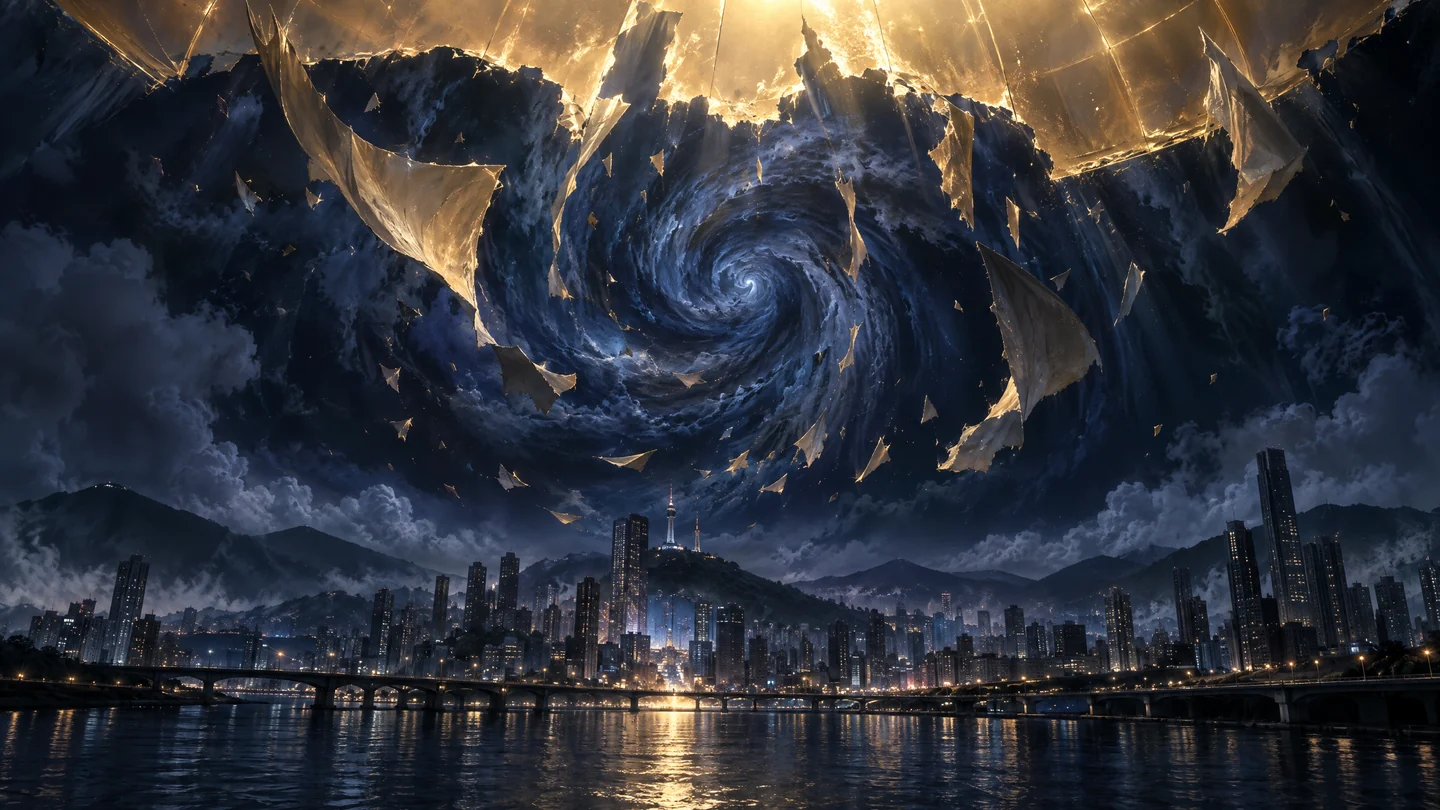
After the , the starts to come apart. The ceremony is canceled because of 's breakup on stage, the take every award of the night, and the shield that generations of hunters held up with their voices tears open in the sky. The Saja Boys even announce a special show, at midnight, at Tower, to cheer up the fans saddened by the end of Huntrix.
Depois do , o começa a se desfazer. A premiação é cancelada por causa da separação da no palco, os levam todos os prêmios da noite, e o escudo que gerações de caçadoras sustentaram com a voz se rasga no céu. Os Saja Boys ainda anunciam um show especial, à meia-noite, na torre de , pra animar os fãs tristes com o fim da Huntrix.
For Rumi, the golden Honmoon was more than a shield. It was the reason for everything: the sleeves, the mantra, the forced voice, the waiting. When it falls, it isn't only a magical barrier that falls. It's the reason she endured what she endured.
Pra Rumi, o Honmoon dourado era mais do que um escudo. Era o motivo de tudo: da manga, do mantra, da voz forçada, da espera. Quando ele cai, não cai só uma barreira mágica. Cai a razão pela qual ela aguentou o que aguentou.
The word usually circulates as a synonym for "nothing matters." Nietzsche used it more precisely. In a fragment from the autumn of 1887, he defines it: nihilism is when the highest values devalue themselves. The goal is missing; the answer to "what for?" is missing. And in a note from the same year, he describes the nihilist as someone who judges that the world as it is ought not to be, and that the world as it ought to be does not exist.
A palavra costuma circular como sinônimo de "nada importa". O Nietzsche usava com mais precisão. Num fragmento do outono de 1887, ele define: niilismo é quando os valores supremos se desvalorizam. Falta o objetivo, falta a resposta ao "pra quê?". E numa anotação do mesmo ano, ele descreve o niilista como alguém que julga que o mundo como ele é não deveria ser, e que o mundo como deveria ser não existe.
Put Rumi inside that sentence. The world as it is, with the , ought not to be. The world as it ought to be, golden, with no mark at all, does not exist. Rumi spent her whole life trapped in that definition without knowing it, propped up by a highest value that hadn't devalued itself yet. At the Idol Awards, it devalues itself in front of everyone.
Coloque a Rumi dentro dessa frase. O mundo como ele é, com os , não deveria ser. O mundo como deveria ser, dourado, sem marca nenhuma, não existe. A Rumi passou a vida inteira presa nessa definição sem saber, apoiada num valor supremo que ainda não tinha se desvalorizado. No Idol Awards, ele se desvaloriza na frente de todo mundo.
The same 1887 fragment separates two ways of reacting to this. Passive nihilism is the weary kind, which no longer attacks anything and looks for anesthesia: it's the of chapter 15, who accepted the promise of forgetting. Active nihilism is a sign of strength, and it begins by destroying. It's Rumi before , at the end of chapter 13, saying that if this is the Honmoon she's supposed to protect, she's glad to see it destroyed. For the first time, she doesn't mourn the value that fell. She refuses it.
O mesmo fragmento de 1887 separa dois jeitos de reagir a isso. O niilismo passivo é o cansado, que já não ataca nada e procura anestesia: é o do capítulo 15, que aceitou a promessa de esquecer. O niilismo ativo é sinal de força, e começa destruindo. É a Rumi diante da , no fim do capítulo 13, dizendo que, se esse é o Honmoon que ela deveria proteger, fica feliz de vê-lo destruído. Pela primeira vez, ela não lamenta o valor que caiu. Ela o recusa.
There's a third expression, and it's the one that explains the image of the spiral: existential nihilism. It's the recognition that life doesn't come with a factory-installed meaning. No value arrives ready-made and guaranteed from outside, and a value that arrived ready-made can fall. Sartre, who appeared in chapter 2, drew from this the most famous formula of existentialism: existence precedes essence. First we exist, and what we are comes later, from what we do. I don't sign the whole formula, and chapter 1 already said why: the becoming in this essay is becoming what you already are. But the diagnosis is precise. When a meaning that came ready-made from outside falls, something has to take its place.
Tem ainda uma terceira expressão, e é ela que explica a imagem da espiral: o niilismo existencial. É a constatação de que a vida não vem com um sentido de fábrica. Nenhum valor chega pronto e garantido de fora, e um valor que chegou pronto pode cair. O Sartre, que apareceu no capítulo 2, tirou disso a fórmula mais famosa do existencialismo: a existência precede a essência. Primeiro a gente existe, e o que a gente é vem depois, do que a gente faz. Eu não assino a fórmula inteira, e o capítulo 1 já disse por quê: o tornar-se deste texto é tornar-se o que já se é. Mas o diagnóstico é preciso. Quando o sentido que veio pronto de fora cai, alguma coisa precisa ocupar o lugar dele.
Personal threadFio pessoal
Nihilism, to me, is a spiral with an abyss at the bottom. The more a person tries to climb out of the spiral, the deeper she goes. When she stops fighting and goes down into the abyss, she comes face to face with herself, and with the way out. It sounds strange, but it's consistent with existential nihilism.
O niilismo, pra mim, é uma espiral com um abismo no fundo. Quanto mais a pessoa tenta sair da espiral, mais ela entra. Quando para de lutar e desce até o abismo, dá de cara consigo mesma, e com a saída. Parece estranho, mas é coerente com o niilismo existencial.
Rumi shows why. Someone who has lost her highest value tries to escape the void, and tries to escape it using the same measure that produced the void. To flee her shame, Rumi bets everything on the golden Honmoon, which is born from the same doctrine that condemned her. Every attempt to escape is one more effort inside the old rule: cover more, rehearse more, fix more. And every turn tightens the spiral. The way out she's looking for is drawn with the same lines as the prison.
A Rumi mostra por quê. Quem perdeu o valor supremo tenta sair do vazio, e tenta sair usando a mesma medida que produziu o vazio. Pra fugir da vergonha, a Rumi aposta tudo no Honmoon dourado, que nasce da mesma doutrina que a condenou. Cada tentativa de sair é mais um esforço dentro da regra antiga: cobrir mais, ensaiar mais, consertar mais. E cada volta aperta a espiral. A saída que ela procura está desenhada com o mesmo traço da prisão.
Going down into the abyss means putting the old measure away. It means accepting that no factory-made value will save you, that the golden Honmoon isn't coming, that the mark won't go away. It looks like giving up, and it isn't. At the bottom, without the old measure, a person finds what remains when everything borrowed has fallen away: herself. And it's from there, and only from there, that she can build something that doesn't depend on the old measure. That is the way out.
Descer até o abismo é parar de usar a medida velha. É aceitar que nenhum valor de fábrica vai salvar, que o Honmoon dourado não vem, que a marca não vai sumir. Parece desistência, e não é. No fundo, sem a medida antiga, a pessoa encontra o que sobra quando tudo o que era emprestado caiu: ela mesma. E é dali, e só dali, que dá pra construir alguma coisa que não dependa da medida velha. Essa é a saída.
Nietzsche wrote, in Beyond Good and Evil, that whoever fights monsters must take care not to become one, and that whoever stares long into an abyss is stared back at by it. Rumi is that very figure: a hunter of monsters who is, in part, what she hunts. And Zarathustra itself begins with a descent. The first thing Zarathustra does is his Untergang, his going under.
O Nietzsche escreveu, em Além do Bem e do Mal, que quem luta contra monstros precisa tomar cuidado pra não virar um, e que quem olha muito tempo pra dentro de um abismo é olhado de volta por ele. A Rumi é essa figura: uma caçadora de monstros que é, em parte, o que caça. E o próprio Zaratustra começa descendo. A primeira coisa que o Zaratustra faz é o seu Untergang, a descida.
That descent may have divine help, or not. Jung, in Aion, writes that the spontaneous symbols of the cannot, in practice, be told apart from an image of God. It's a psychological claim, not a theological one, and that's why it leaves the question open in the right way. Whoever goes down to the bottom finds herself. Whether she also finds someone who was there before her, psychology doesn't decide. I have my answer, and it's .
Essa descida pode ter ajuda divina, ou não. O Jung, no Aion, escreve que os símbolos espontâneos do , na prática, não se distinguem de uma imagem de Deus. É uma afirmação psicológica, não teológica, e por isso deixa a pergunta aberta do jeito certo. Quem desce ao fundo encontra a si mesmo. Se encontra também alguém que estava lá antes, isso a psicologia não decide. Eu tenho a minha resposta, e ela é .
Interactive 15Interativo 15
The spiralA espiral
try to climbtente subirArrow Up tries to climb, Arrow Down lets it go down. Enter or Space does what the button says.Seta pra cima tenta subir, seta pra baixo deixa descer. Enter ou Espaço faz o que o botão diz.
Rumi reaches Namsan at the end of the spiral. She arrives reciting the hunters' creed in the voice of the demons: hunters with strong voices, who will fix the world and make it right. It's the last turn, the old mantra coming out of the very mouth it condemned. What she says next is chapter 18.
A Rumi chega a Namsan no fim da espiral. Chega recitando o credo das caçadoras com a voz dos demônios: caçadoras de voz forte, que vão consertar o mundo e deixá-lo certo. É a última volta, o mantra antigo saindo pela boca que ele mesmo condenou. O que ela diz em seguida é o capítulo 18.
Chapter 18Capítulo 18
FixingConsertar
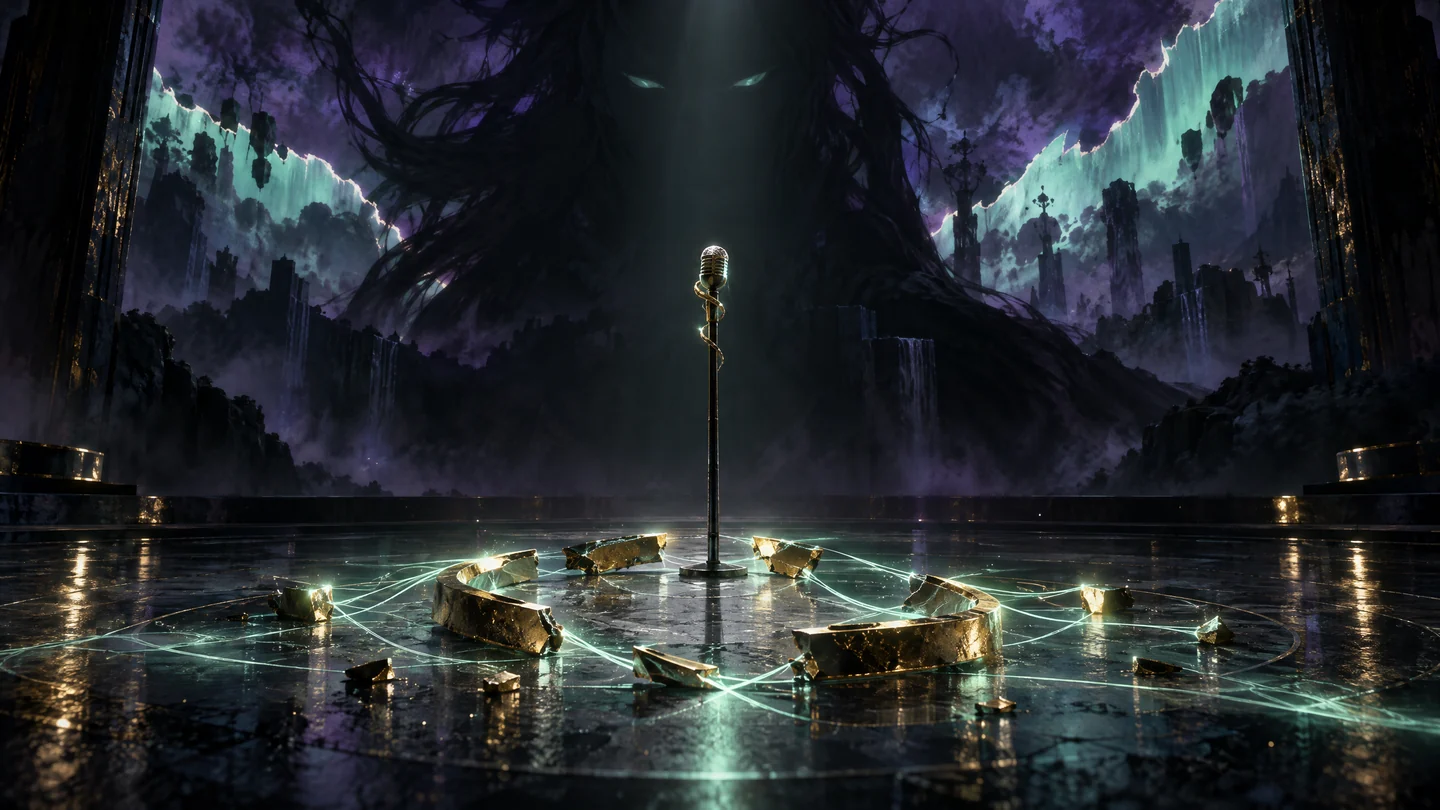
At , mocks the hunter who showed up speaking with his voice. She comes here like this, and still thinks she can fix the world? She can't even fix herself.
Em , o debocha da caçadora que chegou falando com a voz dele. Ela vem assim, desse jeito, e ainda acha que pode consertar o mundo? Ela não consegue consertar nem a si mesma.
And Rumi agrees. She can't.
E a Rumi concorda. Não consegue.
Gwi-Ma goes on: now everyone finally sees what she really is. She agrees again. They do. And the is gone. It is, she says. So we'll make a new one.
O Gwi-Ma continua: agora todo mundo finalmente vê o que ela realmente é. Ela concorda de novo. Veem. E o acabou. Acabou, ela diz. Então a gente faz um novo.
The word she refuses is the key to the film. The whole story turns on one verb, fix, and it shows up in almost every mouth. The hunters' creed promises to fix the world and make it right. orders hiding until they can fix everything, and still thinks, at the end, that it can be fixed. The three of them agree to hide the problem and fix it. Rumi, alone, away from everyone, asks how she's supposed to fix the world and fix herself without her voice. Before Celine, she confesses that she thought she could fix it all. At Namsan, it's Gwi-Ma himself who uses the word, as a weapon: she can't fix herself.
A palavra que ela recusa é a chave do filme. A história inteira gira em torno de um verbo, consertar, e ele aparece em quase todas as bocas. O credo das caçadoras promete consertar o mundo e deixá-lo certo. A manda esconder até elas conseguirem consertar tudo, e ainda acha, no fim, que dá pra consertar. As três combinam esconder o problema e consertar. A Rumi, sozinha, longe de todo mundo, se pergunta como vai consertar o mundo e consertar a si mesma sem a voz. Diante da Celine, ela confessa que achou que conseguiria consertar tudo. Em Namsan, é o próprio Gwi-Ma quem usa a palavra, como arma: ela não consegue se consertar.
And she doesn't argue. That's the smartest move in the film. Rumi agrees with every fact the accuser uses, and refuses his conclusion. Yes, she can't fix herself. Yes, everyone saw. Yes, the Honmoon is gone. Gwi-Ma's conclusion was obvious: so she's lost. Her conclusion is different: so a new one can be made.
E ela não discute. Esse é o movimento mais inteligente do filme. A Rumi concorda com cada fato que o acusador usa, e recusa a conclusão dele. Sim, ela não consegue se consertar. Sim, todo mundo viu. Sim, o Honmoon acabou. A conclusão do Gwi-Ma era óbvia: então ela está perdida. A conclusão dela é outra: então dá pra fazer um novo.
That's what acceptance is. It isn't saying the facts are lies. It's agreeing with the facts and refusing the sentence.
Aceitar é exatamente isso. Não é dizer que os fatos são mentira. É concordar com os fatos e recusar a sentença.
Some read acceptance as a way of saying that everything in a person is good, as if the film were teaching that no one has anything to change. The scene takes that reading apart. Rumi doesn't say she's perfect. She says, flatly, that she can't fix herself. And the song she sings next, as chapter 10 showed, speaks of darkness and harmony in the same voice. The darkness is still there. What changes is that it stops being a reason to hide the whole voice.
Tem quem leia aceitação como uma forma de dizer que tudo na pessoa é bom, e que o filme estaria ensinando que não existe nada a mudar em ninguém. A cena desmonta essa leitura. A Rumi não diz que é perfeita. Diz, sem rodeio, que não consegue se consertar. E a música que ela canta em seguida, como o capítulo 10 mostrou, fala de escuridão e harmonia na mesma voz. A escuridão continua lá. O que muda é que ela deixa de ser motivo pra esconder a voz inteira.
Kierkegaard gave a name to what Rumi leaves behind in this scene. In The Sickness unto Death, he describes the despair of not willing to be oneself: the person wants to be rid of herself, to trade in her self, to be something else. The Rumi of lives in that despair. The analysis of Golden called Golden an that wants the wrong thing, and the wrong thing was this: to stop being who she is. The cure Kierkegaard proposes is nowhere near a repair: it's the self that, in willing to be itself, rests transparently in the power that established it.
O Kierkegaard deu nome ao que a Rumi abandona nessa cena. Em A doença para a morte, ele descreve o desespero de não querer ser si mesmo: a pessoa quer se livrar de si, trocar de eu, ser outra coisa. A Rumi de vive nesse desespero. A análise de Golden chamou Golden de que deseja a coisa errada, e a coisa errada era essa: deixar de ser quem ela é. A cura que o Kierkegaard propõe passa longe do conserto: é o eu que, ao querer ser si mesmo, repousa transparente no poder que o estabeleceu.
Paul Tillich, in a sermon called "You Are Accepted," says almost the same thing with a different emphasis. often arrives at the bottom of despair, and what it asks is simple and hard: to accept the fact that you are accepted. Not after fixing yourself. Before.
O Paul Tillich, num sermão chamado "Você é aceito", diz quase a mesma coisa com outra ênfase. A chega muitas vezes no fundo do desespero, e o que ela pede é simples e difícil: aceitar o fato de que se é aceito. Não depois de consertar. Antes.
Nietzsche, who in chapter 17 explained the force that destroys the old value, comes in here with the next step. Whoever destroys the Honmoon that demanded hiding isn't finished yet. There's still the creating. Rumi doesn't restore the old Honmoon, or try to glue back what tore. She makes a new one. Creation, not repair.
O Nietzsche, que no capítulo 17 explicou a força que destrói o valor velho, entra aqui com o passo seguinte. Quem destrói o Honmoon que exigia esconderijo ainda não terminou. Falta criar. A Rumi não restaura o Honmoon antigo, nem tenta colar o que se rasgou. Ela faz um novo. Criação, não conserto.
The mix this essay chose becomes clear at this point. Nietzsche and Kierkegaard refuse repair for the same reasons and end up in different places. One creates. The other rests in the one who creates.
O misto que este ensaio escolheu fica claro nesse ponto. O Nietzsche e o Kierkegaard recusam o conserto pelos mesmos motivos e chegam a lugares diferentes. Um cria. O outro repousa em quem cria.
What comes after Rumi's line, chapter 10 has already told. The song starts with no rehearsal.
O que vem depois da frase da Rumi, o capítulo 10 já contou. A música começa sem ensaio.
Chapter 19Capítulo 19
The BathhouseO banho
In one of the film's last scenes, the three of them are at the . Rumi lets out a breath and says it feels amazing. Her friends answer that they've been saying so for years, and ask whether she finally sees what she's been missing. She wants to come back every day of their three-month break. Zoey says she's really happy Rumi didn't die, Mira complains about how literal Zoey is, and then agrees right away: same. And the three of them end up crying together, telling each other how much they love each other.
Numa das últimas cenas do filme, as três estão na . A Rumi solta o ar e diz que aquilo é maravilhoso. As amigas respondem que vivem dizendo isso há anos, e perguntam se ela finalmente vê o que estava perdendo. Ela quer voltar ali todos os dias dos três meses de pausa. A Zoey diz que está muito feliz que a Rumi não morreu, a Mira reclama do jeito literal da Zoey, e logo concorda: ela também. E as três acabam chorando juntas, dizendo o quanto se amam.
The bathhouse runs through this whole essay. In chapter 2, it was the invitation Rumi always turned down, the one her friends called modesty. In chapter 11, it was the promise she made counting on the cure arriving the next day: after the , once the were gone, they'd go together. The cure never came. The patterns are still on her body, in front of her friends, no sleeves and no excuses.
A casa de banho atravessa o ensaio inteiro. No capítulo 2, era o convite que a Rumi sempre recusava, e que as amigas chamavam de modéstia. No capítulo 11, era a promessa que ela fazia contando que a cura viria no dia seguinte: depois do , quando os sumissem, elas iriam juntas. A cura nunca veio. Os patterns continuam no corpo dela, na frente das amigas, sem manga e sem desculpa.
It's the end of the arc that began in chapter 0. The first lesson Rumi got about her body was to cover it. The last image of her body in the film is a body seen, among people who stay.
É o fim do arco que começou no capítulo 0. A primeira lição que a Rumi recebeu sobre o corpo foi cobrir. A última imagem do corpo dela no filme é o corpo visto, entre gente que fica.
Maggie Kang said that the only scene the studio pushed back on was exactly this one. You can understand the discomfort. And you can understand why it stayed. Without this scene, the film would be saying that Rumi learned to sing with her marks showing on a stage, in front of millions, but still couldn't be at ease with her friends. The stage is public courage. The bathhouse is intimacy. One without the other doesn't close the arc.
A Maggie Kang contou que a única cena em que o estúdio fez objeção foi justamente essa. Dá pra entender o desconforto. E dá pra entender por que ela ficou. Sem essa cena, o filme diria que a Rumi aprendeu a cantar com as marcas à mostra num palco, diante de milhões, mas continuou sem conseguir ficar à vontade com as amigas. O palco é a coragem pública. O banho é a intimidade. Um sem o outro não fecha.
After the bathhouse, the break they wanted so badly can wait. The three decide the couch can wait, and go meet their fans. According to Netflix itself, after learning to accept herself, Rumi no longer hides her patterns. She greets the fans, the fans scream her name, and nobody asks her to cover anything.
Depois do banho, a pausa que elas tanto queriam fica pra depois. As três decidem que o sofá pode esperar, e vão encontrar as fãs. Segundo a própria Netflix, depois de aprender a se aceitar, a Rumi não esconde mais os patterns. Ela cumprimenta as fãs, as fãs gritam o nome dela, e ninguém pede que ela cubra nada.
The cure never came. The bathhouse came anyway.
A cura nunca veio. O banho veio mesmo assim.
Chapter 20Capítulo 20
Logos

The born at is not golden. From beginning to end, the goal was the golden Honmoon, perfect, which would seal off the demon world forever and, in 's promise, erase Rumi's marks. What appears at the end is something else. According to Netflix, surpasses gold with a rainbow Honmoon, which symbolizes the united voices of all the fans.
O que nasce em não é dourado. Do começo ao fim, a meta foi o Honmoon dourado, perfeito, que selaria o mundo dos demônios pra sempre e, na promessa da , apagaria as marcas da Rumi. O que surge no fim é outra coisa. Segundo a Netflix, a supera o dourado com um Honmoon arco-íris, que simboliza as vozes unidas de todos os fãs.
A detail from the art team changes how that image reads. The colors of the Honmoon are in the girls' clothes and also in Rumi's marks. Her mark was always made of the shield's colors. The golden Honmoon needed to erase the mark in order to exist. The rainbow has room for it.
Um detalhe da equipe de arte muda a leitura dessa imagem. As cores do Honmoon estão nas roupas das meninas e também nas marcas da Rumi. A marca dela sempre foi feita das cores do escudo. O Honmoon dourado precisava apagar a marca pra existir. O arco-íris tem lugar pra ela.
The prologue had already told where the Honmoon comes from. The first hunters were born with voices that could drive back the darkness, and it was the connection those voices created that raised the shield. In the world of the film, the voice doesn't describe things. It makes things exist.
O prólogo já tinha contado de onde o Honmoon vem. As primeiras caçadoras nasceram com vozes capazes de afastar a escuridão, e foi a conexão criada por essas vozes que levantou o escudo. No mundo do filme, a voz não descreve as coisas. Ela faz as coisas existirem.
The Gospel of John begins right there: "In the beginning was the Word, and the Word was with God, and the Word was God." The Word is the , the word that creates. All things were made by him, the text says. And a few verses later comes the line the film seems to have read without knowing it: "And the light shineth in darkness; and the darkness comprehended it not."
O Evangelho de João começa exatamente aí: "No princípio era o Verbo, e o Verbo estava com Deus, e o Verbo era Deus". O Verbo é o , a palavra que cria. Tudo foi feito por ele, diz o texto. E alguns versos depois vem a frase que o filme parece ter lido sem saber: "E a luz resplandece nas trevas, e as trevas não a compreenderam".
I'm not saying KPop Demon Hunters is a Christian film. It isn't. Its roots are , the who drove out evil with music and dance, the of the hub essay. Reading the Logos of John into a film like this would be forcing it, if the reading claimed that this is what the film means. The reading says something else: that the voice that creates the Honmoon is an image of the Word that creates.
Eu não estou dizendo que KPop Demon Hunters é um filme cristão. Não é. As raízes dele são o , as que expulsavam o mal com música e dança, a da matéria-mãe. Ler o Logos de João num filme assim seria forçar, se a leitura dissesse que o filme quer dizer isso. A leitura diz outra coisa: que a voz que cria o Honmoon é uma imagem do Verbo que cria.
Personal threadFio pessoal
And here comes what I see in them. The women of Huntrix are completely feminine, but they act as Logos: the power that moves, creates and destroys everything. They are the pillar of the world.
E aqui entra o que eu vejo nelas. As Huntrix são completamente femininas, mas agem como Logos: o poder que move, cria e destrói tudo. São o pilar do mundo.
The film shows three women who are a word that acts. Their voices hold the world up, bring down a king of demons and, when the old shield falls, create a new one. There's nothing passive in that. And there's nothing less feminine in it either.
O filme mostra três mulheres que são palavra que age. A voz delas segura o mundo, derruba um rei de demônios e, quando o escudo velho cai, cria um novo. Não tem nada de passivo nisso. E não tem nada de menos feminino nisso também.
In chapter 0, Nietzsche gave us the formula of becoming: become who you are. The Gospel of John answers with the place where that happens. We become who we are before the Word that creates, and not before Celine's mirror. It's the of chapter 16, again: a person decides together with the one who decided first.
No capítulo 0, o Nietzsche deu a fórmula do tornar-se: torna-te quem tu és. O Evangelho de João responde com o lugar onde isso acontece. A gente se torna quem é diante do Verbo que cria, e não diante do espelho da Celine. É a do capítulo 16, de novo: a pessoa decide junto com quem decidiu primeiro.
Rumi began the film hearing an order: cover that. She ends it creating, with her own voice, a shield that carries the colors of her mark.
A Rumi começou o filme ouvindo uma ordem: cobre isso. Termina criando, com a própria voz, um escudo que tem as cores da marca dela.
Covering was one answer. The other was singing.
Cobrir era uma resposta. A outra era cantar.
The mark does not define who you are. But it becomes part of the person you become.
A marca não define quem você é. Mas entra na pessoa que você se torna.
SourcesFontes
Quotations from works not originally in English come from standard translations or are my own renderings. The Bible is quoted from the King James Version. Song lyrics appear in paraphrase only.
As citações de obras estrangeiras estão em tradução livre, salvo quando a edição brasileira é indicada. A Bíblia é citada pela Almeida Corrigida Fiel. As letras das músicas aparecem só em paráfrase.
The film and the people who made itO filme e quem o fez
- KPop Demon Hunters. Directed by Maggie Kang and Chris Appelhans; written by Danya Jimenez, Hannah McMechan, Maggie Kang and Chris Appelhans. Sony Pictures Animation and Netflix, 2025.
- KPop Demon Hunters. Direção de Maggie Kang e Chris Appelhans; roteiro de Danya Jimenez, Hannah McMechan, Maggie Kang e Chris Appelhans. Sony Pictures Animation e Netflix, 2025.
- Kang, Maggie, and Appelhans, Chris. Interview with Consequence, "KPop Demon Hunters Expanded Music's Mythology with the Pop Culture Event of the Year," December 2025. https://consequence.net/cover/kpop-demon-huntersnetflix-event-of-the-year
- Kang, Maggie e Appelhans, Chris. Entrevista à Consequence, "KPop Demon Hunters Expanded Music's Mythology with the Pop Culture Event of the Year", dezembro de 2025. https://consequence.net/cover/kpop-demon-huntersnetflix-event-of-the-year
- Kang, Maggie. Press conference in Seoul, August 22, 2025, as reported by the Korean press, including the Korea Herald. https://www.koreaherald.com/article/10559957
- Kang, Maggie. Coletiva de imprensa em Seul, 22 de agosto de 2025, em reportagens da imprensa coreana, entre elas a do Korea Herald. https://www.koreaherald.com/article/10559957
- Kang, Maggie, and Appelhans, Chris. Exclusive interview with 3DVF. https://3dvf.com/en/redaction/kpop-demon-hunters-our-exclusive-interview-with-directors-maggie-kang-and-chris-appelhans/
- Kang, Maggie e Appelhans, Chris. Entrevista exclusiva à 3DVF. https://3dvf.com/en/redaction/kpop-demon-hunters-our-exclusive-interview-with-directors-maggie-kang-and-chris-appelhans/
- Sugg, Aaron. "KPop Demon Hunters co-writer says film helped her come out as bisexual." Attitude, 2026. https://www.attitude.co.uk/culture/kpop-demon-hunters-co-writer-helped-come-out-bisexual-525711/
- Sugg, Aaron. "KPop Demon Hunters co-writer says film helped her come out as bisexual". Attitude, 2026. https://www.attitude.co.uk/culture/kpop-demon-hunters-co-writer-helped-come-out-bisexual-525711/
- Acuna, Kirsten. "KPop Demon Hunters Writer Hannah McMechan Came Out as Bisexual While Making the Netflix Hit: 'So Afraid' (Exclusive)." People, June 14, 2026. Republished by Yahoo: https://www.yahoo.com/entertainment/movies/articles/kpop-demon-hunters-writer-hannah-150000790.html
- Acuna, Kirsten. "KPop Demon Hunters Writer Hannah McMechan Came Out as Bisexual While Making the Netflix Hit: 'So Afraid' (Exclusive)". People, 14 de junho de 2026. Republicada pelo Yahoo: https://www.yahoo.com/entertainment/movies/articles/kpop-demon-hunters-writer-hannah-150000790.html
- Netflix Tudum. "KPop Demon Hunters: The Story Behind Every Color." https://www.netflix.com/tudum/features/kpop-demon-hunters-colors
- Netflix Tudum. "KPop Demon Hunters: The Story Behind Every Color". https://www.netflix.com/tudum/features/kpop-demon-hunters-colors
- Netflix Tudum. Feature on the animators of KPop Demon Hunters. https://www.netflix.com/tudum/features/kpop-demon-hunters-animators
- Netflix Tudum. Matéria sobre os animadores de KPop Demon Hunters. https://www.netflix.com/tudum/features/kpop-demon-hunters-animators
- Netflix Tudum. Release, cast and plot guide to KPop Demon Hunters. https://www.netflix.com/tudum/articles/kpop-demon-hunters-release-date-cast-news
- Netflix Tudum. Guia de lançamento, elenco e enredo de KPop Demon Hunters. https://www.netflix.com/tudum/articles/kpop-demon-hunters-release-date-cast-news
- Weverse Magazine. Feature on What It Sounds Like and Rumi choosing to reveal her marks. https://magazine.weverse.io/article/view/1508
- Weverse Magazine. Matéria sobre What It Sounds Like e a Rumi que escolhe revelar as marcas. https://magazine.weverse.io/article/view/1508
Criticism, fandom and scholarshipCrítica, fandom e academia
- Cramer, Alexa. "Pop Culture's Idea of Shame and Spirituality: A Review of 'K-Pop Demon Hunters'." Christian Research Journal, vol. 48, no. 4, 2025. https://www.equip.org/articles/pop-cultures-idea-of-shame-and-spirituality-a-review-of-k-pop-demon-hunters/
- Cramer, Alexa. "Pop Culture's Idea of Shame and Spirituality: A Review of 'K-Pop Demon Hunters'". Christian Research Journal, v. 48, n. 4, 2025. https://www.equip.org/articles/pop-cultures-idea-of-shame-and-spirituality-a-review-of-k-pop-demon-hunters/
- Rattray, Chloe T. "'Fearless and undefined': An affirmative crip reading of KPop Demon Hunters." Australasian Journal of Popular Culture, vol. 14, no. 2, 2025, p. 155. https://doi.org/10.1386/ajpc_00119_1
- Rattray, Chloe T. "'Fearless and undefined': An affirmative crip reading of KPop Demon Hunters". Australasian Journal of Popular Culture, v. 14, n. 2, 2025, p. 155. https://doi.org/10.1386/ajpc_00119_1
- "K-Pop Demon Hunters." Salon Futura, March 2026. https://www.salonfutura.net/2026/03/k-pop-demon-hunters/
- "K-Pop Demon Hunters". Salon Futura, março de 2026. https://www.salonfutura.net/2026/03/k-pop-demon-hunters/
- "What It Sounds Like is the underrated true heart of KPop Demon Hunters." The Nerds of Color, November 13, 2025. https://thenerdsofcolor.org/2025/11/13/what-it-sounds-like-is-the-underrated-true-heart-of-kpop-demon-hunters
- "What It Sounds Like is the underrated true heart of KPop Demon Hunters". The Nerds of Color, 13 de novembro de 2025. https://thenerdsofcolor.org/2025/11/13/what-it-sounds-like-is-the-underrated-true-heart-of-kpop-demon-hunters
- "The Unexpected Queer Legacy of KPop Demon Hunters." Gaysi, 2026. https://gaysifamily.com/culture/the-unexpected-queer-legacy-of-kpop-demon-hunters/
- "The Unexpected Queer Legacy of KPop Demon Hunters". Gaysi, 2026. https://gaysifamily.com/culture/the-unexpected-queer-legacy-of-kpop-demon-hunters/
Clinical researchClínica
- Mazur, Tom. "Gender Dysphoria and Gender Change in Androgen Insensitivity or Micropenis." Archives of Sexual Behavior, vol. 34, no. 4, 2005, pp. 411-421. https://doi.org/10.1007/s10508-005-4341-x
- Mazur, Tom. "Gender Dysphoria and Gender Change in Androgen Insensitivity or Micropenis". Archives of Sexual Behavior, v. 34, n. 4, 2005, pp. 411-421. https://doi.org/10.1007/s10508-005-4341-x
- Hines, Melissa; Ahmed, S. Faisal; and Hughes, Ieuan A. "Psychological Outcomes and Gender-Related Development in Complete Androgen Insensitivity Syndrome." Archives of Sexual Behavior, vol. 32, 2003, pp. 93-101.
- Hines, Melissa; Ahmed, S. Faisal e Hughes, Ieuan A. "Psychological Outcomes and Gender-Related Development in Complete Androgen Insensitivity Syndrome". Archives of Sexual Behavior, v. 32, 2003, pp. 93-101.
- Brunner, Franziska; Fliegner, Maike; Krupp, Kerstin; Rall, Katharina; Brucker, Sara Y.; and Richter-Appelt, Hertha. "Gender Role, Gender Identity and Sexual Orientation in CAIS ('XY-Women') Compared With Subfertile and Infertile 46,XX Women." The Journal of Sex Research, vol. 53, no. 1, 2016, pp. 109-124. https://doi.org/10.1080/00224499.2014.1002124
- Brunner, Franziska; Fliegner, Maike; Krupp, Kerstin; Rall, Katharina; Brucker, Sara Y. e Richter-Appelt, Hertha. "Gender Role, Gender Identity and Sexual Orientation in CAIS ('XY-Women') Compared With Subfertile and Infertile 46,XX Women". The Journal of Sex Research, v. 53, n. 1, 2016, pp. 109-124. https://doi.org/10.1080/00224499.2014.1002124
- Cai, Valerie, and Yap, Tet. "Gender Identity and Questioning in Klinefelter's Syndrome." BJPsych Open, vol. 8, suppl. 1, 2022, pp. S44-S45. https://doi.org/10.1192/bjo.2022.176
- Cai, Valerie e Yap, Tet. "Gender Identity and Questioning in Klinefelter's Syndrome". BJPsych Open, v. 8, supl. 1, 2022, pp. S44-S45. https://doi.org/10.1192/bjo.2022.176
Philosophy and theologyFilosofia e teologia
Passages are located by book, section, paragraph or standard numbering, which hold across editions. That's why page numbers don't appear. The editions below are standard English translations.
Os trechos são localizados por livro, seção, parágrafo ou numeração clássica, que valem pra qualquer edição. Por isso as páginas não aparecem. As edições abaixo são as de referência em português, quando existem.
- Aristotle. Nicomachean Ethics. Trans. W. D. Ross. VIII, 3, 1156b; IX, 4, 1166a.
- Agostinho. Confissões. Trad. Maria Luiza Jardim Amarante. São Paulo: Paulus. Livro IV, 4, 9.
- Augustine. Confessions. Trans. Henry Chadwick. Oxford University Press. Book IV, 4, 9.
- Aristóteles. Ética a Nicômaco. Trad. Leonel Vallandro e Gerd Bornheim. São Paulo: Abril Cultural (Os Pensadores). VIII, 3, 1156b; IX, 4, 1166a.
- Beauvoir, Simone de. The Second Sex. Trans. Constance Borde and Sheila Malovany-Chevallier. New York: Knopf, 2009. Volume II, opening.
- Beauvoir, Simone de. O Segundo Sexo. Trad. Sérgio Milliet. Rio de Janeiro: Nova Fronteira. Volume II, abertura.
- The Holy Bible. King James Version. Genesis 3:7, 3:10 and 3:11; John 1:1 and 1:5.
- Bíblia Sagrada. Almeida Corrigida Fiel. Sociedade Bíblica Trinitariana do Brasil. Gênesis 3:7, 3:10 e 3:11; João 1:1 e 1:5.
- Bonhoeffer, Dietrich. Letters and Papers from Prison. The poem "Who Am I?" (1944).
- Bonhoeffer, Dietrich. Resistência e Submissão: cartas e anotações escritas na prisão. Trad. Nélio Schneider. São Leopoldo: Sinodal e EST. O poema "Quem sou eu?", de 1944.
- Westminster Confession of Faith (1646). Chapter III, section 1.
- Confissão de Fé de Westminster (1646). São Paulo: Cultura Cristã. Capítulo III, seção 1.
- Epictetus. Enchiridion. §1.
- Epicteto. Encheirídion (Manual). Trad. Aldo Dinucci e Alfredo Julien, edição bilíngue. §1.
- Foucault, Michel, ed. Herculine Barbin: Being the Recently Discovered Memoirs of a Nineteenth-Century French Hermaphrodite. Trans. Richard McDougall. New York: Pantheon, 1980. Foucault's introduction.
- Foucault, Michel. Herculine Barbin: o diário de um hermafrodita. Trad. Irley Franco. Rio de Janeiro: Francisco Alves, 1982. Prefácio de Foucault.
- Goffman, Erving. Stigma: Notes on the Management of Spoiled Identity. Englewood Cliffs: Prentice-Hall, 1963. Chapters 1 and 2.
- Goffman, Erving. Estigma: notas sobre a manipulação da identidade deteriorada. Trad. Mathias Lambert. Rio de Janeiro: LTC. Capítulos 1 e 2.
- Han, Byung-Chul. The Burnout Society. Trans. Erik Butler. Stanford: Stanford University Press, 2015. Psychopolitics: Neoliberalism and New Technologies of Power. Trans. Erik Butler. London: Verso, 2017.
- Han, Byung-Chul. Sociedade do cansaço. Trad. Enio Paulo Giachini. Petrópolis: Vozes, 2015. Psicopolítica: o neoliberalismo e as novas técnicas de poder. Trad. Maurício Liesen. Belo Horizonte: Âyiné, 2018.
- Heidegger, Martin. Being and Time. Trans. John Macquarrie and Edward Robinson. New York: Harper & Row, 1962. §§29 and 31.
- Heidegger, Martin. Ser e Tempo. Trad. Márcia Sá Cavalcante Schuback. Petrópolis: Vozes. §§29 e 31.
- Jung, C. G. Aion: Researches into the Phenomenology of the Self. Collected Works, vol. 9, part 2. Trans. R. F. C. Hull. Princeton: Princeton University Press. Chapter V.
- Jung, C. G. Aion: estudos sobre o simbolismo do si-mesmo. Obra Completa, v. 9/2. Petrópolis: Vozes. Capítulo V.
- Kierkegaard, Søren. The Sickness unto Death. Trans. Howard V. Hong and Edna H. Hong. Princeton: Princeton University Press, 1980. Part one.
- Kierkegaard, Søren. O desespero humano (A doença até a morte). São Paulo: Abril Cultural (Os Pensadores). Primeira parte.
- Levinas, Emmanuel. Totality and Infinity. Trans. Alphonso Lingis. Pittsburgh: Duquesne University Press, 1969. Section III. Ethics and Infinity. Trans. Richard A. Cohen. Pittsburgh: Duquesne University Press, 1985.
- Levinas, Emmanuel. Totalidade e Infinito. Trad. José Pinto Ribeiro. Lisboa: Edições 70. Seção III. Ética e Infinito. Lisboa: Edições 70.
- Lewis, C. S. The Four Loves. London: Geoffrey Bles, 1960. Chapter 4.
- Lewis, C. S. Os quatro amores. São Paulo: WMF Martins Fontes. Capítulo 4.
- Merleau-Ponty, Maurice. Phenomenology of Perception. Trans. Donald A. Landes. London: Routledge, 2012. Part one, "The Body."
- Merleau-Ponty, Maurice. Fenomenologia da percepção. Trad. Carlos Alberto Ribeiro de Moura. São Paulo: Martins Fontes. Primeira parte, "O corpo".
- Nietzsche, Friedrich. The Gay Science, §270; Thus Spoke Zarathustra, prologue, §1, and "On the Despisers of the Body"; Beyond Good and Evil, §146; Ecce Homo: How One Becomes What One Is. Trans. Walter Kaufmann. Posthumous fragments 9[35] and 9[60], autumn 1887, in the German critical edition (Kritische Studienausgabe, vol. 12, ed. Giorgio Colli and Mazzino Montinari).
- Nietzsche, Friedrich. A Gaia Ciência, §270; Assim Falou Zaratustra, prólogo, §1, e "Dos desprezadores do corpo"; Além do Bem e do Mal, §146; Ecce Homo: como alguém se torna o que é. Trad. Paulo César de Souza. São Paulo: Companhia das Letras. Fragmentos póstumos 9[35] e 9[60], outono de 1887, na edição crítica alemã (Kritische Studienausgabe, v. 12, org. Giorgio Colli e Mazzino Montinari).
- Pindar. Pythian Odes, 2.
- Píndaro. Píticas, II.
- Ricoeur, Paul. The Symbolism of Evil. Trans. Emerson Buchanan. New York: Harper & Row, 1967. Part one, chapter 1, and conclusion. Oneself as Another. Trans. Kathleen Blamey. Chicago: University of Chicago Press, 1992. Fifth and sixth studies.
- Ricoeur, Paul. A simbólica do mal. Lisboa: Edições 70. Primeira parte, capítulo 1, e conclusão. O si-mesmo como outro. Trad. Ivone C. Benedetti. São Paulo: WMF Martins Fontes, 2014. Quinto e sexto estudos.
- Sartre, Jean-Paul. Being and Nothingness. Trans. Hazel E. Barnes. New York: Philosophical Library, 1956. Part three, chapter 1, section IV, "The Look." Existentialism Is a Humanism. Trans. Carol Macomber. New Haven: Yale University Press, 2007.
- Sartre, Jean-Paul. O Ser e o Nada. Trad. Paulo Perdigão. Petrópolis: Vozes. Terceira parte, capítulo 1, seção IV, "O olhar". O existencialismo é um humanismo. Petrópolis: Vozes.
- Tillich, Paul. "You Are Accepted," in The Shaking of the Foundations. New York: Scribner, 1948.
- Tillich, Paul. "You Are Accepted", em The Shaking of the Foundations. Nova York: Scribner, 1948. Citado do original.
- Williams, Bernard. Shame and Necessity. Berkeley: University of California Press, 1993. Chapter IV and the endnote "Mechanisms of Shame and Guilt."
- Williams, Bernard. Shame and Necessity. Berkeley: University of California Press, 1993. Capítulo IV e nota final "Mechanisms of Shame and Guilt". Citado do original.
Beyond PatternsBeyond Patterns
- The series on KPop Demon Hunters (March and April 2026): the hub essay K-Pop Demon Hunters: what the dub erased and the analyses of Golden, Soda Pop, Your Idol, What It Sounds Like, How It's Done and Takedown.
- A série sobre KPop Demon Hunters (março e abril de 2026): a matéria-mãe K-Pop Demon Hunters: o que a dublagem apagou e as análises de Golden, Soda Pop, Your Idol, What It Sounds Like, How It's Done e Takedown.
- Intersex · the body that defies the sex binary (April 2026) and Intersex · The Body Decided First (Part 2) (October 2026).
- Intersex · the body that defies the sex binary (abril de 2026) e Intersex · The Body Decided First (Part 2) (outubro de 2026).
- Gender Dysphoria · What Neurobiology Actually Knows (April 2026).
- Gender Dysphoria · What Neurobiology Actually Knows (abril de 2026).
- Individuation Protocol.
- Protocolo de Individuação.
- Destino, Liberdade & Soberania, on Stoicism, Arminianism and Calvinism (May 2026).
- Destino, Liberdade & Soberania · Estoicismo, Arminianismo e Calvinismo (maio de 2026).
- Faith and Belief: why it is not a sin (July 2026).
- Fé e Crença: por que não é pecado (julho de 2026).
- Who Pays the Bill; What's the Source? (October 2026).
- Quem paga a conta; Qual é a fonte? (outubro de 2026).
GlossaryGlossário
- "I Want" song
- A musical theater term for the song, early in a story, in which the protagonist sings what they want most.
- Bathhouse
- A Korean bathhouse, with public baths separated by sex, where people go without clothes. In the film, Rumi's friends keep inviting her, and she always says no.
- CAIS
- Complete androgen insensitivity syndrome. The androgen receptor does not respond to testosterone, and the body forms with a female appearance even with XY chromosomes.
- Celine
- Huntrix's mentor and a hunter of an earlier generation. She raised Rumi after the death of Rumi's mother, also a hunter, and taught her to hide her patterns.
- Critical disability studies
- An academic field that treats disability as a social, cultural and political phenomenon, not only a medical one, and questions the story that every different body must be cured.
- Dies Irae
- A 13th-century Latin sequence about the Last Judgment, sung for centuries in the Requiem Mass. In film music, its melody became a sign of death and menace.
- Free
- Rumi and Jinu's duet in the film, in which they confess how much each has changed the other. It is about secrets that bind.
- Gender dysphoria
- The DSM-5 term: distress linked to the gap between experienced gender and the sex assigned at birth.
- Gender incongruence
- The ICD-11 term: a marked and persistent gap between experienced gender and assigned sex.
- Golden
- Huntrix's song in the film, about no longer hiding and shining. Rumi counts on it to turn the Honmoon gold, and her voice fails right on that line.
- Grace
- In the Reformed tradition, God's favor given to those who do not deserve it. Salvation comes from it, not from the merit of the one who is saved.
- Gwi-Ma
- The demon king of the film. He feeds on human souls and controls the demons through their shame, with a voice that whispers inside their heads.
- Han the healer
- The healer Huntrix turns to when Rumi's voice fails. In a comic scene, he reads all three. Not the philosopher Byung-Chul Han of chapter 14.
- Honmoon
- In the film, the magic barrier the hunters' voices raise between the human world and the demon world. The goal is to seal it for good by turning it gold.
- Huntrix
- The film's K-pop trio: Rumi, Mira and Zoey. Offstage, the three are demon hunters who keep the Honmoon standing with their singing.
- Idem and ipse
- Paul Ricoeur's terms for two senses of identity: idem, sameness, what stays the same over time; ipse, selfhood, the self that holds on by keeping its word.
- Idol Awards
- The film's fictional K-pop awards show, where Huntrix and the Saja Boys compete for the stage. There, Rumi's patterns are exposed in front of everyone.
- Individuation
- The path of becoming the whole person, the Self, which Jung calls individuation. It goes through facing what the persona left out.
- Intersex
- An umbrella term for people born with sex characteristics, such as chromosomes, gonads, hormones or anatomy, that do not fit typical definitions of female or male bodies.
- Jinu
- Leader of the Saja Boys. He was once human: he made a deal with Gwi-Ma to escape poverty, left his mother and sister behind, and became a demon.
- Korean shamanism
- Korea's folk religion, also called musok, with no central doctrine, in which mudang mediate with gods and ancestors. It is still practiced in South Korea.
- Logos
- Greek for word and reason. In the prologue of John's Gospel, it is the eternal Word who was with God and was God: the Son, Jesus Christ.
- Mudang
- A Korean shaman, usually a woman. She leads the gut, a ritual of song, music and dance that mediates between people and spirits.
- Namsan
- A mountain in central Seoul crowned by N Seoul Tower. In the film, it hosts the Saja Boys' midnight show and the final battle.
- Nihilism
- For Nietzsche, the crisis in which the highest values devalue themselves. Passive nihilism, weary, only seeks anesthesia; active nihilism is a sign of strength and begins by destroying.
- Patterns
- The film's word for the purple lines on demons' skin. Rumi, whose father was a demon, has had them since childhood and hides them under long sleeves.
- Princess Bari
- Heroine of a Korean shamanic myth. A king's daughter abandoned at birth, she goes down to the land of the dead for the medicine that saves her parents.
- Providence
- In the Reformed tradition, God's continual care and government of all creatures and all events, set out in chapter V of the Westminster Confession.
- Reformed tradition
- The Protestant tradition that comes from the Swiss Reformation of Zwingli and Calvin, stressing God's sovereignty and the authority of Scripture. It includes Continental Reformed, Presbyterians and Reformed Baptists.
- Saja Boys
- The demon boy band Jinu leads on Gwi-Ma's behalf to steal Huntrix's fans. The name alludes to jeoseung saja, the grim reaper of Korean folklore.
- Second causes
- In Reformed teaching on providence, the created causes, such as the human will and the laws of nature, through which God carries out his decree without cancelling their own action.
- Self
- In Jung, the totality of the person, with what they show and what they hide. The path of becoming that whole person is individuation.
- Takedown
- The song Huntrix prepares to expose the Saja Boys, with lyrics by Mira and Zoey. It condemns demons and anyone with patterns; alone, Rumi rewrites the pre-chorus.
- True sex
- Michel Foucault's phrase for the modern medical and legal demand that every body have one single real sex, to be discovered and recorded.
- Westminster Confession
- A confession of faith drafted by the Westminster Assembly and completed in 1646, adopted by Presbyterian churches. It is one of the doctrinal standards of the Reformed tradition.
- What It Sounds Like
- Huntrix's final song, at Namsan. Rumi starts alone, with her marks showing, and Mira and Zoey join in later. It is about broken pieces and scars.
- XXY
- A karyotype with an extra X chromosome, 47,XXY, which defines Klinefelter syndrome. It usually brings small testes, lower testosterone and difficulty having biological children.
- CAIS
- Síndrome de insensibilidade completa aos andrógenos. O receptor de andrógeno não responde à testosterona, e o corpo se forma com aparência feminina mesmo com cromossomos XY.
- Casa de banho
- Casa de banho coreana, com banhos públicos separados por sexo, em que se fica sem roupa. No filme, as amigas vivem convidando, e a Rumi sempre recusa.
- Causas segundas
- Na doutrina reformada da providência, as causas criadas, como a vontade humana e as leis da natureza, pelas quais Deus executa o que decretou sem anular a ação delas.
- Celine
- Mentora da Huntrix e caçadora de uma geração anterior. Criou a Rumi depois da morte da mãe dela, também caçadora, e a ensinou a esconder os patterns.
- Confissão de Westminster
- Confissão de fé redigida pela Assembleia de Westminster e concluída em 1646, adotada pelas igrejas presbiterianas. É um dos padrões doutrinários da tradição reformada.
- Curandeiro Han
- Curandeiro que a Huntrix procura quando a voz da Rumi falha. Numa cena cômica, ele lê as três. Não é o filósofo Byung-Chul Han, do capítulo 14.
- Dies Irae
- Sequência latina do século XIII sobre o Juízo Final, cantada por séculos na missa de réquiem. Na música de cinema, a melodia virou sinal de morte e ameaça.
- Disforia de gênero
- O termo do DSM-5: o sofrimento ligado à diferença entre o gênero vivido e o sexo atribuído no nascimento.
- Estudos críticos da deficiência
- Campo acadêmico que trata a deficiência como fenômeno social, cultural e político, além de médico, e questiona a narrativa de que todo corpo diferente precisa ser curado.
- Free
- Dueto da Rumi e do Jinu no filme, em que os dois confessam o quanto um mudou o outro. Fala de segredos que prendem.
- Golden
- Canção da Huntrix no filme, sobre deixar de se esconder e brilhar. A Rumi aposta nela para dourar o Honmoon, e a voz falha justamente nesse verso.
- Graça
- Na tradição reformada, o favor de Deus dado a quem não o merece. A salvação vem dela, e não do mérito de quem é salvo.
- Gwi-Ma
- O rei dos demônios no filme. Alimenta-se de almas humanas e controla os demônios pela vergonha, com uma voz que sussurra na cabeça deles.
- Honmoon
- No filme, a barreira mágica que as vozes das caçadoras erguem entre o mundo humano e o dos demônios. A meta é selá-la de vez, deixando-a dourada.
- Huntrix
- O trio de K-pop do filme, formado por Rumi, Mira e Zoey. Fora do palco, as três são caçadoras de demônios e sustentam o Honmoon cantando.
- Idem e ipse
- Termos de Paul Ricoeur para dois sentidos de identidade: idem, a mesmidade, o que fica igual com o tempo; ipse, a ipseidade, o si que se mantém pela palavra dada.
- Idol Awards
- Premiação fictícia de K-pop do filme, em que a Huntrix e os Saja Boys disputam o palco. Ali as marcas da Rumi são expostas diante de todos.
- Incongruência de gênero
- O termo da CID-11: a diferença marcada e persistente entre o gênero vivido e o sexo atribuído.
- Individuação
- O caminho de virar a pessoa inteira, o Self, que Jung chama de individuação. Passa por olhar o que a persona deixou de fora.
- Intersexo
- Termo geral para quem nasce com características sexuais, como cromossomos, gônadas, hormônios ou anatomia, que não se encaixam nas definições típicas de corpo feminino ou masculino.
- Jinu
- Líder dos Saja Boys. Foi humano: fez um pacto com o Gwi-Ma para sair da pobreza, deixou a mãe e a irmã para trás e virou demônio.
- Logos
- Palavra grega para palavra e razão. No prólogo do Evangelho de João, é o Verbo eterno, que estava com Deus e era Deus: o Filho, Jesus Cristo.
- Mudang
- Xamã do xamanismo coreano, em geral uma mulher. Conduz o gut, ritual de canto, música e dança que faz a mediação entre as pessoas e os espíritos.
- Música de desejo
- Termo do teatro musical, do inglês I Want song: a canção, no começo da história, em que o protagonista canta o que mais deseja.
- Namsan
- Montanha no centro de Seul, com a N Seoul Tower no alto. No filme, recebe o show dos Saja Boys à meia-noite e a batalha final.
- Niilismo
- Para Nietzsche, a crise em que os valores mais altos se desvalorizam. O niilismo passivo, cansado, só busca anestesia; o ativo é sinal de força e começa destruindo.
- Patterns
- Palavra do original para as linhas roxas na pele dos demônios. A Rumi, filha de pai demônio, as tem desde criança e as esconde sob mangas compridas.
- Princesa Bari
- Heroína de um mito do xamanismo coreano. Filha de rei abandonada ao nascer, desce ao mundo dos mortos atrás do remédio que salva os pais.
- Providência
- Na tradição reformada, o cuidado e o governo contínuos de Deus sobre todas as criaturas e todos os acontecimentos, descritos no capítulo V da Confissão de Westminster.
- Saja Boys
- Boy band de demônios liderada pelo Jinu, a serviço do Gwi-Ma, para roubar os fãs da Huntrix. O nome alude ao jeoseung saja, o ceifador do folclore coreano.
- Self
- Em Jung, a totalidade da pessoa, com o que ela mostra e o que esconde. O caminho de virar essa pessoa inteira é a individuação.
- Sexo verdadeiro
- Expressão de Michel Foucault para a exigência médica e jurídica moderna de que cada corpo tenha um único sexo real, a ser descoberto e registrado.
- Takedown
- Canção que a Huntrix prepara para desmascarar os Saja Boys, com letra da Mira e da Zoey. Condena os demônios e quem tem patterns; sozinha, a Rumi reescreve o pré-refrão.
- Tradição reformada
- Tradição protestante que vem da Reforma suíça, de Zwínglio e Calvino, com ênfase na soberania de Deus e na autoridade das Escrituras. Inclui reformados continentais, presbiterianos e batistas reformados.
- What It Sounds Like
- Canção final da Huntrix, em Namsan. A Rumi começa sozinha, com as marcas à mostra, e a Mira e a Zoey entram depois. Fala de pedaços quebrados e cicatrizes.
- Xamanismo coreano
- Religião popular da Coreia, também chamada musok, sem doutrina central, em que as mudang fazem a mediação com deuses e ancestrais. Ainda é praticada na Coreia do Sul.
- XXY
- Cariótipo com um cromossomo X a mais, 47,XXY, que caracteriza a síndrome de Klinefelter. Costuma trazer testículos pequenos, menos testosterona e dificuldade para ter filhos biológicos.
Your Patterns Are Part of YouA marca faz parte de você
Leave the mark uncoveredDeixar a marca descoberta