The previous chapter stopped at a question the book's explanation can't answer. Two answers come from very far away, one from Athens and one from Vienna, along roads that never cross. And they arrive at the same place.O capítulo anterior parou numa pergunta que a explicação do livro não consegue responder. Duas respostas vêm de muito longe, uma de Atenas e outra de Viena, por caminhos que nunca se cruzam. E chegam ao mesmo lugar.
Start with the one from Athens. It is, at bottom, a sophist. Everything about It is appearance: the clown, the mummy, the leper, the spider. It has no shape of its own, as chapter 4 showed, and its power is seeming. For the Greeks, that was the problem with the sophists: people who won any argument without ever committing to anything, shifting position as the opponent moved.Comece pela de Atenas. O It, no fundo, é um sofista. Tudo nele é aparência: o palhaço, a múmia, o leproso, a aranha. Ele não tem forma própria, como o capítulo 4 mostrou, e o poder dele é parecer. Pros gregos, esse era o problema dos sofistas: gente que vencia qualquer discussão sem nunca se comprometer com nada, mudando de posição conforme o adversário se mexia.
Plato wrote a whole dialogue about two of them, the Euthydemus. The brothers Euthydemus and Dionysodorus ask questions rigged so that any answer loses. They ask a boy whether the ones who learn are the wise or the ignorant; if he says one, he's refuted, and if he says the other, he's refuted too. In the middle of the confusion, Socrates compares the two to Proteus, the sea god who changes shape to bewitch whoever tries to catch him, and proposes doing what Menelaus does in the Odyssey: not letting go until they show themselves as they really are. In the Odyssey, Menelaus grabs Proteus and holds on while he turns into a lion, a serpent, a leopard, a boar, running water, a tree. Only when the god tires of changing does he answer.O Platão escreveu um diálogo inteiro sobre dois deles, o Eutidemo. Os irmãos Eutidemo e Dionisodoro fazem perguntas armadas de um jeito que qualquer resposta perde. Perguntam a um menino se quem aprende são os sábios ou os ignorantes; se ele diz uma coisa, é refutado, e se diz a outra, também. No meio da confusão, o Sócrates compara os dois ao Proteu, o deus do mar que muda de forma pra enfeitiçar quem tenta pegá-lo, e propõe fazer como o Menelau da Odisseia: não soltar enquanto eles não se mostrarem de verdade. Na Odisseia, o Menelau agarra o Proteu e segura enquanto ele vira leão, serpente, leopardo, javali, água corrente, árvore. Só quando o deus cansa de mudar é que responde.
That's the Chüd, to the letter. Bite and don't let go while the thing changes shape, until it's stuck in one. Chapter 4 promised that a creature made of masks could only be wounded inside one of them. The idea is twenty-four centuries old.O Chüd é isso, ao pé da letra. Morder e não soltar enquanto a coisa muda de forma, até ela ficar presa numa só. O capítulo 4 prometeu que uma criatura feita de máscaras só poderia ser ferida dentro de uma delas. A ideia tem vinte e quatro séculos.
The second piece comes from the Apology. Before the judges, Socrates says that to fear death is nothing other than to think yourself wise when you're not: to think you know what you don't. No one knows whether death is an evil, and everyone fears it as if they knew. Fear, for Socrates, is a form of false knowledge.A segunda peça vem da Apologia. Diante dos juízes, o Sócrates diz que temer a morte não é outra coisa senão se achar sábio sem ser: é achar que sabe o que não sabe. Ninguém sabe se a morte é um mal, e todo mundo a teme como se soubesse. O medo, pro Sócrates, é uma forma de falso saber.
Now look at It with that eye. It eats fear, as the previous chapter showed. Which means It eats false knowledge: a child's certainty that the leper is going to get her, that the clown is what he appears to be.Agora olhe pro It com esse olho. Ele come medo, como o capítulo anterior mostrou. Ou seja, ele come falso saber: a certeza de uma criança de que o leproso vai pegá-la, de que o palhaço é o que parece.
And look at Bill's two slips. In 1958, he lets go because he thinks he knows It is dying. In 1985, he loses because he thinks he knows the Turtle is dead. Both times, his will was intact. What failed was his knowing. Bill thought he knew what he didn't know, and that's the crack It got him through.E repare nos dois escorregões do Bill. Em 1958, ele solta porque acha que sabe que o It está morrendo. Em 1985, perde porque acha que sabe que a Tartaruga morreu. Nas duas vezes, a vontade dele estava inteira. O que falhou foi o saber. O Bill achou que sabia o que não sabia, e foi por essa fresta que o It o pegou.
Richie doesn't make that mistake, because he asserts nothing. He jokes. Socratic irony worked that way: pretending not to know in order to puncture whoever pretends to know. In the Euthydemus, when Socrates asks the sophists to finally show their serious side, the tone is pure irony, because no one there expects a serious side to exist. Richie's laughter does the same thing to It. His laughter refuses the seriousness the monster needs in order to work. The spider laughs, then stops laughing, and what comes in its place is a howl of rage. And there's the rule of the Chüd that chapter 13 laid out: whoever laughs first loses. In the lair, the one who laughed first was the spider.O Richie não comete esse erro, porque não afirma nada. Ele faz piada. A ironia do Sócrates funcionava assim: fingir que não sabe pra furar quem finge que sabe. No Eutidemo, quando o Sócrates pede aos sofistas que finalmente mostrem a parte séria deles, o tom é de ironia pura, porque ninguém ali espera que exista parte séria nenhuma. O riso do Richie faz a mesma coisa com o It. Recusa a seriedade de que o monstro precisa pra funcionar. A aranha ri, depois para de rir, e o que vem no lugar é um uivo de raiva. E tem a regra do Chüd, que o capítulo 13 contou: quem ri primeiro perde. No covil, quem riu primeiro foi a aranha.
Socrates's interlocutors usually end the dialogues in aporia, the Greek word for a dead end: they find out they don't know what they thought they knew. It ends the same way. It spent centuries treating Derry as its pen and the people as sheep. In the house on Neibolt Street, in 1958, It felt pain and fear for the first time. Until then, It didn't know it could.Os interlocutores do Sócrates costumam terminar os diálogos em aporia, a palavra grega pra beco sem saída: descobrem que não sabem o que achavam que sabiam. O It termina igual. Passou séculos tratando Derry como o curral dele e as pessoas como ovelhas. Na casa da rua Neibolt, em 1958, sentiu dor e medo pela primeira vez. Até ali, não sabia que podia.
The second answer comes from Vienna. Popper has already passed through this essay in chapter 1, with the paradox of tolerance. He comes back now through the text in which he tells how he arrived at his criterion.A segunda resposta vem de Viena. O Popper já passou por este ensaio no capítulo 1, com o paradoxo da tolerância. Volta agora pelo texto em que conta como chegou ao critério dele.
In 1919, still a teenager, he was living in Vienna among three theories that impressed everyone around him: Marx's theory of history, Freud's psychoanalysis, and Adler's individual psychology. The admirers of all three were enchanted by their explanatory power. Everything confirmed them. A Marxist couldn't open a newspaper without finding confirmation on every page. Popper brought Adler a case that didn't strike him as Adlerian at all, and Adler explained it with no trouble, without even having seen the child.Em 1919, ainda adolescente, ele convivia em Viena com três teorias que impressionavam todo mundo à volta: a teoria da história do Marx, a psicanálise do Freud e a psicologia individual do Adler. Os admiradores das três se encantavam com o poder de explicação delas. Tudo confirmava. Um marxista não abria o jornal sem achar confirmação em cada página. O Popper levou ao Adler um caso que não lhe parecia nada adleriano, e o Adler explicou sem dificuldade, sem nem ter visto a criança.
He gives two examples that became famous. One man pushes a child into the water to drown it. Another risks his life to save it. The Freudian explains both: the first suffers from repression, the second has sublimated. So does the Adlerian: both suffer from feelings of inferiority, one needs to prove to himself he dares to commit the crime, the other that he dares to make the rescue. No human behavior escaped. And that's when Popper realized that this apparent strength was, in fact, their weakness.Ele dá dois exemplos que ficaram famosos. Um homem empurra uma criança na água pra afogá-la. Outro arrisca a vida pra salvá-la. O freudiano explica os dois: o primeiro sofre de repressão, o segundo sublimou. O adleriano também: os dois sofrem de sentimento de inferioridade, um precisa provar a si mesmo que tem coragem de cometer o crime, o outro, de fazer o resgate. Nenhum comportamento humano escapava. E foi aí que o Popper percebeu que essa força aparente era, na verdade, a fraqueza delas.
With Einstein, it was the reverse. Relativity predicted that light from a star, passing near the Sun, would bend by a calculated amount. In 1919, during an eclipse, Eddington's expedition photographed the stars and measured. The theory could have turned out wrong. The theory ruled out certain possible results of observation. That, and not the number of confirmations, is what made it science: the risk.Com o Einstein, era o contrário. A relatividade previa que a luz de uma estrela, passando perto do Sol, se desviaria num valor calculado. Em 1919, durante um eclipse, a expedição do Eddington fotografou as estrelas e mediu. A teoria podia ter dado errado. Ela era incompatível com certos resultados possíveis da observação. Foi isso, e não a quantidade de confirmações, que fez dela ciência: o risco.
Put It on Popper's table. It is the perfect theory of the wrong kind. It takes any shape and explains any fear. Every dead child confirms its power, and no fact can contradict It, because It becomes the fact. A monster that explains everything and never loses.Ponha o It na mesa do Popper. O It é a teoria perfeita do tipo errado. Toma qualquer forma e explica qualquer medo. Cada criança morta confirma o poder dele, e nenhum fato pode contrariá-lo, porque ele vira o fato. Um monstro que explica tudo e não perde nunca.
What the Losers do with It is science in Popper's sense. They gather evidence: Will Hanlon's album, with the clown showing up in old photos of the town. They risk a prediction: if it's a werewolf, silver wounds it. They test it, in the house on Neibolt Street. And they accept a result they weren't expecting: the silver wounds, but only drives It off. The hypothesis falls, and they switch hypotheses.O que os Perdedores fazem com ele é ciência no sentido do Popper. Juntam evidência: o álbum do Will Hanlon, com o palhaço aparecendo em fotos antigas da cidade. Arriscam uma previsão: se é lobisomem, prata fere. Testam, na casa da rua Neibolt. E aceitam um resultado que não era o esperado: a prata fere, mas só afasta. A hipótese cai, e eles trocam de hipótese.
The Chüd is the next hypothesis, and it's risky too. What Bill discovers in chapter 13 is a prediction: if It is physical in Derry, It can die. Predictions can fail, and this one is tested in the most literal way possible: with a hand closing on a heart. By taking a shape, It commits to that shape's rules. A werewolf obeys silver. A spider has a body, and a body has a heart. Rules can be tested. That's why pinning down the shape was everything. A lie with no shape explains anything. A lie trapped in a shape can be refuted.O Chüd é a hipótese seguinte, e também é arriscada. O que o Bill descobre no capítulo 13 é uma previsão: se em Derry o It é físico, ele pode morrer. Previsão pode falhar, e essa é testada do jeito mais literal possível: com uma mão fechando um coração. Ao tomar uma forma, o It se compromete com as regras dela. Lobisomem obedece à prata. Aranha tem corpo, e corpo tem coração. Regra pode ser testada. Por isso fixar a forma era tudo. Uma mentira sem forma explica qualquer coisa. Uma mentira presa numa forma pode ser refutada.
Popper also has a name for the contrast between the Club and the town. In The Open Society and Its Enemies, he calls the magical, tribal, or collectivist society closed, ruled by taboos that never become objects of criticism, and he calls open the society in which individuals are confronted with personal decisions. Derry is closed in exactly that sense: the taboo is looking, and the custom is forgetting. The Club is an open society in miniature. Each of them says what they saw, the others test it, no one believes out of tradition, and each one decides whether to go back.O Popper tem ainda um nome pro contraste entre o Clube e a cidade. N'A sociedade aberta e seus inimigos, ele chama de fechada a sociedade mágica, tribal ou coletivista, regida por tabus que nunca viram objeto de crítica, e de aberta a sociedade em que cada pessoa encara decisões pessoais. Derry é fechada nesse sentido exato: o tabu é olhar, e o costume é esquecer. O Clube é uma sociedade aberta em miniatura. Cada um conta o que viu, os outros testam, ninguém acredita por tradição, e cada um decide se volta.
Popper's knife cuts this essay too, and in chapter 8 I promised I'd let it. By his criterion, the Freud of chapters 8 to 10 is the same Freud who explained the man who drowns and the man who saves. Which is why he came in here as description, never as proof. And Popper loathed the political Plato, the one of the ideal city ruled by philosophers, against whom he wrote the entire first volume of The Open Society. That Plato doesn't appear in this essay. The one who appears is the Plato of memory, and even the myth of Er, which closes the Republic, comes in here as an image, not as a blueprint for a city.A faca do Popper corta também este ensaio, e no capítulo 8 eu prometi que ia deixar. Pelo critério dele, o Freud dos capítulos 8 a 10 é o mesmo Freud que explicava o homem que afoga e o homem que salva. Por isso ele entrou aqui como descrição, nunca como prova. E o Popper detestava o Platão político, o da cidade ideal governada por filósofos, contra quem escreveu o primeiro volume inteiro d'A sociedade aberta. Esse Platão não aparece neste ensaio. O que aparece é o da memória, e mesmo o mito de Er, que fecha A República, entra aqui como imagem, não como plano de cidade.
Now I can answer the objection from chapter 13, and from here on I speak for myself.Agora eu posso responder à objeção do capítulo 13, e daqui em diante eu falo por mim.
The two lenses arrive at the same place, and that place isn't the one King names. The book's explanation is that belief won: whoever believes more and holds out longer. What the book shows is something else. The strongest will in the room slipped twice. What worked was trapping the lie in a shape and testing the shape. And the ones who held on, when everything was falling apart, were two friends: one cracking jokes, the other running with a water aspirator in his hand.As duas lentes chegam ao mesmo lugar, e esse lugar não é o que o King diz. A explicação do livro é que venceu a crença: quem acredita mais e aguenta mais. O que o livro mostra é outra coisa. A vontade mais forte da sala escorregou duas vezes. O que funcionou foi prender a mentira numa forma e testar a forma. E quem segurou, na hora em que tudo caiu, foram dois amigos: um fazendo piada, outro correndo com uma bombinha de água na mão.
The difference is in the object of the faith. Eddie's aspirator, in chapter 6, was belief in belief: a closed circuit that touches nothing outside the head. The silver was tested belief: the children bet that silver wounds werewolves, went to see, and accepted what they saw. A faith that works has an object outside itself. Faith in faith is Calvin's forge of idols, the one from chapter 4, producing the cheapest idol there is: the strength of the believer.A diferença está no objeto da fé. A bombinha do Eddie, no capítulo 6, era crença na própria crença: um circuito fechado, que não toca em nada fora da cabeça. A prata era crença testada: as crianças apostaram que prata fere lobisomem, foram ver, e aceitaram o que viram. Uma fé que funciona tem objeto fora de si. A fé na própria fé é a fábrica de ídolos do Calvino, a do capítulo 4, produzindo o ídolo mais barato que existe: a força de quem acredita.
That doesn't mean faith has to become a scientific hypothesis to count. Popper made a point of separating the two: his criterion is one of demarcation, not of meaning. Falsifiability, in his formulation, draws its line inside meaningful language, not around it. Plenty of things aren't science and have meaning to spare. But a faith that armors itself against any fact, that explains everything and never loses, behaves just like It. It is unfalsifiable, and it is hungry.Isso não quer dizer que a fé precise virar hipótese científica pra valer. O Popper fez questão de separar as duas coisas: o critério dele é de demarcação, não de sentido. A falseabilidade, escreveu, traça uma linha dentro da linguagem com sentido, e não em volta dela. Muita coisa não é ciência e tem sentido de sobra. Mas uma fé que se blinda contra qualquer dado, que explica tudo e não perde nunca, se comporta igualzinho ao It. É infalseável, e tem fome.
I don't need that armor, and the reason is Reformed. In the Tower essay, I brought in the two-books rule of the Belgic Confession: God makes himself known through creation, which is "before our eyes as a most elegant book," and, more clearly, through Scripture. The two books have the same author. A fact in the first doesn't threaten the second. A faith that has to run from the world in order to stay standing distrusts, deep down, whoever wrote the world.Eu não preciso dessa blindagem, e o motivo é reformado. No ensaio da Torre, eu trouxe a régua de dois livros da Confissão Belga: Deus se dá a conhecer pela criação, que está diante dos nossos olhos como um livro muito elegante, e, de modo mais claro, pela Escritura. Os dois livros têm o mesmo autor. Um fato do primeiro não ameaça o segundo. Uma fé que precisa fugir do mundo pra continuar de pé desconfia, no fundo, de quem escreveu o mundo.
And there's a verse that says in so many words what defeats fear. Not courage, and not will. The verse is in the first letter of John: "There is no fear in love; but perfect love casteth out fear: because fear hath torment." The Greek word for torment is kólasis, punishment. In Derry, fear always came with a bill. And what casts out fear, in the lair, is love with a clown's face: Richie stepping into his friend's place, Eddie running right over his mother's voice to charge toward the thing.E existe um versículo que diz com todas as letras o que vence o medo. Não é a coragem, nem a vontade. Está na primeira carta de João: no amor não há temor, antes o perfeito amor lança fora o temor; porque o temor tem consigo a pena. A palavra grega pra pena é kólasis, castigo. Em Derry, o medo sempre veio com conta. E o que lança fora o medo, no covil, é amor com cara de palhaçada: o Richie entrando no lugar do amigo, o Eddie passando por cima da voz da mãe pra correr na direção da coisa.
The verse the objection used goes back to its place too. Matthew 18 doesn't tell anyone to imagine harder. Jesus calls a little child and sets him in the midst of the disciples, and the next verse says who is greatest: whosoever shall humble himself as this little child. Being like a child, there, means depending. The child did nothing to be in the middle of the circle. He was called and set there.O versículo que a objeção usou também volta pro lugar dele. Mateus 18 não manda ninguém imaginar mais. Jesus chama um menino e o põe no meio dos discípulos, e o versículo seguinte diz quem é o maior: quem se faz humilde como aquela criança. Ser como menino, ali, é depender. O menino não fez nada pra estar no meio da roda. Foi chamado e posto lá.
In the Tower essay, I used the hand that pulls Jonah back to the shore and the Jesus of John saying that no one plucks the sheep out of his hand. Here the same hand answers the last part of the question. In the Chüd, the one holding on is Bill, and Bill slips. In the faith I have, the hand that holds isn't mine: "And I give unto them eternal life; and they shall never perish, neither shall any man pluck them out of my hand." Safety doesn't depend on the strength of the bite. Safety depends on who is holding.No ensaio da Torre, eu usei a mão que puxa o Jonas de volta pra praia e o Jesus de João dizendo que ninguém arrebata as ovelhas da mão dele. Aqui a mesma mão responde à última parte da pergunta. No Chüd, quem segura é o Bill, e o Bill escorrega. Na fé que eu tenho, a mão que segura não é a minha: e dou-lhes a vida eterna, e nunca hão de perecer, e ninguém as arrebatará da minha mão. A segurança não depende da força da mordida. Depende de quem segura.
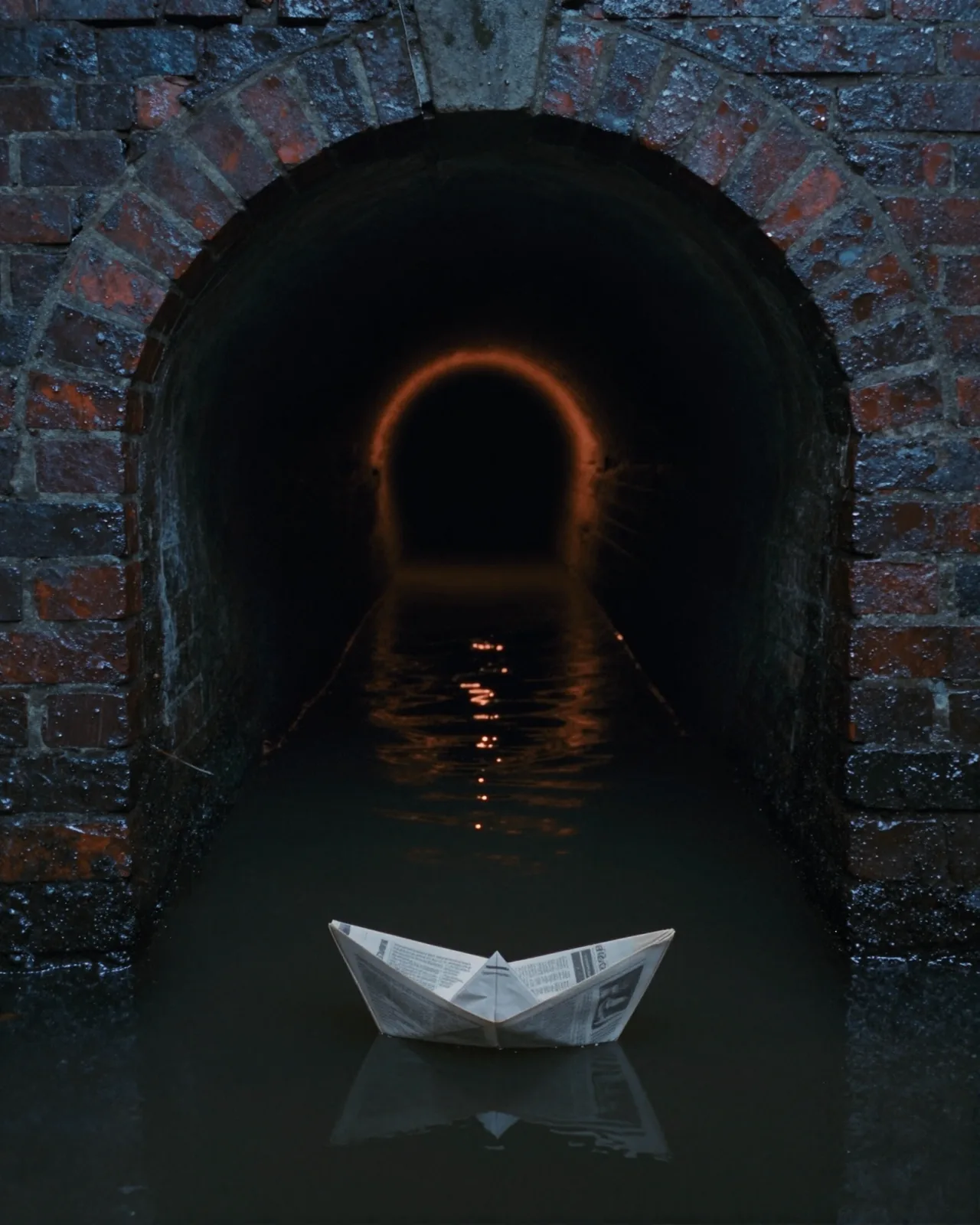
One question remains that this chapter has no way of answering, and it's the heaviest in the essay. If there is a hand that holds, where was it when Georgie leaned over the storm drain? The Turtle, at least, has an excuse: when Bill asks for help, the Turtle answers that it doesn't take sides in these things. The next chapter starts with the Turtle.Fica uma pergunta que este capítulo não tem como responder, e ela é a mais pesada do ensaio. Se existe uma mão que segura, onde ela estava quando o Georgie se debruçou no bueiro? A Tartaruga, pelo menos, tem uma desculpa: quando o Bill pede ajuda, ela responde que não toma partido nessas coisas. O próximo capítulo começa por ela.