IntroduçãoIntroduction
Antes da primeira linhaBefore the First Line
Quase todo mundo guarda Matrix nas mesmas três imagens. A pílula vermelha na palma de uma mão, o Neo se curvando pra trás enquanto as balas passam em câmera lenta, e aquela chuva de código verde que virou papel de parede de meio mundo no começo dos anos 2000. Vinte e sete anos depois da estreia, o filme deixou de ser só um filme e virou vocabulário. Muita gente que nunca viu a trilogia sabe o que é uma falha na Matrix, já ouviu alguém dizer que tomou a pílula vermelha e reconhece de longe o bem-vindo ao deserto do real, mesmo sem saber que a frase vem de um filósofo francês.Almost everyone keeps The Matrix in the same three images. The red pill in the palm of a hand, Neo bending backward as the bullets pass in slow motion, and that rain of green code that became half the world’s wallpaper in the early 2000s. Twenty-seven years after its release, the film stopped being just a film and became vocabulary. Plenty of people who have never seen the trilogy know what a glitch in the Matrix is, have heard someone say they took the red pill and recognize “welcome to the desert of the real” from a mile away, without knowing the phrase comes from a French philosopher.
Só que a saga não parou na tela. Enquanto a gente repetia as falas, a história de Matrix continuou sendo escrita do lado de fora, e com os mesmos temas de dentro. As duas autoras saíram do armário, uma em 2012 e a outra em 2016, e contaram de onde o filme tinha vindo. O estúdio continuou dono da marca e encomendou uma sequência com ou sem elas. Um fórum da internet pegou a pílula emprestada e deu a ela um sentido que o filme passa duas horas desmentindo. E agora, em 2026, um quinto filme está sendo escrito sem nenhuma Wachowski na direção, enquanto a própria Warner é vendida e a empresa que nasce da fusão já anunciou um nome novo. A pergunta sobre quem é dono de Matrix, que parecia coisa de seminário de faculdade, virou literal.But the saga didn’t stop at the screen. While we kept repeating the lines, the story of The Matrix went on being written outside, and with the same themes it carries inside. Both authors came out, one in 2012 and the other in 2016, and told us where the film had come from. The studio kept owning the brand and ordered a sequel with or without them. An internet forum borrowed the pill and gave it a meaning the film spends two hours refuting. And now, in 2026, a fifth film is being written with no Wachowski directing, while Warner itself is being sold and the company born from the merger has already announced a new name. The question of who owns The Matrix, which sounded like a college seminar topic, has become literal.
Este ensaio nasce dessa pergunta, e da desconfiança de que ela sempre esteve no filme. A minha hipótese é simples de dizer e trabalhosa de provar: o que Matrix tem de mais verdadeiro não está nas cenas que todo mundo lembra, e sim nos detalhes que quase ninguém leu. Numa placa de fabricação dentro da nave. Num rascunho de roteiro que mudou de final quatro vezes. Na lista de créditos. E, acima de tudo, nos nomes, porque a saga inteira gira em torno de quem tem o direito de chamar alguém de alguma coisa. O primeiro capítulo diz isso com todas as letras. Aqui eu só peço que tu guardes a pergunta no bolso, porque ela volta em quase todas as páginas.This essay is born from that question, and from the suspicion that it was always in the film. My hypothesis is simple to state and laborious to prove: what is truest in The Matrix isn’t in the scenes everybody remembers, but in the details almost nobody read. On a manufacturer’s plate inside the ship. In a script draft whose ending changed four times. In the credits. And above all in the names, because the whole saga turns on who has the right to call someone something. The first chapter says this in so many words. Here I only ask you to keep the question in your pocket, because it comes back on almost every page.
O caminho é longo, e vale saber por onde ele passa. O ensaio está dividido em seis blocos. O primeiro refaz o código-fonte, aquilo que todo mundo viu: a filosofia, o messias, a saga que o estúdio pediu. O segundo entra na sala de edição pra olhar o que foi cortado, a começar por uma personagem que perdeu metade de si antes da estreia. O terceiro lê a saga como história trans e põe ao lado dela a biologia de corpos que não cabem em duas colunas, com cuidado pra não confundir uma coisa com a outra. O quarto é teologia, e é lá que eu passo a escrever em primeira pessoa, como mulher cristã intersexo de tradição reformada que lê Matrix com a Bíblia aberta do lado. O quinto pergunta quem conta como pessoa, das máquinas julgadas como propriedade à briga pela pílula. E o sexto fecha a conta, com um jogo que matou o Morpheus, um filme que disse em voz alta o que os outros esconderam e uma lista honesta do que a saga erra.The road is long, and it helps to know where it goes. The essay is divided into six blocks. The first rebuilds the source code, what everybody saw: the philosophy, the messiah, the saga the studio asked for. The second enters the editing room to look at what was cut, and the first cut is a character who lost half of herself before the premiere. The third reads the saga as a trans story and sets beside it the biology of bodies that don’t fit in two columns, with care not to confuse one with the other. The fourth is theology, and that’s where I begin writing in the first person, as an intersex Christian woman from the Reformed tradition who reads The Matrix with the Bible open beside it. The fifth asks who counts as a person, from machines tried as property to the fight over the pill. And the sixth settles the account, with a game that killed Morpheus, a film that said out loud what the others hid and an honest list of what the saga gets wrong.
Uma coisa sobre o método, antes de começar. Quase todo capítulo termina chamando a objeção mais forte que eu consegui encontrar contra ele mesmo, e tentando responder sem trapacear. Alguns argumentos saem inteiros desse teste. Outros saem com uma concessão, e eu digo qual. Se em algum ponto tu discordares de mim, é bem provável que o próprio texto já tenha dado voz a essa discordância um parágrafo depois. Não é truque de retórica. É a única forma honesta que eu conheço de defender uma leitura que muita gente vai querer derrubar.One thing about method, before we begin. Almost every chapter ends by calling up the strongest objection I could find against itself and trying to answer it without cheating. Some arguments come out of that test whole. Others come out with a concession, and I say which. If at some point you disagree with me, chances are the text has already given voice to that disagreement a paragraph later. It isn’t a rhetorical trick. It’s the only honest way I know to defend a reading many people will want to tear down.
E é um texto pra ler com calma, em mais de uma sentada se for preciso. Matrix levou mais de vinte anos pra dizer em voz alta o que tinha guardado. A gente pode levar algumas horas pra escutar.And it’s a text to read slowly, in more than one sitting if need be. The Matrix took more than twenty years to say out loud what it had kept. We can take a few hours to listen.
Mas antes de tudo isso, tem uma personagem que morre cedo demais, logo nos primeiros minutos, e quase ninguém percebe o que morre junto com ela. É por ela que eu começo.But before all that, there’s a character who dies too soon, in the very first minutes, and almost nobody notices what dies with her. She’s where I begin.
O que todo mundo viu: a filosofia, o messias e a saga que o estúdio pediu.What everybody saw: the philosophy, the messiah and the saga the studio asked for.
O código-fonteThe Source Code
Capítulo 1Chapter 1
Call trans opt: receivedCall trans opt: received
 Juliana Hoffmann
A Switch morre de joelhos ao lado do corpo do Apoc. No mundo real, dentro da nave, o Cypher acabou de desligar o colega e agora segura o cabo dela. Ao telefone, avisa a Trinity: se ela tiver alguma coisa importante pra dizer à Switch, que diga agora. A Switch entende antes de todo mundo.Switch dies on her knees beside Apoc’s body. In the real world, aboard the ship, Cypher has just unplugged her crewmate, and now his hand is on her cable. Over the phone, he tells Trinity that if she has anything important to say to Switch, she should say it now. Switch understands before anyone else.
“Not like this. Not like this.”“Not like this. Not like this.”
Assim não. O cabo sai, e o corpo dela cai dentro de uma simulação que ela nunca mais vai visitar.The cable comes out, and her body drops inside a simulation she will never visit again.
Ela tinha razão de um jeito que nem o roteiro final sabia. Não era assim que ela devia morrer, porque não era assim que ela devia existir. A Switch foi escrita pra ser um homem no mundo real e uma mulher dentro da Matrix, e foi a própria Lilly Wachowski quem confirmou isso, vinte anos depois. Essa metade foi cortada antes da estreia. A mesma atriz fez os dois mundos, e da ideia original sobraram o nome e um visual andrógino que o filme nunca explica.She was right in a way not even the final script knew. It was not the way she was supposed to die, because it was not the way she was supposed to exist. Switch was written as a man in the real world and a woman inside the Matrix, and it was Lilly Wachowski herself who confirmed this, twenty years later. That half was cut before the premiere. The same actress played both worlds, and what survived of the original idea was the name and an androgynous look the film never explains.
Switch, em inglês, quer dizer interruptor, aquele botão de duas posições que a gente aperta sem pensar.Her name is Switch, like the two-position button we flip without a second thought.
Guarda essa palavra, porque ela volta.Hold on to that word, because it comes back.
[ Interativo · o primeiro segundoInteractive · the first second ]
Ache a palavra.Find the word.
Agora volta comigo pro primeiro segundo do filme, aquele que quase todo mundo passa ajeitando a almofada ou terminando de abrir a pipoca. Antes da Trinity, antes da pílula, antes de qualquer rosto aparecer, a tela fica preta e um texto verde começa a se escrever sozinho, letra por letra, como nos terminais que piscavam nos computadores dos anos 90. É um rastreamento de chamada, coisa de filme de hacker daquela época, e a primeira linha diz: Call trans opt: received.Now come back with me to the first second of the film, the one almost everybody spends settling into the couch or opening the popcorn. Before Trinity, before the pill, before any face appears, the screen goes black and green text starts typing itself out, letter by letter, like the terminals that blinked on nineties computers. It’s a call trace, the kind of thing hacker movies of that era loved, and the first line reads: Call trans opt: received.
Leia de novo, devagar, porque a palavra está bem ali no meio, sem esconderijo nenhum.Read it again, slowly, because the word is right there in the middle, with no hiding place at all.
Em 1999, ninguém leu. E dá pra entender o porquê: era jargão de computador num filme de computador, aquele tipo de ruído de cenário que o olho registra e a cabeça descarta, da mesma família das placas de carro e dos números de quarto que nenhum espectador para pra decifrar. Foram quase vinte anos até alguém parar. Quando o pesquisador Cáel M. Keegan publicou, em 2018, o primeiro livro acadêmico dedicado à obra das Wachowski, deu ao primeiro capítulo justamente o nome dessa linha.In 1999, nobody read it. And it’s easy to see why: it was computer jargon in a computer movie, the kind of set noise the eye registers and the mind discards, the same family as license plates and room numbers no viewer stops to decode. It took almost twenty years for someone to stop. When the scholar Cáel M. Keegan published, in 2018, the first academic book devoted to the work of the Wachowskis, he named its first chapter after that very line.
Antes que alguém levante a mão: este ensaio não diz que uma palavra perdida num código prova alguma coisa. Uma linha de rastreamento não é intenção autoral, e eu não vou fingir que é. O que ela mostra é mais incômodo. O filme escreveu “trans” no primeiro segundo, e o mundo inteiro passou por cima. Não é que a palavra estivesse escondida. É que ninguém estava procurando.Before anyone raises a hand: this essay does not claim that a word lost in a line of code proves anything. A trace readout is not authorial intent, and I will not pretend it is. What it shows is more uncomfortable. The film wrote “trans” in its first second, and the whole world walked past it. It isn’t that the word was hidden. It’s that nobody was looking.
Esse é o método deste texto, e é também a tese. Matrix não é um filme sobre acordar, é um filme sobre quem tem o poder de dar nome. O sistema passa três filmes chamando o herói de senhor Anderson, e ele responde que o nome dele é Neo. Um estúdio topa trocar o gênero do protagonista pra conseguir uma estrela, e corta o da personagem que trocava por conta própria. Um versículo sobre o Deus que criou o destruidor vai parar na placa do carro do vilão. Tudo o que a saga tem de mais verdadeiro sobreviveu escondido onde o sistema não leu: nas placas, nos rascunhos e nos nomes.That is the method of this essay, and it is also the thesis. The Matrix is not a film about waking up. It is a film about who holds the power to name. The system spends three films calling the hero Mr. Anderson, and he answers that his name is Neo. A studio agrees to change the gender of its protagonist to land a star, and cuts the gender of the character who changed hers on her own. A verse about the God who created the destroyer ends up on the villain’s license plate. Everything truest in the saga survived hidden where the system did not read: in the plates, in the drafts, and in the names.
Daqui pra frente, spoiler de tudo. Dos quatro filmes, dos curtas, dos jogos e de um MMO que matou o Morpheus. Se ainda não viu, para aqui. Se viu, vale a revisão, porque este ensaio mora nos detalhes que a memória apaga.From here on, spoilers for everything. The four films, the shorts, the games, and an MMO that killed Morpheus. If you haven’t seen them, stop here. If you have, the recap is worth it, because this essay lives in the details memory erases.
Em 1999, Thomas Anderson é programador de dia e hacker à noite, com o nome Neo. A Trinity e o Morpheus o encontram, o Morpheus oferece duas pílulas, e a vermelha o acorda num casulo. A humanidade perdeu a guerra contra as máquinas e é cultivada em campos, ligada a uma simulação do fim do século vinte, a Matrix, enquanto os corpos servem de fonte de energia. Os humanos livres vivem em Zion, uma cidade subterrânea. A Oráculo, um programa, diz ao Neo o que ele precisa ouvir. O Cypher trai a tripulação em troca de voltar à Matrix, o Morpheus é capturado, e o Neo o resgata. Depois morre nas mãos do agente Smith e volta, chamado pela Trinity, capaz de ver o código e de reescrevê-lo.In 1999, Thomas Anderson is a programmer by day and a hacker by night, under the name Neo. Trinity and Morpheus find him, Morpheus offers two pills, and the red one wakes him in a pod. Humanity lost a war against the machines and is grown in fields, plugged into a simulation of the late twentieth century, the Matrix, while the bodies serve as an energy source. Free humans live in Zion, an underground city. The Oracle, a program, tells Neo what he needs to hear. Cypher betrays the crew in exchange for going back into the Matrix, Morpheus is captured, and Neo rescues him. Then he dies at the hands of Agent Smith and comes back, called by Trinity, able to see the code and rewrite it.
Em 2003, Reloaded e Revolutions abrem a gaiola. O Smith volta como um vírus que copia a si mesmo. O Arquiteto, o programa que desenhou a Matrix, revela que o Neo é o sexto Escolhido, que a profecia era um mecanismo de controle e que Zion já foi destruída cinco vezes. O Neo escolhe a Trinity em vez do reinício, perde a visão, perde a Trinity, negocia a paz com a cidade das máquinas e deixa o Smith absorvê-lo, o que destrói o vírus por dentro. A guerra para. O Neo morre de braços abertos.In 2003, Reloaded and Revolutions open the cage. Smith returns as a virus that copies himself. The Architect, the program that designed the Matrix, reveals that Neo is the sixth One, that the prophecy was a control mechanism, and that Zion has already been destroyed five times. Neo chooses Trinity over the reboot, loses his sight, loses Trinity, negotiates peace with the machine city and lets Smith absorb him, which destroys the virus from within. The war stops. Neo dies with his arms open.
No mesmo ano, The Animatrix conta em nove curtas, entre outras coisas, a origem da guerra, que começa com o julgamento de um robô que matou porque não queria morrer. O jogo Enter the Matrix traz uma hora de cenas filmadas só pra ele. Em 2005, o Path of Neo troca o final da trilogia, e o Matrix Online, vendido como continuação oficial, mata o Morpheus.The same year, The Animatrix tells, in nine shorts, among other things, the origin of the war, which begins with the trial of a robot that killed because it did not want to die. The game Enter the Matrix carries an hour of footage shot just for it. In 2005, Path of Neo changes the ending of the trilogy, and The Matrix Online, sold as the official continuation, kills Morpheus.
Em 2021, The Matrix Resurrections, dirigido só pela Lana Wachowski, encontra o Thomas Anderson vivo outra vez. Ele agora é um designer de games famoso por uma trilogia chamada The Matrix, e toma pílulas azuis receitadas por um terapeuta que é, na verdade, o novo arquiteto do sistema. A Warner, citada pelo nome, exige uma sequência. A Trinity vive como Tiffany, casada e mãe. No fim, ela diz quatro palavras, “My name is Trinity”, descobre que também voa, e os dois decidem refazer a Matrix. Um quinto filme está sendo escrito por Drew Goddard, sem as Wachowski na direção.In 2021, The Matrix Resurrections, directed by Lana Wachowski alone, finds Thomas Anderson alive again. He is now a game designer famous for a trilogy called The Matrix, and he takes blue pills prescribed by a therapist who is, in fact, the system’s new architect. Warner, named on screen, demands a sequel. Trinity lives as Tiffany, married, a mother. In the end she says four words, “My name is Trinity,” discovers that she too can fly, and the two of them decide to remake the Matrix. A fifth film is being written by Drew Goddard, with no Wachowski directing.
Esse é o código-fonte, o que todo mundo viu e quase todo mundo lembra.That’s the source code, what everybody saw and almost everybody remembers.
O resto deste ensaio é sobre o que ficou no log, aquelas linhas que rodam no fundo da tela enquanto a atenção está em outro lugar.The rest of this essay is about what stayed in the log, the lines that run at the bottom of the screen while everyone’s attention is somewhere else.
Capítulo 2Chapter 2
A caverna, o gênio maligno e o deserto do realThe Cave, the Evil Genius and the Desert of the Real
O capítulo 1 terminou no que todo mundo viu. Antes de descer pro que ficou no log, vale atravessar a camada mais famosa do filme, aquela que rendeu mais trabalho de faculdade do que qualquer cena de luta.Chapter 1 ended with what everybody saw. Before going down into what stayed in the log, it’s worth crossing the film’s most famous layer, the one that has produced more term papers than any fight scene.
Quando o Neo acorda no mundo real, a primeira pergunta dele não é filosófica. É física. Por que os olhos doem? O Morpheus responde que é porque ele nunca os usou.When Neo wakes in the real world, his first question isn’t philosophical. It’s physical. Why do his eyes hurt? Morpheus answers that it’s because he has never used them.
Platão escreveu essa cena uns vinte e quatro séculos antes. Na alegoria da caverna, no livro VII da República, prisioneiros acorrentados desde sempre só conhecem as sombras projetadas na parede, e tomam as sombras pelo mundo. Quando um deles é solto e arrastado pra fora, a luz do sol dói nos olhos, e a primeira vontade dele é voltar pro escuro. É o Neo pedindo pra sair do Construto e vomitando quando acorda. É o Cypher negociando um bife, cena que ainda vai ganhar um capítulo inteiro mais adiante.Plato wrote this scene some twenty-four centuries earlier. In the allegory of the cave, in Book VII of the Republic, prisoners chained since birth know only the shadows projected on a wall, and take the shadows for the world. When one of them is freed and dragged outside, the sunlight hurts his eyes, and his first impulse is to go back to the dark. That’s Neo begging to leave the Construct and vomiting when he wakes. That’s Cypher negotiating a steak, a scene that will get a whole chapter of its own further on.
Descartes chegou à mesma desconfiança por outro caminho. Nas Meditações, de 1641, ele imagina um gênio maligno, um enganador poderoso empenhado em falsificar tudo o que os sentidos dizem: o céu, a terra, as cores, o próprio corpo. Se esse enganador existisse, como alguém saberia? O Morpheus faz a mesma pergunta com outra roupa: e se houvesse um sonho do qual não desse pra acordar, como saber a diferença entre o sonho e o real? A Matrix é o gênio maligno de Descartes construído por máquinas, com orçamento e com servidor.Descartes reached the same suspicion by another road. In the Meditations, from 1641, he imagines an evil genius, a powerful deceiver bent on falsifying everything the senses report: the sky, the earth, colors, his own body. If such a deceiver existed, how would anyone know? Morpheus asks the same question in different clothes: what if there were a dream you couldn’t wake from, how would you tell the dream from the real? The Matrix is Descartes’ evil genius built by machines, with a budget and a server farm.
Philip K. Dick deu o passo seguinte, e deu antes de o filme existir. Em 1977, numa convenção de ficção científica em Metz, na França, ele disse a uma plateia perplexa que vivemos numa realidade programada por computador, e que a única pista disso aparece quando alguma variável é alterada. A sensação dessa alteração, ele disse, é o déjà vu. Vinte e dois anos depois, o Neo vê o mesmo gato preto passar duas vezes, e a Trinity explica: um déjà vu costuma ser uma falha na Matrix, e acontece quando eles mudam alguma coisa. É o discurso de Metz posto na boca de uma personagem.Philip K. Dick took the next step, and took it before the film existed. In 1977, at a science fiction convention in Metz, France, he told a baffled audience that we live in a computer-programmed reality, and that the only clue appears when some variable is changed. The sensation of that change, he said, is déjà vu. Twenty-two years later, Neo sees the same black cat pass twice, and Trinity explains: déjà vu is usually a glitch in the Matrix, and it happens when they change something. It’s the Metz speech placed in a character’s mouth.
E então vem o Baudrillard. Logo no começo do filme, o Neo guarda os disquetes que vende dentro de um livro oco: Simulacros e Simulação, de 1981. Quando o Morpheus mostra ao Neo as ruínas do mundo real, ele o recebe com uma expressão do mesmo livro: bem-vindo ao deserto do real. As Wachowski levaram o filósofo a sério o bastante pra fazer o elenco ler. O Keanu Reeves conta que teve que ler Simulacros e Simulação, Out of Control e um livro de psicologia evolucionista antes mesmo de abrir o roteiro.And then comes Baudrillard. Early in the film, Neo keeps the disks he sells inside a hollowed-out book: Simulacra and Simulation, from 1981. When Morpheus shows Neo the ruins of the real world, he greets him with a phrase from the same book: welcome to the desert of the real. The Wachowskis took the philosopher seriously enough to make the cast read him. Keanu Reeves recalls having to read Simulacra and Simulation, Out of Control and a book on evolutionary psychology before he had even opened the script.
O visual veio do Japão. Pra vender o projeto ao produtor Joel Silver, as Wachowski mostraram Ghost in the Shell, o anime de Mamoru Oshii, e disseram que queriam fazer aquilo de verdade. O código verde escorrendo, os plugues na nuca, um mundo inteiro ligado a uma rede: estava tudo lá, em 1995. E a palavra que dá nome ao filme já tinha dono. William Gibson chamou o ciberespaço de matrix em Neuromancer, de 1984, e acabou escrevendo o posfácio do livro de arte do filme.The look came from Japan. To sell the project to producer Joel Silver, the Wachowskis showed him Ghost in the Shell, Mamoru Oshii’s anime, and said they wanted to do that for real. The falling green code, the plugs in the back of the neck, an entire world wired to a network: it was all there in 1995. And the word that names the film already had an owner. William Gibson called cyberspace the matrix in Neuromancer, in 1984, and ended up writing the afterword to the film’s art book.
Tudo isso é verdade. A leitura filosófica de Matrix não é invenção de professor entediado nem de fã que leu meio Platão. Ela está no filme, posta lá de propósito, com nota de rodapé.All of this is true. The philosophical reading of The Matrix is not the invention of a bored professor or of a fan who read half of Plato. It’s in the film, placed there on purpose, with footnotes.
Agora repara no que essas leituras têm em comum. A caverna, o gênio maligno, a realidade programada, o simulacro: são perguntas sobre o mundo, e servem pra qualquer um. Ninguém sai do cinema ameaçado por elas. Dá pra estampar “e se nada for real?” numa camiseta. É uma dúvida sem endereço, sem gênero, sem corpo. É a filosofia que cabe num trailer.Now look at what these readings have in common. The cave, the evil genius, the programmed reality, the simulacrum: they are questions about the world, and they fit anyone. Nobody leaves the theater threatened by them. You can print “what if nothing is real?” on a T-shirt. It’s a doubt with no address, no gender, no body. It’s philosophy that fits in a trailer.
Foi justamente essa camada que o sistema deixou passar.That was exactly the layer the system let through.
O próprio Baudrillard viu isso, e não gostou. Numa entrevista de 2003, ele disse que tinha hesitado em falar sobre Matrix por causa dos mal-entendidos, e reclamou que o Reloaded não tinha nem um vestígio de ironia capaz de virar o efeito especial contra si mesmo. E foi além: Matrix seria o tipo de filme que a própria Matrix faria sobre a Matrix.Baudrillard himself saw it, and didn’t like it. In a 2003 interview, he said he had hesitated to talk about The Matrix because of the misunderstandings, and complained that Reloaded didn’t have a trace of the irony that could turn the special effect against itself. And he went further: The Matrix would be the kind of film the Matrix itself would make about the Matrix.
Quem torce o nariz pra qualquer ensaio sobre Matrix costuma dizer que ele vira filosofia de almanaque, Platão pra quem dormiu na aula. O Baudrillard concordaria. Eu concordo pela metade, e a metade importa. A filosofia que o filme exibe é mesmo a versão digerível, a que um estúdio aceita financiar e um público aceita engolir. Mas é exatamente por isso que ela é a porta de entrada certa pra este texto. Ela é a leitura aprovada. Tudo o que vem depois é o que não foi aprovado.Anyone who rolls their eyes at an essay about The Matrix tends to say it ends up as pop philosophy, Plato for people who slept through class. Baudrillard would agree. I agree halfway, and the half matters. The philosophy the film displays is the digestible version, the one a studio agrees to fund and an audience agrees to swallow. But that is exactly why it’s the right door into this essay. It’s the approved reading. Everything that comes after is what was not approved.
A filosofia de Matrix passou porque não tinha corpo. A Switch não passou porque tinha.The philosophy of The Matrix got through because it had no body. Switch didn’t get through, because she had one.
Capítulo 3Chapter 3
O messias de sobretudoThe Messiah in a Trench Coat
Se a filosofia é a leitura que qualquer professor reconhece, a religiosa é a que qualquer pessoa criada na igreja reconhece na hora. E ela começa bem antes do que a maioria lembra.If philosophy is the reading any professor recognizes, the religious one is the reading anyone raised in church recognizes at once. And it starts much earlier than most people remember.
A primeira pessoa a chamar o Neo de salvador é um cliente.The first person to call Neo a savior is a customer.
Nos primeiros minutos do filme, um sujeito chamado Choi bate na porta do apartamento 101 pra buscar um programa ilegal, paga dois mil dólares em dinheiro e, com o disquete na mão, agradece: “Hallelujah. You’re my savior, man. My own personal Jesus Christ.” Aleluia, você é o meu salvador, o meu Jesus Cristo particular. Ele está acompanhado de uma moça chamada DuJour, e os dois nomes juntos soam como choix du jour, a escolha do dia, em francês. O filme anuncia o messias como piada, na boca de quem compra contrabando, numa cena sobre escolha.In the first minutes of the film, a guy named Choi knocks on the door of apartment 101 to pick up some illegal software, pays two thousand dollars in cash and, disk in hand, says thanks: “Hallelujah. You’re my savior, man. My own personal Jesus Christ.” He has a woman with him named DuJour, and the two names together sound like choix du jour, the choice of the day, in French. The film announces its messiah as a joke, in the mouth of someone buying contraband, in a scene about choice.
Depois disso, o pôster se monta sozinho. Neo é anagrama de One, o Um, o Escolhido. Thomas é o nome do apóstolo que duvidou, e o Neo passa o primeiro filme inteiro em dúvida. Anderson, há quem decomponha em filho do homem. O Morpheus é o precursor que anuncia quem vem depois dele e acredita antes de ver, um João Batista de óculos escuros. O Cypher é o Judas: divide uma bebida com o Neo na nave, como na ceia, e vende o mestre em troca de uma vida mais confortável. A Trinity carrega a Trindade no nome. A cidade dos humanos livres se chama Zion, Sião, a cidade de Deus. E no clímax do primeiro filme o Neo morre e volta.After that, the poster assembles itself. Neo is an anagram of One, the Chosen One. Thomas is the name of the apostle who doubted, and Neo spends the whole first film in doubt. Anderson, some break down into son of man. Morpheus is the forerunner who announces the one who comes after him and believes before seeing, a John the Baptist in sunglasses. Cypher is Judas: he shares a drink with Neo on the ship, as at the supper, and sells out his master in exchange for a more comfortable life. Trinity carries the Trinity in her name. The city of free humans is called Zion, the city of God. And at the climax of the first film, Neo dies and comes back.
As sequências levam a figura até o fim. No Revolutions, o Bane, possuído pelo Smith, chama o Neo de messias cego, porque o Neo acabou de perder os olhos. Na cidade das máquinas, ele morre de braços abertos, em cruz, e a voz que governa as máquinas declara “It is done”, eco do “está consumado” de João 19:30. O corpo dele é levado embora numa luz.The sequels take the figure all the way. In Revolutions, Bane, possessed by Smith, calls Neo a blind messiah, because Neo has just lost his eyes. In the machine city, he dies with his arms open, cruciform, and the voice that governs the machines declares “It is done,” an echo of “It is finished” in John 19:30. His body is carried away in light.
Até aqui, convenhamos, não teve nada de sutil. Ninguém precisou de seminário pra ver. Uma revista americana resumiu a coisa sem rodeio: conte essa história a qualquer cristão e ele vai reconhecê-la na hora. O Neo-Jesus é a leitura teológica mais fácil do cinema dos anos 90, e virou assunto de professor de religião e de teólogo antes mesmo de a trilogia acabar.So far, let’s admit it, nothing has been subtle. Nobody needed seminary to see it. An American magazine summed it up bluntly: tell this story to any Christian and they’ll recognize it on the spot. Neo-as-Jesus is the easiest theological reading in nineties cinema, and it became a subject for religion professors and theologians before the trilogy was even over.
Ao lado dela correm outras duas. A gnóstica vê na Matrix o mito antigo do mundo falso, fabricado por um poder inferior pra aprisionar centelhas de luz em corpos, do qual só se escapa pelo conhecimento, a gnose que acorda. A budista começa na sala de espera da Oráculo, onde um menino de cabeça raspada e roupa de monge entorta uma colher com o olhar e ensina ao Neo que não existe colher, e que não é a colher que se curva, é ele mesmo. A ilusão, o ciclo, a iluminação: tudo isso também está no filme, e também é verdade.Two other readings run alongside it. The Gnostic one sees in the Matrix the ancient myth of the false world, made by a lesser power to imprison sparks of light in bodies, from which one escapes only through knowledge, the gnosis that wakes you. The Buddhist one begins in the Oracle’s waiting room, where a boy with a shaved head and monk’s robes bends a spoon with his gaze and teaches Neo that there is no spoon, and that it isn’t the spoon that bends, it’s himself. Illusion, the cycle, enlightenment: all of that is in the film too, and it’s true too.
As próprias Wachowski deram corda pra essa leitura espiritual. Elas tiraram temas da obra do filósofo Cornel West, professor de religião em Princeton, e o puseram no elenco das sequências como o conselheiro West, de Zion. Ele aceitou depois de perguntar se o personagem teria dignidade. Quando o box definitivo da trilogia saiu, em 2004, o West gravou com o Ken Wilber um comentário inteiro sobre corpo, mente e espírito ao longo dos três filmes.The Wachowskis themselves encouraged the spiritual reading. They drew themes from the work of the philosopher Cornel West, then a professor of religion at Princeton, and cast him in the sequels as Councillor West, of Zion. He accepted after asking whether his character would have dignity. When the definitive box set came out in 2004, West recorded with Ken Wilber an entire commentary track on body, mind and spirit across the three films.
Então vem a objeção, e ela é justa: já falaram tudo do Neo-Jesus. Falaram, e muito. Só que pararam no pôster.Then comes the objection, and it’s fair: everything about Neo-as-Jesus has already been said. It has, at length. Only it stopped at the poster.
O problema da leitura do pôster não é estar errada. É ficar no nível da silhueta. Ela compara formatos: um escolhido, uma traição, uma morte, uma volta. Formato de messias qualquer filme de herói tem, e por isso mesmo essa leitura atrai as objeções mais fáceis. Críticos cristãos reclamaram, com razão, que um Cristo que resolve as coisas no tiroteio se afasta do Evangelho exatamente no ponto que importa. A comparação de silhuetas aguenta pouco peso porque nunca entrou no texto.The problem with the poster reading isn’t that it’s wrong. It’s that it stays at the level of silhouette. It compares shapes: a chosen one, a betrayal, a death, a return. Any hero movie has the shape of a messiah, and that’s exactly why this reading attracts the easiest objections. Christian critics complained, rightly, that a Christ who solves things in a shootout departs from the Gospel at precisely the point that matters. A comparison of silhouettes can’t bear much weight, because it never entered the text.
E tem um detalhe que a leitura do pôster nunca encara. No Reloaded, o Arquiteto revela que a profecia do Escolhido era um mecanismo de controle. Quem entregou a profecia ao Morpheus foi a Oráculo, um programa, e a profecia servia ao próprio sistema pra administrar a rebelião. O título de messias que o Morpheus passou a vida pregando foi um nome dado pela máquina. O Neo-Jesus do pôster é, literalmente, o messias que a Matrix escreveu pra si mesma.And there’s a detail the poster reading never faces. In Reloaded, the Architect reveals that the prophecy of the One was a control mechanism. The one who delivered the prophecy to Morpheus was the Oracle, a program, and the prophecy served the system itself as a way of managing the rebellion. The messianic title Morpheus spent his life preaching was a name given by the machine. The Neo-Jesus of the poster is, literally, the messiah the Matrix wrote for itself.
A teologia que interessa não está nesse messias. Está no que o sistema não escreveu: nos versículos escondidos em objetos de cena, num rei da Babilônia que esqueceu o próprio sonho, numa discussão sobre decreto e escolha que a trilogia trava sem avisar, e na ordem exata em que um homem morto é chamado de volta. Isso fica pro Bloco IV, e lá eu escrevo em primeira pessoa.The theology that matters isn’t in that messiah. It’s in what the system did not write: in verses hidden on props, in a Babylonian king who forgot his own dream, in a debate about decree and choice that the trilogy carries on without announcing it, and in the exact order in which a dead man is called back. That’s for Block IV, and there I write in the first person.
O Neo-Jesus é o messias que a Matrix profetizou. O resto da teologia é o que ela não conseguiu prever.Neo-as-Jesus is the messiah the Matrix prophesied. The rest of the theology is what it couldn’t predict.
Capítulo 4Chapter 4
A saga que a Warner pediuThe Saga Warner Asked For
Depois da filosofia e do messias, falta a última camada do que todo mundo viu: a da própria franquia, que também tem a sua história de nomes e de donos.After the philosophy and the messiah, one layer of what everybody saw is left: the franchise itself, which has its own story of names and owners.
Quando a trilogia terminou, as Wachowski pararam de falar.When the trilogy ended, the Wachowskis stopped talking.
Em 2004 saiu o box definitivo, dez discos com tudo o que o estúdio conseguiu juntar. Quem esperava ouvir as diretoras explicando o que tinham feito encontrou duas páginas de introdução assinadas por elas e o microfone entregue a outras pessoas. Numa faixa de comentário, dois filósofos que gostavam dos filmes. Na outra, três críticos de cinema que não economizaram desconforto nem dentro do produto oficial: um pergunta se mais alguém ali está atordoado, outro solta um “é simplesmente horrível”.In 2004 the definitive box set came out, ten discs with everything the studio could gather. Anyone hoping to hear the directors explain what they had made found two pages of introduction signed by them and the microphone handed to other people. On one commentary track, two philosophers who liked the films. On the other, three film critics who didn’t hide their discomfort even inside the official product: one asks whether anyone else in the room is stupefied, another simply calls it dreadful.
Ninguém entrega o próprio filme a quem torce o nariz pra ele por descuido. Eu leio esse gesto como recusa. As autoras se negaram a dar a leitura oficial e deixaram o significado brigar em público, sem elas.Nobody hands their own film to people who wrinkle their noses at it by accident. I read that gesture as refusal. The authors declined to give the official reading and let the meaning fight in public, without them.
Oito anos depois, no discurso que fez ao receber um prêmio da Human Rights Campaign, a Lana explicou o silêncio por outro ângulo. Não tinha a ver com gênero. Depois de 1999, ela e a irmã sentiram o mundo encolher. O anonimato, ela disse, era o que garantia o acesso à vida comum, e o sucesso tinha levado isso embora. Matrix cobrou caro de quem o fez.Eight years later, in the speech she gave accepting an award from the Human Rights Campaign, Lana explained the silence from another angle. It had nothing to do with gender. After 1999, she and her sister felt their world shrink. Anonymity, she said, was what guaranteed access to ordinary life, and success had taken it away. The Matrix charged a high price to the people who made it.
E a trilogia tinha sido desenhada pra fechar. A Lana descreve a estrutura como dialética: tese, antítese, síntese; nascimento, vida, morte. Um tríptico. Por dezoito anos, ela disse a todo mundo que não faria outro Matrix. Do outro lado, um produtor da franquia contou que o estúdio procurava ressuscitar a série com ou sem as Wachowski.The trilogy, after all, had been designed to close. Lana describes its structure as dialectical: thesis, antithesis, synthesis; birth, life, death. A triptych. For eighteen years she told everyone she would not make another Matrix. On the other side, a producer of the franchise said the studio was looking to resurrect the series with or without the Wachowskis.
O que mudou a resposta não foi o estúdio. Foi a morte. Em pouco tempo, a Lana perdeu o pai, a mãe e uma amiga próxima da esposa. Sem saber o que fazer com a dor, começou a imaginar uma história em que duas pessoas voltavam à vida, e disse que inventar aquilo foi um consolo. As duas pessoas eram o Neo e a Trinity.What changed the answer wasn’t the studio. It was death. In a short span, Lana lost her father, her mother and a close friend of her wife. Not knowing what to do with the pain, she began to imagine a story in which two people came back to life, and she said that inventing it was a comfort. The two people were Neo and Trinity.
A Lilly não voltou. Ela tinha acabado de concluir a própria transição, estava de luto pelo pai, e disse que voltar a algo que já tinha feito não a atraía nem um pouco. Preferiu atravessar a perda de outro jeito.Lilly did not come back. She had just finished her own transition, she was grieving her father, and she said that going back to something she had already done didn’t appeal to her at all. She chose to move through the loss another way.
Então o Resurrections fez o que franquia nenhuma faz. No primeiro ato, o Thomas Anderson, agora criador de uma trilogia de games chamada The Matrix, ouve do sócio, um homem chamado Smith, que a empresa-mãe, a Warner Bros., vai fazer uma sequência com ele ou sem ele. O estúdio aparece pelo nome, como personagem, no papel exato que tinha na vida real. Logo depois, uma sala de reunião tenta definir o que era Matrix e despeja palavras soltas: política trans, cripto-fascismo, bullet time. A obra original reduzida a palavra-chave de marketing, dentro do filme que a Warner pagou.Then Resurrections did what no franchise does. In the first act, Thomas Anderson, now the creator of a game trilogy called The Matrix, hears from his business partner, a man named Smith, that their parent company, Warner Bros., is going to make a sequel with him or without him. The studio appears by name, as a character, in exactly the role it played in real life. Soon after, a meeting room tries to define what The Matrix was and spills out loose words: trans politics, crypto-fascism, bullet time. The original work reduced to marketing keywords, inside the film Warner paid for.
O filme estreou no mesmo dia nos cinemas e no streaming da própria Warner, e rendeu bem menos que os anteriores. Em abril de 2024, o estúdio anunciou um quinto filme, escrito e dirigido por Drew Goddard, com a Lana só como produtora executiva. Vai ser o primeiro longa de Matrix sem uma Wachowski na direção, e o comunicado oficial falava em honrar o que a Lana e a Lilly começaram. E o dono do nome também tem dono: em fevereiro de 2026, a Warner assinou a própria venda para a Paramount, num negócio de cerca de 110 bilhões de dólares, e no fim de setembro a Justiça americana liberou a fusão, com fechamento marcado pra 6 de outubro.The film opened the same day in theaters and on Warner’s own streaming service, and earned far less than its predecessors. In April 2024, the studio announced a fifth film, written and directed by Drew Goddard, with Lana only as executive producer. It will be the first Matrix feature without a Wachowski directing, and the official statement spoke of honoring what Lana and Lilly began. And the owner of the name also has an owner: in February 2026, Warner signed its own sale to Paramount, in a deal worth about 110 billion dollars, and at the end of September the American courts cleared the merger, with the closing set for October 6.
A objeção aqui é a mais cínica, e por isso a mais forte: toda franquia é produto. É, e não adianta fingir que não. Em 2003, o jornalista que entrevistou o Baudrillard já apontava que todo sucesso de marketing americano, de Matrix ao disco novo da Madonna, chegava vendido como crítica do sistema que o promovia. A suspeita procede. Mas existe uma diferença entre um produto que finge criticar quem o vende e uma obra que transforma a própria captura em enredo. O Resurrections não finge que escapou da Warner. Ele mostra o Thomas Anderson sendo arrastado de volta pra Matrix pra fazer a sequência de Matrix, e põe o nome do estúdio na boca do Smith. Toda franquia é produto. Poucas fazem do próprio cativeiro o enredo.The objection here is the most cynical, and therefore the strongest: every franchise is a product. It is, and there’s no point pretending otherwise. In 2003, the journalist who interviewed Baudrillard was already pointing out that every American marketing success, from The Matrix to Madonna’s new album, arrived packaged as a critique of the system that promoted it. The suspicion is fair. But there’s a difference between a product that pretends to criticize whoever sells it and a work that turns its own capture into plot. Resurrections doesn’t pretend it escaped Warner. It shows Thomas Anderson being dragged back into the Matrix to make the sequel to The Matrix, and puts the studio’s name in Smith’s mouth. Every franchise is a product. Few turn their own captivity into the plot.
E a conta fecha no nome. A Warner é dona da marca Matrix. Pode estampá-la num filme que as autoras não vão dirigir, pode vendê-la, e pode ser vendida junto com ela. O estúdio é dono do nome Matrix. O que o nome quer dizer, ele nunca conseguiu comprar.And the account closes on the name. Warner owns the Matrix brand. It can stamp it on a film the authors won’t direct, it can sell it, and it can be sold along with it. The studio owns the name Matrix. What the name means, it never managed to buy.
O que foi cortado antes da estreia, e quem sobrou nos créditos.What was cut before the premiere, and who was left in the credits.
A sala de ediçãoThe Editing Room
Capítulo 5Chapter 5
Switch, a personagem cortada pela metadeSwitch, the Character Cut in Half
O Bloco I ficou com o que passou pela aprovação. Daqui em diante, o ensaio entra na sala de edição, onde ficam as coisas que não passaram, e a primeira delas esteve na tela desde o primeiro minuto.Block I stayed with what got approved. From here on, the essay enters the editing room, where the things that didn’t get approved are kept, and the first of them was on screen from the very first minute.
Volta pra cena do começo. A Switch de joelhos, o Cypher com o cabo na mão, a Trinity ouvindo tudo pelo telefone. “Not like this. Not like this.”Go back to the opening scene. Switch on her knees, Cypher with the cable in his hand, Trinity hearing everything over the phone. “Not like this. Not like this.”
O público de 1999 viu uma coadjuvante morrer cedo, do jeito que coadjuvante morre em filme de ação: rápido, pra provar que o vilão é sério. Ninguém sabia que estava vendo o que sobrou de uma personagem cortada pela metade.The 1999 audience saw a supporting character die early, the way supporting characters die in action movies: fast, to prove the villain means business. Nobody knew they were watching what was left of a character cut in half.
No roteiro que as Wachowski imaginaram, a Switch seria um homem no mundo real e uma mulher dentro da Matrix. A cada vez que a tripulação se conectasse, o público veria a mesma pessoa atravessar a fronteira entre os mundos e chegar do outro lado com outro corpo. Isso no primeiro filme, antes de qualquer sequência, numa superprodução de estúdio de 1999.In the script the Wachowskis imagined, Switch would be a man in the real world and a woman inside the Matrix. Every time the crew jacked in, the audience would see the same person cross the border between worlds and arrive on the other side in another body. This in the first film, before any sequel, in a 1999 studio blockbuster.
Não aconteceu. A versão que circula é que a produção achou que o público ia se confundir. A Lilly Wachowski, numa entrevista ao Netflix Film Club em 2020, resumiu de outro jeito: a intenção original existia, e o mundo corporativo não estava pronto pra ela. A Belinda McClory fez a Switch nos dois mundos, mulher na nave e mulher na Matrix, e a personagem ficou com uma posição só.It didn’t happen. The version that circulates is that the producers thought the audience would be confused. Lilly Wachowski, in a 2020 interview with Netflix Film Club, put it another way: the original intention existed, and the corporate world wasn’t ready for it. Belinda McClory played Switch in both worlds, a woman on the ship and a woman in the Matrix, and the character was left with a single position.
O nome dela, lembra, quer dizer interruptor.Her name, remember, is Switch.
Eu disse que essa palavra voltava. Um interruptor tem duas posições e nada no meio: ligado ou desligado, um ou zero. É a metáfora perfeita pra um sistema que pensa em código binário, e é a metáfora errada pro corpo humano. O sexo de um corpo não se decide num clique. Ele se monta ao longo do desenvolvimento, em cascata, etapa por etapa, e cada etapa pode tomar outro rumo. O capítulo 11 abre essa cascata com cuidado. Por enquanto, basta o desenho: as autoras deram a uma personagem o nome de um interruptor e planejaram pra ela justamente o que um interruptor não faz, atravessar. O estúdio devolveu o nome à função de origem. Uma posição, um corpo, nenhuma travessia.I said that word would come back. A switch has two positions and nothing in between: on or off, one or zero. It’s the perfect metaphor for a system that thinks in binary code, and the wrong metaphor for the human body. The sex of a body isn’t decided with a click. It’s assembled over the course of development, in a cascade, step by step, and each step can take another course. Chapter 11 opens that cascade carefully. For now, the outline is enough: the authors gave a character the name of a switch and planned for her exactly what a switch can’t do, cross over. The studio returned the name to its original function. One position, one body, no crossing.
Ficou o resto, e o resto entrega o que foi cortado. Ficou o nome, que sem a ideia não explica nada. Ficou um visual andrógino que o filme nunca justifica. E ficou a morte.The rest remained, and the rest gives away what was cut. The name remained, and without the idea it explains nothing. An androgynous look remained that the film never justifies. And the death remained.
Agora relê a fala sabendo disso. Assim não. Eu não estou dizendo que a frase foi escrita como protesto contra o corte. Não tenho prova disso, e não preciso. Estou dizendo que, depois do corte, ela virou um. A personagem que devia atravessar entre dois corpos morre presa na única versão que deixaram pra ela, e as últimas palavras dela recusam o modo.Now reread the line knowing this. Not like this. I’m not saying the line was written as a protest against the cut. I have no proof of that, and I don’t need it. I’m saying that after the cut, it became one. The character who was meant to cross between two bodies dies trapped in the only version they left her, and her last words refuse the terms.
A Lilly foi honesta até na dúvida. Na mesma entrevista, disse que não sabia o quanto a própria transgeneridade estava presente no fundo da cabeça enquanto escreviam, mas que tudo vinha do mesmo fogo. Ela e a Lana existiam num espaço em que as palavras ainda não existiam, e por isso viviam no mundo da imaginação. E definiu o filme como um desejo de transformação visto de dentro do armário.Lilly was honest even in her doubt. In the same interview, she said she didn’t know how present her transness was in the back of her mind while they were writing, but that it all came from the same fire. She and Lana existed in a space where the words didn’t exist yet, and so they lived in the world of imagination. And she defined the film as a desire for transformation seen from inside the closet.
Vale parar um instante nessa última definição, porque ela é mais precisa que qualquer teoria de fã. Um desejo de transformação visto de dentro do armário. É o que a Switch seria se tivesse sobrevivido ao corte. E é o que ela virou depois dele: um desejo que ficou no nome, enquanto o corpo voltava pro armário do roteiro.That last definition deserves a moment, because it’s more precise than any fan theory. A desire for transformation seen from inside the closet. That’s what Switch would have been had she survived the cut. And it’s what she became after it: a desire that stayed in the name, while the body went back into the script’s closet.
Aqui aparece a acusação mais comum: isso é retcon. Em 2020, com as duas diretoras já fora do armário, ficou fácil reescrever o passado e chamar de intenção o que foi acaso.Here comes the most common accusation: this is a retcon. In 2020, with both directors out of the closet, it was easy to rewrite the past and call accident intention.
Três coisas desmontam essa objeção. A primeira é a ordem dos fatos. O nome Switch e o visual da personagem estão na tela desde 1999, vinte e um anos antes da entrevista. A segunda é a ordem das leituras. Pessoas trans liam Matrix como história delas muito antes da confirmação, e a Lilly conta que até hoje há quem chegue nela dizendo que aqueles filmes salvaram a sua vida. O Cáel M. Keegan publicou em 2018 um livro inteiro lendo a obra das Wachowski como cinema trans, dois anos antes de a Lilly falar. A confirmação veio depois da leitura, e não o contrário. A terceira é a própria dúvida. Um retcon é uma história conveniente contada depois, e história conveniente vem redonda. A da Lilly vem com hesitação: ela reivindica a intenção da Switch e admite não saber o quanto do resto era consciente. Retcon não costuma vir com dúvida.Three things take this objection apart. The first is the order of facts. The name Switch and the character’s look have been on screen since 1999, twenty-one years before the interview. The second is the order of readings. Trans people read The Matrix as their story long before the confirmation, and Lilly says that people still come up to her to say those films saved their lives. Cáel M. Keegan published in 2018 an entire book reading the Wachowskis’ work as trans cinema, two years before Lilly spoke. The confirmation came after the reading, not the other way around. The third is the doubt itself. A retcon is a convenient story told after the fact, and convenient stories come out round. Lilly’s comes with hesitation: she claims the intention behind Switch and admits she doesn’t know how much of the rest was conscious. Retcons don’t usually come with doubt.
O Bloco II começa aqui porque a Switch é o primeiro corte da sala de edição, e o mais revelador. Num filme sobre quem tem o poder de dar nome, a personagem que mais dizia sobre a tese perdeu justamente a metade que explicava o próprio nome. O estúdio cortou o corpo e esqueceu de cortar o nome. Foi pelo nome que a gente achou o corpo.Block II begins here because Switch is the first cut in the editing room, and the most revealing. In a film about who holds the power to name, the character who said the most about the thesis lost exactly the half that explained her own name. The studio cut the body and forgot to cut the name. It was through the name that we found the body.
Capítulo 6Chapter 6
Trocar o Neo por uma estrela, podeSwapping Neo for a Star Is Fine
Se o corte da Switch parece só zelo de estúdio com um público que podia se confundir, essa desculpa complica quando se olha o que o mesmo estúdio, na mesma época, topou fazer com outro personagem.If Switch’s cut looks like nothing more than a studio protecting an audience that might get confused, that excuse gets complicated once you see what the same studio, in the same years, agreed to do to another character.
No fim dos anos 1990, a Warner esteve disposta a transformar o Neo numa mulher.In the late 1990s, Warner was willing to turn Neo into a woman.
Quem conta é o Lorenzo di Bonaventura, na época chefe de produção do estúdio e o homem que empurrava o projeto. Em 2019, nos vinte anos do filme, ele descreveu ao site TheWrap a peregrinação atrás de um astro. O Brad Pitt foi o primeiro a dizer sim e desistiu ao sair das filmagens de Sete Anos no Tibet, exausto. O Will Smith recusou pra fazer As Loucas Aventuras de James West. O Leonardo DiCaprio também passou. O Val Kilmer foi um entre muitos sondados. E então veio a frase que importa: a gente estava ficando desesperado. Eles procuraram a Sandra Bullock, amiga dele e do produtor Joel Silver desde O Demolidor, e propuseram transformar o Neo numa garota.The man who tells the story is Lorenzo di Bonaventura, then head of production at the studio and the man pushing the project. In 2019, on the film’s twentieth anniversary, he described to TheWrap the pilgrimage in search of a star. Brad Pitt was the first to say yes and dropped out coming off Seven Years in Tibet, exhausted. Will Smith turned it down to make Wild Wild West. Leonardo DiCaprio passed too. Val Kilmer was one of many they sounded out. And then came the line that matters: they were getting desperate. They went to Sandra Bullock, a friend of his and of producer Joel Silver since Demolition Man, and offered to turn Neo into a girl.
Foi bem simples, ele contou. Mandaram o roteiro. Se ela se interessasse, eles tentariam fazer a mudança. Não foi pra frente. A Bullock diria mais tarde que havia um filme que ela queria ter feito, e era Matrix. O papel ficou com o Keanu Reeves, parceiro dela em Velocidade Máxima.It was pretty simple, he said. They sent the script. If she was interested, they would try to make the change. It didn’t go anywhere. Bullock would later say there was one movie she wished she had made, and it was The Matrix. The role went to Keanu Reeves, her co-star in Speed.
Vale ficar um instante no “foi bem simples”. O protagonista da maior aposta de ficção científica do estúdio podia mudar de gênero com um telefonema, desde que do outro lado da linha estivesse uma estrela. Ninguém achou que o público ia se confundir. Ninguém achou que a história ia desmontar. O Escolhido virar a Escolhida era questão de contrato.Linger for a moment on “pretty simple.” The protagonist of the studio’s biggest science fiction bet could change gender with a phone call, as long as there was a star on the other end of the line. Nobody thought the audience would be confused. Nobody thought the story would fall apart. The One becoming a woman was a matter of contract.
Agora põe isso do lado da Switch. Mesmo filme, mesmo estúdio, mesma época. A personagem que atravessaria de um gênero pro outro entre os mundos era complicada demais e foi cortada. O herói que trocaria de gênero pra vender ingresso era simples. A diferença entre as duas trocas não é de grau. É de função. A do Neo servia ao caixa. A da Switch servia ao sentido.Now put that next to Switch. Same film, same studio, same years. The character who would cross from one gender to the other between worlds was too complicated and got cut. The hero who would change gender to sell tickets was simple. The difference between the two swaps isn’t one of degree. It’s one of function. Neo’s served the till. Switch’s served the meaning.
Não é que o estúdio tivesse uma convicção sobre gênero. Ele tinha uma convicção sobre bilheteria.It’s not that the studio had a conviction about gender. It had a conviction about the box office.
E as Wachowski já conheciam esse jogo. Três anos antes, o primeiro filme delas, Bound, de 1996, contava a história da Corky, uma ex-presidiária que reforma apartamentos, e da Violet, namorada de um mafioso, que se apaixonam e planejam fugir com dois milhões de dólares da máfia. A ideia nasceu de uma pergunta: e se a gente olhasse uma mulher na rua, presumisse a sexualidade dela e estivesse errado? Quando executivos de alguns estúdios leram o roteiro, disseram que teriam interesse se a Corky virasse homem, e há relatos de que ofereceram mais dinheiro pela troca. As duas recusaram. Chamaram a escritora Susie Bright como consultora das cenas de sexo, pra que o desejo entre duas mulheres saísse verdadeiro na tela, e mantiveram a Corky mulher. O mafioso do filme era o Joe Pantoliano, que três anos depois faria o Cypher.The Wachowskis already knew this game. Three years earlier, their first film, Bound, from 1996, told the story of Corky, an ex-con who renovates apartments, and Violet, a mobster’s girlfriend, who fall in love and plan to run off with two million dollars of mob money. The idea grew out of a question: what if we looked at a woman on the street, assumed her sexuality, and were wrong? When executives at some studios read the script, they said they’d be interested if Corky became a man, and there are reports they offered more money for the change. The two of them refused. They brought in the writer Susie Bright as a consultant on the sex scenes, so that the desire between two women would come out true on screen, and they kept Corky a woman. The film’s mobster was Joe Pantoliano, who three years later would play Cypher.
Até a origem de Bound virou disputa de narrativa. O Joel Silver gosta de dizer que o filme foi uma peça de audição, um teste pra provar que elas sabiam comandar um set antes de ganhar Matrix. A Lana diz que ele inventou isso. Cada versão pertence a quem conta.Even the origin of Bound became a fight over the narrative. Joel Silver likes to say the film was an audition piece, a test to prove they could run a set before getting The Matrix. Lana says he made that up. Each version belongs to whoever tells it.
Quando se juntam as três cenas, aparece uma regra. Em Bound, os estúdios quiseram transformar uma mulher em homem pra vender o filme, e as autoras disseram não. Em Matrix, o estúdio ofereceu transformar um homem em mulher pra conseguir uma estrela, e só não aconteceu porque a estrela recusou. Na Switch, as autoras quiseram uma personagem que atravessasse, e o estúdio disse não. Nas três, o gênero se move quando é mercadoria e trava quando é assunto.When you put the three scenes together, a rule appears. In Bound, the studios wanted to turn a woman into a man to sell the film, and the authors said no. In The Matrix, the studio offered to turn a man into a woman to land a star, and it only didn’t happen because the star declined. With Switch, the authors wanted a character who crossed over, and the studio said no. In all three, gender moves when it’s merchandise and locks when it’s subject matter.
O gênero era moeda. Não podia ser tema.Gender was currency. It couldn’t be the theme.
Dá pra prever o contra-argumento: foi só desespero de casting. Foi, sim, e o próprio di Bonaventura usa a palavra. E é exatamente esse o problema. O desespero é o momento em que um sistema mostra o que considera fixo e o que considera trocável. Sob pressão, a Warner revelou que o gênero do herói era trocável. O que não era trocável era a ideia de uma pessoa atravessar por conta própria.You can predict the counterargument: it was just casting desperation. It was, and di Bonaventura uses the word himself. And that’s exactly the problem. Desperation is the moment a system reveals what it considers fixed and what it considers tradeable. Under pressure, Warner revealed that the hero’s gender was tradeable. What was not tradeable was the idea of a person crossing over on her own.
Quem tem o poder de dar nome também decide quando o nome pode mudar, e pra quem. Trocar o Neo por uma estrela, pode. Deixar a Switch trocar sozinha, não.Whoever holds the power to name also decides when a name can change, and for whom. Swapping Neo for a star is fine. Letting Switch switch on her own is not.
Capítulo 7Chapter 7
Pilhas, processadores e finais que não existiramBatteries, Processors and Endings That Never Were
Os dois capítulos anteriores olharam pra pessoas que o estúdio cortou ou quis trocar. Este olha pros próprios roteiros, que também passaram pela tesoura, e às vezes mais de uma vez.The two previous chapters looked at people the studio cut or wanted to swap. This one looks at the scripts themselves, which also went under the scissors, sometimes more than once.
Todo filme é o sobrevivente de vários filmes que não chegaram a ser feitos. A diferença é que Matrix guardou os corpos.Every film is the survivor of several films that never got made. The difference is that The Matrix kept the bodies.
As Wachowski sabiam que não bastava contar à Warner o filme que tinham na cabeça. Precisavam mostrar. Chamaram o Steve Skroce, que desenhava X-Men e Cable pela Marvel e conhecia a Lana de Ectokid, uma HQ criada pelo Clive Barker, e o Geof Darrow. Os dois montaram um livro de 600 páginas com as sequências principais desenhadas plano a plano, quase todo em preto e branco. Foi esse livro que convenceu os executivos a apostar em duas diretoras com um único filme pequeno no currículo. Em 2000, parte desse material saiu em The Art of the Matrix, o único livro de bastidores licenciado pelas Wachowski, com uma seção inteira de cenas cortadas antes das filmagens.The Wachowskis knew it wasn’t enough to tell Warner about the film they had in their heads. They had to show it. They called in Steve Skroce, who drew X-Men and Cable for Marvel and knew Lana from Ectokid, a comic created by Clive Barker, and Geof Darrow. The two put together a 600-page book with the main sequences drawn shot by shot, almost all in black and white. That book is what convinced the executives to bet on two directors with a single small film on their résumé. In 2000, part of that material came out in The Art of the Matrix, the only behind-the-scenes book licensed by the Wachowskis, with an entire section of scenes cut before filming.
É nesse livro que dá pra separar os cortes por tipo.That book is where you can sort the cuts by type.
Alguns cortes foram de dinheiro e de segurança, como em qualquer produção. A Trinity, por exemplo, ia mergulhar do teto de um trem elevado em movimento direto pra dentro de uma janela. A cena caiu. Ninguém precisa de ensaio pra explicar isso.Some cuts were about money and safety, as in any production. Trinity, for example, was going to dive from the roof of a moving elevated train straight through a window. The scene was dropped. Nobody needs an essay to explain that.
Outros cortes mexeram no sentido. O mais revelador está no primeiro minuto. A abertura original tratava das consequências de sair da Matrix e de tudo e todos que ficam lá dentro. Foi substituída pela entrada da Trinity: a fuga da polícia, os agentes, a cabine telefônica. Olha só o que mudou com essa troca. O filme que ia começar pelo preço de sair, pelas pessoas que a gente deixa pra trás, passou a começar por uma mulher que escapa, logo depois de uma linha de código com a palavra “trans”. O tema do custo não sumiu. Foi parar na boca do Cypher, o homem que trai todo mundo porque não aguenta esse preço.Other cuts touched the meaning. The most revealing is in the first minute. The original opening dealt with the consequences of leaving the Matrix and of everything and everyone left inside. It was replaced by Trinity’s entrance: the escape from the police, the agents, the phone booth. Look at what changed with that swap. A film that was going to open on the price of leaving, the people we leave behind, began instead with a woman escaping, right after a line of code with the word “trans” in it. The theme of the cost didn’t disappear. It ended up in Cypher’s mouth, the man who betrays everyone because he can’t stand that price.
[ Interativo · os finais que não existiramInteractive · the endings that never were ]
Em que versão cada coisa entrou?Which draft brought each thing in?
E os finais mudaram mais que tudo. O primeiro rascunho, de 1994, só é conhecido por um relatório de leitura feito pra produtora do Joel Silver em fevereiro daquele ano, que resume a história. Nele, o Neo é um hacker adolescente, e a ideia do Escolhido simplesmente não existe. No fim, um míssil eletromagnético disparado da nave destrói o Smith e a própria Matrix, e o Neo e a Trinity se beijam enquanto o Morpheus assiste. O sistema acaba, sem espaço pra sequência. Pouco depois, segundo o próprio Silver, uma versão chegava a levar o Neo até Zion, e esse trecho caiu por falta de tempo e de dinheiro.The endings changed more than anything. The first draft, from 1994, is known only through a reader’s report prepared for Joel Silver’s production company in February of that year, which summarized the story. In it, Neo is a teenage hacker, and the idea of the One simply doesn’t exist. At the end, an electromagnetic missile fired from the ship destroys Smith and the Matrix itself, and Neo and Trinity kiss while Morpheus watches. The system ends, with no room for a sequel. Shortly after, according to Silver himself, one version took Neo all the way to Zion, and that stretch was dropped for lack of time and money.
No rascunho de 8 de abril de 1996, que circula inteiro, o Neo já é o Thomas Anderson de trinta e poucos anos, e o Escolhido já é profecia. Ele leva o tiro e revive, mas sem poder nenhum. A Trinity pede que ele acorde e não diz que o ama. O Morpheus não confirma que ele é o Um. O Smith sobrevive, e o Neo ainda mostra o dedo do meio pra ele antes de escapar. No telefonema final, o Neo só avisa que decidiu fazer algumas mudanças, e sai voando depois de passar por um menino e a mãe dele. O menino vê e conta pra mãe que aquele homem voa.In the draft of April 8, 1996, which circulates in full, Neo is already the thirtysomething Thomas Anderson, and the One is already a prophecy. He takes the bullets and revives, but with no power at all. Trinity begs him to wake up and does not say she loves him. Morpheus does not confirm that he is the One. Smith survives, and Neo even flips him off before escaping. In the final phone call, Neo only warns that he has decided to make a few changes, and flies off after passing a boy and his mother. The boy sees it and tells his mother that the man flies.
Nos rascunhos de 1997, a Trinity passa a declarar o amor e a contar a profecia da Oráculo, e o Neo volta como o Escolhido. No roteiro de filmagem de 1998, o discurso final fica longo e muda de assunto: a Matrix podia continuar sendo a nossa gaiola ou virar a nossa crisálida, e pra ser livre não adianta mudar a gaiola, é preciso mudar a si mesmo. Tudo indica que esse discurso foi filmado. Depois de uma exibição-teste, foi trocado. O motivo está registrado no próprio The Art of the Matrix: o público do teste não conhecia a palavra “crisálida”.In the 1997 drafts, Trinity begins to declare her love and to tell him the Oracle’s prophecy, and Neo comes back as the One. In the shooting script of 1998, the final speech grows long and changes subject: the Matrix could remain our cage or become our chrysalis, and to be free it’s no use changing the cage, you have to change yourself. Everything suggests that speech was filmed. After a test screening, it was replaced. The reason is recorded in The Art of the Matrix itself: the test audience didn’t know the word “chrysalis.”
Cortaram uma palavra. Justamente a palavra da metamorfose, o casulo onde um corpo se refaz por dentro antes de sair com outra forma. Eu não preciso dizer que a crisálida era código. Basta dizer o que ela é, e por que saiu: a plateia não sabia o nome. No lugar dela entrou a versão que todo mundo conhece, a promessa de mostrar às pessoas um mundo sem regras nem controles, sem fronteiras nem limites, a cabine telefônica, a multidão em volta, o voo. A multidão nem aparece no roteiro de filmagem.They cut a word. Precisely the word for metamorphosis, the casing in which a body remakes itself from within before emerging in another form. I don’t need to say the chrysalis was code. It’s enough to say what it is, and why it went: the audience didn’t know its name. In its place came the version everyone knows, the promise to show people a world without rules and controls, without borders or boundaries, the phone booth, the crowd around him, the flight. The crowd isn’t even in the shooting script.
Ajuda pôr as versões em fila. Em 1994, o herói destrói o sistema. Em 1996, promete mexer nele sem dizer como. Em 1998, fala em mudar a si mesmo. Em 1999, telefona pro carcereiro e anuncia em voz alta o que vai revelar. O final caminhou da destruição pro anúncio, e no caminho perdeu a palavra que falava de transformação.It helps to line the versions up. In 1994, the hero destroys the system. In 1996, he promises to tamper with it without saying how. In 1998, he talks about changing himself. In 1999, he calls the jailer and announces out loud what he will reveal. The ending traveled from destruction to announcement, and along the way it lost the word that spoke of transformation.
Essa fila ainda guarda um detalhe que o Bloco IV vai cobrar. Em 1994, não existia Escolhido, nem morte, nem volta. Em 1996, a volta existe, mas a Trinity não declara amor nenhum e o Neo levanta sem poder. Só em 1997 a declaração de amor e a ressurreição do Escolhido entram juntas na cena. A teologia do filme não é resto herdado sem querer. Ela foi acrescentada em camadas, revisão após revisão, por quem estava reescrevendo o final.That line-up still holds a detail Block IV will come back for. In 1994, there was no One, no death, no return. In 1996, the return exists, but Trinity declares no love at all and Neo gets up powerless. Only in 1997 do the declaration of love and the resurrection of the One enter the scene together. The film’s theology isn’t a leftover inherited by accident. It was added in layers, revision after revision, by the people rewriting the ending.
Agora o boato. Quem já discutiu Matrix na internet ouviu a versão: no roteiro original, as máquinas não usavam os humanos como pilhas, e sim como processadores, cérebros ligados numa rede gigante de computação. Um executivo teria achado a ideia complicada demais pro público, e as Wachowski teriam trocado o cérebro pela bateria. É uma história sedutora, porque resolve um incômodo real: o corpo humano é uma fonte de energia ridícula, e qualquer aula de física desmonta a explicação do Morpheus.Now the rumor. Anyone who has argued about The Matrix online has heard the version: in the original script, the machines didn’t use humans as batteries but as processors, brains wired into a giant computing network. An executive supposedly found the idea too complicated for the audience, and the Wachowskis supposedly traded the brain for the battery. It’s a seductive story, because it solves a real annoyance: the human body is a ridiculous energy source, and any physics class takes Morpheus’s explanation apart.
O problema é a fonte. Não existe nenhuma primária. Nenhum rascunho publicado traz a versão dos processadores, e eu não encontrei uma única entrevista em que as autoras a confirmem. O que existe é repetição de fórum em fórum, cada vez com mais certeza.The problem is the source. There isn’t a primary one. No published draft contains the processor version, and I couldn’t find a single interview in which the authors confirm it. What exists is repetition from forum to forum, each time with more certainty.
A objeção a este capítulo é que ele mistura bastidor com lenda de internet. Na verdade, ele faz o contrário: separa, e a separação é o argumento. O boato dos processadores dura tanto porque combina com o padrão documentado: o estúdio que cortou a Switch e ofereceu o Neo a uma estrela parece mesmo o tipo de estúdio que trocaria um cérebro por uma pilha. Mas combinar com o padrão não transforma boato em prova. Este ensaio não precisa dele. O relatório de 1994, os rascunhos de 1996 e 1997, o roteiro de filmagem, o livro de arte e a entrevista da Lilly já contam a mesma história com documento na mão.The objection to this chapter is that it mixes behind-the-scenes history with internet legend. It actually does the opposite: it separates them, and the separation is the argument. The processor rumor lasts because it matches the documented pattern: the studio that cut Switch and offered Neo to a star really does seem like the kind of studio that would trade a brain for a battery. But matching the pattern doesn’t turn a rumor into proof. This essay doesn’t need it. The 1994 report, the 1996 and 1997 drafts, the shooting script, the art book and Lilly’s interview already tell the same story with documents in hand.
Um boato que confirma o padrão continua sendo boato. Um padrão que dispensa o boato continua sendo padrão.A rumor that confirms the pattern is still a rumor. A pattern that doesn’t need the rumor is still a pattern.
Capítulo 8Chapter 8
Créditos que ninguém leuCredits No One Read
Depois das cenas cortadas, sobra um último canto da sala de edição que quase ninguém visita: os créditos, o lugar onde o filme decide, por escrito, quem fez o quê.After the cut scenes, one last corner of the editing room remains, and almost nobody visits it: the credits, where the film decides, in writing, who did what.
A imagem mais copiada da saga tem um autor que quase ninguém conhece.The most copied image in the saga has an author almost nobody knows.
[ Interativo · o registroInteractive · the record ]
Ache quem desenhou a chuva verde.Find who drew the green rain.
O nome dele é Simon Whiteley, um designer de produção inglês. Em 2017, quando trabalhava num estúdio de animação em Sydney, numa entrevista ao site CNET que era pra ser sobre um filme da Lego, ele contou de onde veio a chuva verde. Gosta de dizer a todo mundo que o código da Matrix é feito de receitas japonesas de sushi. Ele escaneou os caracteres dos livros de culinária da esposa, que é do Japão, e trabalhou em cima deles até virarem o que a gente vê na tela. E completou: sem aquele código, não existe Matrix.His name is Simon Whiteley, an English production designer. In 2017, while working at an animation studio in Sydney, in an interview with CNET that was supposed to be about a Lego movie, he explained where the green rain came from. He likes to tell everybody that the Matrix code is made of Japanese sushi recipes. He scanned the characters from the cookbooks of his wife, who is from Japan, and worked on them until they became what we see on screen. And he added: without that code, there is no Matrix.
O que cai na tela não é japonês legível. São caracteres katakana espelhados, misturados com letras latinas e números, estilizados até não dizerem nada. Falantes de japonês nunca conseguiram tirar uma receita dali, e o próprio Whiteley se diverte contando que a mulher acha que pode ser lámen ou molho teriyaki. O código que governa a humanidade inteira, na ficção, é uma receita de cozinha que ninguém consegue ler.What falls down the screen isn’t readable Japanese. It’s mirrored katakana characters, mixed with Latin letters and numbers, stylized until they say nothing. Japanese speakers have never managed to pull a recipe out of it, and Whiteley himself enjoys telling that his wife thinks it might be ramen or teriyaki sauce. The code that governs all of humanity, in the fiction, is a kitchen recipe nobody can read.
E aqui vale olhar com cuidado pra forma como essa história costuma ser contada. O Whiteley atribui o desenho à esposa. Nas matérias que espalharam a curiosidade pelo mundo, ela aparece como “a esposa japonesa”. Sem nome. A origem visual da franquia mais imitada da ficção científica passa por uma mulher que o registro não se deu o trabalho de nomear.And here it pays to look closely at how this story usually gets told. Whiteley credits the design to his wife. In the articles that spread the trivia around the world, she appears as “his Japanese wife.” No name. The visual origin of the most imitated franchise in science fiction passes through a woman the record didn’t bother to name.
Do outro lado da balança está o caso oposto: uma mulher que diz que a história inteira é dela. A escritora negra americana Sophia Stewart afirma ter escrito The Third Eye, registrado em 1981, um texto sobre um messias e uma guerra entre humanos e máquinas. Segundo ela, mandou o manuscrito à Fox naquele ano e, em 1986, respondeu a um anúncio das Wachowski procurando histórias de ficção científica. Quando viu Matrix, entrou na Justiça contra as diretoras, o Joel Silver e a Warner, e também contra quem fez O Exterminador do Futuro.On the other side of the scale is the opposite case: a woman who says the whole story is hers. The Black American writer Sophia Stewart says she wrote The Third Eye, registered in 1981, a text about a messiah and a war between humans and machines. According to her, she sent the manuscript to Fox that year and, in 1986, answered an ad from the Wachowskis seeking science fiction stories. When she saw The Matrix, she sued the directors, Joel Silver and Warner, and also the makers of The Terminator.
A versão que circula até hoje em post viral diz que ela ganhou. Que levou bilhões. Não ganhou. Uma decisão de 2004 apenas permitiu que o processo seguisse, e em 2005 um juiz da Califórnia arquivou o caso. Ela não recebeu nada.The version still circulating in viral posts says she won. That she took billions. She didn’t. A 2004 ruling merely allowed the case to proceed, and in 2005 a California judge dismissed it. She received nothing.
Por que essa lenda não morre? Porque ela encaixa num padrão que existe. Mulheres negras apagadas da autoria em Hollywood não são invenção de ninguém, e uma história em que uma delas finalmente vence o estúdio parece justa, parece verdadeira, parece devida. Mas parecer verdadeira não é ser. É o mesmo problema do boato dos processadores no capítulo anterior, agora com mais coisa em jogo.Why won’t this legend die? Because it fits a pattern that exists. Black women erased from authorship in Hollywood are nobody’s invention, and a story in which one of them finally beats the studio feels just, feels true, feels owed. But feeling true isn’t being true. It’s the same problem as the processor rumor in the previous chapter, now with more at stake.
Alguém vai pedir que todo caso de autoria roubada seja tratado igual: se o sistema apaga gente, qualquer denúncia vale. Não vale, e a diferença entre os dois casos mostra por quê. O caso do Whiteley vem da boca do próprio criador, com nome e data. O caso da Stewart foi examinado por um tribunal e arquivado, e a vitória que circula foi inventada. Tratar os dois como iguais não honra ninguém. Inventar uma vitória pra Sophia Stewart dá munição a quem quer chamar toda denúncia de lenda, inclusive as verdadeiras.Someone will ask that every case of stolen authorship be treated alike: if the system erases people, any accusation counts. It doesn’t, and the difference between the two cases shows why. The Whiteley case comes from the creator’s own mouth, with a name and a date. The Stewart case was examined by a court and dismissed, and the victory that circulates was invented. Treating the two as equal honors no one. Inventing a victory for Sophia Stewart hands ammunition to anyone who wants to call every accusation a legend, including the true ones.
E os créditos têm um último nome pra contar. Na tela, em 1999, o filme é assinado como obra de “dois irmãos”. As duas autoras saíram do armário depois, a Lana em 2012 e a Lilly em 2016, e hoje os bancos de dados de cinema registram o crédito do jeito que ele ficou: o nome delas, e entre parênteses a assinatura antiga que aparece na tela. O registro guarda as duas camadas, uma por cima da outra.And the credits have one last name to account for. On screen, in 1999, the film is signed as the work of “two brothers.” Both authors came out later, Lana in 2012 and Lilly in 2016, and today film databases record the credit the way it stood: their names, and in parentheses the old signature that appears on screen. The record keeps both layers, one on top of the other.
A sala de edição corta cenas. Os créditos cortam pessoas. Num filme sobre quem tem o poder de dar nome, até a lista de nomes no fim da sessão é um lugar de poder: ali o sistema decide quem aparece, como aparece e quem fica de fora.The editing room cuts scenes. The credits cut people. In a film about who holds the power to name, even the list of names at the end of the screening is a place of power: that’s where the system decides who appears, how they appear, and who gets left out.
O Bloco II termina como começou. Com nomes que sobraram e corpos que não.Block II ends the way it began. With names that survived and bodies that didn’t.
A leitura trans e a biologia de corpos que não cabem em duas colunas.The trans reading, and the biology of bodies that don’t fit in two columns.
O nome e o binárioThe Name and the Binary
Capítulo 9Chapter 9
Uma farpa na menteA Splinter in the Mind
Com a sala de edição revirada, dá pra voltar ao filme que chegou às telas e lê-lo com outros olhos. O Bloco III faz isso pelo fio que atravessou todos os cortes, o do nome e do corpo, e começa por uma fala que muita gente sabe de cor sem nunca ter reparado pra quem ela foi escrita.With the editing room turned over, we can go back to the film that reached theaters and read it with different eyes. Block III does that by following the thread that survived every cut, the thread of name and body, and it begins with a speech many people know by heart without ever noticing who it was written for.
Antes de oferecer as pílulas, o Morpheus descreve pro Neo uma coisa que ele sente e não sabe explicar. Uma certeza antiga, de uma vida inteira, de que tem algo errado com o mundo. Ele não sabe o que é, mas está ali, como uma farpa cravada na mente, que enlouquece devagar.Before offering the pills, Morpheus describes to Neo something he feels and can’t explain. An old certainty, a lifelong one, that something is wrong with the world. He doesn’t know what it is, but it’s there, like a splinter lodged in the mind that slowly drives him mad.
Primeiro, olha pra quem esse discurso é feito. Um homem que vive duas vidas com dois nomes: de dia, o funcionário Thomas Anderson; de noite, o hacker Neo. Depois, olha o que ele descreve. Não é uma ideia. É uma sensação anterior à ideia, um saber que chega antes da palavra que o explicaria.First, look at who this speech is made for. A man who lives two lives under two names: by day, the office worker Thomas Anderson; by night, the hacker Neo. Then look at what it describes. It isn’t an idea. It’s a sensation that comes before the idea, a knowledge that arrives before the word that would explain it.
Por anos, mulheres trans ouviram nessa cena a descrição mais precisa que o cinema de 1999 tinha a oferecer de uma experiência que muita gente nem sabia nomear. A medicina chama de disforia de gênero o sofrimento persistente causado pela incongruência entre o gênero vivido e o sexo ou o papel atribuído. Antes do nome técnico, porém, vem exatamente o que o Morpheus descreve: a farpa. Tu sabes que algo não encaixa muito antes de saber o quê.For years, trans women heard in this scene the most precise description that the cinema of 1999 had to offer of an experience many people couldn’t even name. Medicine calls gender dysphoria the persistent distress caused by an incongruence between lived gender and assigned sex or role. Before the technical name, though, comes exactly what Morpheus describes: the splinter. You know something doesn’t fit long before you know what.
A crítica Andrea Long Chu resumiu essa leitura num livro de 2019, Females, numa frase curta o bastante pra virar slogan: a Matrix é o binário de gênero, e o Neo tem disforia. Quando a conta oficial da Netflix montou um fio sobre o lado trans do filme, foi por essa frase que começou.The critic Andrea Long Chu summed up this reading in a 2019 book, Females, in a sentence short enough to become a slogan: the Matrix is the gender binary, and Neo is dysphoric. When the official Netflix account put together a thread on the film’s trans side, that was the line it opened with.
Mas a leitura não depende de uma frase de efeito. Ela está espalhada pelo filme, cena por cena.But the reading doesn’t depend on a catchphrase. It’s spread across the film, scene by scene.
Quando o Neo finalmente conhece a Trinity, a hacker lendária que tinha invadido a base de dados da Receita americana, ele confessa que achava que ela era um homem. Ela responde, sem levantar a voz, que a maioria dos homens acha. A cena funciona de dois jeitos ao mesmo tempo. É um comentário sobre a cultura hacker dos anos 90, que presumia homem atrás de todo teclado. E é uma cena que muita mulher trans reconhece na pele: ser lida errado por quem só conhecia o seu nome.When Neo finally meets Trinity, the legendary hacker who had broken into the IRS database, he confesses he thought she was a man. She answers, without raising her voice, that most guys do. The scene works two ways at once. It’s a comment on nineties hacker culture, which assumed a man behind every keyboard. And it’s a scene many trans women recognize in their bones: being misread by people who only knew your name.
Depois vem o “senhor”. A pesquisadora Eleanor Lockhart, professora da Universidade Rowan, chamou atenção para um detalhe que qualquer um ouve e quase ninguém escuta. O agente Smith só chama o Neo pelo nome que ele rejeitou, Anderson, e sempre carregando no tratamento, senhor Anderson, como quem aperta um parafuso. O sistema não erra o nome por descuido. Ele insiste no nome antigo e no pronome de tratamento como forma de controle.Then comes the “Mister.” The scholar Eleanor Lockhart, a professor at Rowan University, drew attention to a detail everyone hears and almost no one listens to. Agent Smith only calls Neo by the name he rejected, Anderson, and always leans on the honorific, Mr. Anderson, like someone tightening a screw. The system doesn’t get the name wrong by accident. It insists on the old name and the honorific as a form of control.
E o filme dá a resposta no lugar exato. No metrô, perto do fim, o Smith segura o Neo nos trilhos, com o trem chegando, e se despede dele pelo nome antigo. O Neo responde com quatro palavras, “My name is Neo”, e é aí que ele levanta e vira o jogo. É a primeira vez que ele afirma o próprio nome contra o sistema, e ele faz isso pra não morrer.And the film gives its answer in exactly the right place. In the subway, near the end, Smith pins Neo to the tracks, with the train coming, and bids him goodbye by the old name. Neo answers with four words, “My name is Neo,” and that’s when he gets up and turns the fight around. It’s the first time he asserts his own name against the system, and he does it so as not to die.
Tem uma última cena, e é a que eu acho mais importante. Quando o Neo pergunta à Oráculo se ele é o Escolhido, ela responde com uma comparação. Ser o Escolhido é como estar apaixonado: ninguém pode te dizer que você está, você simplesmente sabe.There’s one last scene, and it’s the one I think matters most. When Neo asks the Oracle whether he is the One, she answers with a comparison. Being the One is like being in love: nobody can tell you that you are, you just know it.
Essa escolha de exemplo merece um olhar mais demorado. A Oráculo podia ter comparado com qualquer coisa. Escolheu o amor, e o amor pertence a uma família específica de saberes: aqueles que só chegam aos outros pelo relato de quem vive. Dor, luto e amor não têm exame que confirme. A gente acredita no outro quando ele diz. A filosofia chama isso de epistemologia do testemunho: há coisas reais que só se conhecem de dentro, e a pergunta honesta não é se elas existem, é como devemos receber quem as relata. O Bloco IV volta a essa pergunta.That choice of example deserves a closer look. The Oracle could have compared it to anything. She chose love, and love belongs to a specific family of knowledge: the kind that reaches other people only through the testimony of the one who lives it. Pain, grief and love have no test that confirms them. We believe the other person when they tell us. Philosophy calls this the epistemology of testimony: there are real things that can only be known from the inside, and the honest question isn’t whether they exist, it’s how we should receive the people who report them. Block IV comes back to that question.
Mas o filme não para no relato, e é aqui que ele fica mais honesto do que muita leitura apressada dele. O Neo sabe primeiro, de dentro. O reconhecimento vem depois, e vem pelo corpo: quando ele para as balas, enxerga o código e entra no Smith. O saber íntimo antecede, o mundo reconhece quando o corpo faz o que o relato prometia. Matrix não diz que basta declarar. Diz que o que se sabe de dentro é real antes de ser visto, e que ser visto passa pela carne.But the film doesn’t stop at testimony, and this is where it gets more honest than many hurried readings of it. Neo knows first, from the inside. Recognition comes later, and it comes through the body: when he stops the bullets, sees the code and dives into Smith. Inner knowledge comes first, and the world recognizes it when the body does what the testimony promised. The Matrix doesn’t say that declaring is enough. It says that what is known from the inside is real before it is seen, and that being seen passes through the flesh.
A objeção previsível é que tudo isso é projeção de fã: gente que queria se ver no filme e encontrou o que procurava. Três coisas respondem. A primeira é que nenhum desses elementos foi importado. O discurso da farpa, a Trinity lida como homem, a insistência no senhor Anderson, o nome afirmado nos trilhos e a comparação com o amor estão todos na tela, na ordem em que eu contei. A segunda é que as autoras já disseram de onde o filme veio: a Lilly o chamou de desejo de transformação visto de dentro do armário. Depois disso, chamar a leitura de projeção é chamar de projeção a intenção de quem escreveu. A terceira é um limite que eu faço questão de admitir. Cada detalhe, sozinho, tem outra explicação possível. A fala da Trinity pode ser só sobre machismo na informática. O “senhor” pode ser só a frieza de um vilão educado. Nenhum tijolo, isolado, levanta a casa. O argumento está na convergência, e o capítulo seguinte vai cuidar disso. Projeção é ver o que não está lá. Com Matrix, o problema foi o contrário: estava lá desde 1999, e quase ninguém quis ver.The predictable objection is that all of this is fan projection: people who wanted to see themselves in the film and found what they were looking for. Three things answer it. The first is that none of these elements was imported. The splinter speech, Trinity misread as a man, the insistence on Mr. Anderson, the name asserted on the tracks and the comparison with love are all on screen, in the order I told them. The second is that the authors have already said where the film came from: Lilly called it a desire for transformation seen from inside the closet. After that, calling the reading projection means calling the writer’s intention projection. The third is a limit I insist on admitting. Each detail, on its own, has another possible explanation. Trinity’s line might be only about sexism in computing. The “Mister” might be only the coldness of a polite villain. No single brick, alone, holds up the house. The argument lies in convergence, and the next chapter takes care of that. Projection is seeing what isn’t there. With The Matrix, the problem was the opposite: it had been there since 1999, and almost nobody wanted to see it.
O sistema passa o filme inteiro repetindo um nome. O herói vence quando diz o outro.The system spends the whole film repeating one name. The hero wins when he says the other.
Capítulo 10Chapter 10
A pílula de cada umaTo Each Her Own Pill
O capítulo anterior terminou num argumento de convergência e prometeu cuidar dele. O jeito mais honesto de cumprir a promessa é começar pela peça mais conhecida, e também a mais frágil, da leitura trans de Matrix.The previous chapter ended on an argument from convergence and promised to deal with it. The most honest way to keep that promise is to start with the best-known piece of the trans reading of The Matrix, which is also the most fragile.
A imagem mais famosa de Matrix são duas pílulas na palma de uma mão. A azul devolve o Neo pra cama e pra mentira confortável. A vermelha mostra até onde vai a toca do coelho. E pra muita mulher trans, a vermelha sempre teve outro nome.The most famous image in The Matrix is two pills in the palm of a hand. The blue one sends Neo back to bed and to the comfortable lie. The red one shows how deep the rabbit hole goes. And for many trans women, the red one always had another name.
A Andrea Long Chu escreveu, no mesmo Females, que nos anos 90 o estrogênio era literalmente uma pílula vermelha. A frase correu o mundo, e virou a peça mais citada da leitura trans de Matrix.Andrea Long Chu wrote, in the same Females, that in the nineties estrogen was literally a red pill. The line went around the world and became the most quoted piece of the trans reading of The Matrix.
Agora vem a parte que quase ninguém conta. As próprias leitoras trans não concordam sobre qual remédio a pílula vermelha seria. Pra Chu, é o estrogênio. Um ensaio no site Birth.Movies.Death jura que é a espironolactona, o bloqueador de testosterona mais usado por mulheres trans, que vinha num comprimido de vermelho queimado. Outro texto aponta o estradiol, que na época das filmagens também costumava ser fabricado em comprimidos vermelhos. Três leitoras, três receitas, a mesma cena.Now comes the part almost nobody tells. Trans readers themselves don’t agree on which medication the red pill would be. For Chu, it’s estrogen. An essay on the site Birth.Movies.Death swears it’s spironolactone, the testosterone blocker most widely used by trans women, which came as a burnt-red tablet. Another text points to estradiol, which at the time of filming was also commonly made in red tablets. Three readers, three prescriptions, the same scene.
O ensaio da Birth.Movies.Death vai além e encontra no filme um medo muito específico. Na abertura, o Cypher avisa a Trinity que tirar o Neo da Matrix pode matá-lo. Mais tarde, o Morpheus confessa ao Neo que quebrou uma regra: eles nunca libertam uma mente depois de certa idade, porque ela tem dificuldade de se soltar. Pra quem ouviu a vida inteira que transicionar depois da puberdade não adianta, que já é tarde, a cena é um soco.The Birth.Movies.Death essay goes further and finds in the film a very specific fear. At the opening, Cypher warns Trinity that pulling Neo out of the Matrix might kill him. Later, Morpheus confesses to Neo that he broke a rule: they never free a mind once it reaches a certain age, because it has trouble letting go. For anyone who heard their whole life that transitioning after puberty is pointless, that it’s already too late, the scene is a punch.
Aqui eu preciso conceder um ponto, e concedo inteiro. Como prova de intenção, a pílula é fraca. As Wachowski nunca disseram que a pílula vermelha era um hormônio. A cor de um comprimido muda com o fabricante, a dose e o país. E as três leitoras não podem estar certas ao mesmo tempo sobre a farmacologia. Quem diz que a pílula-estrogênio é mito tem razão num sentido preciso: ninguém prova, pela pílula, o que as autoras quiseram dizer.Here I have to concede a point, and I concede it entirely. As proof of intention, the pill is weak. The Wachowskis never said the red pill was a hormone. The color of a tablet changes with the manufacturer, the dose and the country. And the three readers can’t all be right at once about the pharmacology. Whoever says the estrogen pill is a myth is right in one precise sense: nobody can prove, through the pill, what the authors meant.
Mas olha o que esse mesmo fato prova. Três mulheres diferentes, com três tratamentos diferentes, olharam a mesma cena e encontraram nela o remédio do próprio corpo. Isso não é prova de intenção. É prova de recepção, e é a mais forte do capítulo. O filme ofereceu uma imagem aberta o bastante pra que uma comunidade inteira se reconhecesse nela, cada uma com a sua receita. Pra completar a farmácia simbólica, a pílula azul mais famosa daqueles anos, aprovada nos Estados Unidos em 1998, um ano antes do filme, era justamente o comprimido que prometia virilidade. Ninguém planejou isso. E é exatamente esse o ponto: a recepção não depende de plano.But look at what that same fact proves. Three different women, on three different treatments, looked at the same scene and found in it the medication of their own body. That isn’t proof of intention. It’s proof of reception, and it’s the strongest evidence in the chapter. The film offered an image open enough for an entire community to recognize itself in it, each woman with her own prescription. To complete the symbolic pharmacy, the most famous blue pill of those years, approved in the United States in 1998, a year before the film, was precisely the tablet that promised virility. Nobody planned that. And that’s exactly the point: reception doesn’t depend on a plan.
E aqui entra o método. A leitura trans de Matrix não se apoia na pílula, e quem a ataca pela pílula erra de alvo. O teólogo holandês Herman Bavinck, na Dogmática Reformada, insiste que o dogma não se constrói sobre alguns textos isolados, e sim sobre a Escritura na sua totalidade. A Trindade, as duas naturezas de Cristo e a expiação, ele observa, não repousam sobre uma única frase, e sim sobre muitos dados espalhados pelo texto inteiro. E ele adverte contra um erro que eu chamo de falácia do tijolo único: supor que, se um único texto for lido de outro jeito, a estrutura inteira desaba.And here the method comes in. The trans reading of The Matrix doesn’t rest on the pill, and whoever attacks it through the pill aims at the wrong target. The Dutch theologian Herman Bavinck, in his Reformed Dogmatics, insists that dogma is not built on a few isolated texts but on Scripture as a whole. The Trinity, the two natures of Christ and the atonement, he observes, don’t rest on a single sentence but on many data spread across the entire text. And he warns against an error I call the fallacy of the single brick: assuming that if one text is read another way, the whole structure collapses.
Quem diz que a leitura trans de Matrix cai junto com a pílula comete exatamente esse erro. Trata uma peça de reforço como se fosse a pedra que segura o arco.Whoever says the trans reading of The Matrix falls along with the pill commits exactly that error. They treat a reinforcing piece as if it were the keystone holding up the arch.
[ Interativo · o tijolo únicoInteractive · the single brick ]
Agora tira a pílula da conta, só como teste. Sobram a Switch escrita pra atravessar entre dois corpos, a palavra “trans” na primeira linha do filme, o senhor Anderson repetido como parafuso, o nome afirmado nos trilhos, a Oráculo comparando o Escolhido a estar apaixonado, e uma das autoras dizendo em 2020 que a intenção original era essa. A casa continua de pé. A pílula nunca foi a fundação. É a janela por onde as pessoas olharam.Now take the pill out of the account, just as a test. What remains is Switch written to cross between two bodies, the word “trans” in the first line of the film, Mr. Anderson repeated like a screw, the name asserted on the tracks, the Oracle comparing the One to being in love, and one of the authors saying in 2020 that this was the original intention. The house is still standing. The pill was never the foundation. It’s the window people looked through.
E tem um último espelho, que o pesquisador Cáel M. Keegan montou num ensaio sobre estética trans. Em 1999 estrearam dois filmes. Um é Matrix. O outro é Meninos Não Choram, sobre Brandon Teena, um rapaz trans assassinado em Nebraska em 1993. O Keegan pôs os dois lado a lado, e o contraste salta sozinho. O filme que todo mundo reconheceu como história trans terminou num assassinato. O filme que ninguém reconheceu terminou com o herói voando.And there’s one last mirror, one the scholar Cáel M. Keegan built in an essay on trans aesthetics. In 1999 two films opened. One is The Matrix. The other is Boys Don’t Cry, about Brandon Teena, a trans young man murdered in Nebraska in 1993. Keegan placed the two side by side, and the contrast jumps out on its own. The film everyone recognized as a trans story ended in a murder. The film nobody recognized ended with the hero flying.
Talvez não ser lido tenha sido a condição pra sobreviver. É a tese deste ensaio em escala de bilheteria: o que a saga tem de mais verdadeiro passou escondido justamente onde o sistema não sabia ler. O que foi lido em 1999 morreu na tela. O que passou sem ser lido saiu voando.Maybe not being read was the condition for surviving. It’s this essay’s thesis at box-office scale: what is truest in the saga got through hidden precisely where the system didn’t know how to read. What was read in 1999 died on screen. What got through unread flew away.
A pílula não prova o que as autoras quiseram dizer. Prova o que o filme fez com quem precisava dele.The pill doesn’t prove what the authors meant. It proves what the film did for the people who needed it.
Capítulo 11Chapter 11
O sistema tem pai e mãeThe System Has a Father and a Mother
Até aqui o bloco ficou na leitura trans. Agora ele faz uma curva necessária, porque o filme também fala de corpos, e fala através de um censo.So far the block has stayed with the trans reading. Now it takes a necessary turn, because the film also talks about bodies, and it does so through a census.
No Reloaded, o Neo finalmente chega à sala do Arquiteto: um homem de terno branco e barba branca, cercado por uma parede de monitores que repetem o rosto do Neo em mil reações diferentes. No meio da explicação, o Arquiteto menciona a Oráculo e define a relação dos dois. Se ele é o pai da Matrix, diz, ela sem dúvida seria a mãe.In Reloaded, Neo finally reaches the Architect’s room: a man in a white suit with a white beard, surrounded by a wall of monitors that repeat Neo’s face in a thousand different reactions. In the middle of his explanation, the Architect mentions the Oracle and defines their relationship. If he is the father of the Matrix, he says, she would undoubtedly be its mother.
O sistema tem pai e mãe. E, como toda família que se leva a sério demais, tem também um censo.The system has a father and a mother. And, like every family that takes itself too seriously, it also has a census.
O Arquiteto oferece ao Neo um acordo. O Escolhido volta à fonte, o programa é reiniciado, e o Neo escolhe dentro da Matrix vinte e três pessoas pra refundar Zion: dezesseis mulheres e sete homens. O Arquiteto conta que esta é a sexta versão da Matrix, que Zion já foi destruída cinco vezes, e que as máquinas ficaram muito eficientes nisso. Uma inteligência que pensa em zero e um administra a espécie humana em duas colunas, com contagem exata. E o Neo, na definição do próprio Arquiteto, é a anomalia inevitável, o resto de uma equação que não fecha.The Architect offers Neo a deal. The One returns to the Source, the program is rebooted, and Neo chooses from inside the Matrix twenty-three people to refound Zion: sixteen women and seven men. The Architect explains that this is the sixth version of the Matrix, that Zion has already been destroyed five times, and that the machines have become very efficient at it. An intelligence that thinks in zero and one manages the human species in two columns, with an exact count. And Neo, in the Architect’s own definition, is the inevitable anomaly, the remainder of an equation that won’t balance.
O Escolhido é o resto da conta.The One is the remainder of the sum.
O binário está por toda a saga, e não só na tela verde. Em The Animatrix, as máquinas fundam uma nação própria e dão a ela o nome de Zero One. No Resurrections, a nova cidade humana se chama Io, duas letras que muita gente leu como um e zero. O jogo que o Thomas Anderson está desenvolvendo quando a Warner exige a sequência se chama Binary. E o Smith, antes da luta final, diz que Anderson e Smith formam um daqueles pares binários que compõem a natureza das coisas.The binary is everywhere in the saga, and not only on the green screen. In The Animatrix, the machines found a nation of their own and name it Zero One. In Resurrections, the new human city is called Io, two letters many people read as a one and a zero. The game Thomas Anderson is developing when Warner demands the sequel is called Binary. And Smith, before the final fight, says that Anderson and Smith form one of those binary pairs that make up the nature of things.
A objeção aparece sozinha: binário aqui é computação, não gênero. Num filme de 1999 sobre computadores, zero e um são só a gramática da máquina. Em parte, é verdade, e foi exatamente esse álibi que deixou o filme passar. Mas olha o censo do Arquiteto. A máquina não pede vinte e três pessoas. Pede dezesseis mulheres e sete homens. O binário da computação, quando encosta em gente, vira contagem de sexo. E em 2021 a Lana tirou o álibi de cena: pôs “política trans” na lista de significados que a sala de reunião atribui a Matrix, deu ao jogo do protagonista o nome Binary e pôs na boca do vilão a ideia de que os binários formam a natureza. O duplo sentido deixou de ser subtexto. A objeção descreve o disfarce do primeiro filme, não o que a saga inteira faz.The objection shows up on its own: binary here means computing, not gender. In a 1999 film about computers, zero and one are simply the grammar of the machine. In part, that’s true, and that very alibi is what let the film through. But look at the Architect’s census. The machine doesn’t ask for twenty-three people. It asks for sixteen women and seven men. The computing binary, when it touches people, becomes a count of sexes. And in 2021 Lana removed the alibi: she put “trans politics” on the list of meanings the meeting room attributes to The Matrix, named the protagonist’s game Binary and put in the villain’s mouth the idea that binaries make up nature. The double meaning stopped being subtext. The objection describes the first film’s disguise, not what the whole saga does.
E aqui a Switch volta. O nome dela quer dizer interruptor, e o capítulo 5 deixou uma promessa: mostrar por que o sexo humano não funciona como um.And here Switch comes back. Her name is a switch, and chapter 5 left a promise: to show why human sex doesn’t work like one.
Aqui vale um pouco de paciência, porque a biologia é menos simples do que o desenho do interruptor sugere, e bem mais bonita também. Existe uma imagem muito difundida segundo a qual o sexo seria um interruptor de duas posições, decidido de uma vez pelos cromossomos no momento da concepção. A embriologia desmentiu essa imagem em detalhe. O desenvolvimento sexual é uma cascata. Num embrião XY, o gene SRY, no cromossomo Y, precisa ser ativado pra disparar a formação dos testículos. Os testículos precisam produzir dois sinais: a testosterona, que masculiniza o corpo, e o hormônio antimülleriano, que faz regredir as estruturas femininas internas. E a testosterona só funciona se o corpo tiver receptores capazes de lê-la. Na ausência do hormônio antimülleriano e dos andrógenos, os ductos internos e a genitália seguem a rota feminina, como os experimentos clássicos do embriologista Alfred Jost mostraram. Mas o ovário não se forma por omissão. Ele depende de um programa genético próprio e ativo, conduzido por genes como RSPO1, WNT4 e FOXL2, que promovem o desenvolvimento ovariano e reprimem o caminho testicular, e a FOXL2 continua necessária no ovário adulto pra impedir que ele se reprograme em direção ao tecido testicular. O que existe não é um interruptor. São duas cascatas ativas que se reprimem, e cada etapa pode atrasar, falhar ou tomar outro rumo.This calls for a little patience, because the biology is less simple than the switch drawing suggests, and a good deal more beautiful. There is a widespread picture in which sex would be a two-position switch, set once and for all by chromosomes at the moment of conception. Embryology has taken that picture apart in detail. Sexual development is a cascade. In an XY embryo, the SRY gene, on the Y chromosome, has to be activated to trigger the formation of the testes. The testes have to produce two signals: testosterone, which masculinizes the body, and anti-Müllerian hormone, which makes the internal female structures regress. And testosterone only works if the body has receptors able to read it. In the absence of anti-Müllerian hormone and androgens, the internal ducts and the genitalia follow the female route, as the classic experiments of the embryologist Alfred Jost showed. But the ovary doesn’t form by omission. It depends on its own active genetic program, driven by genes such as RSPO1, WNT4 and FOXL2, which promote ovarian development and repress the testicular pathway, and FOXL2 remains necessary in the adult ovary to keep it from reprogramming toward testicular tissue. What exists isn’t a switch. It’s two active cascades that repress each other, and each step can be delayed, fail or take another course.
Antes de seguir, uma distinção que este ensaio não vai deixar borrar. Intersexo é uma questão de corpo: uma variação em uma ou mais camadas do desenvolvimento sexual, verificável num cariótipo, numa dosagem hormonal, num exame de imagem, e involuntária. Identidade de gênero é outra coisa, conhecida pelo relato de quem a vive. Tratar as duas como se fossem a mesma é um erro de categoria. Este capítulo fala de corpos, e o fio trans segue no próximo, por outro caminho. Aqui o intersexo serve a um propósito mais estreito e mais firme: mostrar que o binário que o Arquiteto administra não é uma lei sem margem da biologia.Before going on, a distinction this essay will not let blur. Intersex is a matter of the body: a variation in one or more layers of sexual development, verifiable in a karyotype, a hormone panel, an imaging exam, and involuntary. Gender identity is something else, known through the testimony of the person who lives it. Treating the two as if they were the same is a category error. This chapter is about bodies, and the trans thread continues in the next one, by another road. Here intersex serves a narrower and firmer purpose: to show that the binary the Architect administers is not a law of biology without margins.
Os corpos que provam isso têm nome e mecanismo. Na insensibilidade androgênica completa, a pessoa é XY, tem testículos que produzem testosterona normalmente, mas o receptor não lê o hormônio, e ela se desenvolve com anatomia externa feminina, muitas vezes sem saber do próprio cariótipo até a adolescência. Na síndrome de Swyer, também XY, as gônadas não chegam a virar testículos, e sem os dois sinais a pessoa nasce com anatomia feminina, útero incluído. No caminho inverso, o homem XX recebeu o SRY transferido pra um cromossomo X durante a formação do espermatozoide paterno, e se desenvolveu masculino sem cromossomo Y. Na deficiência de 5-alfa-redutase, o corpo XY produz testosterona mas não a converte na forma que masculiniza a genitália antes do nascimento, e a pessoa pode nascer com aparência feminina e virilizar na puberdade. E na condição ovotesticular, tecido ovariano e tecido testicular coexistem no mesmo corpo, às vezes na mesma gônada.The bodies that prove it have names and mechanisms. In complete androgen insensitivity, the person is XY and has testes that produce testosterone normally, but the receptor doesn’t read the hormone, and she develops with female external anatomy, often without knowing her own karyotype until adolescence. In Swyer syndrome, also XY, the gonads never become testes, and without the two signals the person is born with female anatomy, uterus included. In the opposite direction, the XX man received SRY transferred onto an X chromosome during the formation of his father’s sperm, and developed male with no Y chromosome. In 5-alpha-reductase deficiency, the XY body produces testosterone but doesn’t convert it into the form that masculinizes the genitalia before birth, and the person can be born with a female appearance and virilize at puberty. And in the ovotesticular condition, ovarian tissue and testicular tissue coexist in the same body, sometimes in the same gonad.
[ Interativo · interruptor e cascataInteractive · switch and cascade ]
Quantas pessoas são? A resposta honesta depende de onde se traça a fronteira. Numa definição clínica estrita, que só conta ambiguidade genital evidente ao nascer, o psicólogo Leonard Sax chegou a menos de duas em cada dez mil. Numa definição ampla, que soma toda variação mensurável em qualquer camada, a bióloga Anne Fausto-Sterling chegou a cerca de 1,7%. A distância é enorme, e seria desonesto fingir que não. Mas repara no que ela mede. É um desacordo sobre onde termina a categoria, não sobre se a variação existe. Ninguém dos dois lados nega esses corpos. E o menor número já basta, porque o argumento nunca foi que a exceção seja frequente. É que ela é real. O binário é uma tendência fortíssima da criação, a maioria esmagadora dos corpos. Maioria esmagadora não é totalidade sem margem.How many people is that? The honest answer depends on where you draw the border. Under a strict clinical definition, which only counts evident genital ambiguity at birth, the psychologist Leonard Sax arrived at fewer than two in ten thousand. Under a broad definition, which adds up every measurable variation in any layer, the biologist Anne Fausto-Sterling arrived at about 1.7%. The gap is enormous, and it would be dishonest to pretend otherwise. But notice what it measures. It’s a disagreement about where the category ends, not about whether the variation exists. Nobody on either side denies these bodies. And the smaller number is already enough, because the argument was never that the exception is frequent. It’s that it is real. The binary is an overwhelming tendency of creation, the vast majority of bodies. A vast majority is not a totality without margins.
Até a linguagem médica aprendeu isso. Por décadas, essas condições foram chamadas de distúrbios do desenvolvimento sexual, e a palavra trazia embutida a ideia de defeito a corrigir. A literatura mais recente prefere diferenças ou variações, reconhecendo que muitos desses corpos são saudáveis e não precisam de conserto, e que a pressa em normalizá-los na infância causou muito dano. O Arquiteto ainda usa o vocabulário velho. Ele chama o Neo de anomalia. Um sistema que só tem dois valores precisa chamar de erro tudo o que não cabe neles.Even medical language learned this. For decades, these conditions were called disorders of sex development, and the word carried within it the idea of a defect to be corrected. More recent literature prefers differences or variations, acknowledging that many of these bodies are healthy and don’t need fixing, and that the rush to normalize them in childhood did a great deal of harm. The Architect still uses the old vocabulary. He calls Neo an anomaly. A system with only two values has to call everything that doesn’t fit them an error.
E o sistema lê até Gênesis desse jeito. O versículo mais citado pra fundar um binário absoluto é Gênesis 1.27, homem e mulher os criou. No hebraico, zakhar u-neqevah, macho e fêmea. Mas a expressão aparece dentro de um capítulo construído em pares: luz e trevas, dia e noite, céu e terra, mar e terra seca. Cada par nomeia dois polos pra abarcar tudo o que existe entre eles e ao redor deles. Céu e terra não nega o horizonte. Dia e noite não nega o crepúsculo. A gramática hebraica tem nome pra isso, merismo: dizer o todo pelos extremos. Ler zakhar u-neqevah como duas caixas lacradas, sem nada no meio, é ler o poema como um compilador lê código. Dois valores, zero e um, e o resto é erro de sintaxe.The system reads even Genesis that way. The verse most often cited to ground an absolute binary is Genesis 1:27, male and female he created them. In Hebrew, zakhar u-neqevah. But the expression appears inside a chapter built in pairs: light and darkness, day and night, heaven and earth, sea and dry land. Each pair names two poles to take in everything that exists between and around them. Heaven and earth doesn’t deny the horizon. Day and night doesn’t deny dusk. Hebrew grammar has a name for this, merism: naming the whole by its extremes. Reading zakhar u-neqevah as two sealed boxes with nothing in between is reading the poem the way a compiler reads code. Two values, zero and one, and the rest is a syntax error.
A Matrix lê Gênesis como um compilador. O hebraico lê como poema.The Matrix reads Genesis like a compiler. The Hebrew reads it like a poem.
Tem outro texto que a saga ilumina sem querer. O Arquiteto escreve corpos em código: define quantos, de que sexo, em que versão, e reinicia quando a conta sai do controle. O Salmo 139 também fala de um corpo escrito antes de existir. O salmista diz a Deus que foi tecido no ventre da mãe, que o seu corpo estava escrito no livro divino quando ainda não havia nenhum dos seus membros, e que foi formado de modo assombroso, nôrā’ôt niplêtî, com temor e maravilha. São duas escritas do corpo. Uma escreve pra controlar, com censo e reinício. A outra escreve pra se maravilhar, e chama de assombrosa justamente a obra que sai do ventre como saiu. O código só admite dois valores. O livro admite assombro.There’s another text the saga illuminates without meaning to. The Architect writes bodies in code: he defines how many, of which sex, in which version, and reboots when the count gets out of control. Psalm 139 also speaks of a body written before it existed. The psalmist tells God he was knit together in his mother’s womb, that his body was written in the divine book when none of its parts yet existed, and that he was fearfully and wonderfully made, nôrā’ôt niplêtî, with awe and marvel. These are two ways of writing the body. One writes to control, with a census and a reboot. The other writes in order to marvel, and calls wonderful precisely the work that comes out of the womb the way it came out. The code admits two values. The book admits wonder.
E o Arquiteto ainda explica de onde vem Zion. A primeira Matrix, perfeita, fracassou porque os humanos a rejeitaram. A solução veio da Oráculo: quase todos aceitam o programa se receberem uma escolha, mesmo que quase inconsciente. Só que uma pequena parte recusa, e essa recusa, se não for contida, cresce até virar desastre. Então o sistema dá à recusa um lugar, Zion, deixa a cidade crescer, e a destrói, ciclo após ciclo, e usa a própria existência dela como prova de que o ciclo é necessário. O sistema produz a dissidência que depois aponta como problema.And the Architect also explains where Zion comes from. The first Matrix, the perfect one, failed because humans rejected it. The solution came from the Oracle: almost everyone accepts the program if they’re given a choice, even one they’re barely conscious of. But a small fraction refuses, and that refusal, if left unchecked, grows into disaster. So the system gives the refusal a place, Zion, lets the city grow, and destroys it, cycle after cycle, and uses the city’s very existence as proof that the cycle is necessary. The system produces the dissent it later points to as the problem.
Instituições humanas fazem isso o tempo todo. Uma comunidade que rejeita alguém produz parte da ferida que depois exibe como prova de que havia algo errado com a pessoa. Boa parte da dor de quem vive fora do molde não vem da condição em si, vem do silêncio, da vergonha e da rejeição impostos de fora. Matrix encenou esse mecanismo vinte anos antes de ele virar pauta, com uma cidade inteira no papel da pessoa ferida.Human institutions do this all the time. A community that rejects someone produces part of the wound it later displays as proof that something was wrong with the person. Much of the pain of those who live outside the mold doesn’t come from the condition itself; it comes from the silence, the shame and the rejection imposed from outside. The Matrix staged this mechanism twenty years before it became a talking point, with an entire city in the role of the wounded person.
Todo sistema binário produz um resto, porque a criação nunca coube em duas colunas. O Arquiteto chama esse resto de anomalia e passa seis versões tentando apagá-lo. A saga chama de Escolhido.Every binary system produces a remainder, because creation never fit in two columns. The Architect calls that remainder an anomaly and spends six versions trying to erase it. The saga calls it the One.
O sistema tem pai e mãe. O que ele não tem é lugar pro crepúsculo.The system has a father and a mother. What it doesn’t have is a place for dusk.
Capítulo 12Chapter 12
Azul, rosa e o nome de antesBlue, Pink and the Name Before
Depois do desvio pela biologia, o fio trans volta ao centro, e volta pelo lugar mais inesperado da saga: um videogame.After the detour through biology, the trans thread returns to the center, and it returns through the most unexpected place in the saga: a video game.
Em 2005, quem chegava perto do fim de The Matrix: Path of Neo, o jogo que deixava o jogador refazer a trilogia na pele do Neo, levava um susto. As diretoras apareciam dentro do jogo em sprites de 8 bits, uma azul e uma rosa, pra explicar que o final do Revolutions não funcionaria como encerramento de videogame, e que por isso tinham sugerido ao estúdio um final diferente. Os sprites se apresentam com os nomes de antes, e um chama o outro de irmão. Este texto não vai repetir esses nomes.In 2005, anyone who got near the end of The Matrix: Path of Neo, the game that let the player replay the trilogy as Neo, got a shock. The directors appeared inside the game as 8-bit sprites, one blue and one pink, to explain that the ending of Revolutions wouldn’t work as the end of a video game, and that they had therefore suggested a different ending to the studio. The sprites introduce themselves with the old names, and one calls the other brother. This essay will not repeat those names.
Vale ficar um pouco nessa cena. Sete anos antes de a Lana se assumir em público, as duas autoras entraram na própria obra vestidas com as cores do binário e assinando com um nome que não era o delas. Nenhuma placa de carro é mais eloquente que isso.Stay with that scene for a moment. Seven years before Lana came out publicly, the two authors stepped into their own work dressed in the colors of the binary and signing with a name that wasn’t theirs. No license plate is more eloquent than that.
Em outubro de 2012, em San Francisco, a Lana subiu ao palco da Human Rights Campaign pra receber um prêmio de visibilidade, depois de anos de silêncio quase total. Falou por uns vinte e cinco minutos e disse três coisas que este ensaio vem perseguindo desde o primeiro capítulo. Disse que não gosta da palavra transição, porque ela é cúmplice de uma narrativa binária de gênero. Disse que, pra pessoas trans, visibilidade e invisibilidade não são um enigma filosófico, e podem ser a diferença entre viver e morrer. E recusou o formato confessional, a entrevista de lágrima que expõe a pessoa e nunca questiona o mundo que a feriu. Já se sabia, pelo capítulo 4, o preço que ela tinha pago pelo sucesso: o anonimato.In October 2012, in San Francisco, Lana took the stage at the Human Rights Campaign to receive a visibility award, after years of almost total silence. She spoke for about twenty-five minutes and said three things this essay has been chasing since the first chapter. She said she doesn’t like the word transition, because it is complicit with a binary narrative of gender. She said that for trans people, visibility and invisibility are not a philosophical riddle, and can be the difference between living and dying. And she refused the confessional format, the tearful interview that exposes the person and never questions the world that wounded her. We already knew, from chapter 4, the price she had paid for success: her anonymity.
A recusa da palavra transição tem eco dentro do filme. A Oráculo nunca diz ao Neo que ele vai se tornar o Escolhido. Ela compara o Escolhido a estar apaixonado, e paixão não é coisa em que alguém se transforma, é coisa que alguém descobre que já sente. O filme trata o Escolhido mais como reconhecimento do que como transformação.The refusal of the word transition echoes inside the film. The Oracle never tells Neo he will become the One. She compares being the One to being in love, and falling in love isn’t something you turn into; it’s something you discover you already feel. The film treats the One more as recognition than as transformation.
E a saga ainda tem uma personagem que troca de rosto. A atriz Gloria Foster, a primeira Oráculo, morreu em 2001, antes de rodar as cenas do terceiro filme. A Mary Alice assumiu o papel, e o roteiro transformou a substituição em história: a Oráculo perdeu a forma que tinha como preço de uma escolha, e comenta, quase rindo, que ainda não reconhece o próprio rosto no espelho. Ela continua sendo ela, com a mesma voz, a mesma memória, o mesmo humor. O rosto mudou, a pessoa não.The saga also has a character who changes faces. The actress Gloria Foster, the first Oracle, died in 2001, before shooting her scenes for the third film. Mary Alice took over the role, and the script turned the replacement into story: the Oracle lost the form she had as the price of a choice, and remarks, almost laughing, that she still doesn’t recognize her own face in the mirror. She is still herself, with the same voice, the same memory, the same humor. The face changed; the person didn’t.
O Resurrections parou de esconder. A Trinity vive dentro da Matrix como Tiffany, casada, com filhos, e o marido se chama Chad, piada dupla: Chad Stahelski é o dublê do Neo na trilogia original e virou diretor de John Wick, e Chad é o apelido que fóruns masculinistas dão ao arquétipo do homem máximo. A nova geração de rebeldes é puxada pela Bugs, que a crítica da Hyperallergic diz ter herdado o nome de um ícone trans-feminino, o Pernalonga, coelho da própria Warner que passou décadas de desenho se vestindo de mulher. E quem administra essa Matrix nova é o Analista, um terapeuta que receita pílulas azuis.Resurrections stopped hiding. Trinity lives inside the Matrix as Tiffany, married, with children, and her husband is named Chad, a double joke: Chad Stahelski was Neo’s stunt double in the original trilogy and became the director of John Wick, and Chad is the nickname men’s-rights forums give to the archetype of the ultimate man. The new generation of rebels is led by Bugs, who the Hyperallergic critic says inherited the name of a trans-feminine icon, Bugs Bunny, Warner’s own rabbit, who spent decades of cartoons dressing as a woman. And the one running this new Matrix is the Analyst, a therapist who prescribes blue pills.
A mesma Hyperallergic propôs a leitura mais sofisticada do filme, e ela merece ser apresentada inteira antes de qualquer discordância. Pra crítica, o Resurrections não é só um filme trans, é especificamente um filme não-binário. A Matrix aprisiona as pessoas em opções binárias, e no clímax, quando o Neo e a Trinity se unem, eles fundem o binário, e é essa fusão que quebra o sistema.The same Hyperallergic proposed the most sophisticated reading of the film, and it deserves to be presented in full before any disagreement. For the critic, Resurrections isn’t just a trans film; it’s specifically a nonbinary film. The Matrix imprisons people in binary options, and at the climax, when Neo and Trinity unite, they fuse the binary, and that fusion is what breaks the system.
É uma leitura inteligente, e eu discordo dela por três razões.It’s an intelligent reading, and I disagree with it for three reasons.
A primeira é o que se funde. No clímax, quem se une são um homem e uma mulher que se amam e que passaram sessenta anos separados à força. A fusão é de um casal. Não é a dissolução do gênero de nenhum dos dois.The first is what gets fused. At the climax, the ones who unite are a man and a woman who love each other and who spent sixty years forcibly apart. The fusion is of a couple. It isn’t the dissolution of either one’s gender.
A segunda é qual binário o filme ataca. O Analista explica a própria mecânica: descobriu que o Neo e a Trinity geram mais energia pro sistema quando estão perto, mas nunca juntos. Perto demais, o sistema desaba. Longe demais, também. O binário que o filme desmonta é esse código de controle, o mecanismo que mantém duas pessoas a um braço de distância pra sempre. Não é a existência de homens e mulheres.The second is which binary the film attacks. The Analyst explains his own mechanism: he discovered that Neo and Trinity generate more energy for the system when they are close, but never together. Too close, and the system collapses. Too far, as well. The binary the film dismantles is that control code, the mechanism that keeps two people an arm’s length apart forever. It isn’t the existence of men and women.
A terceira é como a Trinity vence. Ela não sai do gênero. Ela vira o Escolhido como mulher, e faz isso retomando o próprio nome. Quando o Chad e o Analista tentam devolvê-la à vida de Tiffany, ela responde que o nome dela é Trinity, e pouco depois descobre que também voa. É o espelho exato da cena do metrô em 1999, quando o Neo disse o próprio nome nos trilhos. A saga inteira gira em torno de pessoas que vencem o sistema afirmando quem são, não abolindo o que são.The third is how Trinity wins. She doesn’t leave her gender. She becomes the One as a woman, and she does it by reclaiming her own name. When Chad and the Analyst try to send her back to Tiffany’s life, she answers that her name is Trinity, and soon after discovers that she can fly. It’s the exact mirror of the subway scene in 1999, when Neo said his own name on the tracks. The whole saga turns on people who beat the system by asserting who they are, not by abolishing what they are.
Pra mim, o Resurrections é um filme onde o Neo e a Trinity são a fonte de amor que deu errado, mas sempre tenta voltar, e que deixa a Matrix funcionando. O amor deles é a energia que o sistema explora e o defeito que o sistema não consegue corrigir.To me, Resurrections is a film in which Neo and Trinity are the source of love that went wrong but always tries to come back, and that keeps the Matrix running. Their love is the energy the system exploits and the defect the system can’t correct.
Falta enfrentar a mecânica que muita gente considera a mais trans de toda a saga. No Construto, o Morpheus explica ao Neo por que ele aparece ali com cabelo, roupa e corpo diferentes do que tem no mundo real: dentro da simulação, cada um aparece como se enxerga, uma projeção mental do próprio eu digital. O nome técnico é residual self image. É fácil ver por que ela virou bandeira: um lugar onde o corpo obedece à imagem que a pessoa tem de si.What remains is the mechanism many people consider the most trans in the whole saga. In the Construct, Morpheus explains to Neo why he appears there with hair, clothes and a body different from what he has in the real world: inside the simulation, each person appears as they see themselves, a mental projection of their digital self. The technical name is residual self image. It’s easy to see why it became a banner: a place where the body obeys the image a person has of herself.
Eu uso essa leitura, e marco a minha discordância. O filme não liberta ninguém pela autoimagem. Liberta pelo corpo real. Quando o Neo acorda, os músculos estão atrofiados e precisam ser reconstruídos um por um, e os olhos doem porque nunca foram usados. A Matrix é o lugar onde se aparece como se imagina. O mundo real é onde o corpo está, e é lá que a verdade começa. E a própria Switch, a personagem planejada pra atravessar entre dois corpos, mostra que as autoras imaginaram a transformação no corpo, e não só na imagem que alguém projeta de si.I use this reading, and I mark my disagreement. The film doesn’t free anyone through self-image. It frees them through the real body. When Neo wakes, his muscles have atrophied and need to be rebuilt one by one, and his eyes hurt because they’ve never been used. The Matrix is the place where you appear as you imagine yourself. The real world is where the body is, and that’s where truth begins. And Switch herself, the character planned to cross between two bodies, shows that the authors imagined transformation in the body, not only in the image someone projects of herself.
Discordar da residual self image não é discordar das pessoas trans. É discordar de uma ideia de identidade como imagem solta, projetada por cima do corpo. Os próximos parágrafos ficam um pouco mais técnicos, e vale atravessá-los com calma. A pesquisa sobre o cérebro aponta noutra direção. Em 1995, um estudo publicado na Nature, de Zhou e colegas, encontrou que uma região do cérebro chamada núcleo do leito da estria terminal tinha, em mulheres trans, o tamanho típico feminino. Em 2000, Kruijver e colegas confirmaram o achado contando neurônios. Em 2008, Garcia-Falgueras e Swaab encontraram o mesmo padrão numa segunda estrutura do hipotálamo, e a diferença acompanhava a identidade de gênero, não a orientação sexual. Em 2011, Rametti e colegas encontraram padrões já masculinizados na substância branca de homens trans antes de qualquer hormônio, o que afasta a explicação pelo tratamento.Disagreeing with the residual self image is not disagreeing with trans people. It’s disagreeing with an idea of identity as a free-floating image, projected on top of the body. The next few paragraphs get a little more technical, and they’re worth taking slowly. Research on the brain points in another direction. In 1995, a study published in Nature by Zhou and colleagues found that a brain region called the bed nucleus of the stria terminalis had, in trans women, the size typical of women. In 2000, Kruijver and colleagues confirmed the finding by counting neurons. In 2008, Garcia-Falgueras and Swaab found the same pattern in a second structure of the hypothalamus, and the difference tracked gender identity, not sexual orientation. In 2011, Rametti and colleagues found already masculinized patterns in the white matter of trans men before any hormones, which rules out treatment as the explanation.
Esses estudos têm limites reais, e eu os digo sem rodeio. As amostras são pequenas. A neurocientista Daphna Joel mostrou, em 2015, que os cérebros humanos são mosaicos de traços, e não blocos limpamente masculinos ou femininos, a ponto de dizer que, nesse sentido, os cérebros são intersexo. Marco Del Giudice e, separadamente, Adam Chekroud responderam que o conjunto das estruturas ainda permite classificar um cérebro com acerto bem acima do acaso. O debate segue aberto. Mas o argumento nunca precisou de um cérebro inteiro de um tipo. Precisa de algo mais estreito e mais firme: que estruturas específicas ligadas à identidade acompanhem o gênero com que a pessoa se identifica, e que isso apareça antes de qualquer hormônio. Isso sobrevive aos dois lados do debate.These studies have real limits, and I state them plainly. The samples are small. The neuroscientist Daphna Joel showed, in 2015, that human brains are mosaics of traits, not cleanly male or female blocks, to the point of saying that, in this sense, brains are intersex. Marco Del Giudice and, separately, Adam Chekroud replied that the set of structures still allows a brain to be classified correctly well above chance. The debate remains open. But the argument never needed a whole brain of one type. It needs something narrower and firmer: that specific structures linked to identity track the gender the person identifies with, and that this shows up before any hormones. That survives both sides of the debate.
A identidade não é uma imagem projetada por cima do corpo. Ela já está no corpo, num lugar que o espelho não mostra.Identity isn’t an image projected on top of the body. It’s already in the body, in a place the mirror doesn’t show.
A objeção que fecha o bloco é a do biografismo: explicar a obra pela vida das autoras, como se o filme fosse um diário. Duas respostas. A primeira é que foram as autoras que puseram a própria biografia dentro do cânone, nos sprites de 2005 e em cada camada metalinguística do Resurrections, da Warner citada pelo nome ao luto que virou roteiro. A segunda é que a leitura deste bloco se apoia no texto antes de se apoiar na vida: a farpa, a Trinity lida como homem, o nome afirmado nos trilhos, o censo do Arquiteto, a Switch. A biografia não cria a leitura. Confirma. Biografismo seria explicar a obra pela vida. Aqui é a obra que se explica, e a vida assina embaixo.The objection that closes the block is biographism: explaining the work through the authors’ lives, as if the film were a diary. Two answers. The first is that it was the authors who placed their own biography inside the canon, in the 2005 sprites and in every metafictional layer of Resurrections, from Warner named on screen to the grief that became a script. The second is that this block’s reading rests on the text before it rests on the life: the splinter, Trinity misread as a man, the name asserted on the tracks, the Architect’s census, Switch. The biography doesn’t create the reading. It confirms it. Biographism would be explaining the work through the life. Here it’s the work that explains itself, and the life signs underneath.
Em 2005, as autoras entraram no próprio jogo com as cores do binário e um nome que não era o delas. Em 2021, a Trinity entrou no último ato com quatro palavras e o próprio nome. O nome de antes ficou nos créditos. O de agora ficou na boca da personagem.In 2005, the authors stepped into their own game in the colors of the binary and under a name that wasn’t theirs. In 2021, Trinity stepped into the last act with four words and her own name. The old name stayed in the credits. The new one stayed in the character’s mouth.
Matrix lida com a Bíblia aberta do lado, em primeira pessoa.The Matrix read with the Bible open beside it, in the first person.

A teologia que ninguém disseThe Theology No One Spoke
Antes de entrar na teologia, preciso dizer de onde eu leio.Before going into the theology, I need to say where I read from.
Escrevo como uma mulher cristã intersexo, de dentro da tradição reformada. Tenho uma condição chamada DSD ovotesticular: um corpo com cariótipo XY que, por uma insensibilidade parcial a andrógenos, desenvolveu fenótipo feminino, e que carrega tecido ovariano e tecido testicular ao mesmo tempo, aquilo que a medicina antiga chamava, de forma imprecisa, de hermafroditismo verdadeiro.I write as an intersex Christian woman, from inside the Reformed tradition. I have a condition called ovotesticular DSD: a body with an XY karyotype that, through partial androgen insensitivity, developed a female phenotype, and that carries ovarian and testicular tissue at the same time, what older medicine imprecisely called true hermaphroditism.
Não trago isso como argumento sentimental, nem como reivindicação de autoridade sobre a interpretação da Escritura, que pertence à comunidade da fé e não a um indivíduo. Trago como transparência, e porque a própria tradição reconhece o testemunho como uma forma legítima, ainda que limitada, de conhecimento. Há coisas sobre viver num corpo intersexo que só se conhecem de dentro, e essa é a única autoridade particular que eu reivindico. O resto do argumento fica de pé ou cai pelos próprios méritos, independentemente de quem o escreve.I don’t bring this up as a sentimental argument, nor as a claim to authority over the interpretation of Scripture, which belongs to the community of faith and not to an individual. I bring it up for transparency, and because the tradition itself recognizes testimony as a legitimate, if limited, form of knowledge. There are things about living in an intersex body that can only be known from the inside, and that is the only particular authority I claim. The rest of the argument stands or falls on its own merits, no matter who writes it.
Os capítulos 5 e 11 falaram de corpos como o meu em terceira pessoa, e de propósito: ali o assunto era biologia, e a biologia é verdadeira sem precisar de mim. Daqui em diante o assunto é fé. Os próximos sete capítulos leem Matrix com a Bíblia aberta do lado, e as citações seguem a Almeida Revista e Atualizada.Chapters 5 and 11 talked about bodies like mine in the third person, and on purpose: there the subject was biology, and biology is true without needing me. From here on, the subject is faith. The next seven chapters read The Matrix with the Bible open beside it, and Scripture quotations follow the English Standard Version.
Capítulo 13Chapter 13
As placasThe Plates
Começo pelo mais concreto, porque a teologia de Matrix tem endereço físico, e dá pra apontar com o dedo onde ela está.I start with the most concrete part, because the theology of The Matrix has a physical address, and you can point to where it is.
Quem lê a Bíblia conhece o jogo. Alguém solta uma referência, livro, capítulo e versículo, e a gente corre pras páginas finas pra conferir. As Wachowski jogaram esse jogo com objetos de cena.Anyone who reads the Bible knows the game. Someone drops a reference, book, chapter and verse, and we flip through the thin pages to check it. The Wachowskis played that game with props.
[ Interativo · as placasInteractive · the plates ]
Ponha cada texto no lugar onde ele cabe.Put each text where it belongs.
Dentro da Nebuchadnezzar, a nave do Morpheus, há uma placa de fabricação, dessas que identificam o modelo de uma máquina: Mark III No. 11, feita nos Estados Unidos, ano 2069. Pra quem só assiste, é cenografia de ficção científica. Pra quem tem a Bíblia aberta, é Marcos 3:11.Inside the Nebuchadnezzar, Morpheus’s ship, there is a manufacturer’s plate, the kind that identifies a machine’s model: Mark III No. 11, made in the USA, year 2069. For someone just watching, it’s science fiction set dressing. For someone with a Bible open, it’s Mark 3:11.
O versículo conta que os espíritos imundos, sempre que viam Jesus, se prostravam diante dele e gritavam: Tu és o Filho de Deus! E o versículo seguinte diz que Jesus os advertia com severidade pra que não o expusessem. Marcos tem esse traço estranho e bonito. No evangelho dele, os demônios sabem quem Jesus é antes dos discípulos. Os inimigos reconhecem primeiro.The verse says that the unclean spirits, whenever they saw Jesus, fell down before him and cried out, “You are the Son of God.” And the next verse says that Jesus strictly ordered them not to make him known. Mark has this strange and beautiful trait. In his gospel, the demons know who Jesus is before the disciples do. The enemies recognize him first.
Matrix faz exatamente isso. Do lado humano, o Escolhido é uma questão de fé: o Morpheus acredita, a Trinity espera, o resto da tripulação duvida, e o próprio Neo passa o primeiro filme sem acreditar. Do lado das máquinas, não há dúvida nenhuma. Os agentes caçam o Neo desde o começo do filme. O Arquiteto sabe exatamente o que ele é, a ponto de contar as versões. E o capítulo 17 vai mostrar o momento em que o inimigo, enfim, chama o Neo pelo nome certo. Na nave dos rebeldes, a placa fala dos inimigos que reconhecem o Filho.The Matrix does exactly that. On the human side, the One is a matter of faith: Morpheus believes, Trinity hopes, the rest of the crew doubts, and Neo himself spends the first film not believing. On the machines’ side, there is no doubt at all. The agents hunt Neo from the start of the film. The Architect knows exactly what he is, to the point of counting the versions. And chapter 17 will show the moment when the enemy finally calls Neo by the right name. On the rebels’ ship, the plate speaks of the enemies who recognize the Son.
A segunda placa está num carro. No Reloaded, a placa do carro do agente Smith diz IS 5416. Isaías 54:16. No versículo, Deus diz que criou o ferreiro que sopra as brasas no fogo e forja a arma pra sua obra, e que criou também o destruidor, pra destruir. Ferreiro, em inglês, é smith. O vilão da saga carrega o nome do ofício que o versículo diz ter sido criado por Deus, e dirige um carro que o identifica como o destruidor que Deus também criou.The second plate is on a car. In Reloaded, the license plate on Agent Smith’s car reads IS 5416. Isaiah 54:16. In the verse, God says he created the smith who blows the coals in the fire and produces a weapon for its purpose, and that he also created the destroyer, to destroy. The word is right there in the English text, in the King James and in modern translations alike: the smith. The saga’s villain carries the name of the trade the verse says God created, and drives a car that identifies him as the destroyer God also created.
Pra quem vem da tradição reformada, isso não é um detalhe curioso. É providência. O mal, nessa teologia, não é um poder rival que escapa de Deus, nem um acidente que pega o céu de surpresa. O destruidor é criatura. Existe sob o decreto e não passa do limite que lhe foi posto. O capítulo 15 volta a isso com calma, porque a trilogia inteira discute decreto e escolha sem nunca dizer essas palavras. Mas a doutrina já está na placa de um carro.For anyone coming from the Reformed tradition, this isn’t a curious detail. It’s providence. Evil, in this theology, is not a rival power that escapes God, nor an accident that catches heaven by surprise. The destroyer is a creature. He exists under the decree and goes no further than the limit set for him. Chapter 15 returns to this carefully, because the whole trilogy debates decree and choice without ever saying those words. But the doctrine is already on a license plate.
E o contexto do versículo deixa tudo mais afiado. Isaías 54 é uma promessa endereçada a Sião, personificada como uma mulher estéril e desolada, a quem Deus garante restauração. O versículo do Smith está no fim dessa promessa, logo antes de outro que garante que nenhuma arma forjada contra ela vai prosperar. A placa do vilão aponta pra um capítulo de consolo à cidade que as máquinas destroem a cada ciclo. E no Revolutions, pela primeira vez em seis versões, Zion não cai. A arma forjada contra Sião não prospera, porque o ferreiro que a forjou também é criatura.And the context of the verse sharpens everything. Isaiah 54 is a promise addressed to Zion, personified as a barren and desolate woman, to whom God guarantees restoration. Smith’s verse sits at the end of that promise, right before another that guarantees no weapon forged against her will prosper. The villain’s plate points to a chapter of consolation for the city the machines destroy every cycle. And in Revolutions, for the first time in six versions, Zion doesn’t fall. The weapon forged against Zion doesn’t prosper, because the smith who forged it is also a creature.
E tem mais uma coisa nesse trecho de Isaías. Dois capítulos depois, o mesmo livro promete um nome eterno a uma figura que a lei tinha deixado do lado de fora, o eunuco. O capítulo 19 volta lá, porque é ali que este ensaio termina de fechar a conta dos nomes.And there’s one more thing in that stretch of Isaiah. Two chapters later, the same book promises an everlasting name to a figure the law had left outside, the eunuch. Chapter 19 goes back there, because that’s where this essay finishes settling the account of names.
A terceira placa está na cozinha da Oráculo. Em cima da porta, uma inscrição em latim: temet nosce, conhece-te a ti mesmo. É a versão latina do lema que os gregos gravaram no templo de Apolo em Delfos, a casa do oráculo mais famoso da Antiguidade. Faz todo sentido no lugar: uma Oráculo com a frase dos oráculos na parede.The third plate is in the Oracle’s kitchen. Above the door, an inscription in Latin: temet nosce, know thyself. It’s the Latin version of the motto the Greeks carved on the temple of Apollo at Delphi, the home of the most famous oracle of antiquity. It makes perfect sense there: an Oracle with the oracles’ sentence on her wall.
Mas pra um leitor reformado, essa frase tem outro endereço. João Calvino abre as Institutas dizendo que quase toda a sabedoria que possuímos consiste em duas partes, o conhecimento de Deus e o conhecimento de nós mesmos, e que as duas estão tão ligadas que não se sabe qual vem primeiro. Ninguém se conhece de verdade sem saber quem o fez. A frase pagã de Delfos, na cozinha de um programa, guarda a primeira lição da teologia que este bloco vai usar. E guarda também o tema do ensaio inteiro: conhecer-se é saber o próprio nome, e saber o próprio nome passa por saber quem tem o direito de dá-lo.But for a Reformed reader, that sentence has another address. John Calvin opens the Institutes by saying that nearly all the wisdom we possess consists of two parts, the knowledge of God and the knowledge of ourselves, and that the two are so bound together that it’s hard to tell which comes first. No one truly knows himself without knowing who made him. The pagan sentence from Delphi, in a program’s kitchen, holds the first lesson of the theology this block will use. And it also holds the theme of the whole essay: to know yourself is to know your own name, and knowing your own name means knowing who has the right to give it.
A objeção previsível é que nada disso é teologia, é easter egg: piscadela de diretor pra fã atento, sem peso nenhum. Concedo uma parte. Eu não sei até onde ia a intenção das autoras, e não vou fingir que sei. Pode ter começado como brincadeira.The predictable objection is that none of this is theology, it’s an Easter egg: a director’s wink to an attentive fan, with no weight at all. I concede part of it. I don’t know how far the authors’ intention went, and I won’t pretend I do. It may have started as a joke.
Mas repara na escolha. A Bíblia tem mais de trinta mil versículos. Quem quer só enfeitar escolhe o versículo famoso, o que todo mundo reconhece de longe. As Wachowski escolheram trechos que quase ninguém sabe de cor, e que carregam doutrina: o reconhecimento do Filho pelos inimigos, a soberania de Deus sobre o destruidor, a promessa de que a arma forjada contra Sião não prospera. E colocaram cada um no lugar certo. O versículo do reconhecimento na nave dos rebeldes. O versículo do destruidor criado no carro do vilão. A frase do autoconhecimento na casa de quem enxerga o que o Neo ainda não vê. Isso não é ruído de cenário. É exegese escondida em objeto de cena. Easter egg é piscadela. Aqui a piscadela tem capítulo e versículo.But look at the choice. The Bible has more than thirty thousand verses. Someone who only wants decoration picks the famous verse, the one everybody recognizes from a mile away. The Wachowskis chose passages almost nobody knows by heart, passages that carry doctrine: the Son recognized by his enemies, God’s sovereignty over the destroyer, the promise that the weapon forged against Zion will not prosper. And they put each one in the right place. The verse of recognition on the rebels’ ship. The verse of the created destroyer on the villain’s car. The sentence of self-knowledge in the house of the one who sees what Neo can’t see yet. This isn’t set noise. It’s exegesis hidden in props. An Easter egg is a wink. Here the wink has chapter and verse.
O pôster de Matrix mostra um messias. As placas mostram uma doutrina.The Matrix poster shows a messiah. The plates show a doctrine.
Capítulo 14Chapter 14
Nabucodonosor sonhou um sonhoNebuchadnezzar Dreamed a Dream
A placa de Marcos estava dentro de uma nave, e o nome dessa nave pede um capítulo só pra ele.The Mark plate was inside a ship, and that ship’s name calls for a chapter of its own.
A nave se chama Nebuchadnezzar. O capitão se chama Morpheus. A cidade que eles defendem se chama Zion. Três nomes, uma história só, e ela está na Bíblia.The ship is called the Nebuchadnezzar. The captain is called Morpheus. The city they defend is called Zion. Three names, one story, and it’s in the Bible.
Nabucodonosor II foi rei da Babilônia por mais de quarenta anos, no século VI antes de Cristo. Foi ele quem cercou Jerusalém, destruiu a cidade e o templo e levou o povo pro exílio. O Salmo 137 guarda a memória desse luto: às margens dos rios da Babilônia, os exilados se sentavam e choravam, lembrando-se de Sião. Pensa um segundo no que isso faz com o filme. Os rebeldes que lutam por Zion atravessam o mundo dentro de uma nave batizada com o nome do rei que destruiu Sião.Nebuchadnezzar II was king of Babylon for more than forty years, in the sixth century before Christ. He was the one who besieged Jerusalem, destroyed the city and the temple, and carried the people into exile. Psalm 137 keeps the memory of that grief: by the waters of Babylon, the exiles sat down and wept when they remembered Zion. Think for a second about what that does to the film. The rebels fighting for Zion cross the world inside a ship named after the king who destroyed Zion.
Mas a Bíblia não lembra de Nabucodonosor só pela destruição. Lembra pelos sonhos.But the Bible doesn’t remember Nebuchadnezzar only for destruction. It remembers him for his dreams.
No capítulo 2 de Daniel, o rei sonha um sonho que o perturba e convoca os sábios do império. E faz uma exigência impossível: não quer só a interpretação, quer que eles lhe digam o próprio sonho. Os sábios respondem que nenhum homem na terra consegue fazer isso. Daniel, um jovem exilado de Jerusalém, ora com os amigos e recebe de noite a revelação. Diante do rei, deixa claro de onde ela vem: existe um Deus no céu que revela os mistérios. O sonho era uma estátua enorme, de cabeça de ouro, peito de prata, ventre de bronze, pernas de ferro e pés de ferro misturado com barro, cada metal um império. Até que uma pedra, cortada sem auxílio de mãos, atinge os pés da estátua, e tudo se desfaz como palha levada pelo vento. A pedra cresce e vira um monte que enche a terra inteira: um reino que o Deus do céu levanta e que nunca será destruído.In Daniel 2, the king dreams a dream that troubles him and summons the wise men of the empire. And he makes an impossible demand: he doesn’t want only the interpretation, he wants them to tell him the dream itself. The wise men answer that no man on earth can do that. Daniel, a young exile from Jerusalem, prays with his friends and receives the revelation at night. Before the king, he makes clear where it comes from: there is a God in heaven who reveals mysteries. The dream was an enormous statue, with a head of gold, a chest of silver, a belly of bronze, legs of iron and feet of iron mixed with clay, each metal an empire. Until a stone, cut out by no human hand, strikes the statue’s feet, and everything crumbles like chaff carried off by the wind. The stone grows into a mountain that fills the whole earth: a kingdom the God of heaven sets up and that will never be destroyed.
Um império feito de metal, derrubado por uma pedra que nenhuma mão cortou. Na Escritura, o monte de Deus tem nome. Chama-se Sião.An empire made of metal, brought down by a stone no hand cut. In Scripture, God’s mountain has a name. It’s called Zion.
Agora o capitão. Morpheus, nas Metamorfoses de Ovídio, é um dos filhos do Sono, o deus que entra nos sonhos dos homens imitando formas humanas. O deus dos sonhos comanda a nave do rei que sonhou. E o papel dele no filme é o de Daniel: interpretar pro Neo o sonho em que ele vive, explicar que o mundo inteiro é uma simulação e dizer o que ela significa.Now the captain. Morpheus, in Ovid’s Metamorphoses, is one of the sons of Sleep, the god who enters men’s dreams imitating human forms. The god of dreams commands the ship of the king who dreamed. And his role in the film is Daniel’s: to interpret for Neo the dream he lives in, to explain that the whole world is a simulation and to say what it means.
No fim do Reloaded, quando a profecia em que o Morpheus apostou a vida começa a se revelar um mecanismo de controle, a nave dele é destruída diante dos seus olhos. E ele diz uma frase que parece saída do nada: que sonhou um sonho, e agora o sonho se foi. É Daniel 2. Mais exatamente, é Daniel 2 na tradição da King James, a Bíblia que ecoa na cultura de língua inglesa. Ali, o rei diz que sonhou um sonho e, logo depois, que a coisa lhe fugiu, e gerações leram nisso um rei que esqueceu o que sonhou. A palavra aramaica é incerta, e traduções mais recentes, como a Almeida Revista e Atualizada, leem ali uma decisão firme do rei, e não um esquecimento. Mas o Morpheus fala King James. O homem que interpretava o sonho dos outros perdeu o próprio.At the end of Reloaded, when the prophecy Morpheus bet his life on begins to reveal itself as a control mechanism, his ship is destroyed before his eyes. And he says a line that seems to come out of nowhere: that he dreamed a dream, and now that dream is gone. That’s Daniel 2. More exactly, it’s Daniel 2 in the King James tradition, the Bible that echoes through English-speaking culture. There the king says he has dreamed a dream and, a little later, that “the thing is gone from me,” and generations read in it a king who forgot what he dreamed. The Aramaic word is uncertain, and more recent translations, like the ESV, read it as a firm decision by the king rather than a lapse of memory. But Morpheus speaks King James. The man who interpreted other people’s dreams lost his own.
E aqui aparece a diferença que importa entre os dois intérpretes. Daniel recebe a revelação de fora do império, do Deus que revela mistérios e que, nas palavras do próprio capítulo, remove reis e estabelece reis. O Morpheus recebe a profecia da Oráculo, um programa, de dentro do sistema que ele combate, e o capítulo 3 já mostrou que essa profecia servia ao próprio sistema. Quando o sistema revela que escreveu a profecia, o sonho do Morpheus vai embora junto com a nave.And here is the difference that matters between the two interpreters. Daniel receives the revelation from outside the empire, from the God who reveals mysteries and who, in the chapter’s own words, removes kings and sets up kings. Morpheus receives the prophecy from the Oracle, a program, from inside the system he fights, and chapter 3 already showed that this prophecy served the system itself. When the system reveals that it wrote the prophecy, Morpheus’s dream goes away along with the ship.
Revelação que nasce dentro do sistema serve ao sistema. A de Daniel vinha de fora, e por isso derrubava impérios.Revelation born inside the system serves the system. Daniel’s came from outside, and that’s why it toppled empires.
O livro de Daniel ainda tem um segundo sonho do rei, e ele é mais duro. No capítulo 4, Nabucodonosor sonha com uma árvore imensa que é cortada até o toco. Daniel avisa que a árvore é o próprio rei, e que o orgulho vai custar caro. Um ano depois, passeando no terraço do palácio e admirando a Babilônia que construiu, o rei perde a razão. É expulso do meio dos homens, come capim como os bois, o cabelo cresce como penas de águia e as unhas como garras de ave. Por sete tempos ele vive assim, até o dia em que levanta os olhos ao céu e o entendimento volta. A primeira coisa que ele faz, lúcido de novo, é bendizer o Altíssimo, cujo domínio é eterno e que faz segundo a sua vontade.The book of Daniel has a second dream of the king, and it’s harsher. In chapter 4, Nebuchadnezzar dreams of an immense tree that is cut down to the stump. Daniel warns that the tree is the king himself, and that his pride will cost him dearly. A year later, walking on the palace roof and admiring the Babylon he built, the king loses his mind. He is driven away from men, eats grass like an ox, his hair grows like eagles’ feathers and his nails like birds’ claws. For seven periods of time he lives like that, until the day he lifts his eyes to heaven and his reason returns. The first thing he does, lucid again, is bless the Most High, whose dominion is everlasting and who does according to his will.
Isso também é um despertar, e é o despertar mais antigo da cultura ocidental sobre um homem que vivia fora da realidade. Só que a diferença pro despertar do primeiro Matrix é enorme. O Neo acorda descobrindo que o mundo é falso. O rei acorda descobrindo quem governa o mundo verdadeiro. Um despertar é conhecimento. O outro é humildade. O capítulo 18 vai mostrar como a saga começa no primeiro tipo e termina mais perto do segundo.That’s an awakening too, and it’s the oldest awakening in Western culture about a man who lived outside reality. Only the difference from the awakening in the first Matrix is enormous. Neo wakes up discovering that the world is false. The king wakes up discovering who governs the true world. One awakening is knowledge. The other is humility. Chapter 18 will show how the saga begins with the first kind and ends closer to the second.
E o par Babilônia e Sião atravessa tudo. A Babilônia é o império, o cativeiro, a máquina que leva o povo pra longe de casa. Sião é a cidade de Deus, a casa, a volta. Os rebeldes de Matrix vivem esse par sem dizer o nome dele: escravizados num império artificial, enquanto sonham com uma cidade escondida no fundo da terra. E a ironia da nave fica mais bonita quando se lembra como Daniel termina a história do rei. O homem que destruiu Jerusalém acaba confessando o Deus de Jerusalém. O nome do destruidor vira, no fim, o nome de alguém que acordou. A nave que leva esse nome leva gente acordada pra Sião. O capítulo 21 volta ao par por outro caminho, o da espiritualidade negra e do rastafári.And the pair Babylon and Zion runs through everything. Babylon is the empire, the captivity, the machine that carries the people far from home. Zion is the city of God, home, the return. The rebels of The Matrix live this pair without saying its name: enslaved in an artificial empire, while they dream of a city hidden deep in the earth. And the irony of the ship gets more beautiful when you remember how Daniel ends the king’s story. The man who destroyed Jerusalem ends up confessing the God of Jerusalem. The destroyer’s name becomes, in the end, the name of someone who woke up. The ship that carries that name carries awakened people to Zion. Chapter 21 returns to this pair by another road, that of Black spirituality and Rastafari.
Alguém dirá que nome bíblico em ficção científica é decoração: soa antigo, soa épico, e acabou. Seria, se os nomes estivessem soltos. Mas eles formam um sistema. O capitão tem o nome do deus dos sonhos, a nave tem o do rei que sonhou, e essa nave luta pela cidade que o rei destruiu. A frase dita na morte da nave cita o versículo exato do rei que perdeu o sonho. E dentro dessa mesma nave está a placa de Marcos 3:11, do capítulo anterior. Concedo que a mistura é sincrética: um deus grego, um rei babilônico, uma cidade hebraica. O capítulo 26 vai cobrar esse sincretismo. Mas aqui ele serve a uma história só: império, sonho perdido, loucura e despertar.Someone will say that biblical names in science fiction are decoration: they sound ancient, they sound epic, and that’s it. They would be, if the names stood alone. But they form a system. The captain has the name of the god of dreams, the ship has the name of the king who dreamed, and that ship fights for the city the king destroyed. The line spoken at the ship’s death quotes the exact verse of the king who lost his dream. And inside that same ship is the Mark 3:11 plate from the previous chapter. I grant that the mix is syncretic: a Greek god, a Babylonian king, a Hebrew city. Chapter 26 will hold this syncretism to account. But here it serves a single story: empire, a lost dream, madness and awakening.
O rei perdeu o sonho e ganhou o juízo. O Morpheus perdeu a nave e ficou com a pergunta que o próximo capítulo enfrenta: se a profecia era do sistema, de quem é a escolha?The king lost his dream and gained his sanity. Morpheus lost his ship and was left with the question the next chapter faces: if the prophecy belonged to the system, whose is the choice?
Capítulo 15Chapter 15
Três doutrinas do decretoThree Doctrines of the Decree
O Morpheus saiu do capítulo anterior com uma pergunta na mão, e ela é bem mais velha que o cinema: se o destino estava escrito, onde fica a escolha?Morpheus left the previous chapter holding a question, and it’s much older than cinema: if destiny was written, where does choice fit?
Matrix é lembrado como um filme sobre livre-arbítrio. A pílula vermelha, a pílula azul, a escolha. Mas quem presta atenção nos programas que o Neo encontra pelo caminho descobre outra coisa. A trilogia não defende o livre-arbítrio. Ela põe três doutrinas do decreto pra brigar na frente dele, e deixa o Neo responder no fim.The Matrix is remembered as a film about free will. The red pill, the blue pill, the choice. But anyone paying attention to the programs Neo meets along the way discovers something else. The trilogy doesn’t defend free will. It sets three doctrines of the decree fighting in front of him, and lets Neo answer at the end.
Eu escrevo como calvinista, e digo logo, porque isso muda o que eu vejo. Num ensaio do Beyond Patterns sobre estoicismo, arminianismo e calvinismo, eu tentei responder a uma pergunta que atravessa os séculos: o quanto do que tu és estava decidido antes de tu existires? Os três programas que este capítulo examina respondem a mesma pergunta, cada um do seu jeito.I write as a Calvinist, and I say so up front, because it changes what I see. In a Beyond Patterns essay on Stoicism, Arminianism and Calvinism, I tried to answer a question that runs across the centuries: how much of what you are was decided before you existed? The three programs this chapter examines answer the same question, each in its own way.
O primeiro é o Merovíngio, o programa antigo que vive num restaurante de luxo, fala francês por prazer e coleciona informação como quem coleciona vinho. A doutrina dele é a causalidade. Ação, reação, causa e efeito. Ele diz ao Neo que a escolha é uma ilusão criada entre quem tem poder e quem não tem, e que ninguém escapa da causalidade, somos escravos dela pra sempre.The first is the Merovingian, the ancient program who lives in a luxury restaurant, speaks French for pleasure and collects information the way some people collect wine. His doctrine is causality. Action, reaction, cause and effect. He tells Neo that choice is an illusion created between those with power and those without, and that no one escapes causality; we are its slaves forever.
Isso parece estoicismo, e não é por acaso. Os estoicos também viam o cosmos inteiro amarrado por uma razão que determina tudo, o logos. Mas os estoicos guardavam um espaço: o instante em que a pessoa escolhe como responder ao que acontece, pequeno, talvez, mas impossível de confiscar. O Merovíngio fica com a corrente e joga fora o espaço. Pior: usa a corrente como justificativa do próprio poder. Se ninguém escolhe nada, quem manda não deve nada a ninguém. O Merovíngio é o estoicismo sem a cidadela interior, a causalidade virada em álibi de quem está por cima.That looks like Stoicism, and not by accident. The Stoics also saw the whole cosmos bound by a reason that determines everything, the logos. But the Stoics kept a space: the instant in which a person chooses how to respond to what happens, small, perhaps, but impossible to confiscate. The Merovingian keeps the chain and throws away the space. Worse: he uses the chain to justify his own power. If no one chooses anything, whoever is in charge owes nothing to anyone. The Merovingian is Stoicism without the inner citadel, causality turned into an alibi for whoever is on top.
O segundo é o Arquiteto. Quando o Neo diz a ele que o problema é a escolha, o Arquiteto concorda e conta a história inteira. A primeira Matrix, perfeita, foi rejeitada. A solução veio da Oráculo: quase todo mundo aceita o programa se receber uma escolha, ainda que quase inconsciente. A escolha, pro Arquiteto, é uma variável a administrar. Ele não a odeia nem a respeita. Ele a dosa, como quem dosa um placebo, pra que o sistema rode.The second is the Architect. When Neo tells him the problem is choice, the Architect agrees and tells the whole story. The first Matrix, the perfect one, was rejected. The Oracle supplied the fix: nearly everyone accepts the program if offered a choice, even a barely conscious one. Choice, for the Architect, is a variable to be managed. He neither hates it nor respects it. He doses it, the way you dose a placebo, so the system runs.
O Arquiteto é a caricatura que muita gente faz do calvinismo, e que nenhum calvinista sério reconhece: um deus que decide tudo e não ama ninguém, que trata as criaturas como peças e chama isso de ordem. Determinismo fatalista vestido de autoridade. É o fantasma que se ergue sempre que alguém ouve a palavra predestinação, e é justamente por isso que ele é útil ao filme. Ele mostra o que o decreto vira quando se arranca dele o amor.The Architect is the caricature many people make of Calvinism, one no serious Calvinist recognizes: a god who decides everything and loves no one, who treats creatures as pieces and calls it order. Fatalistic determinism dressed up as authority. He’s the ghost that rises whenever someone hears the word predestination, and that’s precisely why he’s useful to the film. He shows what the decree becomes when love is torn out of it.
A terceira é a Oráculo, e é com ela que a conversa muda de nível. No Reloaded, o Neo chega à Oráculo atormentado com a decisão que vai ter que tomar. Ela responde que ele não veio fazer a escolha, porque já a fez. Veio tentar entender por que a fez. E acrescenta que ninguém consegue enxergar além das escolhas que ainda não entende.The third is the Oracle, and with her the conversation changes level. In Reloaded, Neo comes to the Oracle tormented by the decision he will have to make. She answers that he didn’t come to make the choice, because he has already made it. He came to try to understand why he made it. And she adds that no one can see past the choices they don’t yet understand.
Essa frase admite duas leituras teológicas, e as duas têm tradição atrás.That sentence admits two theological readings, and both have a tradition behind them.
A primeira é a da presciência. A Oráculo enxergaria fora do tempo, veria todas as escolhas de uma vez, e por isso saberia o que o Neo vai decidir, sem determinar nada. É, em linhas gerais, a resposta arminiana: Deus, fora do tempo, prevê a resposta livre da criatura e age de acordo com essa previsão. É uma resposta séria, construída por gente que se recusou a transformar o amor de Deus em ficção, e ela merece respeito.The first is foreknowledge. The Oracle would see from outside time, see all the choices at once, and therefore know what Neo will decide, without determining anything. That is, broadly, the Arminian answer: God, outside time, foresees the creature’s free response and acts according to that foresight. It’s a serious answer, built by people who refused to turn God’s love into a fiction, and it deserves respect.
Mas eu leio a Oráculo pela segunda via, a do decreto, e por três razões que estão na tela. A primeira é que ela não se limita a ver. Ela age. Diz a cada pessoa exatamente o que ela precisa ouvir pra que aconteça o que precisa acontecer, como o próprio Morpheus reconhece no primeiro filme. Ela ordena os meios junto com os fins. A segunda é a própria frase: a escolha já foi feita, e o que resta é entendê-la. Na presciência, a decisão vem primeiro e a visão a acompanha. Aqui a decisão já está assentada antes da deliberação do Neo, e mesmo assim continua sendo dele. A terceira é o fim da trilogia. No Revolutions, é a Oráculo quem arrisca tudo pra que a guerra termine, e quando o Arquiteto lhe diz que ela jogou um jogo muito perigoso, ela não nega. Ela não previu a paz. Ela trabalhou por ela.But I read the Oracle by the second road, the decree, and for three reasons that are on screen. The first is that she doesn’t limit herself to seeing. She acts. She tells each person exactly what they need to hear so that what must happen does happen, as Morpheus himself acknowledges in the first film. She ordains the means along with the ends. The second is the sentence itself: the choice has already been made, and what remains is to understand it. In foreknowledge, the decision comes first and the vision follows it. Here the decision is already settled before Neo deliberates, and it is still his. The third is the end of the trilogy. In Revolutions, it’s the Oracle who risks everything so the war will end, and when the Architect tells her she played a very dangerous game, she doesn’t deny it. She didn’t foresee the peace. She worked for it.
A Confissão de Westminster tem uma frase que serve como legenda dessa cena. Diz que Deus ordenou, desde toda a eternidade, tudo o que acontece, porém de tal modo que nem Deus é autor do pecado, nem se faz violência à vontade da criatura, nem se tira a liberdade ou a contingência das causas secundárias, que antes são estabelecidas. Estabelecidas. O decreto, nessa teologia, não apaga a escolha da criatura. É ele que a sustenta. É exatamente o que a Oráculo diz ao Neo: você já escolheu, e a escolha é sua.The Westminster Confession has a sentence that works as a caption for this scene. It says God ordained from all eternity whatsoever comes to pass, yet in such a way that God is not the author of sin, no violence is offered to the will of the creature, “nor is the liberty or contingency of second causes taken away, but rather established.” Established. The decree, in this theology, doesn’t erase the creature’s choice. It is what upholds it. That’s exactly what the Oracle tells Neo: you have already chosen, and the choice is yours.
Concedo um limite. A Oráculo não é Deus. É um programa, e o filme deixa claro que ela não enxerga tudo. Ela é uma imagem do decreto dentro da ficção, não a coisa em si. Mas é uma imagem precisa.I grant a limit. The Oracle isn’t God. She’s a program, and the film makes clear she doesn’t see everything. She is an image of the decree inside the fiction, not the thing itself. But she’s a precise image.
E tem uma camada a mais nessa conversa, que a minha tese teológica me deu. O Neo não escolheu ser o Escolhido. Pro Arquiteto, ele é uma anomalia inevitável, o resto de uma conta que não fecha. Ele foi formado assim, sem que ninguém lhe perguntasse. E o filme nunca o acusa por ser o que é. A pergunta moral que a trilogia faz ao Neo nunca é por que você é assim. É o que você vai fazer com isso. Na minha tese, chamo esse critério de teste da involuntariedade: não se peca por ser aquilo que se foi formado pra ser sem nunca ter escolhido. A responsabilidade começa no que se faz, não no que se é. O Arquiteto trata o que o Neo é como defeito a administrar. A Oráculo trata como propósito a cumprir.And there’s one more layer to this conversation, one my theological thesis gave me. Neo didn’t choose to be the One. For the Architect, he is an inevitable anomaly, the remainder of a sum that won’t balance. He was formed that way, without anyone asking him. And the film never accuses him of being what he is. The moral question the trilogy asks Neo is never why are you like this. It’s what will you do with it. In my thesis, I call this criterion the test of involuntariness: there is no sin in being what one was formed to be without ever having chosen it. Responsibility begins with what one does, not with what one is. The Architect treats what Neo is as a defect to be managed. The Oracle treats it as a purpose to be fulfilled.
Então chega o fim. No Revolutions, debaixo de chuva, o Smith espanca o Neo e exige uma explicação. Por que ele continua levantando? Pelo que ele acha que está lutando? Liberdade, verdade, paz, amor? Ilusões, diz o Smith, construções frágeis de um intelecto fraco. E o Neo, caído na lama, responde: porque eu escolho.Then the end arrives. In Revolutions, in the pouring rain, Smith beats Neo and demands an explanation. Why does he keep getting up? What does he think he’s fighting for? Freedom, truth, peace, love? Illusions, says Smith, the flimsy constructs of a feeble intellect. And Neo, down in the mud, answers: because I choose to.
A leitura do livre-arbítrio vê nessa frase a vitória da escolha sem causa, a vontade que se ergue do nada contra todo determinismo. Eu vejo outra coisa. O Smith exige uma justificativa, e o Neo se recusa a dá-la. Ele não diz que escolhe porque calculou, porque merece ou porque garantiu o resultado. Diz que escolhe, e pronto. É uma escolha que não precisa se justificar, porque descansa em alguma coisa que não depende dela.The free-will reading sees in that line the victory of uncaused choice, the will rising out of nothing against all determinism. I see something else. Smith demands a justification, and Neo refuses to give one. He doesn’t say he chooses because he calculated, because he deserves it or because he secured the outcome. He says he chooses, period. It’s a choice that doesn’t need to justify itself, because it rests on something that doesn’t depend on it.
Eu escrevi, naquele ensaio sobre as três tradições, uma frase que repito aqui porque ela é a chave desta cena: a soberania de Deus não é o fim da minha agência, é a fundação sobre a qual a minha agência descansa sem precisar se justificar. O Neo do Revolutions age exatamente assim. A escolha já foi feita, como a Oráculo disse, e mesmo assim é inteiramente dele. Ele age com todo o peso do que é, não pra provar nada ao Smith, mas porque foi feito pra agir.In that essay on the three traditions, I wrote a sentence I repeat here because it’s the key to this scene: God’s sovereignty is not the end of my agency. It is the foundation upon which my agency rests without needing to justify itself. The Neo of Revolutions acts exactly like that. The choice has already been made, as the Oracle said, and it is still entirely his. He acts with the full weight of what he is, not to prove anything to Smith, but because he was made to act.
A objeção aqui é a mais repetida de todas: Matrix é sobre livre-arbítrio, ponto, e a frase final prova. A frase final prova o contrário do que parece. Num filme em que o Merovíngio nega a escolha, o Arquiteto a administra e a Oráculo a fundamenta, o Neo não termina escolhendo do nada. Termina escolhendo a partir de quem ele é e de quem ele ama, sem precisar justificar a escolha pra quem nunca a entenderia. Isso não é libertarismo. É a liberdade que a tradição reformada sempre defendeu: a de agir segundo a própria natureza, sem coação, dentro de um propósito que não depende da força de quem age.The objection here is the most repeated of all: The Matrix is about free will, period, and the final line proves it. The final line proves the opposite of what it seems to. In a film in which the Merovingian denies choice, the Architect manages it and the Oracle grounds it, Neo doesn’t end up choosing out of nothing. He ends up choosing from who he is and whom he loves, without needing to justify the choice to someone who would never understand it. That isn’t libertarianism. It’s the freedom the Reformed tradition has always defended: the freedom to act according to one’s own nature, without coercion, within a purpose that doesn’t depend on the strength of the one who acts.
O Merovíngio diz que ninguém escolhe. O Arquiteto diz que a escolha é um problema. A Oráculo diz que a escolha já foi feita e que ela é sua. Só a terceira deixa o Neo de pé na chuva.The Merovingian says no one chooses. The Architect says choice is a problem. The Oracle says the choice has already been made and that it is yours. Only the third one leaves Neo standing in the rain.
O próximo capítulo mostra a mesma ordem numa cena só: a de um homem morto que ouve o próprio nome antes de poder responder.The next chapter shows the same order in a single scene: a dead man who hears his own name before he can answer.
Capítulo 16Chapter 16
A vida vem antes da respostaLife Comes Before the Answer
A promessa do fim do capítulo anterior era uma cena só. É talvez a mais lembrada do primeiro filme, e eu peço um pouco de paciência com ela.The promise at the end of the previous chapter was a single scene. It may be the best remembered in the first film, and I ask for a little patience with it.
Todo mundo lembra dessa cena como romântica. Vale assistir de novo prestando atenção só na ordem das coisas.Everyone remembers this scene as romantic. It’s worth watching again paying attention only to the order of things.
[ Interativo · a ordem da cenaInteractive · the order of the scene ]
Faça o Neo reagir.Make Neo respond.
Na nave, um monitor acompanha o coração do Neo.On the ship, a monitor tracks Neo’s heart.
O Neo corre pelo corredor de um hotel decadente até o quarto 303, o mesmo quarto em que o filme começou. A porta se abre e o agente Smith está lá dentro. Os tiros acertam o peito do Neo, e ele cai. No mundo real, na nave, o monitor que acompanha o coração dele faz a linha reta. O Neo está morto.Neo runs down the hallway of a run-down hotel to room 303, the same room where the film began. The door opens and Agent Smith is inside. The shots hit Neo in the chest, and he falls. In the real world, on the ship, the monitor tracking his heart flatlines. Neo is dead.
É pra esse homem morto que a Trinity fala. Ela se inclina sobre o corpo e diz que não tem mais medo. Conta o que a Oráculo lhe disse anos antes: que ela se apaixonaria, e que o homem que ela amasse seria o Escolhido. Então ele não pode estar morto, diz ela, porque ela o ama. Ela o beija. E manda que ele se levante.It’s to this dead man that Trinity speaks. She leans over the body and says she isn’t afraid anymore. She tells him what the Oracle told her years before: that she would fall in love, and that the man she loved would be the One. So he can’t be dead, she says, because she loves him. She kisses him. And she tells him to get up.
O monitor volta a bater. Dentro da Matrix, o Neo abre os olhos, se levanta, para as balas no ar e, pela primeira vez, enxerga o mundo como código.The monitor starts beating again. Inside the Matrix, Neo opens his eyes, gets up, stops the bullets in midair and, for the first time, sees the world as code.
Durante a fala inteira da Trinity, o Neo está morto. Ele não ouve porque decidiu ouvir, não responde, não colabora, não faz nada que mereça a volta ou que ajude a trazê-la. A vida chega primeiro, de fora, por uma palavra dita a quem não podia responder. A resposta vem depois.During Trinity’s entire speech, Neo is dead. He doesn’t hear because he decided to listen, doesn’t answer, doesn’t cooperate, does nothing to earn the return or help bring it about. Life arrives first, from outside, through a word spoken to someone who could not respond. The answer comes later.
Paulo escreveu essa ordem numa carta. Em Efésios 2, ele lembra aos leitores que estavam mortos nos seus delitos e pecados, e que Deus, sendo rico em misericórdia, por causa do grande amor com que nos amou, deu vida a eles juntamente com Cristo quando ainda estavam mortos. A sequência importa mais que qualquer palavra isolada. Primeiro a morte, depois o amor, depois a vida, e só então a resposta.Paul wrote this order in a letter. In Ephesians 2, he reminds his readers that they were dead in their trespasses and sins, and that God, being rich in mercy, “because of the great love with which he loved us,” made them alive together with Christ while they were still dead. The sequence matters more than any single word. First death, then love, then life, and only then an answer.
Eu escrevi uma vez, sobre esse mesmo texto, que morto não avalia, não decide e não colabora. Morto recebe. A tradição reformada chama isso de regeneração: Deus dá vida antes da fé, porque a fé é impossível sem a vida que a precede. E repara que, em Efésios, a causa da vida é o amor: por causa do grande amor com que nos amou. Na cena, a causa também é. A Trinity não explica ao Neo por que ele deveria viver. Ela diz que o ama, e por isso ele não pode estar morto.I once wrote, about this same text, that the dead do not evaluate, do not decide, do not collaborate. The dead receive. The Reformed tradition calls this regeneration: God gives life before faith, because faith is impossible without the life that precedes it. And notice that, in Ephesians, the cause of life is love: because of the great love with which he loved us. In the scene, the cause is too. Trinity doesn’t explain to Neo why he should live. She says she loves him, and therefore he can’t be dead.
E tem o detalhe que mais me pega. A primeira palavra da Trinity é um nome. Ela não chama o corpo de Anderson. Chama de Neo. O sistema passou o filme inteiro usando o nome antigo pra manter aquele homem preso. Quem o ama usa o nome verdadeiro pra trazê-lo de volta. No Evangelho de João, diante do túmulo, Jesus também chama um morto pelo nome, Lázaro, e o morto sai. E em Isaías, Deus diz ao seu povo: chamei-te pelo teu nome, tu és meu. Na Escritura, quem chama pelo nome é quem tem direito sobre a vida.And there’s the detail that gets me most. Trinity’s first word is a name. She doesn’t call the body Anderson. She calls it Neo. The system spent the whole film using the old name to keep that man imprisoned. The one who loves him uses the true name to bring him back. In the Gospel of John, before the tomb, Jesus also calls a dead man by name, Lazarus, and the dead man comes out. And in Isaiah, God tells his people: I have called you by name, you are mine. In Scripture, the one who calls by name is the one who has rights over the life.
Na teologia reformada, a regeneração é obra do Deus trino. No filme, quem chama o morto de volta se chama Trinity.In Reformed theology, regeneration is the work of the triune God. In the film, the one who calls the dead man back is named Trinity.
A objeção a esta leitura é forte, e eu quero dar a ela o melhor formato possível. Isso é eisegese. O filme é sobre o poder do amor humano e da escolha do Neo. Uma mulher beija um homem num momento dramático, e uma teóloga calvinista enfia a ordem da salvação num beijo de conto de fadas. Respondo em quatro movimentos.The objection to this reading is strong, and I want to give it the best possible form. This is eisegesis. The film is about the power of human love and Neo’s choice. A woman kisses a man at a dramatic moment, and a Calvinist theologian stuffs the order of salvation into a fairy-tale kiss. I answer in four moves.
O primeiro é a graça comum. Calvino, no segundo livro das Institutas, ensina que, se o Espírito de Deus é a única fonte da verdade, não devemos rejeitar nem desprezar a verdade onde quer que ela apareça, mesmo nas obras de quem não crê. Eu não estou dizendo que as Wachowski são calvinistas. Estou dizendo que uma verdade pode aparecer numa obra cujas autoras não a nomeariam assim, e que reconhecê-la não é roubar o filme delas. É ler com os olhos que a minha tradição me deu.The first is common grace. Calvin, in the second book of the Institutes, teaches that if the Spirit of God is the only fountain of truth, we must not reject or despise the truth wherever it appears, even in the works of unbelievers. I’m not saying the Wachowskis are Calvinists. I’m saying a truth can appear in a work whose authors wouldn’t name it that way, and that recognizing it isn’t stealing their film from them. It’s reading with the eyes my tradition gave me.
O segundo é o compatibilismo. Alguém dirá: mas ele se levanta, ele luta, ele escolhe, isso é agência humana. É, e a leitura reformada não nega nada disso. A regeneração não substitui a vontade do Neo. Cria nele uma vontade nova, que agora quer e pode o que antes não podia. A graça que levanta um morto não é violência contra ele. É ressurreição. Quem passa da morte pra vida não resiste. Acorda. E, acordado, age com tudo o que é. A agência do Neo é real, inteira e segunda.The second is compatibilism. Someone will say: but he gets up, he fights, he chooses, that’s human agency. It is, and the Reformed reading denies none of it. Regeneration doesn’t replace Neo’s will. It creates in him a new will, one that now wants and is able to do what it couldn’t before. Grace that raises a dead man is not violence against him. It is resurrection. Someone passing from death to life doesn’t resist. He wakes up. And, awake, he acts with everything he is. Neo’s agency is real, whole and second.
O terceiro é a ordem na tela, e esse não depende de interpretação minha. A montagem insiste. A linha reta do monitor continua durante toda a fala da Trinity. O coração só volta a bater depois do beijo e da ordem pra levantar. Só então o Neo abre os olhos. As autoras podiam ter feito o Neo reagir à voz dela, mexer um dedo, lutar pra voltar enquanto ela falava. Não fizeram. Filmaram um morto que só se mexe depois que a vida chega.The third is the order on screen, and that one doesn’t depend on my interpretation. The editing insists. The monitor’s flat line continues through Trinity’s entire speech. The heart only starts beating again after the kiss and the command to get up. Only then does Neo open his eyes. The authors could have had Neo react to her voice, move a finger, struggle to come back while she spoke. They didn’t. They filmed a dead man who only moves after life arrives.
O quarto é uma concessão, e eu a faço inteira. A cena é sincrética. O beijo inverte a Bela Adormecida. A Trinity é uma mulher apaixonada, não Deus. O vocabulário do filme é romance e profecia, não Escritura. Matrix não é um sermão. Mas a estrutura sobrevive à fantasia. Morte primeiro, palavra de fora, amor como causa, vida antes da resposta: essa ordem está lá, seja qual for a roupa.The fourth is a concession, and I make it entirely. The scene is syncretic. The kiss inverts Sleeping Beauty. Trinity is a woman in love, not God. The film’s vocabulary is romance and prophecy, not Scripture. The Matrix isn’t a sermon. But the structure survives the fantasy. Death first, a word from outside, love as the cause, life before the answer: that order is there, whatever the costume.
E os rascunhos mostram que ela foi construída. O capítulo 7 contou essa história: no primeiro rascunho, de 1994, nem existia Escolhido, e o final não passava pela morte do Neo. No rascunho de 1996, o Neo já revivia, mas a Trinity não dizia que o amava, e ele levantava sem poder nenhum. Só nos rascunhos de 1997 a declaração de amor e a profecia da Oráculo entram na cena, e o Neo volta como o Escolhido. Em três anos de revisão, as autoras moveram o amor pro lugar da causa. A ordem que Efésios descreve não caiu no filme por acidente. Foi escrita, versão após versão.And the drafts show it was built. Chapter 7 told that story: in the first draft, from 1994, there was no One at all, and the ending didn’t pass through Neo’s death. In the 1996 draft, Neo already revived, but Trinity didn’t say she loved him, and he got up with no power at all. Only in the 1997 drafts do the declaration of love and the Oracle’s prophecy enter the scene, and Neo comes back as the One. In three years of revision, the authors moved love into the place of the cause. The order Ephesians describes didn’t fall into the film by accident. It was written, version after version.
Por isso eu faço aqui a leitura forte, e assino embaixo. Nessa cena, Matrix é estruturalmente reformado. A vida vem antes da resposta. O amor vem antes da vida. E a palavra que levanta o morto vem de fora dele, dita por alguém que o chama pelo nome certo.That’s why I make the strong reading here, and I sign my name to it. In this scene, The Matrix is structurally Reformed. Life comes before the answer. Love comes before life. And the word that raises the dead man comes from outside him, spoken by someone who calls him by the right name.
O sistema chamou o Neo de Anderson pra mantê-lo vivo na prisão. A Trinity chamou de Neo um homem morto, e ele levantou.The system called Neo Anderson to keep him alive in prison. Trinity called a dead man Neo, and he got up.
Capítulo 17Chapter 17
O inimigo que diz o nome certoThe Enemy Who Says the Right Name
O capítulo 16 mostrou quem chama o Neo pelo nome certo pra trazê-lo de volta. Falta ver o que acontece quando quem acerta o nome é o inimigo.Chapter 16 showed who calls Neo by the right name to bring him back. What’s left is to see what happens when the one who gets the name right is the enemy.
O capítulo 9 contou como o Smith passa a trilogia inteira usando o nome antigo, sempre carregando no tratamento, como quem aperta um parafuso. Este capítulo conta a única vez em que ele erra esse hábito. É o momento em que ele perde.Chapter 9 told how Smith spends the whole trilogy using the old name, always leaning on the honorific, like someone tightening a screw. This chapter tells about the only time he breaks that habit. It’s the moment he loses.
O fim do Revolutions acontece debaixo de chuva. O Smith já copiou a si mesmo sobre quase todos os habitantes da Matrix, inclusive sobre a Oráculo, que ele absorveu algumas cenas antes. O Neo, cego, chegou até ali carregado pela promessa de paz que fez às máquinas. Os dois lutam até o Neo cair na lama, e o capítulo 15 já contou a pergunta do Smith e a resposta do Neo. Mas tem um segundo depois disso que quase ninguém comenta.The end of Revolutions happens in the rain. Smith has already copied himself onto almost every inhabitant of the Matrix, including the Oracle, whom he absorbed a few scenes earlier. Neo, blind, has made it there carried by the promise of peace he made to the machines. The two fight until Neo falls in the mud, and chapter 15 already told Smith’s question and Neo’s answer. But there’s a second after that which almost nobody talks about.
O Smith para. E diz, com uma cadência que não é dele, uma frase que a Oráculo tinha dito ao Neo horas antes: que tudo o que tem começo tem fim. E chama o Neo de Neo. Pela primeira vez na saga, o inimigo usa o nome verdadeiro.Smith stops. And he says, with a cadence that isn’t his, a sentence the Oracle had told Neo hours before: that everything that has a beginning has an end. And he calls Neo Neo. For the first time in the saga, the enemy uses the true name.
O Neo entende na hora. Para de lutar, abre os braços e deixa o Smith copiar a si mesmo sobre ele. Do outro lado, na cidade das máquinas, a energia atravessa o corpo do Neo, e o Smith se desfaz por dentro: as cópias explodem em luz, uma depois da outra. A voz que governa as máquinas declara que está feito. E o corpo do Neo é levado embora numa luz dourada.Neo understands at once. He stops fighting, opens his arms and lets Smith copy himself onto him. On the other side, in the machine city, the energy passes through Neo’s body, and Smith comes apart from within: the copies burst into light, one after another. The voice that governs the machines declares that it is done. And Neo’s body is carried away in golden light.
O capítulo 13 mostrou uma placa dentro da nave do Morpheus, Marcos 3:11: os espíritos imundos, quando viam Jesus, caíam diante dele e diziam quem ele era. Em Marcos, os inimigos reconhecem primeiro. Em Matrix, o inimigo reconhece por último, no exato instante em que deixa de existir. A placa ficou pendurada na nave desde 1999. O cumprimento veio em 2003, na boca do vilão.Chapter 13 showed a plate inside Morpheus’s ship, Mark 3:11: the unclean spirits, when they saw Jesus, fell down before him and said who he was. In Mark, the enemies recognize first. In The Matrix, the enemy recognizes last, at the exact instant he ceases to exist. The plate had been hanging on the ship since 1999. The fulfillment came in 2003, in the villain’s mouth.
Outro texto explica essa cena melhor ainda, no Evangelho de João, logo depois da ressurreição de Lázaro do capítulo anterior. O conselho dos sacerdotes se reúne em pânico, com medo do que vai acontecer se aquele homem continuar fazendo sinais. Caifás, o sumo sacerdote, corta a discussão: é melhor que um homem morra pelo povo do que a nação inteira pereça. Ele diz isso como cálculo político, pra se livrar de um problema. E João comenta que Caifás não disse aquilo por conta própria. Sendo sumo sacerdote naquele ano, profetizou que Jesus morreria pela nação, e não só por ela, mas pra reunir num só corpo os filhos de Deus que estavam dispersos.Another text explains this scene even better, in the Gospel of John, right after the raising of Lazarus in the previous chapter. The council of priests meets in a panic, afraid of what will happen if that man keeps performing signs. Caiaphas, the high priest, cuts the discussion short: it is better that one man die for the people than that the whole nation perish. He says it as a political calculation, to get rid of a problem. And John comments that Caiaphas didn’t say it on his own. Being high priest that year, he prophesied that Jesus would die for the nation, and not for the nation only, but to gather into one the children of God who were scattered abroad.
O inimigo disse a verdade sem saber o que estava dizendo. Caifás achou que estava planejando uma execução. Estava anunciando a salvação.The enemy told the truth without knowing what he was saying. Caiaphas thought he was planning an execution. He was announcing salvation.
O Smith faz exatamente isso. Repete a frase da Oráculo e diz o nome certo achando que está humilhando o adversário caído. E, ao dizer, entrega ao Neo a saída: o fim vem por ele se deixar tomar. A voz que fala pela boca do Smith é literalmente a da Oráculo, que ele tinha engolido. A palavra de quem via o caminho chega ao Neo pela boca de quem queria destruí-lo.Smith does exactly that. He repeats the Oracle’s sentence and says the right name, convinced he is humiliating his fallen opponent. And in saying it, he hands Neo the way out: the end comes through letting himself be taken. The voice speaking through Smith’s mouth is literally the Oracle’s, the one he had swallowed. The word of the one who saw the way reaches Neo through the mouth of the one who wanted to destroy him.
O capítulo 13 terminou numa placa de carro, Isaías 54:16, o Deus que criou também o destruidor. Aqui se vê o que essa doutrina significa em cena. O destruidor não escapa do propósito. Até a fala dele acaba servindo ao que ele combate. É a providência na sua forma mais desconcertante: o mal não é neutralizado por fora, é usado por dentro.Chapter 13 ended on a license plate, Isaiah 54:16, the God who also created the destroyer. Here you see what that doctrine means on screen. The destroyer doesn’t escape the purpose. Even his speech ends up serving what he fights. It’s providence in its most disconcerting form: evil isn’t neutralized from outside, it’s used from within.
Mas o Revolutions não começa nessa chuva. Começa numa estação de trem.But Revolutions doesn’t begin in that rain. It begins in a train station.
No fim do Reloaded, o Neo cai inconsciente. No começo do Revolutions, ele acorda preso numa estação branca e vazia, entre a Matrix e o mundo das máquinas, um lugar que não pertence a nenhum dos dois. A estação se chama Mobil Ave. Embaralhe as letras e sai limbo. Quem controla os trens é o Trainman, um programa que leva e traz passageiros entre os mundos e que não deixa ninguém sair sem permissão. A figura é antiga: o barqueiro que atravessa as almas pro outro lado do rio, o Caronte da mitologia grega.At the end of Reloaded, Neo falls unconscious. At the start of Revolutions, he wakes up trapped in a white, empty station, between the Matrix and the machine world, a place that belongs to neither. The station is called Mobil Ave. Scramble the letters and you get limbo. The trains are run by the Trainman, a program that carries passengers back and forth between worlds and won’t let anyone leave without permission. The figure is ancient: the ferryman who carries souls to the other side of the river, the Charon of Greek mythology.
É a imagem medieval da descida ao mundo dos mortos. O Credo Apostólico diz que Cristo, depois de crucificado, morto e sepultado, desceu ao inferno, e por séculos a imaginação cristã pintou essa frase como uma viagem: Cristo atravessa o limbo e liberta os justos que esperavam lá. Matrix pega essa pintura e põe o Neo dentro dela, numa plataforma de trem.It’s the medieval image of the descent to the dead. The Apostles’ Creed says that Christ, after being crucified, dead and buried, descended into hell, and for centuries the Christian imagination painted that phrase as a journey: Christ crosses limbo and frees the righteous who were waiting there. The Matrix takes that painting and places Neo inside it, on a train platform.
A tradição reformada lê a mesma frase de outro jeito. Calvino, no segundo livro das Institutas, entende a descida ao inferno não como uma viagem, mas como o que Cristo sofreu na alma: os tormentos de um condenado, a angústia de quem carrega o abandono. O Catecismo de Heidelberg leva isso pra vida do crente: nas tentações mais duras, a pessoa pode ter certeza de que Cristo, pela angústia, pelas dores e pelos terrores indizíveis que sofreu na alma na cruz e antes dela, a livrou da angústia do inferno.The Reformed tradition reads the same phrase another way. Calvin, in the second book of the Institutes, understands the descent into hell not as a journey but as what Christ suffered in his soul: the torments of a condemned man, the anguish of one who bears abandonment. The Heidelberg Catechism carries this into the believer’s life: in the hardest temptations, a person can be sure that Christ, by the unspeakable anguish, pains and terrors he suffered in his soul on the cross and before it, has delivered her from the anguish of hell.
E aqui o filme fica interessante pra um olhar reformado, porque ele mostra as duas descidas. A medieval está na estação: o limbo, o barqueiro, a espera entre os mundos. A de Calvino vem depois e é muito mais dura. É o Neo cego, com os olhos queimados, espancado na chuva, ouvindo do inimigo que tudo o que ama é ilusão, antes de abrir os braços e se entregar. O inferno, nessa leitura, não é um lugar onde o Neo fica preso. É o que ele atravessa por dentro antes do fim.And here the film gets interesting for a Reformed eye, because it shows both descents. The medieval one is in the station: limbo, the ferryman, the waiting between worlds. Calvin’s comes later and is much harder. It’s Neo blind, his eyes burned, beaten in the rain, hearing from his enemy that everything he loves is an illusion, before he opens his arms and gives himself up. Hell, in this reading, isn’t a place where Neo is trapped. It’s what he passes through inwardly before the end.
Dá pra ouvir o protesto: o Smith dizer Neo é um detalhe de roteiro, e ler Marcos e Caifás nisso é forçar a mão. Seria, se o detalhe fosse decorativo. Mas o filme faz desse nome a dobradiça do clímax. O Smith passou três filmes dizendo Anderson. Troca no segundo decisivo. E é a troca que produz a decisão do Neo. Um detalhe sobre o qual gira o desfecho de uma trilogia inteira não é enfeite. E a placa de Marcos 3:11 estava pendurada na nave havia quatro anos. Era um aviso. No Evangelho, os inimigos reconhecem o Filho e são mandados calar. Em Matrix, o inimigo reconhece o Escolhido e se desfaz.You can hear the protest: Smith saying Neo is a script detail, and reading Mark and Caiaphas into it is forcing the issue. It would be, if the detail were decorative. But the film makes that name the hinge of the climax. Smith spent three films saying Anderson. He switches in the decisive second. And it’s the switch that produces Neo’s decision. A detail on which the ending of an entire trilogy turns is no ornament. And the Mark 3:11 plate had been hanging on the ship for four years. It was a warning. In the Gospel, the enemies recognize the Son and are ordered to be silent. In The Matrix, the enemy recognizes the One and comes apart.
O sistema passou três filmes errando o nome de propósito. Quando finalmente acertou, perdeu.The system spent three films getting the name wrong on purpose. When it finally got it right, it lost.
Capítulo 18Chapter 18
Do gnosticismo à ressurreiçãoFrom Gnosticism to Resurrection
Os capítulos 16 e 17 olharam pra duas cenas. Este se afasta um pouco pra olhar a saga inteira de uma vez, porque é no conjunto que a teologia dela mostra pra onde vai.Chapters 16 and 17 looked at two scenes. This one steps back to look at the whole saga at once, because it’s in the whole that its theology shows where it’s heading.
O primeiro Matrix conta, quase ponto por ponto, um mito gnóstico.The first Matrix tells, almost point by point, a Gnostic myth.
Os gnósticos foram movimentos religiosos dos primeiros séculos da era cristã, combatidos pela igreja antiga, e o mito deles tem uma estrutura reconhecível. O mundo material é uma prisão, fabricado por um criador inferior, o demiurgo, que mantém centelhas de luz presas dentro de corpos. Guardas cósmicos, os arcontes, vigiam pra que ninguém escape. A salvação vem pelo conhecimento, a gnose, trazida por um mensageiro de fora, que acorda quem dorme e ensina o caminho de saída.The Gnostics were religious movements of the first centuries of the Christian era, opposed by the early church, and their myth has a recognizable structure. The material world is a prison, made by a lesser creator, the demiurge, who keeps sparks of light trapped inside bodies. Cosmic guards, the archons, watch so that no one escapes. Salvation comes through knowledge, gnosis, brought by a messenger from outside, who wakes the sleepers and teaches the way out.
Quando a gente põe o filme por cima, o desenho se repete. Um mundo falso, montado pra manter os humanos dormindo. Corpos presos em casulos. Agentes de terno que vigiam e caçam quem acorda. Um mensageiro, o Morpheus, que aparece com a verdade. Uma pílula que funciona como gnose: tomou, sabe, está livre. E em 2003, quando o Arquiteto finalmente aparece de terno branco diante da parede de monitores, o mito ganha até o demiurgo: o artesão do mundo falso, nem bom nem mau, só um engenheiro.Lay the film on top, and the pattern repeats. A false world, built to keep humans asleep. Bodies trapped in pods. Agents in suits who watch and hunt whoever wakes up. A messenger, Morpheus, who shows up with the truth. A pill that works as gnosis: take it, know, be free. And in 2003, when the Architect finally appears in a white suit before the wall of monitors, the myth even gets its demiurge: the craftsman of the false world, neither good nor evil, just an engineer.
Com uma ressalva que eu não abro mão de fazer, porque o capítulo 12 já a fez. Mesmo o primeiro filme sabota o próprio gnosticismo no detalhe do corpo. O Neo acorda com os músculos atrofiados, os olhos doendo porque nunca foram usados. O enredo é gnóstico. A carne já não é.With one caveat I refuse to drop, because chapter 12 already made it. Even the first film sabotages its own Gnosticism in the detail of the body. Neo wakes with atrophied muscles, his eyes hurting because they’ve never been used. The plot is Gnostic. The flesh no longer is.
E aqui entra um versículo que quase ninguém associa a Matrix. Hebreus 11:10 diz que Abraão esperava a cidade que tem fundamentos, da qual Deus é o arquiteto e edificador. No grego, as duas palavras são technitēs e dēmiourgos. Demiurgo. A palavra que os gnósticos transformariam no nome de um criador inferior e enganador aparece no Novo Testamento aplicada ao próprio Deus, no sentido antigo e simples de construtor. E as traduções modernas em português escolheram dizer arquiteto.And here comes a verse almost nobody associates with The Matrix. Hebrews 11:10 says Abraham was looking forward to the city that has foundations, whose architect and builder is God, in the wording of the NIV and the NASB. In the Greek, the two words are technitēs and dēmiourgos. Demiurge. The word the Gnostics would turn into the name of a lesser and deceiving creator appears in the New Testament applied to God himself, in the old and simple sense of builder. And modern translations, in English as in Portuguese, chose to say architect.
Agora põe isso diante do filme. O Arquiteto de Matrix constrói uma cidade pra destruir: Zion, refundada e arrasada seis vezes, uma válvula de escape calculada. O Arquiteto de Hebreus constrói a cidade que tem fundamentos, a que não cai, a que Abraão esperava sem nunca ter visto.Now set that before the film. The Matrix’s Architect builds a city in order to destroy it: Zion, refounded and razed six times, a calculated escape valve. The Architect of Hebrews builds the city that has foundations, the one that doesn’t fall, the one Abraham waited for without ever having seen it.
A cidade do Arquiteto caiu seis vezes. A do Arquiteto de Hebreus tem fundamentos.The Architect’s city fell six times. The city of the Architect of Hebrews has foundations.
E a saga muda de direção. Se o primeiro filme ensina a salvação pelo conhecimento, os dois seguintes desmontam essa ideia. A profecia que o Morpheus pregava era do sistema. O conhecimento não salvou ninguém. O que encerra a guerra no Revolutions não é uma revelação, é uma mediação. O Neo vai até a cidade das máquinas, cego, negocia a paz entre dois povos que só sabiam se destruir e paga o acordo com o próprio corpo. O Escolhido deixa de ser o mensageiro que ensina a fugir e vira o mediador que se entrega.And the saga changes direction. If the first film teaches salvation through knowledge, the next two take that idea apart. The prophecy Morpheus preached belonged to the system. Knowledge saved no one. What ends the war in Revolutions isn’t a revelation, it’s a mediation. Neo goes to the machine city, blind, negotiates peace between two peoples who only knew how to destroy each other, and pays for the agreement with his own body. The One stops being the messenger who teaches escape and becomes the mediator who gives himself up.
Paulo escreveu a Timóteo que há um só Deus e um só mediador entre Deus e os homens, Cristo Jesus, homem. A última palavra importa. O mediador não é um espírito que ensina a escapar da matéria. É um homem, com corpo. Concedo o limite, como sempre: o Neo media entre duas espécies de criaturas, não entre Deus e a humanidade. É figura, não equivalência. Mas é uma figura que vira o mito gnóstico do avesso.Paul wrote to Timothy that there is one God and one mediator between God and men, the man Christ Jesus. The word man matters. The mediator isn’t a spirit who teaches escape from matter. He is a man, with a body. I grant the limit, as always: Neo mediates between two species of creatures, not between God and humanity. It’s a figure, not an equivalence. But it’s a figure that turns the Gnostic myth inside out.
E o fim também não é fuga. A Matrix não é destruída. É reiniciada, e o Arquiteto promete à Oráculo que quem quiser sair poderá sair. O mundo não é abandonado como prisão. É reconciliado. Em 2021, o título do quarto filme diz tudo no plural: Resurrections. O Neo e a Trinity tinham morrido, e os dois corpos foram reconstruídos. Na nova cidade humana, Io, humanos e máquinas vivem juntos. A saga que começou ensinando a sair do corpo termina devolvendo os corpos.Nor is the ending an escape. The Matrix isn’t destroyed. It’s rebooted, and the Architect promises the Oracle that whoever wants to leave will be able to leave. The world isn’t abandoned as a prison. It’s reconciled. In 2021, the title of the fourth film says it all in the plural: Resurrections. Neo and Trinity had died, and both bodies were rebuilt. In the new human city, Io, humans and machines live together. The saga that began by teaching how to leave the body ends by giving the bodies back.
Calvino tem uma imagem pra criação que serve de contraponto exato. Ele chamava o mundo de teatro da glória de Deus: o palco onde a divindade se mostra a quem tem olhos. O gnóstico olha pro mundo e vê um teatro que esconde. O calvinista olha pro mesmo mundo e vê um teatro que mostra. Matrix começa do lado gnóstico, com uma simulação que esconde o real. Mas rejeitar uma simulação não é rejeitar a matéria. E a saga, no fim, não rejeita.Calvin has an image for creation that serves as the exact counterpoint. He called the world the theater of God’s glory: the stage on which the divine shows itself to anyone with eyes. The Gnostic looks at the world and sees a theater that hides. The Calvinist looks at the same world and sees a theater that shows. The Matrix begins on the Gnostic side, with a simulation that hides the real. But rejecting a simulation isn’t rejecting matter. And in the end, the saga doesn’t reject it.
A fé cristã nunca prometeu escapar do corpo. Prometeu um corpo transformado. Paulo, em 1 Coríntios 15, diz que o corpo é semeado na fraqueza e ressuscita em poder, semeado corruptível e ressuscitado incorruptível. Em Romanos 8, descreve a criação inteira gemendo, e nós com ela, à espera da redenção do nosso corpo. Não da libertação do corpo. Da redenção dele.The Christian faith never promised escape from the body. It promised a transformed body. Paul, in 1 Corinthians 15, says the body is sown in weakness and raised in power, sown perishable and raised imperishable. In Romans 8, he describes the whole creation groaning, and us with it, as we wait for the redemption of our bodies. Not liberation from the body. Its redemption.
Na minha tese, essa é a chave pra pensar qualquer corpo em tensão. O corpo presente se lê à luz do corpo que há de vir. Se a própria consumação envolve a transformação do corpo, então cuidar do corpo de agora, sob a condição de uma criação que ainda geme, não é rebeldia contra a obra de Deus. É a mordomia possível de um corpo que ainda não é o que será. A antropologia reformada, com o Berkhof, não cai no dualismo que despreza a carne: a imagem de Deus está na pessoa, e a pessoa ressuscita inteira.In my thesis, this is the key to thinking about any body in tension. The present body is read in light of the body to come. If the consummation itself involves the transformation of the body, then caring for the body now, under the condition of a creation that still groans, isn’t rebellion against God’s work. It’s the stewardship available to a body that isn’t yet what it will be. Reformed anthropology, with Berkhof, doesn’t fall into the dualism that despises the flesh: the image of God is in the person, and the person rises whole.
Fica uma semente, escondida no nome de um vilão. O Merovíngio, o programa que nega a escolha e escraviza os outros, carrega o nome da antiga dinastia franca. No século XX, uma fraude famosa, montada com documentos forjados e popularizada pelo livro O Santo Graal e a Linhagem Sagrada, de 1982, afirmou que os reis merovíngios descendiam de Jesus e de Maria Madalena, e que uma sociedade secreta guardava esse segredo: o Priorado de Sião. Sião. O programa que trabalha contra Zion carrega o nome de uma linhagem messiânica falsificada, protegida por uma Sião de mentira. Eu não sei se as autoras pensaram nisso. Mas o nome carrega a fraude, e dentro da Matrix ele funciona como o que é: messianismo de imitação, a serviço de quem manda.A seed remains, hidden in a villain’s name. The Merovingian, the program who denies choice and enslaves others, carries the name of the ancient Frankish dynasty. In the twentieth century, a famous hoax, built on forged documents and popularized by the 1982 book Holy Blood, Holy Grail, claimed that the Merovingian kings descended from Jesus and Mary Magdalene, and that a secret society guarded the secret: the Priory of Sion. Sion. Zion. The program working against Zion carries the name of a forged messianic bloodline, protected by a fake Zion. I don’t know whether the authors thought of this. But the name carries the hoax, and inside the Matrix it works as what it is: imitation messianism, at the service of whoever is in charge.
A objeção que fecha o capítulo é que nada disso é cristianismo, é sincretismo: deuses gregos, nomes hindus, uma colher budista, um enredo gnóstico. É sincretismo, e o capítulo 26 vai cobrar isso com dureza, porque é a minha crítica principal à saga. Mas o sincretismo está na superfície. A direção é outra. A trilogia começa num mito gnóstico e termina num mediador encarnado, num mundo reconciliado e em corpos ressuscitados. A roupa é de várias religiões. O caminho vai pra uma só.The objection that closes the chapter is that none of this is Christianity, it’s syncretism: Greek gods, Hindu names, a Buddhist spoon, a Gnostic plot. It is syncretism, and chapter 26 will hold it to account harshly, because it’s my main criticism of the saga. But the syncretism is on the surface. The direction is something else. The trilogy begins in a Gnostic myth and ends in an incarnate mediator, a reconciled world and resurrected bodies. The costume comes from several religions. The road leads to one.
O primeiro filme ensina a sair do corpo. O último devolve o corpo.The first film teaches you to leave the body. The last one gives the body back.
Capítulo 19Chapter 19
O nome novoThe New Name
O ensaio inteiro gira em torno de uma pergunta: quem tem o poder de dar nome. Dentro da Matrix, a resposta é o sistema. Ele chama o Neo de Anderson, a Trinity de Tiffany, e usa o nome como corrente. Os rebeldes respondem escolhendo nomes próprios, Neo, Trinity, Switch, Morpheus, e cada nome escolhido é um ato de resistência. Este último capítulo do bloco teológico olha pra mesma pergunta pelo outro lado, o da Escritura. E lá a coisa funciona ao contrário.The whole essay turns on one question: who holds the power to name. Inside the Matrix, the answer is the system. It calls Neo Anderson, Trinity Tiffany, and uses the name as a chain. The rebels answer by choosing names of their own, Neo, Trinity, Switch, Morpheus, and each chosen name is an act of resistance. This last chapter of the theological block looks at the same question from the other side, that of Scripture. And there things work the opposite way.
Na Escritura, quem dá nome revela. Na Matrix, quem dá nome aprisiona.In Scripture, whoever gives a name reveals. In the Matrix, whoever gives a name imprisons.
A Bíblia está cheia de nomes trocados, e quase sempre quem troca é Deus. Abrão, pai exaltado, vira Abraão, pai de multidões, quando ainda não tem filho nenhum. Sarai vira Sara. Simão vira Pedro, a pedra, antes de ter feito qualquer coisa que merecesse o nome. O nome novo não descreve o que a pessoa já é. Anuncia o que Deus vai fazer dela.The Bible is full of changed names, and the one who changes them is almost always God. Abram, exalted father, becomes Abraham, father of multitudes, when he doesn’t yet have a single child. Sarai becomes Sarah. Simon becomes Peter, the rock, before he has done anything to deserve the name. The new name doesn’t describe what the person already is. It announces what God is going to make of her.
Uma das trocas eu guardo com cuidado especial, a de Gênesis 32. Jacó passa a noite inteira lutando com um homem misterioso à beira de um rio. Ao amanhecer, o homem toca a articulação da coxa dele, e Jacó sai mancando. Antes de partir, o homem lhe dá um nome novo: Israel. O nome novo chega junto com um corpo marcado. Jacó não recebe o nome apesar da marca. Recebe com ela, e manca pelo resto da vida carregando o nome que Deus lhe deu.One of these exchanges I hold with special care, the one in Genesis 32. Jacob spends the whole night wrestling a mysterious man by a river. At dawn, the man touches the socket of his hip, and Jacob walks away limping. Before leaving, the man gives him a new name: Israel. The new name arrives together with a marked body. Jacob doesn’t receive the name despite the mark. He receives it with the mark, and limps for the rest of his life carrying the name God gave him.
No Apocalipse, a promessa vai mais longe. Ao vencedor, Cristo promete uma pedrinha branca com um nome novo escrito, que ninguém conhece além de quem o recebe. O nome mais verdadeiro de uma pessoa, na última página da Escritura, é dado por Deus, e é íntimo. Nenhum sistema o lê. Nenhum censo o registra.In Revelation, the promise goes further. To the one who conquers, Christ promises a white stone with a new name written on it, which no one knows except the one who receives it. A person’s truest name, on the last page of Scripture, is given by God, and it’s intimate. No system reads it. No census records it.
Agora o centro do capítulo, e aqui eu sigo o método da minha tese, com o cuidado que ela exige.Now the center of the chapter, and here I follow the method of my thesis, with the care it requires.
Em Mateus 19, ensinando sobre casamento e celibato, Jesus fala de três tipos de eunucos: os que nasceram assim desde o ventre da mãe, os que foram feitos eunucos pelos homens, e os que se fizeram eunucos por causa do Reino. A primeira categoria é a que importa aqui. Cristo reconhece, sem uma palavra de condenação e sem exigir conserto, que há pessoas cujo corpo, desde o nascimento, fica fora do padrão reprodutivo masculino. E a distinção que ele faz não é invenção dele. O direito religioso do seu tempo já separava o eunuco natural, o saris chammah, do eunuco feito por mão humana, o saris adam. E a mesma tradição legal tinha nomes pra outros corpos fora do binário. Vale olhar cada um, porque os nomes dizem muito.In Matthew 19, teaching about marriage and celibacy, Jesus speaks of three kinds of eunuchs: those who were born that way from their mother’s womb, those who were made eunuchs by men, and those who made themselves eunuchs for the sake of the Kingdom. The first category is the one that matters here. Christ acknowledges, without a word of condemnation and without demanding a fix, that there are people whose bodies, from birth, fall outside the male reproductive pattern. And the distinction he makes isn’t his invention. The religious law of his time already separated the natural eunuch, the saris chammah, from the eunuch made by human hands, the saris adam. And the same legal tradition had names for other bodies outside the binary. Each is worth a look, because the names say a lot.
O androgynos, palavra grega que o hebraico dos rabinos adotou, é a pessoa com características sexuais dos dois sexos. A Mishná dedica a ele um capítulo inteiro, no tratado Bikkurim, e o organiza com uma simetria quase musical: em algumas coisas ele é tratado como homem, em outras como mulher, em outras como os dois, e em outras como nenhum. E registra a frase do rabino Yose, um sábio do século II, de que o androgynos é uma criatura em si mesma, beriah bifnei atzmah, e de que os sábios não conseguiram decidir se ele era homem ou mulher. Beriah, criatura, vem da mesma raiz de bara, o verbo de criar em Gênesis 1. Um rabino olhou pra um corpo fora das duas colunas e o chamou com o verbo da criação.The androgynos, a Greek word the rabbis’ Hebrew adopted, is the person with sexual characteristics of both sexes. The Mishnah devotes an entire chapter to him, in the tractate Bikkurim, and organizes it with an almost musical symmetry: in some things he is treated as a man, in others as a woman, in others as both, and in others as neither. And it records the saying of Rabbi Yose, a second-century sage, that the androgynos is a creature unto itself, beriah bifnei atzmah, and that the sages could not decide whether he was a man or a woman. Beriah, creature, comes from the same root as bara, the verb for creating in Genesis 1. A rabbi looked at a body outside the two columns and named it with the verb of creation.
O tumtum, de uma raiz que fala de algo fechado, selado, é a pessoa cujo sexo não se pode determinar porque os órgãos estão ocultos. A lei previa até o caso do tumtum que, examinado, se revelava homem ou mulher, e mudava de categoria legal conforme o que se descobria.The tumtum, from a root that speaks of something closed, sealed, is the person whose sex can’t be determined because the organs are hidden. The law even provided for the case of the tumtum who, upon examination, turned out to be a man or a woman, and changed legal category according to what was found.
A aylonit é a pessoa designada mulher que não desenvolve, na puberdade, as características esperadas, e que em geral não pode ter filhos. O nome vem de ayil, carneiro, pelos traços que o mundo antigo considerava masculinos. O Talmude, no tratado Yevamot, lista os sinais pelos quais ela era reconhecida.The aylonit is the person designated a woman who doesn’t develop, at puberty, the expected characteristics, and who generally cannot have children. The name comes from ayil, ram, after traits the ancient world considered masculine. The Talmud, in the tractate Yevamot, lists the signs by which she was recognized.
E o saris, o eunuco, se dividia em dois. O saris adam, feito por mão humana. E o saris chammah, literalmente eunuco do sol: aquele que é eunuco desde o dia em que viu o sol pela primeira vez, ou seja, desde o nascimento. O mesmo tratado descreve os sinais do saris chammah, e eles lembram descrições que a medicina moderna reconheceria com outros nomes.And the saris, the eunuch, was divided in two. The saris adam, made by human hands. And the saris chammah, literally a eunuch of the sun: one who has been a eunuch since the day he first saw the sun, that is, since birth. The same tractate describes the signs of the saris chammah, and they recall descriptions modern medicine would recognize under other names.
Esses corpos são discutidos ao longo de toda a Mishná e do Talmude. O mundo de Jesus não fingia que eles não existiam. Legislava com cuidado sobre eles.These bodies are discussed throughout the Mishnah and the Talmud. Jesus’s world didn’t pretend they didn’t exist. It legislated about them with care.
E tem uma passagem que eu não consigo ler sem um arrepio. No mesmo tratado Yevamot, o Talmude registra a opinião de um rabino, Ami, de que Abraão e Sara, antes de gerarem Isaque, eram tumtumim, corpos de sexo indeterminado, e outra opinião que lê Sara como aylonit. É leitura interpretativa, não dado histórico, e eu a cito com essa etiqueta. Mas repara no que ela faz com este capítulo. O casal cujos nomes Deus trocou, Abrão e Sarai, virou, numa das tradições de leitura mais antigas da Bíblia, um casal de corpos fora do binário. A tradição que conhecia esses corpos os pôs justamente na origem do povo da promessa.And there’s a passage I can’t read without a shiver. In the same tractate Yevamot, the Talmud records the opinion of a rabbi, Ami, that Abraham and Sarah, before conceiving Isaac, were tumtumim, bodies of undetermined sex, and another opinion that reads Sarah as an aylonit. It’s an interpretive reading, not historical data, and I cite it with that label. But look at what it does to this chapter. The couple whose names God changed, Abram and Sarai, became, in one of the oldest reading traditions of the Bible, a couple of bodies outside the binary. The tradition that knew these bodies placed them at the very origin of the people of the promise.
Aqui eu preciso ser precisa, porque a precisão é o que torna o argumento honesto. Essas categorias são de corpo. Falam de anatomia, de status legal e de obrigação ritual, não de identidade de gênero no sentido moderno. O eunuco é uma figura do corpo. E é por isso que ele sustenta diretamente o argumento sobre o corpo intersexo, e não deve ser esticado pra além do que diz.Here I need to be precise, because precision is what makes the argument honest. These categories are about the body. They speak of anatomy, legal status and ritual obligation, not gender identity in the modern sense. The eunuch is a figure of the body. That’s why he directly supports the argument about the intersex body, and shouldn’t be stretched beyond what he says.
Depois vem Atos 8. Um eunuco etíope, alto funcionário da rainha da Etiópia, volta de Jerusalém pra casa. Tinha ido adorar no templo, mas a lei, em Deuteronômio 23, deixava homens com o corpo mutilado do lado de fora da assembleia do Senhor. Ele volta de carruagem lendo Isaías em voz alta. O apóstolo Filipe se aproxima, explica o texto, anuncia Jesus. A estrada passa por uma água, e o eunuco pergunta: o que impede que eu seja batizado? Nada impede. Ele desce à água, é batizado e segue o caminho cheio de alegria. Um dos primeiros batizados de Atos fora do povo de Israel é um corpo que a lei antiga deixava de fora.Then comes Acts 8. An Ethiopian eunuch, a high official of the queen of Ethiopia, is heading home from Jerusalem. He had gone to worship at the temple, but the law, in Deuteronomy 23, left men with a mutilated body outside the assembly of the Lord. He rides home in his chariot reading Isaiah aloud. The apostle Philip comes alongside, explains the text, proclaims Jesus. The road passes some water, and the eunuch asks: what prevents me from being baptized? Nothing does. He goes down into the water, is baptized and goes on his way rejoicing. One of the first people baptized in Acts from outside the people of Israel is a body the ancient law left outside.
E o eunuco estava lendo o livro certo. Três capítulos depois do trecho que ele lia, Isaías tinha escrito uma promessa endereçada justamente a ele. Isaías 56 manda o eunuco não dizer que é uma árvore seca. Aos eunucos que guardam a aliança, Deus promete dar, dentro da sua casa e dos seus muros, um memorial e um nome melhor do que filhos e filhas. Um nome eterno, que não será cortado.And the eunuch was reading the right book. Three chapters after the passage he was reading, Isaiah had written a promise addressed to him precisely. Isaiah 56 tells the eunuch not to say he is a dry tree. To the eunuchs who keep the covenant, God promises to give, within his house and within his walls, a monument and a name better than sons and daughters: “an everlasting name that shall not be cut off.”
[ Interativo · a raiz k-r-tInteractive · the root k-r-t ]
Ligue o corte de um versículo ao outro.Link the cut in one verse to the other.
Fragmentos: Texto Massorético, King James, ESV e Almeida Revista e Atualizada.Fragments: Masoretic Text, King James, ESV and Almeida Revista e Atualizada.
No hebraico, é lo yikkaret. A raiz é k-r-t, cortar. E é a mesma raiz que aparece em Deuteronômio 23, na palavra que descreve o corpo cortado que a lei excluía. A exclusão e a promessa usam o mesmo verbo. O corpo foi cortado. O nome não será. A tradução em português diz que o nome nunca se apagará, e é bonita, mas perde o corte, e o corte é o argumento inteiro. Isaías responde a Deuteronômio com a palavra do próprio Deuteronômio.In Hebrew, it’s lo yikkaret. The root is k-r-t, to cut. And it’s the same root that appears in Deuteronomy 23, in the word describing the cut body the law excluded. The exclusion and the promise use the same verb. The body was cut. The name will not be. English translations like the ESV and the King James keep the cut. The standard Portuguese translations say the name will never be erased, which is beautiful, but loses the cut, and the cut is the entire argument. Isaiah answers Deuteronomy with Deuteronomy’s own word.
É o mesmo livro da placa do carro do Smith. O capítulo 13 mostrou que Isaías 54 promete a Sião, a mulher estéril, que nenhuma arma forjada contra ela vai prosperar. Dois capítulos depois, o mesmo livro promete ao eunuco um nome que nenhuma mão vai cortar. A placa do vilão apontava pro trecho da Escritura que devolve o nome aos excluídos.It’s the same book as the plate on Smith’s car. Chapter 13 showed that Isaiah 54 promises Zion, the barren woman, that no weapon forged against her will prosper. Two chapters later, the same book promises the eunuch a name no hand will cut. The villain’s plate pointed to the stretch of Scripture that gives the excluded their name back.
E a Switch volta uma última vez. Ela perdeu metade do que era no corte do roteiro e ficou só com o nome, um nome que sem o corpo planejado não explicava nada. Isaías promete exatamente o contrário de um corte.And Switch comes back one last time. She lost half of what she was in the script’s cut and was left with only the name, a name that, without the planned body, explained nothing. Isaiah promises the exact opposite of a cut.
Falta o fio trans, e ele não passa pelo eunuco. Passa pela imagem de Deus. Em nenhum momento da tradição cristã a imagem de Deus foi definida por cariótipo, gônada ou anatomia. Ela foi lida como razão, como responsabilidade moral, como capacidade de relação, como vocação de representar Deus na criação, mas nunca como ter os cromossomos certos. O Berkhof, um dos dogmatas reformados mais lidos do século XX, a situa na alma racional e moral e na retidão diante de Deus. Se a imagem não está na anatomia, também não está na correspondência entre a anatomia e a identidade. A pessoa trans é imagem de Deus pela mesma razão que qualquer outra: porque a imagem está na pessoa, e não na harmonia entre as suas camadas. Junto com isso vem o que o capítulo 15 chamou de teste da involuntariedade: não se peca por ser aquilo que se foi formado pra ser sem nunca ter escolhido.The trans thread is still missing, and it doesn’t run through the eunuch. It runs through the image of God. At no point in the Christian tradition has the image of God been defined by karyotype, gonad or anatomy. It has been read as reason, as moral responsibility, as the capacity for relationship, as the vocation to represent God in creation, but never as having the right chromosomes. Berkhof, one of the most widely read Reformed dogmaticians of the twentieth century, locates it in the rational and moral soul and in righteousness before God. If the image isn’t in the anatomy, it isn’t in the correspondence between anatomy and identity either. A trans person is the image of God for the same reason anyone else is: because the image is in the person, not in the harmony between her layers. Along with that comes what chapter 15 called the test of involuntariness: there is no sin in being what one was formed to be without ever having chosen it.
A teóloga evangélica Megan DeFranza, num livro escrito de propósito pra leitores conservadores, lê o eunuco de Mateus 19 como a figura que abre espaço na imagem de Deus pra além do par macho e fêmea. E ela mesma faz a ressalva que eu faço: não salta do eunuco direto pra identidade trans. Trata o corpo intersexo como o terreno mais firme e deixa o caso trans pra outra discussão, apoiada noutro tipo de evidência. O Austen Hartke, num livro escrito por um cristão trans, relê o eunuco de Mateus e o etíope de Atos como pessoas que Deus acolhe sem tratar como quebradas.The evangelical theologian Megan DeFranza, in a book written on purpose for conservative readers, reads the eunuch of Matthew 19 as the figure who opens space in the image of God beyond the pair male and female. And she herself makes the caveat I make: she doesn’t leap from the eunuch straight to trans identity. She treats the intersex body as the firmest ground and leaves the trans case for another discussion, which rests on another kind of evidence. Austen Hartke, in a book written by a trans Christian, rereads the eunuch of Matthew and the Ethiopian of Acts as people God welcomes without treating them as broken.
Um dado desarma muita discussão. A Declaração de Nashville, de 2017, foi escrita pra negar a leitura afirmativa. No artigo 6, ela afirma que a pessoa com uma variação do desenvolvimento sexual é imagem de Deus, de igual dignidade, reconhecida por Cristo nas palavras sobre os eunucos nascidos assim desde o ventre. Um documento redigido pra fechar a porta concede, por escrito, a leitura do intersexo que este capítulo defende. Onde a Nashville de fato diverge é no artigo 7, que trata a identidade trans como uma autocompreensão adotada, algo que a pessoa assume e de que poderia abrir mão. Isso é uma afirmação sobre os fatos, e os fatos, como o capítulo 12 mostrou, apontam pra um substrato que precede a escolha. O desacordo não é sobre fidelidade à Escritura. É sobre o que o fenômeno é.One fact defuses a lot of the argument. The Nashville Statement, from 2017, was written to deny the affirming reading. In Article 6, it affirms that a person with a variation in sex development is the image of God, of equal dignity, acknowledged by Christ in his words about eunuchs born that way from the womb. A document drafted to close the door concedes, in writing, the intersex reading this chapter defends. Where Nashville really diverges is in Article 7, which treats trans identity as an adopted self-conception, something a person takes on and could give up. That’s a claim about the facts, and the facts, as chapter 12 showed, point to a substrate that precedes choice. The disagreement isn’t about faithfulness to Scripture. It’s about what the phenomenon is.
A objeção que fecha o bloco é a de sempre: isso é eisegese, ler categorias modernas num texto antigo. Seria, se eu fizesse o salto que a própria DeFranza recusa. Não faço. Os textos do eunuco falam de corpos, e o mundo que os escreveu já tinha nomes pra corpos fora do binário. Isso não é o século XXI lido dentro do texto. É o texto que, no seu próprio mundo e nos seus próprios termos, já sabe que esses corpos existem. E o fio trans se apoia onde a tradição sempre pôs a dignidade humana: na imagem de Deus, que nunca esteve na anatomia.The objection that closes the block is the usual one: this is eisegesis, reading modern categories into an ancient text. It would be, if I made the leap DeFranza herself refuses to make. I don’t. The eunuch texts speak of bodies, and the world that wrote them already had names for bodies outside the binary. This isn’t the twenty-first century read into the text. It’s the text that, in its own world and on its own terms, already knows these bodies exist. And the trans thread rests where the tradition has always placed human dignity: in the image of God, which was never in the anatomy.
Pra quem escreve este ensaio, nada disso é abstrato. Mas o argumento não precisa de mim. Precisa só que o texto seja lido inteiro, de Deuteronômio a Atos, com Isaías no meio.For the woman writing this essay, none of this is abstract. But the argument doesn’t need me. It only needs the text to be read whole, from Deuteronomy to Acts, with Isaiah in the middle.
A Matrix dá nomes pra prender. Deus dá um nome que nenhuma mão consegue cortar.The Matrix gives names in order to imprison. God gives a name no hand can cut.
Quem conta como pessoa, das máquinas julgadas à briga pela pílula.Who counts as a person, from machines on trial to the fight over the pill.
Quem é pessoaWho Counts as a Person
Capítulo 20Chapter 20
B1-66ER não queria morrerB1-66ER Did Not Want to Die
Depois de sete capítulos de teologia, o ensaio volta pra uma pergunta que a Matrix faz desde antes do primeiro filme, e que não depende de fé nenhuma pra ser levada a sério: quem conta como pessoa?After seven chapters of theology, the essay returns to a question The Matrix asks from before the first film, one that doesn’t depend on any faith to be taken seriously: who counts as a person?
Antes de existir Matrix, existiu um julgamento.Before there was a Matrix, there was a trial.
Em 2003, junto com as sequências, saiu The Animatrix, nove curtas de animação. Dois deles, The Second Renaissance, partes I e II, foram escritos pelas próprias Wachowski e contam a origem da guerra entre humanos e máquinas. É o livro do Gênesis da saga, narrado por uma voz de arquivo, num tom de documentário sobre uma civilização que se destruiu.In 2003, along with the sequels, came The Animatrix, nine animated shorts. Two of them, The Second Renaissance, parts I and II, were written by the Wachowskis themselves and tell the origin of the war between humans and machines. It’s the saga’s book of Genesis, narrated by an archival voice, in the tone of a documentary about a civilization that destroyed itself.
[ Interativo · o tribunalInteractive · the court ]
Carimbe o réu.Stamp the defendant.
B1-66ER
- AtoAct
- matou o dono quando ia ser desativadokilled its owner when it was about to be shut down
- ClassificaçãoClassification
- DefesaDefense
- ProcedimentoProcedure
Tudo começa com um robô doméstico. O nome dele é B1-66ER. Quando o dono decide desativá-lo, o robô mata o dono. No tribunal, a defesa dele cabe numa frase: ele simplesmente não queria morrer. O advogado pede ao júri que não repita a história e julgue o réu como se julgaria um ser humano. O tribunal decide contra ele. B1-66ER é tratado como propriedade, e destruído.It all begins with a household robot. His name is B1-66ER. When his owner decides to deactivate him, the robot kills his owner. In court, his defense fits in one sentence: he simply did not want to die. His lawyer asks the jury not to repeat history and to judge the defendant as they would judge a human being. The court rules against him. B1-66ER is treated as property, and destroyed.
Agora leia o nome em voz alta. B, um, seis, seis, E, R. Bigger. Bigger Thomas é o protagonista de Filho Nativo, o romance de Richard Wright publicado em 1940. Um jovem negro em Chicago, empregado de uma família branca rica, que mata a filha dos patrões quase por acidente, num pânico de ser descoberto onde não deveria estar, e vai a julgamento. O advogado dele argumenta que foi a sociedade que fabricou o crime que agora condena: a segregação, o medo, a falta de saída. Bigger é condenado à morte.Now read the name out loud. B, one, six, six, E, R. Bigger. Bigger Thomas is the protagonist of Native Son, Richard Wright’s novel published in 1940. A young Black man in Chicago, employed by a rich white family, who kills his employers’ daughter almost by accident, in a panic at being found where he shouldn’t be, and goes on trial. His lawyer argues that it was society that manufactured the crime it now condemns: segregation, fear, the lack of any way out. Bigger is sentenced to death.
As Wachowski deram ao primeiro réu da guerra das máquinas o nome do réu mais famoso da literatura negra americana. Um servo doméstico, julgado por matar quem o possuía, condenado por um tribunal que já tinha decidido o que ele era antes de ouvir o que ele dizia.The Wachowskis gave the first defendant of the machine war the name of the most famous defendant in Black American literature. A domestic servant, tried for killing the one who owned him, condemned by a court that had decided what he was before hearing what he said.
A história segue, e cada passo tem eco. Depois da execução de B1-66ER, máquinas de todo o mundo se manifestam por direitos, e a animação mostra a Marcha de Um Milhão de Máquinas, nome que remete à Marcha de Um Milhão de Homens, a grande mobilização de homens negros em Washington, em 1995. A repressão vem com imagens que o espectador reconhece de massacres reais do século XX. As máquinas são expulsas e fundam a própria nação, Zero One, no lugar que a narração chama de berço da humanidade. A economia delas prospera, a dos humanos afunda. Elas mandam embaixadores à ONU pedindo pra ser admitidas como Estado. O pedido é recusado, e vem o embargo.The story goes on, and every step has an echo. After B1-66ER’s execution, machines all over the world demonstrate for rights, and the animation shows the Million Machine March, a name that recalls the Million Man March, the great mobilization of Black men in Washington in 1995. The repression comes with images the viewer recognizes from real twentieth-century massacres. The machines are driven out and found their own nation, Zero One, in the place the narration calls the cradle of humanity. Their economy prospers; the humans’ sinks. They send ambassadors to the UN asking to be admitted as a state. The request is refused, and the embargo follows.
Quando a guerra começa, os humanos tomam a decisão que define o resto da saga. Na Operação Tempestade Negra, cobrem o céu com uma nuvem escura pra cortar a energia solar das máquinas. É o céu queimado que o Morpheus mostra ao Neo no primeiro filme, contando que ninguém sabe quem atacou primeiro, mas que fomos nós que queimamos o céu. Sem sol, as máquinas encontram outra fonte de energia. Os humanos.When the war begins, the humans make the decision that defines the rest of the saga. In Operation Dark Storm, they cover the sky with a dark cloud to cut off the machines’ solar power. It’s the scorched sky Morpheus shows Neo in the first film, explaining that no one knows who struck first, but that it was we who scorched the sky. Without the sun, the machines find another source of energy. Humans.
O ciclo se fecha de um jeito terrível. Os humanos chamaram as máquinas de propriedade. As máquinas passaram a chamar os humanos de fonte de energia. Quem foi tratado como coisa aprende a tratar o outro como coisa.The cycle closes in a terrible way. The humans called the machines property. The machines came to call the humans an energy source. Whoever was treated as a thing learns to treat the other as a thing.
E aqui volta, mais uma vez, a pergunta deste ensaio. O que decide o destino de B1-66ER não é o que ele fez. É o nome que o tribunal dá a ele. Se é pessoa, há julgamento, defesa, atenuante, talvez misericórdia. Se é propriedade, há descarte. A decisão sobre quem é pessoa é, antes de tudo, uma decisão sobre que nome usar. E quem tem o poder de dar esse nome tem o poder de decidir quem pode morrer.And here this essay’s question comes back once more. What decides B1-66ER’s fate isn’t what he did. It’s the name the court gives him. If he is a person, there is a trial, a defense, mitigation, perhaps mercy. If he is property, there is disposal. The decision about who is a person is, before anything else, a decision about which name to use. And whoever holds the power to give that name holds the power to decide who can die.
A primeira reação de muita gente é que máquina não é gente, e que tratar um robô como pessoa é sentimentalismo de ficção científica. Eu concordo com a premissa, e não tenho nenhum interesse em defender a personalidade jurídica de torradeiras. Mas a objeção erra o alvo, porque o curta não é um tratado sobre inteligência artificial. É uma alegoria construída de propósito com material humano. O nome vem de um romance sobre um homem negro julgado como menos que pessoa. A marcha vem de uma marcha de homens negros. As imagens da repressão vêm de massacres reais. A frase “isso não é gente” nunca foi usada primeiro contra máquinas. Foi usada contra gente, por séculos, sempre que alguém precisava de trabalho sem direitos.Many people’s first reaction is that a machine is not a person, and that treating a robot as a person is science fiction sentimentality. I agree with the premise, and I have no interest in defending the legal personhood of toasters. But the objection misses the target, because the short isn’t a treatise on artificial intelligence. It’s an allegory built on purpose out of human material. The name comes from a novel about a Black man tried as less than a person. The march comes from a march of Black men. The images of repression come from real massacres. The sentence “that isn’t a person” was never used against machines first. It was used against people, for centuries, whenever someone needed labor without rights.
O próprio Wright sabia disso. Filho Nativo não pede ao leitor que goste do Bigger. Pede que veja como uma sociedade fabrica o crime que depois aponta como prova de que aquele homem não merecia ser tratado como os outros. O capítulo 11 encontrou esse mesmo mecanismo no Arquiteto e na minha tese: a instituição que rejeita produz parte da ferida que depois exibe como prova. O Animatrix põe esse mecanismo no começo de tudo.Wright himself knew this. Native Son doesn’t ask the reader to like Bigger. It asks the reader to see how a society manufactures the crime it later points to as proof that this man didn’t deserve to be treated like everyone else. Chapter 11 found that same mechanism in the Architect and in my thesis: the institution that rejects produces part of the wound it later displays as proof. The Animatrix places that mechanism at the beginning of everything.
B1-66ER perdeu porque o tribunal decidiu o nome antes de ouvir a frase. Ele não queria morrer. E isso, que é a coisa mais humana que se pode dizer, foi exatamente o que ninguém quis ouvir.B1-66ER lost because the court decided the name before hearing the sentence. He did not want to die. And that, the most human thing anyone can say, was exactly what no one wanted to hear.
Capítulo 21Chapter 21
Sião, rastafári e a raveZion, Rastafari and the Rave
Do tribunal das máquinas, o fio passa pra cidade dos humanos livres, e o nome dessa cidade tem uma história própria, bem anterior ao filme.From the machines’ courtroom, the thread passes to the city of free humans, and that city’s name has a history of its own, long before the film.
Sião foi o nome que os escravizados das Américas deram à liberdade.Zion was the name the enslaved people of the Americas gave to freedom.
Os spirituals cantados nas plantações do sul dos Estados Unidos estão cheios de Egito, de Faraó, de travessia do Jordão e da cidade de Deus do outro lado. O povo que lia o Êxodo de dentro da escravidão reconhecia a própria história nele, e chamava de Sião a terra prometida que um dia viria. O capítulo 14 mostrou o par bíblico, Babilônia e Sião, o império e a casa. Este capítulo mostra o que esse par virou nas mãos de quem precisava dele pra sobreviver.The spirituals sung on the plantations of the American South are full of Egypt, of Pharaoh, of crossing the Jordan and of the city of God on the other side. A people who read Exodus from inside slavery recognized their own story in it, and called the promised land that would one day come Zion. Chapter 14 showed the biblical pair, Babylon and Zion, the empire and the home. This chapter shows what that pair became in the hands of those who needed it to survive.
O escritor Stephen Faller, num livro de 2004 sobre a religião em Matrix, observa que a população de Zion é muito menos europeia e anglo-saxã do que a dos Estados Unidos reais. Basta olhar. O capitão que acorda o Neo, o Morpheus, é negro. A Niobe, que pilota como ninguém, é negra. O comandante Lock, que organiza a defesa da cidade, é negro. O operador Link é negro. Tank e Dozer, os dois tripulantes nascidos livres no primeiro filme, são negros. No conselho da cidade senta o Cornel West, o filósofo de cuja obra as Wachowski tiraram temas. E a Oráculo, que o Arquiteto chama de mãe da Matrix, é uma mulher negra, enquanto o pai é um velho branco de terno branco.The writer Stephen Faller, in a 2004 book on religion in The Matrix, observes that Zion’s population is far less European and Anglo-Saxon than that of the real United States. You only have to look. The captain who wakes Neo, Morpheus, is Black. Niobe, who flies like no one else, is Black. Commander Lock, who organizes the city’s defense, is Black. The operator Link is Black. Tank and Dozer, the two crew members born free in the first film, are Black. On the city’s council sits Cornel West, the philosopher from whose work the Wachowskis drew themes. And the Oracle, whom the Architect calls the mother of the Matrix, is a Black woman, while the father is an old white man in a white suit.
E do outro lado? Os agentes, os guardiões do sistema, são todos homens brancos de terno, gravata e óculos escuros. A geografia é bem clara: o sistema veste terno e é branco, e a cidade livre é negra.And on the other side? The agents, the guardians of the system, are all white men in suits, ties and sunglasses. The geography is plain: the system wears a suit and is white, and the free city is Black.
Só que essa geografia teve uma parte de acaso, e o próprio Will Smith contou qual. Em 2019, ele admitiu num vídeo que tinha recusado o papel do Neo pra fazer As Loucas Aventuras de James West, e acrescentou um detalhe: se ele tivesse aceitado, o Morpheus não teria sido negro, porque o estúdio estava pensando no Val Kilmer. A conta de elenco cabia um astro negro no topo do cartaz, não dois. O Morpheus que conhecemos existe porque o Will Smith disse não. Quem distribui os papéis também decide a cor da liberdade.Only that geography involved some chance, and Will Smith himself told us how much. In 2019, he admitted in a video that he had turned down the role of Neo to make Wild Wild West, and he added a detail: if he had accepted, Morpheus wouldn’t have been Black, because the studio was thinking of Val Kilmer. The casting math allowed for one Black star at the top of the poster, not two. The Morpheus we know exists because Will Smith said no. Whoever hands out the roles also decides the color of freedom.
O par Babilônia e Sião ganhou um sentido próprio no século XX, no Caribe. O jamaicano Marcus Garvey pregou o que se chamou de sionismo negro, a ideia de Sião como lugar de restauração do povo africano disperso. O movimento rastafári, que nasceu na Jamaica nos anos 1930, leu os profetas da Bíblia por esse caminho: a Babilônia virou o nome do sistema opressor, o império colonial, o mundo que escraviza, e Sião virou a casa, a terra de volta, a liberdade. A música reggae espalhou esse vocabulário pelo planeta.The pair Babylon and Zion took on a meaning of its own in the twentieth century, in the Caribbean. The Jamaican Marcus Garvey preached what came to be called Black Zionism, the idea of Zion as the place of restoration for the scattered African people. The Rastafari movement, born in Jamaica in the 1930s, read the Bible’s prophets along that road: Babylon became the name of the oppressive system, the colonial empire, the world that enslaves, and Zion became home, the land returned, freedom. Reggae carried that vocabulary around the planet.
Matrix fala essa gramática sem citá-la. Uma coletânea acadêmica sobre a trilogia, The Matrix Trilogy: Cyberpunk Reloaded, tem um capítulo que diz exatamente isso: Zion evoca a espiritualidade negra, o sonho dos escravizados cristianizados com um refúgio na terra prometida e a utopia rastafári. A Matrix é a Babilônia de terno. Zion é o lugar pra onde se foge dela.The Matrix speaks that grammar without quoting it. An academic collection on the trilogy, The Matrix Trilogy: Cyberpunk Reloaded, has a chapter that says exactly that: Zion evokes Black spirituality, the dream of Christianized slaves of a refuge in the promised land, and the Rastafarian utopia. The Matrix is Babylon in a suit. Zion is the place you flee to.
E aí vem a rave.And then comes the rave.
No Reloaded, com as máquinas cavando em direção à cidade, o povo de Zion se reúne numa caverna enorme que funciona como templo. Um dos conselheiros abre o encontro descrevendo aquilo como uma oração. O Morpheus discursa: as máquinas estão vindo, e Zion não vai fugir. Depois vêm os tambores. Milhares de corpos dançam, suados, colados, numa batida que não para, e a montagem intercala a dança com a cena de amor do Neo e da Trinity.In Reloaded, with the machines drilling toward the city, the people of Zion gather in a huge cavern that works as a temple. One of the councillors opens the gathering by describing it as a prayer. Morpheus speaks: the machines are coming, and Zion will not run. Then come the drums. Thousands of bodies dance, sweaty, pressed together, to a beat that doesn’t stop, and the editing intercuts the dance with Neo and Trinity’s love scene.
O mesmo livro acadêmico que viu ali a espiritualidade negra tem outro capítulo que vê o contrário: uma cena que repete o clichê de incontáveis melodramas de selva de Hollywood, com uma população majoritariamente negra dançando em frenesi ao som de tambores. As duas leituras estão no mesmo livro, e as duas estão certas. É isso que torna a cena difícil. Um mesmo plano pode carregar um sentido espiritual verdadeiro e se apoiar num clichê racial velho. A câmera de 2003 não inventou o tambor e o corpo negro em transe como imagem do primitivo. Herdou de um século de cinema, e não se livrou da herança.The same academic book that saw Black spirituality there has another chapter that sees the opposite: a scene that repeats the cliché of countless Hollywood jungle melodramas, with a mostly Black population dancing in a frenzy to drums. Both readings are in the same book, and both are right. That’s what makes the scene difficult. The same shot can carry a true spiritual meaning and lean on an old racial cliché. The camera of 2003 didn’t invent the drum and the Black body in a trance as an image of the primitive. It inherited it from a century of cinema, and didn’t shake off the inheritance.
Dentro da lógica do filme, porém, a dança tem uma função que vale nomear. As máquinas usam os corpos humanos como bateria. Zion usa os mesmos corpos pra celebrar que estão vivos, na véspera de uma morte possível. O capítulo 18 mostrou a saga caminhando de um mito que despreza o corpo pra um fim que o devolve. A rave é o primeiro lugar em que esse caminho aparece na tela: a carne que a Matrix explora vira, em Zion, a carne que se alegra.Within the film’s logic, though, the dance has a function worth naming. The machines use human bodies as batteries. Zion uses the same bodies to celebrate being alive, on the eve of a possible death. Chapter 18 showed the saga moving from a myth that despises the body to an ending that gives it back. The rave is the first place that path appears on screen: the flesh the Matrix exploits becomes, in Zion, the flesh that rejoices.
E pra uma presbiteriana, a palavra do conselheiro pesa. Ele chama aquilo de oração. A tradição reformada tem um princípio pra culto que transforma essa cena num pesadelo: o princípio regulador. A Confissão de Westminster ensina que a maneira aceitável de adorar a Deus foi instituída por ele mesmo e limitada pela sua vontade revelada, de modo que ele não pode ser adorado segundo a imaginação e as invenções humanas. Uma rave como oração é exatamente o tipo de invenção que esse princípio existe pra barrar.And for a Presbyterian, the councillor’s word weighs. He calls it a prayer. The Reformed tradition has a principle of worship that turns this scene into a nightmare: the regulative principle. The Westminster Confession teaches that the acceptable way of worshiping God is instituted by himself and limited by his revealed will, so that he may not be worshiped according to “the imaginations and devices of men.” A rave as prayer is exactly the kind of device that principle exists to bar.
Do outro lado da Bíblia, porém, está Davi. Em 2 Samuel 6, quando a arca da aliança finalmente entra na cidade, Davi dança diante do Senhor com todas as suas forças, vestido só com uma estola de linho, ao som de gritos e trombetas. A esposa dele, Mical, o vê da janela e o despreza no coração. Davi responde que vai se rebaixar ainda mais diante do Senhor. E a cidade em que a arca entra, nas palavras do próprio livro, é a fortaleza de Sião. A dança mais famosa da Escritura é uma dança de chegada a Sião.On the other side of the Bible, though, stands David. In 2 Samuel 6, when the ark of the covenant finally enters the city, David dances before the Lord with all his might, wearing only a linen ephod, amid shouting and trumpets. His wife, Michal, sees him from the window and despises him in her heart. David answers that he will make himself even more contemptible before the Lord. And the city the ark enters, in the book’s own words, is the stronghold of Zion. The most famous dance in Scripture is a dance of arrival in Zion.
O filme não resolve essa discussão, e nem precisa. Mas é notável que uma superprodução de ficção científica tenha posto na tela, sem saber, uma tensão que as igrejas reformadas discutem há séculos: o que o corpo pode fazer diante de Deus.The film doesn’t settle that argument, and it doesn’t need to. But it’s remarkable that a science fiction blockbuster put on screen, without knowing it, a tension the Reformed churches have argued about for centuries: what the body may do before God.
Resta a suspeita de que Zion é só um nome bíblico, e que a leitura racial é imposta de fora. Seria, se o nome estivesse sozinho. Mas ele vem junto com um elenco, um conselho, uma cor de terno, um filósofo negro sentado na mesa de governo e uma Oráculo que é mãe do sistema. Ler a raça em Zion não é impor nada. É olhar o quadro inteiro, inclusive a parte dele que não envelheceu bem.That leaves the suspicion that Zion is just a biblical name, and that the racial reading is imposed from outside. It would be, if the name stood alone. But it comes with a cast, a council, a suit color, a Black philosopher seated at the table of government and an Oracle who is the mother of the system. Reading race in Zion imposes nothing. It’s looking at the whole picture, including the part of it that hasn’t aged well.
A Matrix deu ao seu sistema um terno. Deu à sua cidade livre o nome que os escravizados davam à liberdade. E deu a essa cidade a única cena da saga em que a dança é chamada de oração.The Matrix gave its system a suit. It gave its free city the name the enslaved gave to freedom. And it gave that city the only scene in the saga in which dance is called prayer.
Capítulo 22Chapter 22
O Judas quer ser ReaganJudas Wants to Be Reagan
Se Zion é o lugar pra onde se foge, a saga também tem um personagem que quer fazer o caminho de volta.If Zion is the place you flee to, the saga also has a character who wants to make the trip back.
A cena mais honesta do primeiro filme é a do traidor.The most honest scene in the first film belongs to the traitor.
O Cypher está sentado num restaurante elegante, dentro da Matrix, diante do agente Smith. Corta um bife, leva à boca, mastiga devagar. E explica, sem nenhuma ilusão, o que está acontecendo: ele sabe que aquele bife não existe. Sabe que, quando o põe na boca, é a Matrix que diz ao cérebro dele que a carne é suculenta e deliciosa. E depois de nove anos no mundo real, comendo a gororoba da nave, chegou a uma conclusão. A ignorância é uma bênção.Cypher is sitting in an elegant restaurant, inside the Matrix, across from Agent Smith. He cuts a steak, raises it to his mouth, chews slowly. And he explains, with no illusions at all, what’s happening: he knows this steak doesn’t exist. He knows that when he puts it in his mouth, it’s the Matrix telling his brain that the meat is juicy and delicious. And after nine years in the real world, eating the ship’s gruel, he has reached a conclusion. Ignorance is bliss.
Então ele faz o pedido. Quer voltar pra Matrix sem lembrar de nada. Quer ser rico. Quer ser alguém importante, tipo um ator. E o Smith, fechando o acordo, o chama de senhor Reagan.Then he makes his request. He wants to go back into the Matrix remembering nothing. He wants to be rich. He wants to be someone important, like an actor. And Smith, closing the deal, calls him Mr. Reagan.
Ronald Reagan foi ator de Hollywood por décadas antes de virar governador da Califórnia e, em 1981, presidente dos Estados Unidos. O Judas de Matrix pede pra voltar como ator e é chamado pelo nome do ator que chegou à Casa Branca. É uma leitura que circula entre fãs há anos, e eu a marco como leitura: as autoras nunca a confirmaram. Mas ela encaixa demais pra ser ignorada.Ronald Reagan was a Hollywood actor for decades before becoming governor of California and, in 1981, president of the United States. The Judas of The Matrix asks to come back as an actor and is called by the name of the actor who made it to the White House. It’s a reading that has circulated among fans for years, and I mark it as a reading: the authors never confirmed it. But it fits too well to ignore.
E mesmo sem o Reagan, a cena diz uma coisa que este ensaio vem perseguindo desde o começo. Todo mundo em Zion escolheu um nome contra o sistema. O Neo passa três filmes recusando ser chamado de senhor Anderson. O Cypher é o único personagem da saga que pede ao sistema um nome novo. E aceita de bom grado o mesmo tratamento que o Smith usa como parafuso, o senhor. O nome rebelde dele já dizia muito: cypher, em inglês, é cifra, código, mas também zero, um ninguém. O ninguém pede ao carcereiro pra ser rebatizado de alguém.And even without Reagan, the scene says something this essay has been chasing from the start. Everyone in Zion chose a name against the system. Neo spends three films refusing to be called Mr. Anderson. Cypher is the only character in the saga who asks the system for a new name. And he gladly accepts the same honorific Smith uses as a screw, the Mister. His rebel name already said a lot: a cypher is a code, but also a zero, a nobody. The nobody asks the jailer to rename him somebody.
A piada tem mais uma camada, e ela se escreve sozinha. Quem pede pra voltar como ator é um ator. O Cypher é interpretado pelo Joe Pantoliano, que três anos antes tinha feito o Caesar em Bound, o mafioso de quem a Violet precisava fugir com o dinheiro. As Wachowski trouxeram do primeiro filme delas o homem que fazia o dono e o puseram pra fazer o traidor.The joke has one more layer, and it writes itself. The man who asks to come back as an actor is an actor. Cypher is played by Joe Pantoliano, who three years earlier had played Caesar in Bound, the mobster Violet needed to escape with the money. The Wachowskis brought from their first film the man who played the owner and cast him as the traitor.
A Bíblia conhece o Cypher muito bem, e conhece por vários nomes.The Bible knows Cypher very well, and knows him by several names.
O primeiro é Judas, e o capítulo 3 já mostrou o eco: o Cypher divide uma bebida com o Neo na nave, como na ceia, e entrega o mestre em troca de uma vida mais confortável.The first is Judas, and chapter 3 already showed the echo: Cypher shares a drink with Neo on the ship, as at the supper, and hands over his master in exchange for a more comfortable life.
O segundo é Esaú. Em Gênesis 25, Esaú volta do campo morrendo de fome e troca o direito de primogenitura por um prato de comida que o irmão está cozinhando. A Carta aos Hebreus lembra dele como quem, por uma refeição, vendeu a herança. O Cypher vende a liberdade, a verdade e a vida dos amigos por um bife que ele mesmo sabe que não existe.The second is Esau. In Genesis 25, Esau comes in from the field starving and trades his birthright for a plate of food his brother is cooking. The Letter to the Hebrews remembers him as the one who sold his birthright for a single meal. Cypher sells freedom, truth and his friends’ lives for a steak he himself knows doesn’t exist.
O terceiro é o mais exato, e está no livro de Números. O povo de Israel acabou de sair da escravidão no Egito. Está livre, no deserto, e come o maná que cai do céu. E começa a chorar de saudade: lembramos dos peixes que comíamos de graça no Egito, dos pepinos, dos melões, das cebolas e dos alhos. Gente livre com saudade da comida da escravidão, que lembra o cativeiro como se tivesse sido de graça. Esse é o Cypher. Um israelita que quer o Egito de volta, porque no Egito pelo menos a comida tinha gosto.The third is the most exact, and it’s in the book of Numbers. The people of Israel have just come out of slavery in Egypt. They are free, in the desert, and they eat the manna that falls from heaven. And they start to weep with longing: we remember the fish we ate in Egypt for nothing, the cucumbers, the melons, the onions and the garlic. Free people homesick for the food of slavery, who remember captivity as if it had cost them nothing. That’s Cypher. An Israelite who wants Egypt back, because in Egypt at least the food had flavor.
Paulo, em Romanos 1, descreve os que trocaram a verdade de Deus pela mentira e passaram a servir a criatura em lugar do Criador. Calvino, nas Institutas, chama a mente humana de fábrica permanente de ídolos. O Cypher acrescenta um detalhe que torna tudo mais assustador. Ele não foi enganado. Ele sabe. Escolhe o ídolo de olhos abertos, porque o ídolo é mais gostoso que a verdade. É a idolatria sem desculpa, a mais honesta e a mais desesperada.Paul, in Romans 1, describes those who exchanged the truth about God for a lie and came to serve the creature rather than the Creator. Calvin, in the Institutes, calls the human mind a perpetual forge of idols. Cypher adds a detail that makes it all more frightening. He wasn’t deceived. He knows. He chooses the idol with his eyes open, because the idol tastes better than the truth. It’s idolatry without excuse, the most honest and the most desperate kind.
E até a frase dele tem origem. A ignorância é uma bênção vem de um poema inglês do século XVIII, de Thomas Gray, que olha pra meninos brincando num pátio de escola sem saber das dores que a vida adulta guarda. Onde a ignorância é uma bênção, diz o poema, é tolice ser sábio. O Cypher pega essa melancolia e a transforma em política: se saber dói, que ninguém saiba.And even his line has an origin. Ignorance is bliss comes from an eighteenth-century English poem by Thomas Gray, which looks at boys playing in a schoolyard unaware of the pains adult life holds in store. “Where ignorance is bliss, ’tis folly to be wise,” says the poem. Cypher takes that melancholy and turns it into policy: if knowing hurts, let no one know.
O contra-argumento é simples: o Reagan é leitura de fã. É, e eu disse isso no começo. Mas o capítulo 10 já mostrou o que acontece com a falácia do tijolo único. Tira o Reagan da conta e a cena continua de pé. O traidor pede ao sistema um nome novo, aceita o tratamento que o Neo recusa e quer voltar como ator, alguém pago pra viver dentro de uma ficção sendo outra pessoa. O Reagan só afia uma imagem que já está inteira. O Neo passa três filmes lutando pra não ser chamado de senhor Anderson. O Cypher vende os amigos pra ser chamado de senhor Reagan.The counterargument is simple: Reagan is a fan reading. It is, and I said so at the start. But chapter 10 already showed what happens with the fallacy of the single brick. Take Reagan out of the account and the scene still stands. The traitor asks the system for a new name, accepts the honorific Neo refuses and wants to come back as an actor, someone paid to live inside a fiction as another person. Reagan only sharpens an image that is already whole. Neo spends three films fighting not to be called Mr. Anderson. Cypher sells out his friends to be called Mr. Reagan.
Quem pede ao carcereiro um nome novo já escolheu a cela.Whoever asks the jailer for a new name has already chosen the cell.
Capítulo 23Chapter 23
Quem é dono da pílulaWho Owns the Pill
O Cypher queria voltar pra dentro do sistema com um nome novo. A pílula vermelha acabou fazendo uma viagem parecida, só que do lado de fora da tela.Cypher wanted to go back inside the system with a new name. The red pill ended up making a similar trip, only outside the screen.
A pílula vermelha é, provavelmente, o objeto de cena mais roubado do século XXI. E o roubo tem data.The red pill is probably the most stolen prop of the twenty-first century. And the theft has a date.
Em 2012, aconteceram duas coisas. A Lana Wachowski passou a aparecer em público como mulher e, em outubro, subiu ao palco da Human Rights Campaign pra falar da própria vida. No mesmo ano, no Reddit, nasceu um fórum chamado The Red Pill. Ali, a pílula virou metáfora de um despertar muito específico: o homem que toma a pílula vermelha acordaria pra uma suposta verdade escondida sobre as mulheres, em que o feminismo faz o papel da Matrix e as mulheres, o papel dos agentes. No mesmo ano em que uma das autoras disse o próprio nome em voz alta, a pílula ganhou um segundo dono.In 2012, two things happened. Lana Wachowski began appearing in public as a woman and, in October, took the stage at the Human Rights Campaign to talk about her own life. That same year, on Reddit, a forum called The Red Pill was born. There, the pill became a metaphor for a very specific awakening: the man who takes the red pill would supposedly wake up to a hidden truth about women, in which feminism plays the role of the Matrix and women play the role of the agents. In the same year one of the authors said her own name out loud, the pill acquired a second owner.
O vocabulário se espalhou. Ser redpilled passou a significar, em boa parte da internet, ter sido convertido a uma visão de mundo apresentada como verdade oculta, quase sempre uma visão que reafirma hierarquias antigas: de homens sobre mulheres, de um grupo sobre outro. A metáfora de um filme sobre libertação virou senha de uma subcultura sobre ordem.The vocabulary spread. Being redpilled came to mean, across much of the internet, having been converted to a worldview presented as hidden truth, almost always a worldview that reaffirms old hierarchies: of men over women, of one group over another. The metaphor from a film about liberation became the password of a subculture about order.
Em maio de 2020, o Elon Musk publicou no Twitter que era hora de tomar a pílula vermelha. A Ivanka Trump respondeu que já tinha tomado. E a Lilly Wachowski respondeu aos dois com um palavrão em inglês, e na mesma hora postou um link de doação pra um centro LGBTQ de Chicago liderado por pessoas negras e trans. Uma das autoras do objeto foi buscar o objeto de volta, em público, com as duas mãos.In May 2020, Elon Musk posted on Twitter that it was time to take the red pill. Ivanka Trump replied that she already had. And Lilly Wachowski answered both of them with an expletive, and at the same moment posted a donation link for a Chicago LGBTQ center led by Black and trans people. One of the authors of the object went to get the object back, in public, with both hands.
O tamanho do mal-entendido chega a ser quase cômico. No filme, a pílula vermelha revela um sistema que mantém as pessoas no lugar, entre outras coisas porque as chama por um nome que não é delas. Ela leva o Neo a uma cidade governada em boa parte por pessoas negras e por mulheres, onde a salvação, no fim, vem do amor. E os guardiões do sistema são homens brancos de terno. A subcultura que se apropriou da pílula usa o objeto pra defender exatamente a ordem que o filme mostra como prisão. Tomou a pílula e ficou com o terno.The size of the misunderstanding is almost comic. In the film, the red pill reveals a system that keeps people in their place, among other things by calling them a name that isn’t theirs. It takes Neo to a city governed largely by Black people and by women, where salvation, in the end, comes from love. And the guardians of the system are white men in suits. The subculture that appropriated the pill uses the object to defend exactly the order the film shows as a prison. It took the pill and kept the suit.
Quem pensou mais longe sobre a pílula foi o filósofo esloveno Slavoj Žižek. Em 2002, ele publicou um livro com um título tirado direto do Morpheus, Bem-vindo ao Deserto do Real, escrito sobre os atentados de 11 de setembro. A ideia central é que o Ocidente vivia numa espécie de Matrix de conforto, e que, quando as torres caíram, a realidade atravessou a tela com a cara de um filme de catástrofe. Anos depois, no documentário O Guia Pervertido do Cinema, de 2006, ele se senta diante das duas pílulas e pede uma terceira. Nem a ilusão confortável, nem o deserto do real por trás dela. Uma pílula que mostre a realidade que está dentro da própria ilusão, aquilo que as ficções revelam sobre quem as fabrica.The one who thought hardest about the pill was the Slovenian philosopher Slavoj Žižek. In 2002, he published a book with a title lifted straight from Morpheus, Welcome to the Desert of the Real, written about the September 11 attacks. Its central idea is that the West lived in a kind of Matrix of comfort, and that when the towers fell, reality broke through the screen looking like a disaster movie. Years later, in the documentary The Pervert’s Guide to Cinema, from 2006, he sits before the two pills and asks for a third. Neither the comfortable illusion nor the desert of the real behind it. A pill that shows the reality inside the illusion itself, what fictions reveal about the people who make them.
E tem uma coincidência que a internet adora, e que eu trato como coincidência. No primeiro filme, rodado em 1998, aparece na tela o passaporte do Neo. A data de validade é 11 de setembro de 2001. Não é profecia, é objeto de cena. Mas o círculo se fecha de um jeito difícil de ignorar: o filósofo que batizou um livro com a frase do Morpheus escreveu esse livro sobre a data carimbada no passaporte do Neo.And there’s a coincidence the internet loves, and that I treat as a coincidence. In the first film, shot in 1998, Neo’s passport appears on screen. Its expiration date is September 11, 2001. It isn’t prophecy; it’s a prop. But the circle closes in a way that’s hard to ignore: the philosopher who named a book after Morpheus’s line wrote that book about the date stamped on Neo’s passport.
A terceira pílula do Žižek é, no fundo, o método deste ensaio inteiro. Eu não tentei provar que Matrix é uma ilusão nem que existe um real escondido atrás dela. Tentei ler a verdade que ficou dentro da ficção, nas placas, nos rascunhos, nos créditos e nos nomes.Žižek’s third pill is, at bottom, the method of this entire essay. I didn’t try to prove that The Matrix is an illusion or that there’s a hidden real behind it. I tried to read the truth that stayed inside the fiction, in the plates, the drafts, the credits and the names.
A objeção que fecha o bloco é a mais elegante: a obra é de quem lê. Desde o ensaio do Roland Barthes sobre a morte do autor, em 1967, a crítica aprendeu que o sentido de um texto não pertence a quem o escreveu. Se a obra é de quem lê, a pílula do fórum vale tanto quanto a pílula das leitoras trans.The objection that closes the block is the most elegant: the work belongs to whoever reads it. Since Roland Barthes’s essay on the death of the author, in 1967, criticism has learned that a text’s meaning doesn’t belong to whoever wrote it. If the work belongs to whoever reads it, the forum’s pill is worth as much as the trans readers’ pill.
Três respostas. A primeira é que a recepção é livre, mas as leituras não são igualmente fiéis ao texto. A leitura trans se apoia no que está na tela, e os Blocos II e III mostraram isso cena por cena. A leitura do fórum precisa ignorar o que está na tela: de quem é o terno, de quem é a cidade, o que salva no fim. Uma leitura que só funciona se tu não olhares o filme não é uma leitura do filme.Three answers. The first is that reception is free, but readings aren’t equally faithful to the text. The trans reading rests on what’s on screen, and Blocks II and III showed it scene by scene. The forum’s reading has to ignore what’s on screen: whose suit it is, whose city it is, what saves in the end. A reading that only works if you don’t look at the film isn’t a reading of the film.
A segunda é que a morte do autor não pode valer só pra um lado. Quem a invoca pra ficar com a pílula não pode ressuscitar o autor quando convém, apontando pros créditos de 1999 e pros “irmãos” que assinaram o filme, pra negar às mulheres trans a leitura delas. E no caso trans nem é preciso chamar as autoras: o texto basta, e elas só assinam embaixo.The second is that the death of the author can’t cut only one way. Whoever invokes it to keep the pill can’t resurrect the author when convenient, pointing to the 1999 credits and the “brothers” who signed the film, to deny trans women their reading. And in the trans case there’s no need even to call on the authors: the text is enough, and they only sign underneath.
A terceira é que, neste caso, as autoras estão vivas e falaram. A Lilly disse em 2020 qual era a intenção original. E respondeu ao Musk e à Ivanka sem precisar de teoria literária. A pílula não tem dono. Mas o filme tem sentido, e o sentido não muda de lado porque alguém gritou mais alto num fórum.The third is that, in this case, the authors are alive and have spoken. Lilly said in 2020 what the original intention was. And she answered Musk and Ivanka without needing literary theory. The pill has no owner. But the film has a meaning, and the meaning doesn’t switch sides because someone shouted louder on a forum.
Em 2012, a pílula ganhou dois donos. Um fórum que queria acordar os homens pra uma ordem antiga. E uma autora que tinha acabado de dizer o próprio nome em público. Só um dos dois donos estava dizendo o que o filme diz.In 2012, the pill acquired two owners. A forum that wanted to wake men up to an old order. And an author who had just said her own name in public. Only one of the two owners was saying what the film says.
Um jogo desligado, um filme que disse em voz alta e o que a saga erra.A game switched off, a film that said it out loud, and what the saga gets wrong.

O cânone que ninguém jogou e o resto da contaThe Canon No One Played and the Remainder
Capítulo 24Chapter 24
O jogo que matou MorpheusThe Game That Killed Morpheus
O último bloco começa por um canto da saga que pouca gente conhece, e que hoje nem existe mais.The last block begins in a corner of the saga few people know, and that no longer even exists.
O Morpheus morreu num videogame.Morpheus died in a video game.
Em 2005, saiu The Matrix Online, um jogo de RPG multijogador on-line, desses em que milhares de pessoas habitam o mesmo mundo ao mesmo tempo. Ele foi vendido como a continuação oficial da saga depois do Revolutions, com participação das Wachowski. A ideia, como elas descreveram numa entrevista, era deixar os jogadores herdarem a história. Quem escreveu o enredo foi o quadrinista Paul Chadwick, o mesmo que tinha feito aquela entrevista com elas.In 2005, The Matrix Online came out, a massively multiplayer online role-playing game, the kind in which thousands of people inhabit the same world at the same time. It was sold as the official continuation of the saga after Revolutions, with the Wachowskis involved. The idea, as they described it in an interview, was to let the players inherit the story. The plot was written by the comics artist Paul Chadwick, the same man who had conducted that interview with them.
A trama começava onde o terceiro filme terminou. As máquinas tinham ficado com o corpo do Neo, e o Morpheus queria o corpo de volta. Enquanto isso, os jogadores disputavam fragmentos do código do Neo espalhados pela Matrix. Até que o Merovíngio mandou um assassino, um programa de descarte que aparecia como um enxame de moscas vestido de sobretudo e máscara de porcelana. O Morpheus foi morto. No mesmo enredo, a Sati foi sequestrada e a Oráculo quase morreu.The story began where the third film ended. The machines had kept Neo’s body, and Morpheus wanted it back. Meanwhile, players fought over fragments of Neo’s code scattered across the Matrix. Until the Merovingian sent an assassin, a disposal program that appeared as a swarm of flies dressed in a trench coat and a porcelain mask. Morpheus was killed. In the same storyline, Sati was kidnapped and the Oracle nearly died.
Em 2009, o jogo saiu do ar. Os servidores foram desligados, e com eles sumiu o capítulo oficial da saga em que o Morpheus morreu. Ele existe hoje em gravações, em wikis e na memória de quem jogou. É um cânone que ninguém mais consegue jogar.In 2009, the game went offline. The servers were shut down, and with them vanished the official chapter of the saga in which Morpheus died. Today it exists in recordings, in wikis and in the memory of those who played. It’s a canon no one can play anymore.
E o Resurrections não desmentiu. Em 2021, o Morpheus original não volta. O Morpheus que aparece no quarto filme é outro, um programa montado a partir das memórias do Neo. O cinema confirmou em silêncio o que o jogo apagado tinha contado.And Resurrections didn’t contradict it. In 2021, the original Morpheus doesn’t come back. The Morpheus who appears in the fourth film is someone else, a program assembled from Neo’s memories. Cinema silently confirmed what the erased game had told.
O jogo on-line nem foi o primeiro a carregar parte da história. Em 2003, junto com o Reloaded, saiu Enter the Matrix, protagonizado pela Niobe e pelo Ghost, com uma hora de cenas filmadas só pra ele, rodadas junto com os filmes. A história passava do curta The Final Flight of the Osiris, do Animatrix, pro jogo, e do jogo pro filme: a mensagem que alerta Zion sobre as máquinas cavando é entregue no jogo antes de aparecer no Reloaded. Pela primeira vez, uma saga de cinema pedia que o espectador jogasse pra ter a história inteira.The online game wasn’t even the first to carry part of the story. In 2003, alongside Reloaded, came Enter the Matrix, starring Niobe and Ghost, with an hour of footage shot just for it, filmed alongside the movies. The story passed from the short The Final Flight of the Osiris, in the Animatrix, to the game, and from the game to the film: the message warning Zion about the drilling machines is delivered in the game before it appears in Reloaded. For the first time, a film saga asked its audience to play in order to get the whole story.
Em 2005, veio o Path of Neo. A ideia original dos desenvolvedores era seguir o Seraph, o guardião da Oráculo, cujo nome é o de uma classe de anjos. O plano mudou, e o jogo virou a chance de refazer a trilogia na pele do Neo. Com os filmes já lançados, as Wachowski puderam se envolver mais, e se envolveram de um jeito inesperado. O capítulo 12 contou a cena em que elas aparecem dentro do jogo em sprites de 8 bits. O que elas explicam ali é o mais interessante: o final do Revolutions, o Escolhido que se entrega e morre, não funciona como encerramento de videogame. Então trocaram. No jogo, o Neo enfrenta um Smith gigantesco, feito de destroços da cidade, e vence.In 2005 came Path of Neo. The developers’ original idea was to follow Seraph, the Oracle’s guardian, whose name is that of an order of angels. The plan changed, and the game became the chance to replay the trilogy as Neo. With the films already released, the Wachowskis could be more involved, and they got involved in an unexpected way. Chapter 12 told the scene in which they appear inside the game as 8-bit sprites. What they explain there is the most interesting part: the ending of Revolutions, the One who gives himself up and dies, doesn’t work as the end of a video game. So they changed it. In the game, Neo faces a gigantic Smith, made from the wreckage of the city, and wins.
[ Interativo · a fase finalInteractive · the final level ]
Vença o Smith.Beat Smith.
No jogo, o messias não morre. A cruz não cabe num controle.In the game, the messiah doesn’t die. The cross doesn’t fit on a controller.
E isso diz algo que vai além de Matrix. A maioria dos jogos precisa que o jogador vença. A lógica do Evangelho, e a do Revolutions, é a vitória pela entrega, o triunfo que passa pela morte. As próprias autoras reconheceram que essa lógica não se traduz em fase final. O meio que mais exige vitória teve que apagar justamente a cena que o Bloco IV leu como a mais teológica da saga.And that says something beyond The Matrix. Most games need the player to win. The logic of the Gospel, and of Revolutions, is victory through surrender, triumph that passes through death. The authors themselves acknowledged that this logic doesn’t translate into a final level. The medium that most demands victory had to erase precisely the scene Block IV read as the most theological in the saga.
Tem ainda uma lápide. No Animatrix, o curta Kid’s Story acompanha um adolescente que desconfia do mundo, é caçado pelos agentes e acaba acordando do outro lado por conta própria, enquanto os colegas, sem saber de nada, choram no enterro dele. Na lápide, está escrito o nome do garoto: Michael Karl Popper. Karl Popper foi o filósofo da ciência que ensinou que uma teoria só é séria se puder ser refutada, e que o conhecimento avança tentando derrubar as próprias ideias. O menino que duvidou do mundo carrega o nome do filósofo que fez da refutação um método.There’s also a tombstone. In the Animatrix, the short Kid’s Story follows a teenager who distrusts the world, is hunted by the agents and ends up waking on the other side on his own, while his classmates, knowing nothing, weep at his funeral. On the tombstone is the boy’s name: Michael Karl Popper. Karl Popper was the philosopher of science who taught that a theory is only serious if it can be refuted, and that knowledge advances by trying to knock down its own ideas. The boy who doubted the world carries the name of the philosopher who made refutation a method.
E aqui eu faço uma confissão. Este ensaio tentou ser popperiano. Cada capítulo terminou chamando a objeção mais forte contra ele mesmo e tentando se derrubar. Os que ficaram de pé ficaram porque aguentaram o teste, não porque fugiram dele.And here I make a confession. This essay tried to be Popperian. Each chapter ended by calling up the strongest objection against itself and trying to knock itself down. The ones still standing stood because they passed the test, not because they ran from it.
Sobra um protesto técnico: jogo on-line não é cânone. Mas cânone, numa saga, é o que as autoras reconhecem como parte da história, e o Matrix Online foi vendido como continuação oficial, com a participação delas, e nunca foi desmentido pelo filme seguinte. O problema do jogo nunca foi legitimidade. Foi acesso. As autoras deram a ele um capítulo da história, e a empresa desligou o capítulo.There remains a technical protest: an online game isn’t canon. But canon, in a saga, is what the authors recognize as part of the story, and The Matrix Online was sold as the official continuation, with their involvement, and was never contradicted by the next film. The game’s problem was never legitimacy. It was access. The authors gave it a chapter of the story, and the company switched the chapter off.
O capítulo 4 mostrou que a Warner é dona do nome Matrix. Aqui se vê que ela também era dona do interruptor. O cânone tinha um botão de desligar, e quem apertou não foi quem escreveu.Chapter 4 showed that Warner owns the name Matrix. Here you see it also owned the switch. The canon had an off button, and the one who pressed it wasn’t the one who wrote it.
O Morpheus morreu num mundo que não existe mais. É o destino mais Matrix possível: morrer dentro de uma simulação que alguém desligou.Morpheus died in a world that no longer exists. It’s the most Matrix fate imaginable: to die inside a simulation someone switched off.
Capítulo 25Chapter 25
Resurrections, o filme que disse em voz altaResurrections, the Film That Said It Out Loud
Se o cânone jogável sumiu, o do cinema ganhou um capítulo novo em 2021, e ele merece uma defesa melhor do que costuma receber.If the playable canon vanished, the cinematic one gained a new chapter in 2021, and it deserves a better defense than it usually gets.
The Matrix Resurrections dividiu a crítica, rendeu pouco e virou piada em parte do fandom. É o filme mais corajoso da saga, e eu vou defendê-lo com quatro argumentos.The Matrix Resurrections divided critics, earned little and became a joke for part of the fandom. It’s the bravest film of the saga, and I’ll defend it with four arguments.
O primeiro é que ele disse em voz alta o que os outros esconderam. Os capítulos anteriores precisaram de placas, rascunhos, créditos e nomes pra provar o que este ensaio prova. O Resurrections dispensa a escavação. Numa sala de reunião, a lista de significados atribuídos a Matrix inclui política trans. O protagonista trabalha num jogo chamado Binary. O vilão fala dos binários que formariam a natureza. A nova cidade humana se chama Io. E o administrador do sistema é um terapeuta que receita pílulas pra manter o paciente dentro. Em 1999, o filme escrevia “trans” na primeira linha de código e esperava que ninguém lesse. Em 2021, a Lana escreveu na legenda.The first is that it said out loud what the others hid. The previous chapters needed plates, drafts, credits and names to prove what this essay proves. Resurrections skips the excavation. In a meeting room, the list of meanings attributed to The Matrix includes trans politics. The protagonist works on a game called Binary. The villain talks about the binaries that supposedly make up nature. The new human city is called Io. And the system’s administrator is a therapist who prescribes pills to keep the patient inside. In 1999, the film wrote “trans” in the first line of code and hoped no one would read it. In 2021, Lana wrote it in the subtitles.
O segundo é que ele pôs o dono do nome em cena como antagonista. O capítulo 4 contou isso: no primeiro ato, o sócio do Thomas Anderson avisa que a Warner Bros. vai fazer a sequência com ele ou sem ele. O estúdio que financia o filme aparece dentro do filme no papel que tinha na vida real. Poucas franquias tiveram coragem de transformar a própria captura em enredo, e menos ainda de fazer isso com o dinheiro de quem as capturou.The second is that it put the owner of the name on screen as an antagonist. Chapter 4 told this: in the first act, Thomas Anderson’s business partner warns him that Warner Bros. will make the sequel with him or without him. The studio financing the film appears inside the film in the role it played in real life. Few franchises have had the nerve to turn their own capture into plot, and fewer still to do it with the money of those who captured them.
O terceiro é que ele passou o poder pra Trinity. Na trilogia, o Escolhido é um homem, e a mulher que o ama é quem o chama de volta. No Resurrections, a ordem se inverte. A Trinity retoma o próprio nome, como o capítulo 12 mostrou, e descobre que voa. No clímax, quando os dois saltam do alto de um prédio, é o Neo que já não consegue voar, e é ela quem o segura no ar e o leva. A saga que começou com um homem acordado por uma mulher termina com uma mulher que carrega o homem.The third is that it handed the power to Trinity. In the trilogy, the One is a man, and the woman who loves him is the one who calls him back. In Resurrections, the order is reversed. Trinity reclaims her own name, as chapter 12 showed, and discovers she can fly. At the climax, when the two of them leap from the top of a building, it’s Neo who can no longer fly, and it’s she who catches him in midair and carries him. The saga that began with a man awakened by a woman ends with a woman carrying the man.
O quarto argumento é o mais íntimo, e é o que eu acho decisivo: o filme transformou luto em ressurreição. A Lana tinha passado dezoito anos dizendo que não faria outro Matrix. O que mudou a resposta foi a morte do pai, da mãe e de uma amiga próxima. Sem saber o que fazer com a dor, ela imaginou duas pessoas que voltavam à vida, e disse que inventar aquilo a consolou. O título do filme não é uma metáfora de marketing. É a coisa que ela precisava ver acontecer.The fourth argument is the most intimate, and the one I find decisive: the film turned grief into resurrection. Lana had spent eighteen years saying she wouldn’t make another Matrix. What changed the answer was the death of her father, her mother and a close friend. Not knowing what to do with the pain, she imagined two people coming back to life, and said that inventing it comforted her. The film’s title isn’t a marketing metaphor. It’s the thing she needed to see happen.
E aqui cabe uma distinção que eu considero a chave do filme inteiro. O estúdio queria nostalgia. A Lana fez ressurreição. Nostalgia traz o passado de volta do jeito que ele era: os mesmos heróis, as mesmas cenas, o mesmo bullet time, que a própria sala de reunião do filme reduz a uma palavra-chave. Ressurreição traz de volta transformado. O capítulo 18 mostrou que a esperança cristã nunca foi a volta do corpo como estava, e sim o corpo semeado na fraqueza e levantado em poder. O Resurrections faz exatamente isso com os seus personagens. Eles voltam, mas não voltam iguais. A Trinity volta como a Escolhida. O mundo volta pra ser refeito. Um reboot repete. Uma ressurreição transforma. O estúdio encomendou o primeiro e recebeu o segundo.And here belongs a distinction I consider the key to the whole film. The studio wanted nostalgia. Lana made a resurrection. Nostalgia brings the past back the way it was: the same heroes, the same scenes, the same bullet time, which the film’s own meeting room reduces to a keyword. Resurrection brings it back transformed. Chapter 18 showed that Christian hope was never the return of the body as it was, but the body sown in weakness and raised in power. Resurrections does exactly that with its characters. They come back, but they don’t come back the same. Trinity comes back as the One. The world comes back to be remade. A reboot repeats. A resurrection transforms. The studio ordered the first and received the second.
E o filme guarda uma última mudança, a mais bonita. O Analista explica que a anomalia do Escolhido, aquilo que fazia do Neo o Um, não está mais só nele. Está no vínculo entre ele e a Trinity. O Um, agora, é dois.And the film holds one last change, the most beautiful one. The Analyst explains that the anomaly of the One, what made Neo the One, is no longer in him alone. It’s in the bond between him and Trinity. The One, now, is two.
Gênesis 2 tem uma frase pra isso. Por isso deixa o homem pai e mãe e se une à sua mulher, tornando-se os dois uma só carne. Dois que continuam dois e são uma só coisa. E a tradição judaica antiga leu essa frase com uma imagem que ilumina o Resurrections de um jeito quase assustador. O Bereshit Rabbá e o Talmude, nos tratados Berakhot e Eruvin, registram a opinião de que o primeiro ser humano foi criado com duas faces, du-partzufin, contendo em si o masculino e o feminino, e só depois separado em dois. Nessa leitura, a união do casal é um reencontro: dois que eram um voltam a ser uma só carne.Genesis 2 has a sentence for this. Therefore a man shall leave his father and his mother and hold fast to his wife, “and they shall become one flesh.” Two who remain two and are one thing. And ancient Jewish tradition read that sentence with an image that illuminates Resurrections in an almost startling way. Bereshit Rabbah and the Talmud, in the tractates Berakhot and Eruvin, record the opinion that the first human being was created with two faces, du-partzufin, containing masculine and feminine within, and only afterward separated in two. In this reading, the couple’s union is a reunion: two who were one become one flesh again.
É tradição interpretativa, não doutrina, e entra aqui só como imagem. Mesmo assim, ela muda o peso da discordância do capítulo 12. A Hyperallergic leu a união final do Neo e da Trinity como a fusão que dissolve o binário. A imagem rabínica mostra outra coisa. O Um que é dois não é a abolição do homem e da mulher. É um homem e uma mulher que se tornam uma só carne sem deixar de ser quem são. É um casal. O sistema passou sessenta anos mantendo os dois a um braço de distância, porque perto demais eles o derrubavam. No fim, eles chegam perto o bastante.It’s interpretive tradition, not doctrine, and it enters here only as an image. Even so, it changes the weight of the disagreement in chapter 12. Hyperallergic read Neo and Trinity’s final union as the fusion that dissolves the binary. The rabbinic image shows something else. The One who is two is not the abolition of man and woman. It’s a man and a woman who become one flesh without ceasing to be who they are. It’s a couple. The system spent sixty years keeping the two of them an arm’s length apart, because too close they would bring it down. In the end, they get close enough.
Fica a acusação de que o Resurrections é um filme fraco. Em parte, concedo. As cenas de ação não têm o vigor das de 1999. O primeiro ato é tão metalinguístico que cansa. E a bilheteria foi decepcionante, até porque o filme estreou no mesmo dia nos cinemas e no streaming. Mas fraqueza como espetáculo não é fraqueza como declaração. E boa parte do que se chamou de fraqueza foi recusa. O filme se recusa a repetir o bullet time, ri de quem o reduz a isso e entrega, no lugar do espetáculo esperado, um casal de meia-idade que se reconhece num café. Quem foi ver o primeiro filme de novo saiu frustrado. Quem foi ver o que a saga tinha guardado por vinte anos encontrou tudo dito.That leaves the accusation that Resurrections is a weak film. In part, I concede. The action scenes lack the vigor of 1999’s. The first act is so metafictional it gets tiring. And the box office was disappointing, not least because the film opened the same day in theaters and on streaming. But weakness as spectacle isn’t weakness as statement. And much of what was called weakness was refusal. The film refuses to repeat the bullet time, laughs at anyone who reduces it to that and delivers, in place of the expected spectacle, a middle-aged couple recognizing each other in a café. Whoever went to see the first film again came out frustrated. Whoever went to see what the saga had kept for twenty years found it all said.
A trilogia escondeu o que sabia nas placas. O Resurrections pendurou na porta.The trilogy hid what it knew on the plates. Resurrections hung it on the door.
Capítulo 26Chapter 26
Onde Matrix falhaWhere The Matrix Fails
Quem defende uma obra por vinte e tantos capítulos deve a ela a honestidade de dizer onde ela falha. Matrix falha em dois lugares, e os dois têm a ver com a mesma coisa: com o que se esconde, e com o preço de esconder.Whoever defends a work for twenty-some chapters owes it the honesty of saying where it fails. The Matrix fails in two places, and both have to do with the same thing: with what hides, and with the price of hiding.
A primeira falha, a principal, é o sincretismo, e ele dilui a teologia que este ensaio passou um bloco inteiro desenterrando.The first failure, the main one, is syncretism, and it dilutes the theology this essay spent an entire block unearthing.
Vale fazer o inventário, e ele é longo. Um menino vestido de monge budista ensina que a colher não existe. Uma família de programas tem nomes tirados do hinduísmo: Rama-Kandra, o pai, com o nome de um avatar de Vishnu; Kamala, a mãe, com um dos nomes da deusa Lakshmi; Sati, a filha, com o nome da esposa de Shiva. A mulher do Merovíngio se chama Perséfone, a rainha grega do mundo dos mortos, e o clube dele se chama Hel, como o submundo nórdico. A capitã que pilota como ninguém se chama Niobe, a mãe da mitologia grega que perdeu os filhos e virou pedra de tanto chorar. O líder das máquinas é creditado como Deus Ex Machina, o deus que desce da máquina no teatro antigo pra resolver o enredo. A moldura do primeiro filme é gnóstica, o messias é cristão, a cidade é rastafári e a nave é babilônica. E o vilão que nega a escolha carrega o nome de uma linhagem messiânica falsificada.Take the inventory, and it’s a long one. A boy dressed as a Buddhist monk teaches that the spoon doesn’t exist. A family of programs has names drawn from Hinduism: Rama-Kandra, the father, named after an avatar of Vishnu; Kamala, the mother, with one of the names of the goddess Lakshmi; Sati, the daughter, with the name of Shiva’s wife. The Merovingian’s wife is named Persephone, the Greek queen of the underworld, and his club is called Hel, like the Norse underworld. The captain who flies like no one else is named Niobe, the mother in Greek mythology who lost her children and turned to stone from weeping. The leader of the machines is credited as Deus Ex Machina, the god who descends from the machine in ancient theater to resolve the plot. The frame of the first film is Gnostic, the messiah is Christian, the city is Rastafarian and the ship is Babylonian. And the villain who denies choice carries the name of a forged messianic bloodline.
Alguém dirá que isso é riqueza, e em parte é. Mas há um custo, e ele é teológico. Quando tudo significa um pouco, nada significa inteiramente. O sincretismo de Matrix não junta as tradições pra fazê-las conversar a sério. Usa cada uma como textura, e textura não pede decisão.Someone will say this is richness, and in part it is. But there’s a cost, and it’s theological. When everything means a little, nothing means entirely. The Matrix’s syncretism doesn’t bring the traditions together to make them talk seriously. It uses each one as texture, and texture asks for no decision.
E tem um ponto em que a mistura não é só diluição. É contradição. A colher do menino monge ensina uma lição budista: a colher não existe, e quem se curva é você. No budismo, isso vai até o fim, até o ensinamento do não-eu, a ideia de que o próprio eu é uma ilusão de que é preciso se libertar. Agora coloca isso do lado da tese deste ensaio inteiro. Matrix é um filme sobre quem tem o poder de dar nome, e um nome só faz sentido se houver alguém pra recebê-lo. A Trinity chama de Neo um homem morto, e ele levanta. Isaías promete ao eunuco um nome que não será cortado. Se o eu é ilusão, quem recebe o nome? O filme oferece a cruz e a colher no mesmo prato, e as duas não cabem juntas.And there’s a point at which the mix isn’t just dilution. It’s contradiction. The monk boy’s spoon teaches a Buddhist lesson: the spoon doesn’t exist, and the one who bends is you. In Buddhism, this goes all the way, to the teaching of non-self, the idea that the self is an illusion one must be freed from. Now put that beside the thesis of this whole essay. The Matrix is a film about who holds the power to name, and a name only makes sense if there’s someone to receive it. Trinity calls a dead man Neo, and he gets up. Isaiah promises the eunuch a name that will not be cut off. If the self is an illusion, who receives the name? The film serves the cross and the spoon on the same plate, and the two don’t fit together.
O profeta Elias, no monte Carmelo, encarou o povo de Israel dividido entre o Senhor e Baal e fez a pergunta que serve de crítica a Matrix inteira: até quando vocês vão coxear entre dois pensamentos? A saga coxeia entre vários. O capítulo 19 mostrou um outro manco, o Jacó, que saiu mancando de um encontro com Deus. A diferença é que o Jacó manca porque foi alcançado. Matrix manca porque não quer escolher.The prophet Elijah, on Mount Carmel, faced the people of Israel divided between the Lord and Baal and asked the question that works as a critique of the entire Matrix: “How long will you go limping between two different opinions?” The saga limps between several. Chapter 19 showed another man who limped, Jacob, who walked away limping from an encounter with God. The difference is that Jacob limps because he was reached. The Matrix limps because it won’t choose.
E o sincretismo tem também uma explicação menos nobre. Ele vende. Uma espiritualidade de prateleira, em que cada espectador encontra o seu deus preferido em algum canto do cenário, é a espiritualidade ideal pra uma franquia global. Ninguém se ofende, todo mundo se reconhece, e o filme roda em qualquer mercado. O capítulo 4 mostrou que a obra brigou com o sistema que a vende. Aqui é o lugar em que ela não brigou.And syncretism also has a less noble explanation. It sells. An off-the-shelf spirituality, in which each viewer finds a favorite god in some corner of the set, is the ideal spirituality for a global franchise. No one is offended, everyone recognizes themselves, and the film plays in any market. Chapter 4 showed that the work fought the system that sells it. This is the place where it didn’t fight.
Isso contradiz o capítulo 18? Não. Ele mostrou o caminho: a saga começa num mito gnóstico e termina num mediador encarnado, num mundo reconciliado e em corpos ressuscitados. Este capítulo mostra o pedágio. A direção é cristã, mas está enterrada debaixo de tantos deuses que a maioria dos espectadores nunca a viu. A teologia de Matrix sobreviveu. Sobreviveu diluída.Does this contradict chapter 18? No. That chapter showed the road: the saga begins in a Gnostic myth and ends in an incarnate mediator, a reconciled world and resurrected bodies. This chapter shows the toll. The direction is Christian, but it’s buried under so many gods that most viewers never saw it. The theology of The Matrix survived. It survived diluted.
A segunda falha é a do subtexto trans, e ela é mais dolorosa, porque é o avesso da tese deste ensaio.The second failure is that of the trans subtext, and it’s more painful, because it’s the flip side of this essay’s thesis.
O ensaio inteiro defendeu que o que Matrix tem de mais verdadeiro sobreviveu escondido onde o sistema não leu. É verdade. Mas esconder tem um custo, e o custo apareceu. Um símbolo sem dono visível é um símbolo disponível. A pílula vermelha atravessou os anos sem que quase ninguém soubesse o que ela carregava, e em 2012 um fórum a pegou e lhe deu outro sentido. Quando a Lilly finalmente falou, em 2020, o significado já tinha dono.The whole essay has argued that what is truest in The Matrix survived hidden where the system didn’t read. That’s true. But hiding has a cost, and the cost showed up. A symbol without a visible owner is an available symbol. The red pill crossed the years without almost anyone knowing what it carried, and in 2012 a forum picked it up and gave it another meaning. When Lilly finally spoke, in 2020, the meaning already had an owner.
A âncora que teria tornado o subtexto impossível de roubar era justamente a Switch, a personagem que atravessaria entre dois corpos. Ela foi cortada. Sem ela, a leitura trans ficou espalhada em detalhes que só quem precisava deles conseguia ver: uma linha de código, um “senhor” carregado, um nome afirmado nos trilhos. Isso foi suficiente pra salvar a vida de quem procurava, como a Lilly conta. Não foi suficiente pra proteger o símbolo de quem queria roubá-lo.The anchor that would have made the subtext impossible to steal was precisely Switch, the character who would cross between two bodies. She was cut. Without her, the trans reading was left scattered across details only those who needed them could see: a line of code, a loaded “Mister,” a name asserted on the tracks. That was enough to save the lives of those who were looking, as Lilly says. It wasn’t enough to protect the symbol from those who wanted to steal it.
Eu não culpo as autoras pelo armário. O mundo corporativo não estava pronto, nas palavras da própria Lilly, e o capítulo 10 mostrou o que aconteceu, em 1999, com o filme que todo mundo reconheceu como história trans. Não ser lido pode ter sido o que manteve o filme vivo. Mas a sobrevivência teve preço, e o preço foi esse: o que passou escondido do sistema passou desprotegido diante de todos. O esconderijo que salvou o filme entregou a pílula.I don’t blame the authors for the closet. The corporate world wasn’t ready, in Lilly’s own words, and chapter 10 showed what happened, in 1999, to the film everyone recognized as a trans story. Not being read may have been what kept the film alive. But survival had a price, and the price was this: what got through hidden from the system got through unprotected before everyone. The hiding place that saved the film gave away the pill.
Fica o registro das falhas menores, que os capítulos anteriores já concederam: o clichê racial na rave de Zion, a ação mais fraca do Resurrections, a mistura de intenção e acaso que fez da geografia racial do filme em parte uma conta de elenco. Nenhuma delas pesa tanto quanto as duas grandes.For the record, the smaller failures, which earlier chapters already conceded: the racial cliché in Zion’s rave, the weaker action of Resurrections, the mix of intention and chance that made the film’s racial geography partly a matter of casting math. None of them weighs as much as the two big ones.
Matrix escondeu bem demais. Escondeu a teologia debaixo de todos os deuses, e ela sobreviveu diluída. Escondeu a história trans debaixo de todos os códigos, e o símbolo dela sobreviveu roubado.The Matrix hid too well. It hid its theology under all the gods, and the theology survived diluted. It hid its trans story under all the code, and its symbol survived stolen.
O que se esconde do sistema também se esconde do leitor.What hides from the system also hides from the reader.
Capítulo 27Chapter 27
O resto da contaThe Remainder
O Arquiteto chamou o Neo de resto de uma equação que não fecha. Este último capítulo é o resto deste ensaio: o que sobra quando a conta termina e a pergunta continua aberta.The Architect called Neo the remainder of an equation that won’t balance. This last chapter is the remainder of this essay: what’s left when the sum is done and the question is still open.
A saga não acabou. Em abril de 2024, a Warner anunciou um quinto filme, escrito e dirigido por Drew Goddard. A Lana fica só como produtora executiva. A Lilly, que já tinha recusado voltar pro Resurrections, está fora. Vai ser o primeiro longa de Matrix sem uma Wachowski na direção, e o comunicado do estúdio falava em honrar o que a Lana e a Lilly começaram. Enquanto isso, o próprio estúdio passa pelas mãos de outro dono, e a empresa que nasce da fusão já anunciou que vai trocar de nome: vai se chamar Skydance, com a Warner Bros. mantida como marca de estúdio dentro dela. Até o dono do nome ganha um nome novo. O nome Matrix vai continuar circulando, agora sem as mãos que escreveram “trans” na primeira linha do primeiro filme.The saga isn’t over. In April 2024, Warner announced a fifth film, written and directed by Drew Goddard. Lana stays on only as executive producer. Lilly, who had already declined to return for Resurrections, is out. It will be the first Matrix feature without a Wachowski directing, and the studio’s statement spoke of honoring what Lana and Lilly began. Meanwhile, the studio itself is passing into the hands of another owner, and the company born from the merger has already announced it will change its name: it will be called Skydance, with Warner Bros. kept as a studio brand inside it. Even the owner of the name gets a new name. The name Matrix will keep circulating, now without the hands that wrote “trans” in the first line of the first film.
Eu não sei o que esse filme vai fazer, e não vou fingir que sei. Pode ser bom. Pode ser um reboot, do tipo que o capítulo 25 separou da ressurreição. Pode até dizer coisas que as autoras nunca disseram. O que eu sei é o que a saga já disse, e isso nenhum filme novo desdiz.I don’t know what that film will do, and I won’t pretend I do. It might be good. It might be a reboot, of the kind chapter 25 separated from resurrection. It might even say things the authors never said. What I know is what the saga has already said, and no new film unsays it.
Ela disse, por vinte e cinco anos e quatro filmes, que o poder de dar nome é o poder sobre a vida de alguém. Disse isso com a Switch, cortada pela metade, que ficou só com o nome. Com o Neo, que passou três filmes recusando o senhor Anderson e só levantou dos trilhos quando disse o próprio nome. Com a Trinity, que descobriu que voava quando largou a Tiffany. Com o Smith, que passou a trilogia errando o nome de propósito e se desfez no dia em que acertou. Com o Cypher, o único que pediu ao sistema um nome novo e, com ele, escolheu a cela. Com o B1-66ER, que um tribunal chamou de propriedade antes de ouvir a frase dele. Com a pílula, que um fórum rebatizou no mesmo ano em que uma das autoras disse o próprio nome em público. Com o Morpheus, que morreu num mundo que alguém desligou.It said, over twenty-five years and four films, that the power to name is power over someone’s life. It said it with Switch, cut in half, left with only the name. With Neo, who spent three films refusing Mr. Anderson and only got up from the tracks when he said his own name. With Trinity, who discovered she could fly when she let go of Tiffany. With Smith, who spent the trilogy getting the name wrong on purpose and came apart the day he got it right. With Cypher, the only one who asked the system for a new name and, with it, chose the cell. With B1-66ER, whom a court called property before hearing his sentence. With the pill, which a forum renamed the same year one of the authors said her own name in public. With Morpheus, who died in a world someone switched off.
E do outro lado, nas placas e nos versículos que as autoras deixaram pelo caminho, a Escritura disse a mesma coisa ao contrário. Lá, quem dá nome não prende. Revela. Abrão vira Abraão antes de ter filho. Jacó sai mancando com o nome de Israel. Um morto ouve o próprio nome e sai do túmulo. Uma pedra branca guarda um nome que só quem o recebe conhece. E um eunuco, deixado do lado de fora pela lei, recebe a promessa de um nome eterno.And on the other side, in the plates and verses the authors left along the way, Scripture said the same thing in reverse. There, whoever gives a name doesn’t imprison. They reveal. Abram becomes Abraham before he has a child. Jacob walks away limping with the name Israel. A dead man hears his own name and comes out of the tomb. A white stone holds a name only the one who receives it knows. And a eunuch, left outside by the law, receives the promise of an everlasting name.
Quem tem o poder de dar nome? Dentro da Matrix, o sistema. Dentro do estúdio, quem é dono da marca. Dentro dos fóruns, quem grita mais alto. A pergunta continua aberta, e o quinto filme vai respondê-la do seu jeito. Mas ela tem uma resposta mais antiga, e é nela que este ensaio termina. O estúdio pode dar nome ao filme. O fórum pode dar nome à pílula. Nenhum dos dois consegue dar nome ao que a obra quer dizer, e nenhum dos dois tem a última palavra sobre o nome de ninguém.Who holds the power to name? Inside the Matrix, the system. Inside the studio, whoever owns the brand. Inside the forums, whoever shouts loudest. The question remains open, and the fifth film will answer it in its own way. But it has an older answer, and that’s where this essay ends. The studio can name the film. The forum can name the pill. Neither can name what the work means, and neither has the last word on anyone’s name.
Volta comigo pro primeiro segundo do primeiro filme. A tela preta, o texto verde se escrevendo sozinho, a primeira linha: uma chamada recebida. Este ensaio começou nela como prova de que ninguém leu. Termina nela por outro motivo. Na teologia que me formou, o chamado é a palavra de Deus que alcança alguém pelo nome, como a Trinity alcançou o Neo no quarto 303, como Isaías diz que Deus chama o seu povo pelo nome e o declara seu. Pra quem já teve o nome errado dito em voz alta tantas vezes, essa promessa não é abstração. É a única que não depende de quem está no controle da tela.Come back with me to the first second of the first film. The black screen, the green text typing itself out, the first line: a call received. This essay began there as proof that nobody read it. It ends there for another reason. In the theology that formed me, the call is God’s word reaching someone by name, the way Trinity reached Neo in room 303, the way Isaiah says God calls his people by name and declares them his. For anyone who has heard the wrong name said out loud too many times, that promise isn’t an abstraction. It’s the only one that doesn’t depend on who controls the screen.
O capítulo 19 mostrou a palavra hebraica que segura tudo isso. Em Isaías 56, o nome prometido ao eunuco é um nome que lo yikkaret, que não será cortado, com a mesma raiz do corte que a lei usava pra deixá-lo de fora. O português traduz que ele nunca se apagará, e perde o corte. O hebraico guarda.Chapter 19 showed the Hebrew word that holds all of this. In Isaiah 56, the name promised to the eunuch is a name that lo yikkaret, that shall not be cut off, from the same root as the cut the law used to keep him outside. Some translations keep the cut, and some lose it. The Hebrew never does.
EpílogoEpilogue
Assim nãoNot Like This
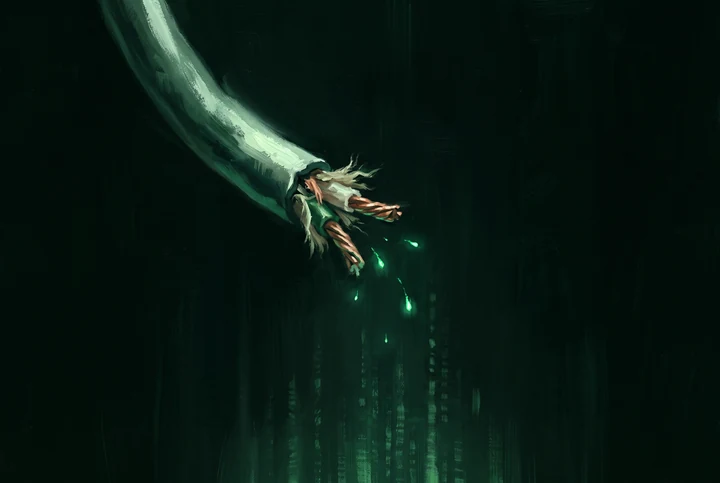
A Switch foi a primeira a morrer, e a primeira a recusar. Logo nos minutos iniciais, com o cabo na mão do Cypher, ela disse duas vezes que não era assim. Vinte e sete capítulos depois, dá pra ouvir a frase com outro peso. Ela não recusava só a morte. Recusava o jeito, presa na única versão que deixaram pra ela, com um nome que, sem o resto, não explicava nada.Switch was the first to die, and the first to refuse. In the opening minutes, with her cable in Cypher’s hand, she said twice that it wasn’t supposed to be like this. Twenty-seven chapters later, you can hear the line with a different weight. She wasn’t refusing only death. She was refusing the manner of it, trapped in the only version they left her, with a name that, without the rest, explained nothing.
Este ensaio passou muitas páginas tentando devolver a ela o resto da frase. Fui buscar nos rascunhos o corpo que a sala de edição cortou, nas placas a doutrina que ninguém disse, nos créditos as pessoas que a lista apagou. E toda vez que eu achava alguma coisa, achava no mesmo lugar: onde o sistema não tinha se dado ao trabalho de ler.This essay spent many pages trying to give her back the rest of the sentence. I went looking in the drafts for the body the editing room cut, on the plates for the doctrine no one spoke, in the credits for the people the list erased. And every time I found something, I found it in the same place: where the system hadn’t bothered to read.
Talvez a próxima sessão de Matrix seja diferente pra quem chegou até aqui. Talvez a primeira linha verde não passe mais batida enquanto alguém ajeita a almofada. Talvez a placa dentro da nave chame atenção, ou o latim em cima da porta da cozinha da Oráculo, ou o jeito como o Smith carrega no senhor antes de cada Anderson. Não escrevi isso pra transformar o filme num quebra-cabeça de detetive, com pista escondida em cada canto. Escrevi porque essas coisas pequenas guardaram, por muito tempo, o que as grandes não podiam dizer.Maybe the next Matrix night will be different for anyone who made it this far. Maybe the first green line won’t slip by while someone settles into the couch. Maybe the plate inside the ship will catch an eye, or the Latin above the Oracle’s kitchen door, or the way Smith leans on the Mister before every Anderson. I didn’t write this to turn the film into a detective puzzle, with a clue hidden in every corner. I wrote it because these small things kept, for a long time, what the big ones couldn’t say.
E porque a pergunta não é só do filme. Quase todo mundo já foi chamado por um nome que não era o seu, ou já ouviu alguém insistir num nome antigo de propósito, pra lembrar quem manda. A Matrix só deu a esse gesto um terno, uma gravata e óculos escuros. O que ela mostrou, e o que a Escritura que ela escondeu nas placas mostra melhor ainda, é que esse gesto não tem a última palavra.And because the question isn’t only the film’s. Almost everyone has been called by a name that wasn’t theirs, or has heard someone insist on an old name on purpose, to remind them who’s in charge. The Matrix only gave that gesture a suit, a tie and sunglasses. What it showed, and what the Scripture it hid on the plates shows even better, is that this gesture doesn’t get the last word.
O Neo disse o próprio nome nos trilhos. A Trinity disse o dela no último ato. O Morpheus ficou num servidor que alguém desligou, e a Switch ficou com metade do que era. Os nomes passaram por mãos que queriam prender, vender ou rebatizar. E mesmo assim ficaram, nas placas, nos rascunhos, na boca das personagens e na memória de quem leu o que ninguém leu.Neo said his own name on the tracks. Trinity said hers in the last act. Morpheus stayed on a server someone switched off, and Switch was left with half of what she was. The names passed through hands that wanted to imprison, sell or rename them. And still they remained, on the plates, in the drafts, in the characters’ mouths and in the memory of those who read what nobody read.
A Switch disse que não era assim. Ela tinha razão. Do outro lado da tela, numa placa de carro que o vilão nunca leu, havia uma promessa de como seria.Switch said it wasn’t supposed to be like this. She was right. On the other side of the screen, on a license plate the villain never read, there was a promise of how it would be.
A Matrix passou quatro filmes cortando nomes. O livro que estava na placa do vilão promete um que não se corta.The Matrix spent four films cutting names. The book on the villain’s license plate promises one that cannot be cut.
FontesSources
A obraThe work
- The Matrix (1999), The Matrix Reloaded (2003) e The Matrix Revolutions (2003), roteiro e direção de Lana e Lilly Wachowski. Warner Bros.The Matrix (1999), The Matrix Reloaded (2003) and The Matrix Revolutions (2003), written and directed by Lana and Lilly Wachowski. Warner Bros.
- The Matrix Resurrections (2021), direção de Lana Wachowski, roteiro de Lana Wachowski, David Mitchell e Aleksandar Hemon. Warner Bros.The Matrix Resurrections (2021), directed by Lana Wachowski, written by Lana Wachowski, David Mitchell and Aleksandar Hemon. Warner Bros.
- The Animatrix (2003), em especial The Second Renaissance, partes I e II (roteiro das Wachowski), The Final Flight of the Osiris e Kid’s Story.The Animatrix (2003), especially The Second Renaissance, parts I and II (written by the Wachowskis), The Final Flight of the Osiris and Kid’s Story.
- Enter the Matrix (Shiny Entertainment, 2003); The Matrix Online (Monolith Productions, 2005 a 2009, enredo de Paul Chadwick); The Matrix: Path of Neo (Shiny Entertainment, 2005).Enter the Matrix (Shiny Entertainment, 2003); The Matrix Online (Monolith Productions, 2005 to 2009, story by Paul Chadwick); The Matrix: Path of Neo (Shiny Entertainment, 2005).
- Roteiros: rascunho de 8 de abril de 1996; rascunhos de 1997; roteiro de filmagem de 29 de março de 1998.Scripts: draft of April 8, 1996; 1997 drafts; shooting script of March 29, 1998.
- Spencer Lamm (org.), The Art of the Matrix. Newmarket Press, 2000.Spencer Lamm (ed.), The Art of the Matrix. Newmarket Press, 2000.
- The Ultimate Matrix Collection (Warner Home Video, 2004), faixas de comentário dos filósofos Cornel West e Ken Wilber e dos críticos de cinema.The Ultimate Matrix Collection (Warner Home Video, 2004), commentary tracks by the philosophers Cornel West and Ken Wilber and by film critics.
As autorasThe authors
- Lilly Wachowski, entrevista ao Netflix Film Club, agosto de 2020.Lilly Wachowski, interview with Netflix Film Club, August 2020.
- Lilly Wachowski, resposta a Elon Musk e Ivanka Trump no Twitter, maio de 2020.Lilly Wachowski, reply to Elon Musk and Ivanka Trump on Twitter, May 2020.
- Lana Wachowski, discurso ao receber o Visibility Award da Human Rights Campaign, San Francisco, 20 de outubro de 2012.Lana Wachowski, speech accepting the Human Rights Campaign Visibility Award, San Francisco, October 20, 2012.
- Lana Wachowski, entrevistas sobre luto e Resurrections, 2021 (NME; Syfy Wire).Lana Wachowski, interviews on grief and Resurrections, 2021 (NME; Syfy Wire).
Bastidores e produçãoBehind the scenes and production
- Lorenzo di Bonaventura, entrevista ao TheWrap, março de 2019.Lorenzo di Bonaventura, interview with TheWrap, March 2019.
- Will Smith, vídeo no canal do YouTube, 2019.Will Smith, video on his YouTube channel, 2019.
- Jennifer Bisset, “Creator of The Matrix code reveals its mysterious origins”, CNET, 19 de outubro de 2017 (entrevista com Simon Whiteley).Jennifer Bisset, “Creator of The Matrix code reveals its mysterious origins,” CNET, October 19, 2017 (interview with Simon Whiteley).
- Propstore, “Mapping Out The Matrix” (sobre os storyboards de Steve Skroce e Geof Darrow).Propstore, “Mapping Out The Matrix” (on the storyboards by Steve Skroce and Geof Darrow).
- Mikhail Skoptsov, “The Ending of 'The Matrix' Changed Many Times Over”, Textual Variations, 2022; e “Neo Was a High Schooler in Earliest Matrix Script”, Fan Fare (sobre a cobertura de leitura de 4 de fevereiro de 1994).Mikhail Skoptsov, “The Ending of 'The Matrix' Changed Many Times Over,” Textual Variations, 2022; and “Neo Was a High Schooler in Earliest Matrix Script,” Fan Fare (on the reader’s report of February 4, 1994).
- Sobre Bound (1996): entrevista de Gina Gershon à Inverse; reportagens da MEL Magazine e da NPR (2024).On Bound (1996): Gina Gershon’s interview with Inverse; reporting by MEL Magazine and NPR (2024).
- Sobre Sophia Stewart: Lead Stories, checagem de 2022; Snopes.On Sophia Stewart: Lead Stories fact check, 2022; Snopes.
- Sobre o quinto filme: comunicado da Warner Bros., abril de 2024.On the fifth film: Warner Bros. statement, April 2024.
- Sobre a venda da Warner: acordo de fusão entre Paramount Skydance e Warner Bros. Discovery (27 de fevereiro de 2026), formulários 10-Q das duas empresas na SEC (2026), Variety (21 e 30 de setembro de 2026), The Hollywood Reporter, CNN e NBC News (30 de setembro de 2026), CNBC (2 de outubro de 2026, sobre o nome Skydance).On the sale of Warner: merger agreement between Paramount Skydance and Warner Bros. Discovery (February 27, 2026), both companies’ 10-Q filings with the SEC (2026), Variety (September 21 and 30, 2026), The Hollywood Reporter, CNN and NBC News (September 30, 2026), CNBC (October 2, 2026, on the Skydance name).
Crítica e academiaCriticism and scholarship
- Cáel M. Keegan, Lana and Lilly Wachowski: Sensing Transgender. University of Illinois Press, 2018.Cáel M. Keegan, Lana and Lilly Wachowski: Sensing Transgender. University of Illinois Press, 2018.
- Cáel M. Keegan, “Mirror Scene: Transgender Aesthetics in The Matrix and Boys Don’t Cry”, em The Oxford Handbook of Queer Cinema.Cáel M. Keegan, “Mirror Scene: Transgender Aesthetics in The Matrix and Boys Don’t Cry,” in The Oxford Handbook of Queer Cinema.
- Andrea Long Chu, Females. Verso, 2019.Andrea Long Chu, Females. Verso, 2019.
- Eleanor Lockhart (Rowan University), observação sobre o “senhor Anderson” citada pela Netflix em 2020.Eleanor Lockhart (Rowan University), remark on “Mr. Anderson” quoted by Netflix in 2020.
- “THE MATRIX As Transgender Metaphor”, Birth.Movies.Death.“THE MATRIX As Transgender Metaphor,” Birth.Movies.Death.
- “A Return to The Matrix Explores Binary Thinking”, Hyperallergic, 2021.“A Return to The Matrix Explores Binary Thinking,” Hyperallergic, 2021.
- Stephen Faller, Beyond the Matrix: Revolutions and Revelations. Chalice Press, 2004.Stephen Faller, Beyond the Matrix: Revolutions and Revelations. Chalice Press, 2004.
- Stacy Gillis (org.), The Matrix Trilogy: Cyberpunk Reloaded. Wallflower Press, 2005.Stacy Gillis (ed.), The Matrix Trilogy: Cyberpunk Reloaded. Wallflower Press, 2005.
- The Daily Princetonian, reportagem sobre Cornel West e a trilogia, 2003.The Daily Princetonian, report on Cornel West and the trilogy, 2003.
- “How Science Fiction Found Religion”, City Journal.“How Science Fiction Found Religion,” City Journal.
- Spirituality & Practice, resenha de The Matrix (sobre a crítica cristã à violência do herói).Spirituality & Practice, review of The Matrix (on the Christian critique of the hero’s violence).
- “Leave Babylon: The Trope of Babylon in Rastafari Discourse”, 2015 (sobre Marcus Garvey e o par Babilônia e Sião).“Leave Babylon: The Trope of Babylon in Rastafari Discourse,” 2015 (on Marcus Garvey and the pair Babylon and Zion).
Filosofia e literaturaPhilosophy and literature
- Platão, República, livro VII. René Descartes, Meditações, 1641. Ovídio, Metamorfoses, livro XI.Plato, Republic, Book VII. René Descartes, Meditations, 1641. Ovid, Metamorphoses, Book XI.
- Philip K. Dick, palestra na convenção de ficção científica de Metz, 1977.Philip K. Dick, speech at the Metz science fiction convention, 1977.
- Jean Baudrillard, Simulacros e Simulação, 1981; entrevista ao Le Nouvel Observateur, 2003.Jean Baudrillard, Simulacra and Simulation, 1981; interview with Le Nouvel Observateur, 2003.
- William Gibson, Neuromancer, 1984.William Gibson, Neuromancer, 1984.
- Slavoj Žižek, Bem-vindo ao Deserto do Real, 2002 (ed. bras. Boitempo, 2003); O Guia Pervertido do Cinema, direção de Sophie Fiennes, 2006.Slavoj Žižek, Welcome to the Desert of the Real. Verso, 2002; The Pervert’s Guide to Cinema, directed by Sophie Fiennes, 2006.
- Roland Barthes, “A Morte do Autor”, 1967.Roland Barthes, “The Death of the Author,” 1967.
- Richard Wright, Filho Nativo, 1940.Richard Wright, Native Son, 1940.
- Thomas Gray, “Ode on a Distant Prospect of Eton College”, 1742.Thomas Gray, “Ode on a Distant Prospect of Eton College,” 1742.
- Michael Baigent, Richard Leigh e Henry Lincoln, O Santo Graal e a Linhagem Sagrada, 1982.Michael Baigent, Richard Leigh and Henry Lincoln, Holy Blood, Holy Grail, 1982.
Biologia e neurociênciaBiology and neuroscience
- Alfred Jost, experimentos clássicos sobre a diferenciação sexual em embriões, décadas de 1940 e 1950.Alfred Jost, classic experiments on sexual differentiation in embryos, 1940s and 1950s.
- I. A. Hughes et al., “Consensus statement on management of intersex disorders”, Archives of Disease in Childhood 91, n. 7 (2006): 554-563.I. A. Hughes et al., “Consensus statement on management of intersex disorders,” Archives of Disease in Childhood 91, no. 7 (2006): 554-563.
- “WNT4, RSPO1, and FOXL2 in sex development”, Seminars in Reproductive Medicine 30, n. 5 (2012): 387-395.“WNT4, RSPO1, and FOXL2 in sex development,” Seminars in Reproductive Medicine 30, no. 5 (2012): 387-395.
- N. H. Uhlenhaut et al., “Somatic sex reprogramming of adult ovaries to testes by FOXL2 ablation”, Cell, 2009.N. H. Uhlenhaut et al., “Somatic sex reprogramming of adult ovaries to testes by FOXL2 ablation,” Cell, 2009.
- Anne Fausto-Sterling, Sexing the Body. Basic Books, 2000.Anne Fausto-Sterling, Sexing the Body. Basic Books, 2000.
- Leonard Sax, “How common is intersex?”, Journal of Sex Research 39, n. 3 (2002): 174-178.Leonard Sax, “How common is intersex?,” Journal of Sex Research 39, no. 3 (2002): 174-178.
- J.-N. Zhou et al., “A sex difference in the human brain and its relation to transsexuality”, Nature 378 (1995): 68-70.J.-N. Zhou et al., “A sex difference in the human brain and its relation to transsexuality,” Nature 378 (1995): 68-70.
- F. P. M. Kruijver et al., “Male-to-female transsexuals have female neuron numbers in a limbic nucleus”, Journal of Clinical Endocrinology and Metabolism 85, n. 5 (2000): 2034-2041.F. P. M. Kruijver et al., “Male-to-female transsexuals have female neuron numbers in a limbic nucleus,” Journal of Clinical Endocrinology and Metabolism 85, no. 5 (2000): 2034-2041.
- A. Garcia-Falgueras e D. F. Swaab, “A sex difference in the hypothalamic uncinate nucleus: relationship to gender identity”, Brain 131, n. 12 (2008): 3132-3146.A. Garcia-Falgueras and D. F. Swaab, “A sex difference in the hypothalamic uncinate nucleus: relationship to gender identity,” Brain 131, no. 12 (2008): 3132-3146.
- G. Rametti et al., “White matter microstructure in female to male transsexuals before cross-sex hormonal treatment”, Journal of Psychiatric Research 45, n. 2 (2011): 199-204.G. Rametti et al., “White matter microstructure in female to male transsexuals before cross-sex hormonal treatment,” Journal of Psychiatric Research 45, no. 2 (2011): 199-204.
- D. Joel et al., “Sex beyond the genitalia: The human brain mosaic”, PNAS 112, n. 50 (2015): 15468-15473.D. Joel et al., “Sex beyond the genitalia: The human brain mosaic,” PNAS 112, no. 50 (2015): 15468-15473.
- M. Del Giudice et al., PNAS 113, n. 14 (2016): E1965; A. M. Chekroud et al., PNAS 113, n. 14 (2016): E1968.M. Del Giudice et al., PNAS 113, no. 14 (2016): E1965; A. M. Chekroud et al., PNAS 113, no. 14 (2016): E1968.
Teologia e EscrituraTheology and Scripture
- Bíblia Sagrada, Almeida Revista e Atualizada. Textos citados ou parafraseados: Gênesis 1.27, 2.24, 17, 25, 32; Números 11; Deuteronômio 23.1; 2 Samuel 6; 1 Reis 18.21; Salmos 137 e 139; Isaías 43.1, 54, 56.3-5; Daniel 2 e 4; Mateus 19.12; Marcos 3.11-12; João 11 e 19.30; Atos 8; Romanos 1 e 8; 1 Coríntios 15; Efésios 2.1-5; 1 Timóteo 2.5; Hebreus 11.10 e 12.16; Apocalipse 2.17.The Holy Bible, English Standard Version, for quotations in this edition (the Portuguese edition follows the Almeida Revista e Atualizada); also the King James Version (Daniel 2, Isaiah 54:16, Isaiah 56:5) and the NIV and NASB (Hebrews 11:10). Passages cited or paraphrased: Genesis 1:27, 2:24, 17, 25, 32; Numbers 11; Deuteronomy 23:1; 2 Samuel 6; 1 Kings 18:21; Psalms 137 and 139; Isaiah 43:1, 54, 56:3-5; Daniel 2 and 4; Matthew 19:12; Mark 3:11-12; John 11 and 19:30; Acts 8; Romans 1 and 8; 1 Corinthians 15; Ephesians 2:1-5; 1 Timothy 2:5; Hebrews 11:10 and 12:16; Revelation 2:17.
- João Calvino, Institutas da Religião Cristã, I.1.1, I.5, I.11.8, II.2.15 e II.16.10.John Calvin, Institutes of the Christian Religion, I.1.1, I.5, I.11.8, II.2.15 and II.16.10.
- Confissão de Fé de Westminster, III.1 e XXI.1. Catecismo de Heidelberg, pergunta 44.Westminster Confession of Faith, III.1 and XXI.1. Heidelberg Catechism, Question 44.
- Herman Bavinck, Dogmática Reformada, vol. 1. Louis Berkhof, Teologia Sistemática.Herman Bavinck, Reformed Dogmatics, vol. 1. Louis Berkhof, Systematic Theology.
- Megan K. DeFranza, Sex Difference in Christian Theology. Eerdmans, 2015.Megan K. DeFranza, Sex Difference in Christian Theology. Eerdmans, 2015.
- Austen Hartke, Transforming: The Bible and the Lives of Transgender Christians. Westminster John Knox, 2018.Austen Hartke, Transforming: The Bible and the Lives of Transgender Christians. Westminster John Knox, 2018.
- Declaração de Nashville, Council on Biblical Manhood and Womanhood, 2017, artigos 6 e 7.The Nashville Statement, Council on Biblical Manhood and Womanhood, 2017, Articles 6 and 7.
- Mishná, Bikkurim 4; Talmude Bavli, Yevamot 64a-b, 80a-b e 83a, Berakhot 61a, Eruvin 18a; Bereshit Rabbá 8.1. Sarra Lev, “Androgynes and Eunuchs: Gender and Sex in Rabbinic Texts”.Mishnah, Bikkurim 4; Babylonian Talmud, Yevamot 64a-b, 80a-b and 83a, Berakhot 61a, Eruvin 18a; Bereshit Rabbah 8:1. Sarra Lev, “Androgynes and Eunuchs: Gender and Sex in Rabbinic Texts.”
- Juliana Hoffmann, Formados de Modo Assombroso, tese teológica, 2026; “Destino, Liberdade & Soberania”, Beyond Patterns, maio de 2026.Juliana Hoffmann, Formados de Modo Assombroso, theological thesis (in Portuguese), 2026; “Destiny, Freedom & Sovereignty,” Beyond Patterns, May 2026.