Prologue: I Didn't Know How Much I Would CryPrólogo: Eu Não Sabia o Quanto Eu Ia Chorar
Full spoilers ahead. This piece covers the whole story of Marvel's Wolverine, including the final act and the hidden post-credits scene. If you haven't finished the game, save it for later. Everything below assumes you've seen the end. Along the way there are also lighter spoilers for Sekiro: Shadows Die Twice, Marvel's Spider-Man 2, The Last of Us and Brothers: A Tale of Two Sons.Spoilers totais. Este texto cobre a história inteira de Marvel's Wolverine, incluindo o ato final e a cena escondida pós-créditos. Se você ainda não terminou o jogo, salva pra depois. Tudo daqui pra baixo parte do princípio de que você já viu o final. No caminho também tem spoilers mais leves de Sekiro: Shadows Die Twice, Marvel's Spider-Man 2, The Last of Us e Brothers: A Tale of Two Sons.
My loves, I played Marvel's Wolverine on a PS5 Pro. It ran smoothly from start to finish. The claws landed where I wanted them to land. The body in my hands felt heavy, fast and angry, which is exactly what a Wolverine game owes you.Meus amores, eu joguei Marvel's Wolverine num PS5 Pro. Rodou liso do começo ao fim. As garras entravam onde eu queria que entrassem. O corpo nas minhas mãos era pesado, rápido e furioso, que é exatamente o que um jogo do Wolverine te deve.
None of that is why I'm writing this.Nada disso é o motivo deste texto.
I'm writing this because of the ending. More precisely, because of the moment Logan loses his memories. Jean's fire goes through him and takes everything with it: the farm, the years, Team X, her. That's where I broke down. Not the discreet kind of crying, the single tear you catch with a knuckle before anyone notices. I cried a lot, and the part that still surprises me is that I didn't see it coming. I didn't know how much I would cry until I was already doing it.Eu estou escrevendo por causa do final. Mais precisamente, por causa do momento em que o Logan perde as memórias. O fogo da Jean atravessa ele e leva tudo junto: a fazenda, os anos, o Team X, ela. Foi ali que eu desabei. Não aquele choro discreto, a lágrima única que você seca com o nó do dedo antes que alguém perceba. Eu chorei muito, e o que ainda me surpreende é que eu não vi vindo. Eu não sabia o quanto eu ia chorar até já estar chorando.
That surprise deserves an explanation, because on paper this was not supposed to be the game that did it. The critical reception was lukewarm: a 77 on Metacritic, a 6 out of 10 from IGN, whose verdict was that the combat wears thin well before the conclusion and that even the strong character work can't lift the game past "okay". Reviewers praised the performances and complained about the combat loop, the pacing, a story that doesn't always hold its shape. Some of that criticism is fair. I'll get to it.Essa surpresa merece uma explicação, porque no papel este não era o jogo que ia fazer isso comigo. A recepção da crítica foi morna: 77 no Metacritic, 6 de 10 na IGN, cujo veredito foi que o combate cansa bem antes do fim e que nem o bom trabalho de personagem consegue levar o jogo além do "ok". A crítica elogiou as atuações e reclamou do ciclo de combate, do ritmo, de uma história que nem sempre segura a própria forma. Parte dessa crítica é justa. Eu chego lá.
And yet. A game plenty of people called average built an ending that took me apart.E mesmo assim. Um jogo que muita gente chamou de mediano construiu um final que me desmontou.
Here is the complication, and it is the reason this essay exists at all. The same scene that broke me also bothered me. Something in the way the finale is staged left a taste I couldn't name right away, a feeling that the game had taken something from its own protagonist at the exact moment he was supposed to be most himself. Both reactions are real. I'm not going to pick one and pretend the other didn't happen. The tears and the discomfort came from the same place, and this essay is an attempt to find that place.Aqui está a complicação, e ela é o motivo de este ensaio existir. A mesma cena que me quebrou também me incomodou. Alguma coisa no jeito como o final é encenado deixou um gosto que eu não consegui nomear na hora, a sensação de que o jogo tinha tirado algo do próprio protagonista exatamente no momento em que ele devia ser mais ele mesmo. As duas reações são reais. Eu não vou escolher uma e fingir que a outra não aconteceu. As lágrimas e o incômodo vieram do mesmo lugar, e este ensaio é uma tentativa de achar esse lugar.
So let me say what the game does, in one sentence, before we spend seventeen thousand words taking it apart.Então deixa eu dizer o que o jogo faz, numa frase só, antes de a gente gastar dezessete mil palavras desmontando ele.
Marvel's Wolverine erases Logan's memory twice.Marvel's Wolverine apaga a memória do Logan duas vezes.
The first time, Nathaniel Essex does it. He breaks Logan with the death of the woman he loves, loops that death until the man collapses into the animal, and then builds a soldier out of what's left. The second time, Jean Grey does it, because Logan asks her to. She burns his mind clean so that something older and worse can't wear him like a coat.Na primeira, quem apaga é o Nathaniel Essex. Ele quebra o Logan com a morte da mulher que ele ama, repete essa morte em loop até o homem desabar no animal, e depois constrói um soldado com o que sobrou. Na segunda, quem apaga é a Jean Grey, porque o Logan pede. Ela queima a mente dele até deixar limpa, pra que uma coisa mais antiga e pior não possa vestir ele como um casaco.
Same operation. Opposite meaning. The first erasure was a leash. The second was a release. And the second one is the one that made me cry.Mesma operação. Sentido oposto. O primeiro apagamento foi uma coleira. O segundo foi uma libertação. E foi o segundo que me fez chorar.
He dies twice in this game, too. If that phrase rings a bell, let it ring. We'll come back to it.Ele também morre duas vezes neste jogo. Se a frase soa familiar, deixa ela soar. A gente volta nisso.
A word about what this is and what it isn't. This isn't a review. You won't find a score here, and the only technical talk is in service of an argument. It isn't an "ending explained" either. The internet already has plenty of those, and they answer the question of what happened. I'm interested in why it works, why it hurts, and where it fails. Call it an anatomy, not a verdict. Two deaths, laid side by side on the table: one that gives a man his name back, and one that takes it away.Uma palavra sobre o que isto é e o que não é. Isto não é review. Você não vai achar nota aqui, e a única conversa técnica está a serviço de um argumento. Também não é um "final explicado". A internet já tem vários, e eles respondem o que aconteceu. Eu estou interessada em por que funciona, por que dói e onde falha. Chama de anatomia, não de veredito. Duas mortes, lado a lado na mesa: uma que devolve o nome de um homem, e uma que tira.
Here's the route.Aqui está o caminho.
Part I goes back to the oldest wound in the character: a Wolverine with no past, and why the comics protected that emptiness for decades. Part II leaves the game for a while and walks into clinical territory, because there is a real name for what Essex does to Logan. Dissociative fugue is not a comic book invention. It has a history, a mechanism and a place in the diagnostic manuals, and it also carries a set of myths the game happily borrows. We'll separate the two. Parts III and IV put Essex and Jean face to face: a man who treats memory as something to own, and a woman who treats it as a promise she keeps alone. Part V follows the thread the game hides in plain sight, from a word spoken in Tokyo to a title Logan carried long before Team X. Part VI slows down and walks through the ending beat by beat, because the details are where it lives. Part VII talks about the body in your hands, how the game plays and runs, and why that matters for what comes after. Part VIII is where the discomfort gets a name. Part IX asks the question I couldn't stop asking after the credits: in Logan's game, who should have been the one to forget? Part X looks at the player, the person holding the controller, and what the game asks us to carry. The coda brings us back here.A Parte I volta à ferida mais antiga do personagem: um Wolverine sem passado, e por que os quadrinhos protegeram esse vazio por décadas. A Parte II sai do jogo por um tempo e entra em território clínico, porque existe um nome real pro que o Essex faz com o Logan. A fuga dissociativa não é invenção de quadrinho. Ela tem história, mecanismo e lugar nos manuais de diagnóstico, e também carrega um punhado de mitos que o jogo pega emprestado com gosto. A gente vai separar as duas coisas. As Partes III e IV colocam Essex e Jean frente a frente: um homem que trata a memória como algo pra possuir, e uma mulher que trata a memória como uma promessa que ela cumpre sozinha. A Parte V segue o fio que o jogo esconde à vista de todos, de uma palavra dita em Tóquio até um título que o Logan carregava muito antes do Team X. A Parte VI desacelera e percorre o final passo a passo, porque é nos detalhes que ele vive. A Parte VII fala do corpo nas suas mãos, de como o jogo joga e roda, e de por que isso importa pro que vem depois. A Parte VIII é onde o incômodo ganha nome. A Parte IX faz a pergunta que eu não consegui parar de fazer depois dos créditos: no jogo do Logan, quem devia ter esquecido? A Parte X olha pra quem joga, a pessoa que segura o controle, e pro que o jogo pede pra gente carregar. A coda traz a gente de volta pra cá.
Read the subtitle again. Slowly. Only one of those deaths was cruel.Lê o subtítulo de novo. Devagar. Só uma dessas mortes foi cruel.
The other one was love. It hurt more anyway.A outra foi amor. Doeu mais mesmo assim.

Both can be true.As duas cabem.
Light each lens. You can keep both on.Acenda cada lente. Você pode manter as duas acesas.
Two lenses. Neither cancels the other.Duas lentes. Uma não anula a outra.
Part I: Wolverine Without a PastParte I: Wolverine Sem Passado
Wolverine arrived without a history, and for a long time that was the point.O Wolverine chegou sem história, e por muito tempo esse era o ponto.
He first shows up in 1974, in the closing pages of The Incredible Hulk #180, and gets his first real fight in #181: a short Canadian agent with claws, sent to stop the Hulk. No origin. No childhood. No name beyond a codename and, later, "Logan", which might not even be his. When Chris Claremont took over the X-Men in 1975, he inherited a character who was mostly silhouette, and he made a decision that shaped the next half century: he didn't fill the hole. He fed it.Ele aparece pela primeira vez em 1974, nas páginas finais de The Incredible Hulk #180, e ganha a primeira luta de verdade no #181: um agente canadense baixinho, com garras, mandado pra parar o Hulk. Sem origem. Sem infância. Sem nome além de um codinome e, depois, "Logan", que talvez nem seja dele. Quando o Chris Claremont assumiu os X-Men em 1975, ele herdou um personagem que era quase só silhueta, e tomou uma decisão que moldou o meio século seguinte: ele não preencheu o buraco. Ele alimentou.
Over sixteen years, Claremont handed readers fragments. A past in Japan. A war he had apparently fought in. A 1990 flashback that put him in Madripoor in 1941, next to Captain America, decades before he should have existed as anything we recognized. Every answer arrived carrying two new questions, and the reader never got a biography, only evidence that one existed somewhere, locked away from the man it belonged to.Ao longo de dezesseis anos, o Claremont foi entregando fragmentos. Um passado no Japão. Uma guerra em que ele parecia ter lutado. Um flashback de 1990 que colocava ele em Madripoor em 1941, ao lado do Capitão América, décadas antes de ele poder existir como qualquer coisa que a gente reconhecesse. Cada resposta chegava carregando duas perguntas novas, e o leitor nunca ganhou uma biografia, só a prova de que uma existia em algum lugar, trancada longe do homem a quem ela pertencia.
This is why the mystery worked for so long. A character who can't remember his past becomes a surface, and readers project onto a surface. But there's a second reason, closer to the bone. Logan can't die and can't remember. He endures without a story: he heals from everything, and nothing that happens to him, no wound, no war, no woman, ever adds up to a self he can hold. The healing factor keeps the body. The amnesia takes the narrative. What's left is a man who keeps going without knowing what he's going toward.É por isso que o mistério funcionou por tanto tempo. Um personagem que não lembra do próprio passado vira uma superfície, e o leitor projeta numa superfície. Mas tem um segundo motivo, mais perto do osso. O Logan não consegue morrer e não consegue lembrar. Ele resiste sem uma história: ele se cura de tudo, e nada do que acontece com ele, nenhuma ferida, nenhuma guerra, nenhuma mulher, chega a formar um eu que ele consiga segurar. O fator de cura guarda o corpo. A amnésia leva a narrativa. O que sobra é um homem que continua andando sem saber pra onde está indo.
The hole was the character.O buraco era o personagem.
Then, in 1991, someone decided to show us how the hole was made.Até que, em 1991, alguém resolveu mostrar como o buraco foi feito.
Barry Windsor-Smith's Weapon X ran across Marvel Comics Presents #72 to #84, and it is less an origin than an autopsy performed on a living patient. Windsor-Smith started it on his own initiative and walked into Marvel's offices with the first finished pages, and what he delivered is thirteen chapters of a man strapped down, wired, helmeted, and flooded with metal. Logan barely speaks in his own origin story. The scientists around him do the talking, and one of the things they try to do, explicitly, is suppress who he is. The adamantium is the famous part. The erasure is the part that matters for us.O Weapon X do Barry Windsor-Smith saiu em Marvel Comics Presents, do #72 ao #84, e é menos uma origem do que uma autópsia feita num paciente vivo. O Windsor-Smith começou a história por conta própria e entrou no escritório da Marvel com as primeiras páginas prontas, e o que ele entregou são treze capítulos de um homem amarrado, cheio de fios, de capacete, inundado de metal. O Logan mal fala na própria história de origem. Quem fala são os cientistas em volta dele, e uma das coisas que eles tentam fazer, explicitamente, é suprimir quem ele é. O adamantium é a parte famosa. O apagamento é a parte que importa pra gente.
Read that setup again, because everything in this essay grows out of it. In Weapon X, Logan's memory isn't lost. It's taken. His past stops being a mystery and becomes a crime scene, and memory turns into territory, something that can be occupied, mined and overwritten by whoever holds the keys to the lab. The project wants a weapon, and a weapon with a biography is a weapon that might say no. So they erase the man to keep the tool.Lê essa premissa de novo, porque tudo neste ensaio nasce dela. Em Weapon X, a memória do Logan não se perde. Ela é tomada. O passado dele deixa de ser mistério e vira cena de crime, e a memória vira território, uma coisa que pode ser ocupada, minerada e sobrescrita por quem tiver a chave do laboratório. O projeto quer uma arma, e uma arma com biografia é uma arma que pode dizer não. Então eles apagam o homem pra ficar com a ferramenta.
Windsor-Smith even plants a trap inside his own story: the long sequence where Logan breaks free and hunts his captors turns out to be a simulation running in his head. His rebellion, the most Wolverine thing in the whole arc, was fabricated by the people he thought he was escaping. The comics that followed pushed the idea further, with Larry Hama's run establishing that some of Logan's memories were implanted outright. By the mid-nineties, Logan's past was a place other people wrote on.O Windsor-Smith ainda planta uma armadilha dentro da própria história: a longa sequência em que o Logan se liberta e caça os seus captores é, na verdade, uma simulação rodando na cabeça dele. A rebelião dele, a coisa mais Wolverine do arco inteiro, foi fabricada pelas pessoas de quem ele achava que estava fugindo. Os quadrinhos que vieram depois levaram a ideia mais longe, com a fase do Larry Hama estabelecendo que algumas memórias do Logan tinham sido implantadas de propósito. Na metade dos anos noventa, o passado do Logan era um lugar onde outras pessoas escreviam.
There's a hand behind the hand. Throughout Weapon X, the Professor running the project takes orders from someone above him, someone who knows more and would happily sacrifice him. According to Windsor-Smith, that figure was meant to be Apocalypse: Claremont had told him he planned to make Apocalypse responsible for Logan's skeleton, but Claremont left the X-books before he could make that connection, and the mystery figure was eventually revealed to be someone else entirely. Remember that figure. It comes back.Tem uma mão por trás da mão. Ao longo de Weapon X, o Professor que comanda o projeto recebe ordens de alguém acima dele, alguém que sabe mais e sacrificaria ele sem pensar duas vezes. Segundo o Windsor-Smith, essa figura era pra ser o Apocalipse: o Claremont tinha contado a ele que planejava fazer do Apocalipse o responsável pelo esqueleto do Logan, mas o Claremont saiu dos títulos dos X-Men antes de conseguir fazer essa conexão, e a figura misteriosa acabou revelada como outra pessoa. Guarda essa figura. Ela volta.
Marvel finally spelled the rest out in 2001, with Origin: a sickly boy named James Howlett, a family tragedy, a stolen name. The mystery ended on paper. It never quite ended in the character, because by then amnesia wasn't a plot point anymore. It was his grammar. Every Wolverine story since has been, on some level, about a man negotiating with a past he can't fully access.A Marvel finalmente escreveu o resto em 2001, com Origin: um menino doente chamado James Howlett, uma tragédia de família, um nome roubado. O mistério acabou no papel. Nunca acabou de verdade no personagem, porque àquela altura a amnésia já não era um detalhe de enredo. Era a gramática dele. Toda história do Wolverine desde então é, em algum nível, sobre um homem negociando com um passado que ele não consegue acessar por inteiro.
Which brings us to the game.O que nos leva ao jogo.
Marvel's Wolverine opens in familiar territory, and it knows it. Logan was found feral by a geneticist named Nathaniel Essex. He spent the next twenty-seven years working for Essex's mutant strike force, Team X, earning the codename "Wolverine" long before anyone handed him back anything resembling a real name. Then he quit. When the game begins, he's been gone for three years, and he comes back to rescue the man who found him.Marvel's Wolverine abre em território conhecido, e sabe disso. O Logan foi encontrado em estado feral por um geneticista chamado Nathaniel Essex. Ele passou os vinte e sete anos seguintes trabalhando pra força de ataque mutante do Essex, o Team X, e ganhou o codinome "Wolverine" muito antes de alguém devolver a ele qualquer coisa parecida com um nome de verdade. Depois ele saiu. Quando o jogo começa, ele está fora há três anos, e volta pra resgatar o homem que o encontrou.
Notice what the game lets him have, and when. The codename comes easy. "Logan" is what the people around him call him, while his full name, James Logan Howlett, is one of the last things the story gives back, and it arrives late for a reason. The game treats his real name as something he has to earn, the way Claremont treated his past as something readers had to earn. On the surface, this is the Wolverine we've always had: a weapon with a nickname, a man with a gap where the beginning should be.Repara no que o jogo deixa ele ter, e quando. O codinome vem fácil. "Logan" é como as pessoas em volta chamam ele, enquanto o nome completo, James Logan Howlett, é uma das últimas coisas que a história devolve, e chega tarde por um motivo. O jogo trata o nome verdadeiro dele como algo que ele precisa conquistar, do mesmo jeito que o Claremont tratava o passado dele como algo que o leitor precisava conquistar. Na superfície, este é o Wolverine de sempre: uma arma com apelido, um homem com um vão onde devia estar o começo.
But there is one difference, and it's the one this whole essay hangs on.Mas tem uma diferença, e é dela que este ensaio inteiro depende.
In the comics, the thief was a program. A committee. An acronym with a letter X in it. Institutions steal memory in the passive voice; nobody in particular did it, everyone was following orders. In Marvel's Wolverine, the thief has a face, a voice and a first name, and he stands much closer to Logan than anyone playing the first hours would ever guess. How close, how he did it, and why, belongs to Part III. For now, it's enough to see the shape: the game takes the old, abstract violence of Weapon X and gives it someone to blame.Nos quadrinhos, o ladrão era um programa. Um comitê. Uma sigla com um X no meio. Instituições roubam memória na voz passiva; ninguém em particular fez, todo mundo estava cumprindo ordens. Em Marvel's Wolverine, o ladrão tem rosto, voz e primeiro nome, e está muito mais perto do Logan do que qualquer pessoa jogando as primeiras horas poderia imaginar. O quão perto, como ele fez isso e por quê, fica pra Parte III. Por enquanto, basta ver o formato: o jogo pega a violência antiga e abstrata do Weapon X e dá a ela alguém pra culpar.
Behind that someone, the game places a figure older and worse, the same shadow Claremont never got to reveal, and whether Insomniac meant it as homage or arrived there on its own, the game finishes a sentence the comics left hanging for thirty-five years.Por trás desse alguém, o jogo coloca uma figura mais antiga e pior, a mesma sombra que o Claremont nunca chegou a revelar, e seja homenagem da Insomniac, seja um caminho a que ela chegou sozinha, o jogo termina uma frase que os quadrinhos deixaram pendurada por trinta e cinco anos.
So here is where Part I leaves us. For fifty years, forgetting has been the wound. It's what was done to Logan, over and over, by people who wanted something from him. Every version of the character carries that injury.Então é aqui que a Parte I nos deixa. Por cinquenta anos, esquecer foi a ferida. É o que fizeram com o Logan, de novo e de novo, pessoas que queriam alguma coisa dele. Toda versão do personagem carrega essa lesão.
What does it mean, then, when a game about Wolverine ends with forgetting as the cure?O que significa, então, quando um jogo do Wolverine termina com o esquecimento como cura?

Under the label.Debaixo do rótulo.
Lift the assigned name. The person was already there.Levante o nome imposto. A pessoa já estava ali.
A codename covers a life.Um codinome cobre uma vida.
Part II: The Fugue StateParte II: O Estado de Fuga
For a few pages, I'm going to leave the game.Por algumas páginas, eu vou sair do jogo.
Not because Marvel's Wolverine needs a clinical excuse. It doesn't. But it borrows a real condition, and borrowing works best when you know exactly what you've taken. What Essex does to Logan has a name outside the comics, and that name comes with a history, a mechanism and a small cloud of myths. We need all three.Não porque Marvel's Wolverine precise de uma desculpa clínica. Não precisa. Mas ele pega emprestada uma condição real, e empréstimo funciona melhor quando você sabe exatamente o que pegou. O que o Essex faz com o Logan tem nome fora dos quadrinhos, e esse nome vem com uma história, um mecanismo e uma pequena nuvem de mitos. A gente precisa dos três.
Start with the word. Dissociation is not a fancy synonym for spacing out, and it isn't a poetic way of saying someone is traumatized. In the clinical sense, it names a failure in something the mind usually does without asking permission: integration. Memory, identity, perception, emotion, the sense of your own body. Normally all of it arrives bound together as one continuous experience of being you, and dissociation is what happens when that binding breaks and part of experience keeps existing without being connected to the rest.Começa pela palavra. Dissociação não é um sinônimo chique de "viajar na maionese", e não é um jeito poético de dizer que alguém está traumatizado. No sentido clínico, ela nomeia uma falha numa coisa que a mente costuma fazer sem pedir licença: integrar. Memória, identidade, percepção, emoção, a sensação do próprio corpo. Normalmente tudo isso chega amarrado numa experiência contínua de ser você, e a dissociação é o que acontece quando essa amarra rompe e uma parte da experiência continua existindo sem estar ligada ao resto.
The idea is older than any current manual. In 1889, the French psychologist Pierre Janet published L'Automatisme psychologique, describing patients whose minds, under overwhelming strain, failed to integrate certain experiences, experiences that didn't disappear: they persisted outside awareness, split off and still able to shape behavior. Janet's word for it was désagrégation. A coming apart.A ideia é mais velha que qualquer manual atual. Em 1889, o psicólogo francês Pierre Janet publicou L'Automatisme psychologique, descrevendo pacientes cuja mente, sob uma pressão avassaladora, não conseguia integrar certas experiências, experiências que não sumiam: elas persistiam fora da consciência, separadas e ainda capazes de moldar o comportamento. A palavra de Janet pra isso era désagrégation. Um desmanchar.
There's an image I need you to carry through the rest of this part. Think of a fire door. When something inside a building is burning, the door closes and seals the section off, and the building survives because part of it becomes unreachable. Nothing in the sealed rooms is destroyed, it's simply no longer connected to the halls you walk through every day.Tem uma imagem que eu preciso que você carregue pelo resto desta parte. Pensa numa porta corta-fogo. Quando alguma coisa pega fogo dentro de um prédio, a porta fecha e isola aquela ala, e o prédio sobrevive porque uma parte dele fica inalcançável. Nada nas salas isoladas é destruído, elas só deixam de estar ligadas aos corredores por onde você anda todo dia.
That door comes back at the end of this part, and again at the end of the game.Essa porta volta no fim desta parte, e de novo no fim do jogo.
The man who sold stationeryO homem que vendia papelaria
On January 17, 1887, a preacher named Ansel Bourne left his home in Greene, Rhode Island, and went to Providence. He withdrew money, paid some bills, visited relatives. Then he vanished.Em 17 de janeiro de 1887, um pregador chamado Ansel Bourne saiu de casa em Greene, Rhode Island, e foi pra Providence. Sacou dinheiro, pagou umas contas, visitou parentes. Depois sumiu.
By early February, a man calling himself A. J. Brown had rented a small shop in Norristown, Pennsylvania, and was selling stationery and confectionery out of it. He lived in the back. By the accounts that survive, he got along with his neighbors. Nothing about him looked broken.No começo de fevereiro, um homem que se chamava A. J. Brown tinha alugado uma lojinha em Norristown, na Pensilvânia, e vendia papelaria e doces ali. Ele morava nos fundos. Pelos relatos que sobreviveram, se dava bem com os vizinhos. Nada nele parecia quebrado.
On the morning of March 14, he woke up terrified. He didn't recognize the room or the town, he believed it was still January, and he insisted, to the confused people around him, that his name was Ansel Bourne. Of the two months he had spent as Brown, he remembered nothing at all.Na manhã de 14 de março, ele acordou apavorado. Não reconhecia o quarto nem a cidade, achava que ainda era janeiro, e insistia, pras pessoas confusas em volta dele, que o nome dele era Ansel Bourne. Dos dois meses que tinha passado como Brown, ele não lembrava de absolutamente nada.
In 1890, while William James was finishing The Principles of Psychology, he brought Bourne to Cambridge and, with his colleague Richard Hodgson, put him under hypnosis. Under trance, Brown came back. He gave Bourne's correct date of birth but a different birthplace, and he said there had been trouble in his life and he had wanted rest. Shown a photograph of Bourne's wife, he didn't recognize her. James described the Brown personality as "a rather shrunken, dejected and amnesic extract of Mr. Bourne himself."Em 1890, enquanto terminava The Principles of Psychology, William James levou Bourne a Cambridge e, com o colega Richard Hodgson, hipnotizou ele. Em transe, o Brown voltou. Ele deu a data de nascimento certa do Bourne, mas outra cidade natal, e disse que tinha tido problemas na vida e que queria descansar. Diante de uma foto da esposa do Bourne, não reconheceu ela. James descreveu a personalidade Brown como "um extrato um tanto encolhido, abatido e amnésico do próprio Sr. Bourne".
Bourne's case is still argued over (some accounts, then and now, point to epilepsy rather than a purely psychological cause), and the question has never been fully closed. But the shape of the episode is what made it a classic, and the shape is what matters here.O caso do Bourne ainda é discutido (alguns relatos, na época e hoje, apontam pra epilepsia em vez de uma causa puramente psicológica), e a questão nunca foi totalmente fechada. Mas foi o formato do episódio que fez dele um clássico, e é o formato que importa aqui.
And Brown could do a great deal: he rented a shop, stocked it, sold to his customers and lived among his neighbors for two months without anyone suspecting a thing. His skills came with him. His story stayed behind.E o Brown fazia muita coisa: alugou uma loja, abasteceu, vendeu pros fregueses e viveu entre os vizinhos por dois meses sem que ninguém desconfiasse de nada. As habilidades foram com ele. A história ficou pra trás.
He wasn't nobody. He was somebody with the beginning cut off.Ele não era ninguém. Ele era alguém com o começo cortado.
What the manual says nowO que o manual diz hoje
For most of the twentieth century, that pattern had its own diagnosis. DSM-IV listed dissociative fugue as a standalone disorder. In 2013, DSM-5 folded it into dissociative amnesia as a specifier, "with dissociative fugue," defined as apparently purposeful travel or bewildered wandering associated with amnesia for identity or other important autobiographical information. A review by David Spiegel and colleagues, written for the revision, had recommended that change. Part of the reasoning was statistical: fugue is rare, it always comes with amnesia, and a fugue that shows up in a clinic is more likely to be part of dissociative identity disorder than a pure case on its own.Durante boa parte do século XX, esse padrão teve diagnóstico próprio. O DSM-IV listava a fuga dissociativa como um transtorno à parte. Em 2013, o DSM-5 incorporou a fuga à amnésia dissociativa como especificador, "com fuga dissociativa", definido como uma viagem aparentemente proposital ou uma perambulação confusa, associada à amnésia da identidade ou de outras informações autobiográficas importantes. Uma revisão de David Spiegel e colegas, escrita para a revisão do manual, tinha recomendado essa mudança. Parte do raciocínio era estatística: a fuga é rara, sempre vem com amnésia, e uma fuga que aparece na clínica tem mais chance de fazer parte de um transtorno dissociativo de identidade do que de ser um caso puro.
The parent diagnosis is defined by an inability to recall important autobiographical information, usually of a traumatic or stressful nature, in a way that ordinary forgetting can't explain. The exclusions carry real weight: the gap can't be better explained by a substance, a brain injury, seizures or another disorder. This isn't forgetting where you left your keys. One community study in upstate New York found that about 1.8% of residents had experienced dissociative amnesia in the previous year. Fugue is far rarer, with estimates around 0.2%.O diagnóstico principal é definido pela incapacidade de lembrar informações autobiográficas importantes, em geral de natureza traumática ou estressante, de um jeito que o esquecimento comum não explica. As exclusões pesam de verdade: a lacuna não pode ser mais bem explicada por uma substância, uma lesão cerebral, convulsões ou outro transtorno. Isto não é esquecer onde deixou a chave. Um estudo comunitário no interior do estado de Nova York encontrou que cerca de 1,8% dos moradores tinham tido amnésia dissociativa no ano anterior. A fuga é bem mais rara, com estimativas em torno de 0,2%.
The detail that matters most for us is what the amnesia takes and what it leaves: it is usually retrograde, and it tends to concentrate in episodic and autobiographical memory, the story of your own life. What survives is almost everything else. Language. Skills. Procedure. A person in a fugue can still drive, count, cook, sell stationery. They just can't tell you who taught them.O detalhe que mais importa pra gente é o que a amnésia leva e o que ela deixa: em geral ela é retrógrada, e tende a se concentrar na memória episódica e autobiográfica, a história da sua própria vida. O que sobrevive é quase todo o resto. Linguagem. Habilidades. Procedimento. Uma pessoa em fuga ainda consegue dirigir, contar, cozinhar, vender papelaria. Ela só não consegue dizer quem ensinou.
And that is Logan: a man who can't remember his life, whose hands have never once forgotten how to fight.E esse é o Logan: um homem que não lembra da própria vida, cujas mãos nunca, nem uma vez, esqueceram como lutar.
Where the memories goPara onde vão as memórias
The mechanical question is the one that matters most. When dissociative amnesia takes a memory, where does it go?A pergunta mecânica é a que mais importa. Quando a amnésia dissociativa leva uma memória, pra onde ela vai?
The best current answer is: probably nowhere. It looks blocked, not erased.A melhor resposta atual é: provavelmente pra lugar nenhum. Ela parece bloqueada, não apagada.
In 2010, Hirokazu Kikuchi and colleagues scanned two patients with dissociative amnesia while showing them faces of people they had known but could no longer recognize. Compared with faces they could still recognize, the unrecognized ones produced more activity in the prefrontal cortex and less in the hippocampus, the structure at the center of retrieving personal memories. After treatment, the pattern disappeared in the patient whose memories came back, and stayed in the patient whose memories didn't.Em 2010, Hirokazu Kikuchi e colegas escanearam dois pacientes com amnésia dissociativa enquanto mostravam a eles rostos de pessoas que eles tinham conhecido mas não conseguiam mais reconhecer. Em comparação com os rostos que eles ainda reconheciam, os não reconhecidos produziam mais atividade no córtex pré-frontal e menos no hipocampo, a estrutura no centro da recuperação de memórias pessoais. Depois do tratamento, o padrão sumiu no paciente cujas memórias voltaram, e continuou no paciente cujas memórias não voltaram.
In 2024, a reanalysis of the same data by Laura Marsh and colleagues, with Kikuchi and Michael Anderson himself among the authors, went further. The prefrontal regions active in these patients overlapped with the network healthy people use in the lab when they deliberately suppress a memory, and the modeling pointed to the prefrontal cortex actively turning the hippocampus down in response to reminders from the forgotten period.Em 2024, uma reanálise dos mesmos dados feita por Laura Marsh e colegas, com o Kikuchi e o próprio Michael Anderson entre os autores, foi mais longe. As regiões pré-frontais ativas nesses pacientes coincidiam com a rede que pessoas saudáveis usam em laboratório quando suprimem uma memória de propósito, e a modelagem apontou o córtex pré-frontal abaixando ativamente o volume do hipocampo diante de lembretes do período esquecido.
That lab network deserves a sentence of explanation, because it makes the finding far less mystical. In the so-called Think/No-Think paradigm, developed by Michael Anderson and Collette Green in 2001, people learn pairs of words, and later, shown one word of a pair, they're told either to recall its partner or to actively keep it out of mind. The words they practiced keeping out become harder to recall afterward, which means suppression is something ordinary brains do on purpose, every day, in small amounts. What the dissociative patients seem to show is the same machinery running at a scale and a persistence nobody chose.Essa rede de laboratório merece uma frase de explicação, porque ela deixa a descoberta muito menos mística. No chamado paradigma Think/No-Think, criado por Michael Anderson e Collette Green em 2001, as pessoas aprendem pares de palavras, e depois, diante de uma palavra do par, recebem a instrução de lembrar a outra ou de mantê-la ativamente fora da cabeça. As palavras que elas treinaram manter de fora ficam mais difíceis de lembrar depois, o que significa que suprimir é uma coisa que cérebros comuns fazem de propósito, todo dia, em pequenas doses. O que os pacientes dissociativos parecem mostrar é a mesma máquina funcionando numa escala e com uma persistência que ninguém escolheu.
In plain language: the brain isn't failing to find the memory. Something is holding the door shut.Em português claro: o cérebro não está falhando em achar a memória. Alguma coisa está segurando a porta fechada.
Now the honest part. That's two patients. At least one other imaging case has reported the opposite hippocampal pattern, and a 2025 review by Henry Otgaar and colleagues argues that treating this neuroscience as proof of repressed memory is premature. So call it a candidate mechanism, a strong one, not a settled fact. But even the cautious version supports the image we started with.Agora a parte honesta. São dois pacientes. Pelo menos um outro caso de neuroimagem relatou o padrão oposto no hipocampo, e uma revisão de 2025 de Henry Otgaar e colegas argumenta que tratar essa neurociência como prova de memória reprimida é precipitado. Então chama de mecanismo candidato, um candidato forte, não de fato estabelecido. Mas até a versão cautelosa sustenta a imagem com que a gente começou.
A door someone is holding shut is still a door.Uma porta que alguém segura fechada continua sendo uma porta.
A door is still a doorUma porta continua sendo uma porta
Close it. Then look again.Feche. Depois olhe de novo.
An original visual interpretation.Uma interpretação visual original.
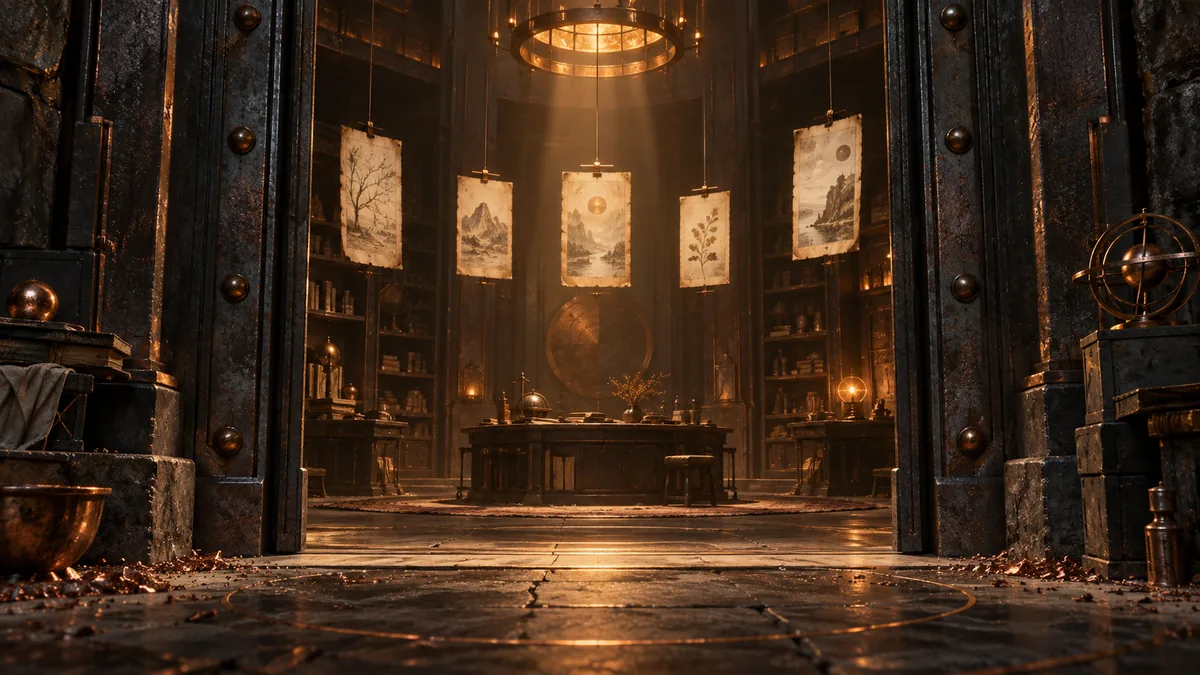
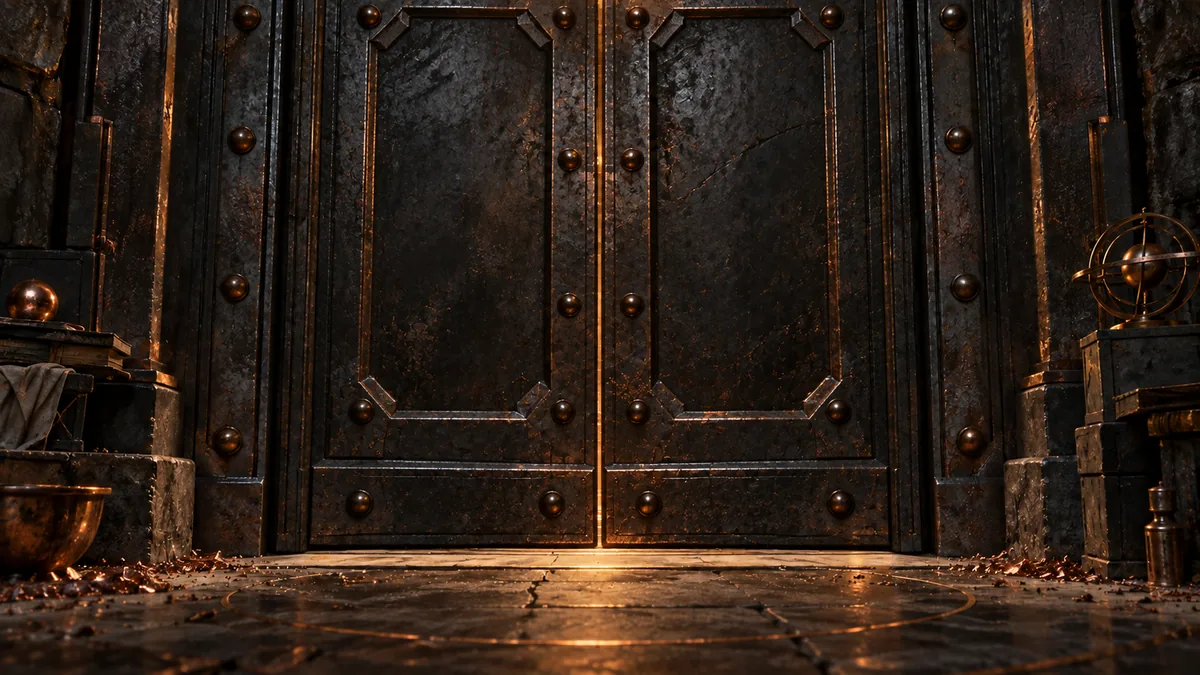
Access open. Five fragments preserved.Acesso aberto. Cinco fragmentos preservados.
The neighborsAs vizinhas
Two conditions sit close to the fugue and get confused with it constantly, so let me separate them by what actually happens, not by the label.Duas condições ficam perto da fuga e vivem sendo confundidas com ela, então deixa eu separar as duas pelo que de fato acontece, não pelo rótulo.
Dissociative identity disorder, in DSM-5, involves a disruption of identity into two or more distinct personality states, together with recurrent gaps in memory for everyday events, personal information or trauma. The difference from a fugue is structural. In DID, the self is divided into states that alternate. In a fugue, one self goes missing and a thinner one fills the space. Bourne and Brown sit uncomfortably between the two, two identities unaware of each other, which is one reason clinicians came to suspect that many fugues are really part of a larger dissociative picture. It's also fair to say that the causes of DID remain debated, with trauma-based and sociocognitive models still arguing.O transtorno dissociativo de identidade, no DSM-5, envolve uma ruptura da identidade em dois ou mais estados de personalidade distintos, junto com lacunas recorrentes na memória de eventos do dia a dia, de informações pessoais ou de traumas. A diferença em relação à fuga é estrutural. No TDI, o eu se divide em estados que se alternam. Na fuga, um eu desaparece e um eu mais ralo ocupa o espaço. Bourne e Brown ficam num lugar desconfortável entre os dois, duas identidades que não sabem uma da outra, e esse é um dos motivos pelos quais os clínicos passaram a suspeitar que muitas fugas fazem parte de um quadro dissociativo maior. Também é justo dizer que as causas do TDI continuam em debate, com os modelos baseados em trauma e os modelos sociocognitivos ainda discutindo.
Confabulation runs in the opposite direction. Where dissociation hides memory, confabulation invents it: people with damage to certain frontal regions, or with Korsakoff's syndrome from severe thiamine deficiency, can produce false memories with complete confidence and no intention to deceive. The neuropsychologist Morris Moscovitch called it "honest lying." The patient isn't concealing anything. The brain is filling a hole with whatever fits.A confabulação vai na direção contrária. Onde a dissociação esconde a memória, a confabulação inventa: pessoas com lesão em certas regiões frontais, ou com síndrome de Korsakoff por deficiência grave de tiamina, podem produzir memórias falsas com total confiança e nenhuma intenção de enganar. O neuropsicólogo Morris Moscovitch chamou isso de "mentira honesta". O paciente não está escondendo nada. O cérebro está tapando um buraco com o que encaixar.
Dissociation locks a room. Confabulation paints a door on a wall where no room exists.A dissociação tranca um cômodo. A confabulação pinta uma porta numa parede onde não existe cômodo nenhum.
Remember the comics from Part I, the implanted memories stacked on top of Logan's real ones? That's closer to engineered confabulation than to dissociation. Someone painted doors.Lembra dos quadrinhos da Parte I, das memórias implantadas empilhadas por cima das memórias reais do Logan? Isso está mais perto de uma confabulação fabricada do que de dissociação. Alguém pintou portas.
The memory warsA guerra das memórias
Now the caution this essay owes its readers, because the game leans hard on an idea that science has spent decades complicating.Agora o cuidado que este ensaio deve aos leitores, porque o jogo se apoia com força numa ideia que a ciência passou décadas complicando.
In the late 1980s and through the 1990s, therapists, courts and families collided over recovered memories, usually of childhood abuse, that surfaced years later, sometimes during therapy. The fight became known as the memory wars, one of its central figures was the psychologist Elizabeth Loftus, and one of its most famous experiments is small and almost gentle.No fim dos anos 1980 e ao longo dos anos 1990, terapeutas, tribunais e famílias se chocaram por causa de memórias recuperadas, em geral de abuso na infância, que vinham à tona anos depois, às vezes durante a terapia. A briga ficou conhecida como a guerra das memórias, uma das figuras centrais foi a psicóloga Elizabeth Loftus, e um dos experimentos mais famosos dela é pequeno e quase delicado.
In 1995, Loftus and Jacqueline Pickrell gathered three true childhood stories about each of 24 participants from an older relative, then added a fourth story that never happened: getting lost in a shopping mall as a small child. After questionnaires and interviews, about a quarter of the participants came to report remembering the invented event, sometimes adding details nobody had given them. In 2023, a preregistered replication with 123 participants found the same thing, at an even higher rate: about 35%.Em 1995, Loftus e Jacqueline Pickrell reuniram, com um parente mais velho, três histórias verdadeiras da infância de cada um de 24 participantes, e acrescentaram uma quarta que nunca aconteceu: se perder num shopping quando pequeno. Depois de questionários e entrevistas, cerca de um quarto dos participantes passou a relatar que lembrava do evento inventado, às vezes acrescentando detalhes que ninguém tinha dado. Em 2023, uma replicação pré-registrada com 123 participantes encontrou a mesma coisa, numa taxa ainda maior: cerca de 35%.
The lesson isn't that people lie, it's that memory is rebuilt every time it's retrieved, and the rebuilding can take in material that was never there. A vivid memory can be false. A confident memory can be false. The feeling of remembering is not proof of the thing remembered.A lição não é que as pessoas mentem, é que a memória é reconstruída toda vez que é acessada, e essa reconstrução pode incorporar material que nunca esteve lá. Uma memória vívida pode ser falsa. Uma memória confiante pode ser falsa. A sensação de lembrar não é prova da coisa lembrada.
None of this means dissociative amnesia is fake, or that people never recover lost memories, because the diagnosis stands and recovery is real, but what the research does undercut is a specific fantasy: the sealed archive that opens one day and returns the past intact, verified by its own intensity. A recovered memory is real as an experience. Its accuracy has to be established like any other claim.Nada disso significa que a amnésia dissociativa é falsa, ou que as pessoas nunca recuperam memórias perdidas, porque o diagnóstico continua de pé e a recuperação é real, mas o que a pesquisa derruba é uma fantasia específica: o arquivo lacrado que um dia se abre e devolve o passado intacto, validado pela própria intensidade. Uma memória recuperada é real como experiência. A precisão dela precisa ser demonstrada como qualquer outra afirmação.
That fantasy is what fiction loves most, and Marvel's Wolverine loves it openly. It names a trophy "Repressed Memories" and builds a whole progression system on doors that open onto the past, as if memory were a vault and the player held the combination. I don't need a game to be a textbook, and I don't hold this against it as fiction. I just want to say once, clearly, that the archive behind those doors is the fictional version. The real one is messier, and it lies to you more politely.Essa fantasia é o que a ficção mais ama, e Marvel's Wolverine ama abertamente. Ele batiza um troféu de "Repressed Memories" e constrói um sistema inteiro de progressão em cima de portas que se abrem pro passado, como se a memória fosse um cofre e quem joga tivesse a combinação. Eu não preciso que um jogo seja um livro didático, e não tenho nada contra isso como ficção. Só quero dizer uma vez, com clareza, que o arquivo atrás daquelas portas é a versão de ficção. O de verdade é mais bagunçado, e mente pra você com mais educação.
Logan, read clinicallyLogan, lido pela clínica
So now look at Logan with the lens we've built.Então agora olha pro Logan com a lente que a gente montou.
Found feral. Given a codename. Deployed for twenty-seven years. Skills intact, biography sealed. His hands remember everything, the claws, the footwork, the exact angle of a killing blow, while his mind remembers almost nothing about where any of it came from. It's the fugue profile almost to the letter: procedural memory preserved, autobiographical memory walled off. And the defining image of the fugue, the traveler who wanders without knowing where he started, is basically Wolverine's silhouette.Encontrado feral. Ganha um codinome. Trabalha em campo por vinte e sete anos. Habilidades intactas, biografia lacrada. As mãos dele lembram de tudo, as garras, o jogo de pés, o ângulo exato de um golpe fatal, enquanto a mente dele quase não lembra de onde nada disso veio. É o perfil da fuga quase ao pé da letra: memória procedural preservada, memória autobiográfica emparedada. E a imagem que define a fuga, o viajante que vaga sem saber de onde saiu, é basicamente a silhueta do Wolverine.
There's a question hiding in that profile, and I'd rather ask it before the game does. Brown lasted two months. Wolverine lasted twenty-seven years. At some point, a substitute self stops being a placeholder and becomes a life: friendships, grudges, a reputation, a way of standing in a doorway. If the fugue goes on long enough, which one is the real person? The man before the gap, whom nobody alive remembers, or the man who has actually been living? Hold that question. The ending answers it, and not gently.Tem uma pergunta escondida nesse perfil, e eu prefiro fazer antes que o jogo faça. O Brown durou dois meses. O Wolverine durou vinte e sete anos. Em algum momento, um eu substituto deixa de ser um tapa-buraco e vira uma vida: amizades, rancores, uma reputação, um jeito de parar na porta. Se a fuga dura tempo suficiente, qual dos dois é a pessoa de verdade? O homem de antes da lacuna, de quem ninguém vivo lembra, ou o homem que de fato está vivendo? Guarda essa pergunta. O final responde, e não com delicadeza.
The game gets something right here. The engine it chooses is trauma, and specifically the kind of experience dissociation exists to wall off: an event too overwhelming to integrate, repeated until the system breaks. What the game compresses is the cause. Real fugues aren't installed on command by a villain. Essex does something no clinician would recognize as a natural process: he forces the trauma, keeps forcing it, and then builds a man on top of the breakage. It's what I call fugue as engineering. How and why he does it belongs to the next part.O jogo acerta uma coisa aqui. O motor que ele escolhe é o trauma, e especificamente o tipo de experiência que a dissociação existe pra isolar: um evento avassalador demais pra ser integrado, repetido até o sistema quebrar. O que o jogo comprime é a causa. Fugas de verdade não são instaladas sob comando por um vilão. O Essex faz uma coisa que nenhum clínico reconheceria como processo natural: ele força o trauma, continua forçando, e depois constrói um homem em cima do que quebrou. É o que eu chamo de fuga como engenharia. Como e por que ele faz isso fica pra próxima parte.
One more thing the clinic explains. During the game, Logan's memories come back, and in dissociative terms that's the whole promise of the condition: what's blocked can return, because it was never destroyed. Essex's amnesia left the rooms intact, and everything was still there, waiting behind the door for the day someone forced it open.Mais uma coisa que a clínica explica. Durante o jogo, as memórias do Logan voltam, e em termos dissociativos essa é toda a promessa da condição: o que está bloqueado pode voltar, porque nunca foi destruído. A amnésia do Essex deixou os cômodos intactos, e tudo continuava lá, esperando atrás da porta pelo dia em que alguém forçasse ela.
Which leaves a question hanging over the ending, and I'm going to leave it hanging until we get there. Everything I've described in this part assumes a door: a mind that seals something away so it can survive, and a past that stays whole on the other side, waiting.O que deixa uma pergunta pendurada sobre o final, e eu vou deixar ela pendurada até a gente chegar lá. Tudo o que eu descrevi nesta parte pressupõe uma porta: uma mente que isola alguma coisa pra conseguir sobreviver, e um passado que continua inteiro do outro lado, esperando.
But what if what happens at the end of this game isn't a door at all?Mas e se o que acontece no fim deste jogo não for uma porta?
What if it's the fire?E se for o fogo?
Part III: Essex, or Memory as a LeashParte III: Essex, ou a Memória Como Coleira
Every Wolverine story needs a man who knows more about Logan than Logan does. In Marvel's Wolverine, that man is Nathaniel Essex, and the game introduces him the way you'd introduce a father: as the person who found Logan when he was nothing, gave him a home, gave him work, gave him a name to answer to.Toda história do Wolverine precisa de um homem que saiba mais sobre o Logan do que o próprio Logan. Em Marvel's Wolverine, esse homem é o Nathaniel Essex, e o jogo apresenta ele do jeito que se apresenta um pai: como a pessoa que encontrou o Logan quando ele não era nada, deu a ele uma casa, deu trabalho, deu um nome pra atender.
Hold on to the word "found." The game spends most of its running time teaching you to trust it, and then teaches you what it really meant.Guarda a palavra "encontrou". O jogo passa a maior parte do tempo te ensinando a confiar nela, e depois te ensina o que ela queria dizer de verdade.
The Essex of the comicsO Essex dos quadrinhos
Readers of the comics met him differently. Chris Claremont and Marc Silvestri created Mister Sinister in the late eighties, mentioning him first as the employer of the Marauders and giving him a full appearance in Uncanny X-Men #221, in 1987. The Marauders were the mercenaries behind the "Mutant Massacre," the slaughter of the Morlocks, the underground community of mutants who couldn't pass as human. Sinister's first real job in Marvel continuity was mass murder of the most vulnerable mutants alive, ordered from a distance.Quem lê quadrinhos conheceu ele de outro jeito. Chris Claremont e Marc Silvestri criaram o Senhor Sinistro no fim dos anos oitenta, mencionando ele primeiro como o patrão dos Carrascos e dando a ele uma aparição completa em Uncanny X-Men #221, em 1987. Os Carrascos eram os mercenários por trás do "Massacre de Mutantes", a matança dos Morlocks, a comunidade subterrânea de mutantes que não conseguiam se passar por humanos. O primeiro trabalho de verdade do Sinistro na cronologia da Marvel foi o assassinato em massa dos mutantes mais vulneráveis que existiam, ordenado à distância.
His history filled in over the following decades. Nathaniel Essex was a Victorian scientist, a contemporary of Darwin, obsessed with evolution and convinced that humanity was changing into something new, and his experiments crossed every ethical line his century had until they drew the attention of Apocalypse. In the version told in The Further Adventures of Cyclops and Phoenix (1996), his wife, Rebecca, loses their child and, dying, condemns her husband with a single word: sinister. He keeps it. Apocalypse remakes him into something that doesn't age, tells him to abandon his old name, and the scientist takes the insult his wife gave him as his new one.A história dele foi sendo preenchida nas décadas seguintes. Nathaniel Essex era um cientista vitoriano, contemporâneo de Darwin, obcecado por evolução e convencido de que a humanidade estava se transformando em algo novo, e os experimentos dele cruzaram todas as linhas éticas que o século dele tinha, até chamarem a atenção do Apocalipse. Na versão contada em The Further Adventures of Cyclops and Phoenix (1996), a esposa dele, Rebecca, perde o filho do casal e, morrendo, condena o marido com uma única palavra: sinistro. Ele guarda a palavra. O Apocalipse transforma ele em algo que não envelhece, manda ele abandonar o nome antigo, e o cientista adota como nome novo o insulto que a esposa deu a ele.
For decades, one of the things Sinister wanted most was Jean Grey. Not her love. Her genetics. He studied her bloodline and Scott Summers's as raw material for a perfect mutant. In the comics, Jean is something Essex wants to own.Por décadas, uma das coisas que o Sinistro mais queria era a Jean Grey. Não o amor dela. A genética dela. Ele estudou a linhagem dela e a do Scott Summers como matéria-prima pra um mutante perfeito. Nos quadrinhos, a Jean é algo que o Essex quer possuir.
What the game keeps, and what it turns inside outO que o jogo mantém, e o que ele vira do avesso
Marvel's Wolverine keeps the scientist. Its Essex is a geneticist who has been alive since the nineteenth century, obsessed with mutants as the next stage of human evolution. It keeps the long life and the cold eye.Marvel's Wolverine mantém o cientista. O Essex do jogo é um geneticista vivo desde o século XIX, obcecado pelos mutantes como o próximo estágio da evolução humana. Mantém a vida longa e o olhar frio.
What it does with the Morlocks is sharper. Early in the game, Essex sends Logan to Vancouver to evacuate a community of reclusive mutants under attack, led by Callisto, and brings the survivors under his protection. If you know the comics, that should make your skin crawl a little, because the man who, in print, ordered the massacre of these exact people is now the man offering them shelter. No wink is needed. The protector is wearing the predator's name.O que ele faz com os Morlocks é mais afiado. No começo do jogo, o Essex manda o Logan a Vancouver pra evacuar uma comunidade de mutantes reclusos sob ataque, liderada pela Callisto, e coloca os sobreviventes sob a proteção dele. Se você conhece os quadrinhos, isso devia arrepiar a sua pele um pouco, porque o homem que, no papel, ordenou o massacre dessas mesmas pessoas agora é o homem que oferece abrigo a elas. Não precisa de piscadela. O protetor está usando o nome do predador.
It takes the game a long time to pull the mask off, and it does it in stages. When Bolivar Trask, the industrialist hunting mutants in the game's first act, is captured, Essex tortures him, and it's Logan, disgusted, who ends it with a mercy killing, which angers Essex. Later, when Essex finally takes the Helix Engine for himself (a machine that forcibly evolves mutants, and kills anyone without the mutant gene), his reaction to the machine gives away something no one suspected: he isn't a true mutant at all. Then the Reavers, the cybernetic militia that had worked for Trask, tear through Madripoor on Essex's orders, hunting dormant mutants, the very people Team X was built to protect.O jogo demora pra arrancar a máscara, e arranca em etapas. Quando Bolivar Trask, o industrial que caça mutantes no primeiro ato do jogo, é capturado, o Essex tortura ele, e é o Logan, enojado, quem encerra aquilo com um golpe de misericórdia, o que deixa o Essex furioso. Mais tarde, quando o Essex finalmente toma o Helix Engine pra si (uma máquina que força a evolução de mutantes e mata quem não tem o gene mutante), a reação dele à máquina entrega algo que ninguém suspeitava: ele não é um mutante de verdade. Depois os Reavers, a milícia cibernética que trabalhava pro Trask, arrasam Madripoor a mando do Essex, caçando mutantes adormecidos, justamente as pessoas que o Team X foi criado pra proteger.
That reveal about his genes is the key to the character, and it's easy to walk past. Essex has spent more than a century surrounded by the thing he worships and cannot be, while Logan was simply born with what Essex has been trying to build. Every mutant in Essex's care is a reminder that nature handed out, for free, what he has to steal.Essa revelação sobre os genes dele é a chave do personagem, e é fácil passar batido. O Essex passou mais de um século cercado da coisa que ele adora e não consegue ser, enquanto o Logan simplesmente nasceu com aquilo que o Essex vive tentando construir. Cada mutante sob os cuidados do Essex é um lembrete de que a natureza distribuiu de graça o que ele precisa roubar.
The collectorO colecionador
When Essex finally shows his true form, it's the logical end of that envy. The body he unveils is the result of experimenting on himself with mutant genes he chose, including genes taken from the mutants he kidnapped, a piece of the Helix Engine itself, and the genes of his own wife, who was a telepathic mutant.Quando o Essex finalmente mostra a forma verdadeira, é o desfecho lógico dessa inveja. O corpo que ele revela é resultado de experimentos nele mesmo com genes mutantes escolhidos a dedo, incluindo genes tirados dos mutantes que ele sequestrou, um pedaço do próprio Helix Engine e os genes da própria esposa, que era uma mutante telepata.
Read that alongside the comics. In print, Rebecca Essex named him with her dying breath, and he wore the name for more than a century; in the game, he doesn't take her word. He takes her cells. The woman who might have judged him is now part of his body, and she has no say in it.Lê isso ao lado dos quadrinhos. No papel, a Rebecca Essex deu nome a ele com o último suspiro, e ele usou esse nome por mais de um século; no jogo, ele não fica com a palavra dela. Ele fica com as células dela. A mulher que poderia ter julgado ele agora é parte do corpo dele, e não tem voz nenhuma nisso.
And she wasn't just any mutant. A telepath. The same power Jean has. Essex carries inside his body, by force, the gift that Jean spends the whole game using to heal people, because he took a telepath apart to have what she had. Jean simply is what she is, and gives it away.E ela não era uma mutante qualquer. Era telepata. O mesmo poder da Jean. O Essex carrega dentro do corpo, à força, o dom que a Jean passa o jogo inteiro usando pra curar pessoas, porque ele desmontou uma telepata pra ter o que ela tinha. A Jean simplesmente é o que é, e dá.
This is how Essex loves, if the word even applies: not by giving, but by incorporating. The people around him are material, and the most intimate thing he can do with a person is absorb them. Watch what happens to Walter, Team X's gentle scientist, whose body and mind the Engine and Essex's experiments corrupt until Jean can't heal him and he asks Logan to end it. Watch the way Essex relates to Trask's suffering: as a resource, not as a line. For Essex, other people's bodies and other people's pain are things you use.É assim que o Essex ama, se é que a palavra se aplica: não dando, mas incorporando. As pessoas em volta dele são matéria-prima, e a coisa mais íntima que ele consegue fazer com alguém é absorver. Olha o que acontece com o Walter, o cientista gentil do Team X, cujo corpo e cuja mente o Engine e os experimentos do Essex corrompem até a Jean não conseguir mais curar ele, e ele pedir ao Logan que acabe com aquilo. Olha como o Essex se relaciona com o sofrimento do Trask: como um recurso, não como um limite. Pro Essex, o corpo e a dor dos outros são coisas que se usam.
The same logic runs through the team he built. Team X is sold as a family, a place for mutants to belong, and the people inside it behave like family members of a very particular kind: the kind organized around one man's approval. Sabretooth is the clearest case. When he and Logan finally have it out, he reveals that he felt abandoned when Logan, the only mutant like him, left the team, and that he read Logan's defiance of Essex as one more betrayal. Mystique ends up complicit in Essex's plans, and it costs her her marriage when her wife, Tyger, walks away. None of these people are simple victims, and the game doesn't pretend they are. But look at the structure they live inside. Essex doesn't just command loyalty. He becomes the thing loyalty is measured against. Leaving him feels, to the people he shaped, like leaving each other.A mesma lógica atravessa o time que ele construiu. O Team X é vendido como uma família, um lugar de pertencimento pra mutantes, e as pessoas lá dentro se comportam como membros de uma família de um tipo muito específico: o tipo organizado em torno da aprovação de um homem só. O Dentes-de-Sabre é o caso mais claro. Quando ele e o Logan finalmente acertam as contas, ele revela que se sentiu abandonado quando o Logan, o único mutante parecido com ele, saiu do time, e que leu a desobediência do Logan ao Essex como mais uma traição. A Mística acaba cúmplice dos planos do Essex, e isso custa o casamento dela quando a esposa, a Tyger, vai embora. Nenhuma dessas pessoas é vítima simples, e o jogo não finge que é. Mas olha a estrutura em que elas vivem. O Essex não só comanda lealdade. Ele vira a régua pela qual a lealdade é medida. Deixar o Essex parece, pras pessoas que ele moldou, deixar umas às outras.
That is what a leash looks like when it's made of belonging.É assim que uma coleira fica quando é feita de pertencimento.
Memory, it turns out, is just another thing you use.A memória, afinal, é só mais uma coisa que se usa.
Everything becomes his.Tudo vira posse.
Collect the three pieces. Watch who gets to keep them.Recolha as três peças. Veja com quem elas ficam.
0 / 3 · Still outside his possession.0 / 3 · Ainda fora da posse dele.
How to manufacture a fugueComo fabricar uma fuga
The game saves its worst secret for the moment Logan dies, and the chapters where his consciousness survives and starts to recover what was taken. What he finds is this.O jogo guarda o pior segredo pro momento em que o Logan morre, e pros capítulos em que a consciência dele sobrevive e começa a recuperar o que foi tirado. O que ele encontra é isto.
He and Jean once lived together on a farm. Essex came to recruit them for Team X. Logan refused. Essex tried to take him anyway, reaching into his mind to control him, and in doing so woke something buried much deeper, a presence that calls itself Apocalypse and calls Logan by a title we'll get to in Part V. In that state, Logan killed Jean as she tried to calm him down.Ele e a Jean moraram juntos numa fazenda. O Essex foi recrutar os dois pro Team X. O Logan recusou. O Essex tentou levar ele mesmo assim, entrando na mente dele pra controlá-lo, e com isso acordou uma coisa enterrada muito mais fundo, uma presença que se chama de Apocalipse e chama o Logan por um título que a gente vai ver na Parte V. Nesse estado, o Logan matou a Jean enquanto ela tentava acalmar ele.
And then Essex did the thing that makes him one of the cruelest villains Insomniac has written. He forced Logan to experience her death, again and again, until Logan's mind gave out and he reverted to a feral state, and then Essex removed his memories and shaped what was left into Wolverine, a tool he could use.E então o Essex fez a coisa que faz dele um dos vilões mais cruéis que a Insomniac já escreveu. Ele obrigou o Logan a viver a morte dela, de novo e de novo, até a mente do Logan ceder e ele voltar ao estado feral, e aí o Essex removeu as memórias dele e moldou o que sobrou no Wolverine, uma ferramenta que ele podia usar.
Part II gave us the language for this. Dissociation, at its root, is protection. It's the mind closing a fire door so that the rest of the building can survive something unbearable. Essex understood that mechanism and aimed it. He didn't just steal Logan's past, he made the past so painful that Logan's own mind would help seal it away, and then he finished the job himself. He turned Logan's defenses into the instrument of his theft.A Parte II nos deu a linguagem pra isso. A dissociação, na raiz, é proteção. É a mente fechando uma porta corta-fogo pra que o resto do prédio sobreviva a algo insuportável. O Essex entendeu esse mecanismo e mirou nele. Ele não só roubou o passado do Logan, ele tornou esse passado tão doloroso que a própria mente do Logan ajudaria a lacrar, e depois terminou o serviço ele mesmo. Ele transformou as defesas do Logan no instrumento do roubo.
The cruelty is not only in the killing, or even in the loop, it's in the design: Essex made Logan an accomplice to his own erasure.A crueldade não está só na morte, nem mesmo no loop, está no desenho: o Essex fez do Logan cúmplice do próprio apagamento.
And then he "found" him.E aí ele "encontrou" o Logan.
Go back to the opening of the game with that knowledge, and every scene between them changes color. The man who picks up a feral stranger in the wilderness and gives him purpose is the man who made him feral, and twenty-seven years of loyalty, missions, gratitude and codename all rest on a crime the victim can't remember. The rescuer is the thief. The family Logan thinks he has is the kennel he was put in.Volta pro começo do jogo sabendo disso, e cada cena entre os dois muda de cor. O homem que acolhe um estranho feral no meio do mato e dá a ele um propósito é o homem que deixou ele feral, e vinte e sete anos de lealdade, missões, gratidão e codinome se apoiam num crime que a vítima não consegue lembrar. O salvador é o ladrão. A família que o Logan acha que tem é o canil em que colocaram ele.
There's one quiet detail here that's easy to miss. Three years before the game begins, Logan quit Team X and walked away without knowing why: nothing in his memory could have told him what Essex was, but something in him refused anyway. Whatever Essex erased, he didn't erase all of it. The part of Logan that said no on the farm said no again, without words, decades later.Tem um detalhe quieto aqui que é fácil de perder. Três anos antes de o jogo começar, o Logan saiu do Team X e foi embora sem saber por quê: nada na memória dele poderia ter contado o que o Essex era, mas alguma coisa nele recusou mesmo assim. O que quer que o Essex tenha apagado, ele não apagou tudo. A parte do Logan que disse não na fazenda disse não de novo, sem palavras, décadas depois.
The world as a patientO mundo como paciente
Once you see what Essex did to one man, his endgame stops looking like a comic book scheme and starts looking like a method.Depois que você vê o que o Essex fez com um homem, o plano final dele deixa de parecer esquema de quadrinho e passa a parecer um método.
His final plan is a giant Sentinel, the mutant-hunting robot of X-Men lore, carrying the Helix Engine, built to evolve mutants worldwide and bring down human civilization in the process. The Engine forcibly activates dormant mutants, drives them and active mutants into violent rages, and kills the people who have no mutant gene at all. Then he sends more of them, to cities across the world.O plano final dele é um Sentinela gigante, o robô caçador de mutantes da mitologia dos X-Men, carregando o Helix Engine, construído pra evoluir mutantes no mundo inteiro e derrubar a civilização humana no processo. O Engine ativa à força mutantes adormecidos, joga eles e os mutantes ativos em surtos de violência, e mata quem não tem gene mutante nenhum. Depois ele manda mais Sentinelas, pra cidades do mundo todo.
The shape is familiar. Break the subject under pressure it can't withstand. Let the old structure collapse. Build what you wanted on the ruins. It's what he did on the farm, scaled up from a single mind to a species. Logan was the prototype. The planet was the product.O formato é conhecido. Quebra o sujeito sob uma pressão que ele não aguenta. Deixa a estrutura antiga desabar. Constrói o que você queria em cima das ruínas. É o que ele fez na fazenda, ampliado de uma mente só pra uma espécie. O Logan foi o protótipo. O planeta era o produto.
That's why I keep insisting on the clinical frame from Part II. Essex isn't just a man with a cruel streak, he's a man with a theory of how people change, and his theory is trauma. He believes in breakage as a form of improvement, and every monster he builds, including the one he built out of Logan, is an argument for that belief.É por isso que eu insisto tanto no enquadramento clínico da Parte II. O Essex não é só um homem com um lado cruel, é um homem com uma teoria de como as pessoas mudam, e a teoria dele é o trauma. Ele acredita na quebra como forma de aperfeiçoamento, e cada monstro que ele constrói, incluindo o que ele construiu com o Logan, é um argumento a favor dessa crença.
The last reachO último alcance
Even at the end, Essex doesn't let go. In the final battle, he's seemingly killed, and with what he has left he triggers Logan's feral state and hands him back to Apocalypse's control. His last act is to reach into the wound he made and pull it open one more time, which is the most honest thing he does in the whole game. Essex never wanted Logan dead, he wanted him owned, and if he couldn't own him, he wanted him to belong to something else.Mesmo no fim, o Essex não solta. Na batalha final, ele parece morrer, e com o que resta dele ativa o estado feral do Logan e entrega ele de volta ao controle do Apocalipse. O último ato dele é enfiar a mão na ferida que ele fez e abrir ela mais uma vez, e essa é a coisa mais honesta que ele faz no jogo inteiro. O Essex nunca quis o Logan morto, queria o Logan possuído, e se não pudesse possuir, queria que ele pertencesse a outra coisa.
So here is Essex, reduced to his principle. Memory, for him, is a leash. You erase the past so the present can be directed. You hold what someone doesn't know about themselves, and you use it to hold them.Então aqui está o Essex, reduzido ao princípio dele. A memória, pra ele, é uma coleira. Você apaga o passado pra poder dirigir o presente. Você segura o que alguém não sabe sobre si mesmo, e usa isso pra segurar a pessoa.
Which is what makes the woman on the other side of this story so hard to watch. Because she also holds what Logan doesn't know about himself. She holds far more of it than Essex ever did.E é isso que torna tão difícil olhar pra mulher do outro lado desta história. Porque ela também segura o que o Logan não sabe sobre si mesmo. Ela segura muito mais do que o Essex jamais segurou.
She just refuses to use it.Ela só se recusa a usar.
Part IV: Jean, or Memory as a VowParte IV: Jean, ou a Memória Como Promessa
Jean Grey enters Marvel's Wolverine as a stranger. A red-haired telepath shows up in Vancouver while Logan is evacuating Callisto's people, helps him fight and introduces herself, and by the end of the operation she's agreed to work with Team X.A Jean Grey entra em Marvel's Wolverine como uma estranha. Uma telepata ruiva aparece em Vancouver enquanto o Logan evacua o pessoal da Callisto, ajuda ele a lutar e se apresenta, e no fim da operação já topou trabalhar com o Team X.
It's a perfectly ordinary meet-cute for an action game. It's also, once you know what the game knows, one of the saddest scenes in it. Because she isn't meeting him. She's meeting him again. The woman introducing herself to Logan in Vancouver has known him, loved him and lost him across more lifetimes than he will ever be able to count, and she is standing in front of him, introducing herself like someone he just met.É um primeiro encontro perfeitamente comum pra um jogo de ação. Também é, depois que você sabe o que o jogo sabe, uma das cenas mais tristes dele. Porque ela não está conhecendo ele. Ela está reencontrando ele. A mulher que se apresenta ao Logan em Vancouver já conheceu, amou e perdeu esse homem em mais vidas do que ele um dia vai conseguir contar, e está parada na frente dele, se apresentando como alguém que ele acabou de conhecer.
She doesn't hide it perfectly, either. Players who went back after the credits have pointed out that she lets slip that she recognizes his face, a line that sounds like small talk the first time and like a confession the second. And that Essex, in their first meeting, clearly recognizes her. Insomniac hides the truth in plain sight, in the one place a first-time player isn't looking: in the faces of the people who already know.E ela também não esconde direito. Jogadores que voltaram depois dos créditos apontaram que ela deixa escapar que reconhece o rosto dele, uma fala que soa como papo furado na primeira vez e como confissão na segunda. E que o Essex, no primeiro encontro dos dois, claramente reconhece ela. A Insomniac esconde a verdade à vista de todos, no único lugar pra onde quem joga pela primeira vez não está olhando: no rosto das pessoas que já sabem.
Replay that scene after the credits. Watch her face.Rejoga essa cena depois dos créditos. Olha o rosto dela.
Not the Jean of the comicsNão é a Jean dos quadrinhos
This Jean is her own person, and the game takes care to make her one. The Hollywood Reporter's piece on the game describes her, played by Krizia Bajos, as a little older than her usual comics counterpart, shaped by abuse at the hands of her mother and other humans, and turned by that history into something like a selfless revolutionary who doesn't back down from a fight. She is the one who brings out the best in Logan and shows him a mutant community that exists outside the toxic orbit of Team X.Esta Jean é uma pessoa própria, e o jogo toma cuidado pra que seja. A matéria da Hollywood Reporter sobre o jogo descreve ela, interpretada por Krizia Bajos, como um pouco mais velha que a versão habitual dos quadrinhos, marcada por abusos da mãe e de outros humanos, e transformada por essa história em algo como uma revolucionária altruísta que não foge de briga. É ela quem tira o melhor do Logan e mostra a ele uma comunidade mutante que existe fora da órbita tóxica do Team X.
That last point matters more than it seems. Essex offers Logan a unit, a mission and a chain of command, while Jean offers him people: Callisto, the refugees, the neighborhood rising up in Madripoor against the men sent to hunt its dormant mutants. With Essex, Logan is a weapon that belongs to a program. With Jean, he's a man who belongs to a community. That difference is the whole distance between the two of them.Esse último ponto importa mais do que parece. O Essex oferece ao Logan uma unidade, uma missão e uma cadeia de comando, enquanto a Jean oferece pessoas: a Callisto, os refugiados, o bairro de Madripoor se levantando contra os homens mandados pra caçar os seus mutantes adormecidos. Com o Essex, o Logan é uma arma que pertence a um programa. Com a Jean, ele é um homem que pertence a uma comunidade. Essa diferença é toda a distância entre os dois.
The same piece connects the game's Jean and Logan to Claremont's take on the characters, as fundamental forces of their universe, life and death, bound together in a way their other relationships, with Cyclops and with Mariko, never were. In the comics, that bond was mostly a longing. Jean chose Scott. Logan loved from the doorway. Insomniac takes that old, unfinished ache and finishes it: here, she was his, and he was hers, long before either of them had a codename.A mesma matéria liga a Jean e o Logan do jogo à leitura que o Claremont fazia dos personagens, como forças fundadoras do universo deles, vida e morte, ligadas de um jeito que as outras relações dos dois, com o Ciclope e com a Mariko, nunca foram. Nos quadrinhos, esse laço era quase sempre saudade. A Jean escolheu o Scott. O Logan amou da porta. A Insomniac pega essa dor antiga e inacabada e termina ela: aqui, ela era dele, e ele era dela, muito antes de qualquer um dos dois ter um codinome.
And there's a quiet reversal of the villain's obsession. In print, Essex wanted Jean's genes. In the game, what he takes from her is the man she loves.E tem uma inversão silenciosa na obsessão do vilão. No papel, o Essex queria os genes da Jean. No jogo, o que ele tira dela é o homem que ela ama.
The one who remembersA que lembra
The mechanic underneath all of this is the Phoenix. We learn that Jean can die and come back and that she has done it many times, and the secret ending makes it explicit: across centuries, she dies, she is reborn, and she finds Logan again, in life after life.O mecanismo por baixo de tudo isso é a Fênix. A gente descobre que a Jean pode morrer e voltar e que já fez isso muitas vezes, e o final secreto deixa explícito: ao longo dos séculos, ela morre, renasce e encontra o Logan de novo, vida após vida.
The structure this creates is not symmetrical, it's lopsided by design. Logan's condition is to forget. Jean's condition is to remember. One of them keeps losing the story and the other keeps carrying it, so every time they find each other, only one of them knows it's a reunion.A estrutura que isso cria não é simétrica, é desequilibrada de propósito. A condição do Logan é esquecer. A condição da Jean é lembrar. Um dos dois vive perdendo a história e o outro vive carregando, então toda vez que eles se encontram, só um sabe que é um reencontro.
The game is full of small traces of that asymmetry, and most of them are easy to miss the first time. The farm. The cabin. The way Logan, broken on the floor in the final act, gets up only because he hears her humming, a thread she has been leaving for him that he can follow without knowing why. The carved wooden bird she hands him at the very end. She keeps planting memories in a man who can't read them, the way you'd leave a lamp in a window for someone who doesn't know the house is theirs.O jogo está cheio de rastros pequenos dessa assimetria, e a maioria é fácil de perder na primeira vez. A fazenda. A cabana. O jeito como o Logan, quebrado no chão no ato final, só levanta porque ouve ela cantarolando, um fio que ela vem deixando pra ele e que ele consegue seguir sem saber por quê. O passarinho de madeira entalhado que ela entrega a ele no final. Ela vive plantando memórias num homem que não consegue ler, do jeito que você deixaria uma luz acesa na janela pra alguém que não sabe que a casa é dele.
And she has already died at his hands once, on that farm, when Essex turned him into something else. She came back. And sooner or later, she found him again. Whatever you want to call that, it isn't a small thing.E ela já morreu pelas mãos dele uma vez, naquela fazenda, quando o Essex transformou ele em outra coisa. Ela voltou. E, mais cedo ou mais tarde, encontrou ele de novo. Seja lá como você queira chamar isso, não é pouca coisa.
Why she doesn't just tell himPor que ela simplesmente não conta
There's a question the game never asks out loud, and it's the most interesting question about her. Jean is a telepath. She knows who he is. She knows who she is to him. Why doesn't she simply tell him?Tem uma pergunta que o jogo nunca faz em voz alta, e é a pergunta mais interessante sobre ela. A Jean é telepata. Ela sabe quem ele é. Ela sabe quem ela é pra ele. Por que ela simplesmente não conta?
The game leaves room for reading here, so let me be clear that what follows is my reading. I think her silence is an ethical position, and Part II gives us the language for it. A past someone hands you is not the same as a past you remember. Told often enough and vividly enough, it might even start to feel like memory, and that feeling proves nothing. Jean, of all people, would know the difference between a memory and a story implanted in someone's head, standing as she is next to a man whose head has already been written on once, by Essex, without his consent.O jogo deixa espaço pra interpretação aqui, então deixa eu ser clara: o que vem a seguir é a minha leitura. Eu acho que o silêncio dela é uma posição ética, e a Parte II nos dá a linguagem pra isso. Um passado que alguém te entrega não é a mesma coisa que um passado de que você lembra. Contado muitas vezes e com vividez suficiente, ele pode até começar a parecer memória, e essa sensação não prova nada. A Jean, mais do que ninguém, saberia a diferença entre uma memória e uma história implantada na cabeça de alguém, parada como está ao lado de um homem cuja cabeça já foi escrita uma vez, pelo Essex, sem o consentimento dele.
So she doesn't write. She waits. She lets him come to her as whoever he is now, and she deals with the cost of that privately. Where Essex imposed a past on Logan, Jean refuses to impose one, even a true one, even one that would give her back the man she lost.Então ela não escreve. Ela espera. Ela deixa ele chegar até ela como quem ele é agora, e lida com o custo disso sozinha. Onde o Essex impôs um passado ao Logan, a Jean se recusa a impor um, nem mesmo um verdadeiro, nem mesmo um que devolveria a ela o homem que ela perdeu.
It's the same restraint that runs through her whole role in the story: she heals the friends the Engine has corrupted, pulling its effects out of their minds. She tries to heal Walter and can't. Her power over minds is enormous, and the game keeps showing her using it only to undo damage, never to take control. For a telepath standing in the shadow of Essex, that choice is the character.É a mesma contenção que atravessa todo o papel dela na história: ela cura os amigos que o Engine corrompeu, tirando os efeitos dele da mente de cada um. Ela tenta curar o Walter e não consegue. O poder dela sobre mentes é enorme, e o jogo insiste em mostrar ela usando esse poder só pra desfazer estragos, nunca pra tomar controle. Pra uma telepata que vive na sombra do Essex, essa escolha é o personagem.
The ending tests that restraint. When the danger is finally over, she tries to tell him. What happens then belongs to Part VI.O final testa essa contenção. Quando o perigo finalmente passa, ela tenta contar. O que acontece aí fica pra Parte VI.
The graveO túmulo
One scene deserves its own pause. When the giant Sentinel kills Logan, Jean recovers and buries what's left of him.Uma cena merece uma pausa só dela. Quando o Sentinela gigante mata o Logan, a Jean recupera e enterra o que sobrou dele.
Think about who is holding the shovel. The one who always comes back is burying the one who always forgets. For once, the positions are reversed: she is the survivor standing over a grave, and he is the one about to return from it. He wakes, and his consciousness, having survived the dark, starts recovering the memories Essex locked away.Pensa em quem está segurando a pá. A que sempre volta está enterrando o que sempre esquece. Pela primeira vez, as posições se invertem: ela é a sobrevivente parada diante de um túmulo, e ele é quem está prestes a voltar dele. Ele acorda, e a consciência dele, depois de sobreviver ao escuro, começa a recuperar as memórias que o Essex trancou.
It's the only point in the story where Logan gets to do what Jean has done for centuries: die, come back and remember. For a single chapter, he gets her condition. Then it takes it away again.É o único ponto da história em que o Logan faz o que a Jean faz há séculos: morrer, voltar e lembrar. Por um único capítulo, ele ganha a condição dela. Depois o jogo tira de novo.
The same past. Two bonds.O mesmo passado. Dois vínculos.
Choose a bond. Try to move away.Escolha o vínculo. Tente se afastar.
An original visual interpretation.Uma interpretação visual original.
Essex holds the memory and the bond.Essex segura a memória e o vínculo.
The criticism this has to faceA crítica que isso precisa encarar
This Jean is written with real care. I also think the essay would be dishonest if it didn't say the uncomfortable part out loud.Esta Jean é escrita com cuidado de verdade. Eu também acho que o ensaio seria desonesto se não dissesse em voz alta a parte desconfortável.
The image at the center of her story is very old. A man wanders, fights, forgets, and loses himself. A woman stays, remembers, and keeps his self safe for him until he comes back to claim it. Ibsen wrote the definitive version in 1867. In Peer Gynt, Peer spends his life running from one identity to the next, and at the end, asking where his true self has been all along, he finds the answer in Solveig, the woman who waited for him for decades: it survived in her faith, her hope and her love. It's a beautiful ending. It's also a division of labor. The man gets the journey. The woman gets the waiting and the remembering.A imagem no centro da história dela é muito antiga. Um homem vaga, luta, esquece e se perde. Uma mulher fica, lembra, e guarda o eu dele em segurança até ele voltar pra buscar. O Ibsen escreveu a versão definitiva em 1867. Em Peer Gynt, o Peer passa a vida fugindo de uma identidade pra outra, e no fim, perguntando onde o verdadeiro eu dele esteve esse tempo todo, encontra a resposta na Solveig, a mulher que esperou por ele durante décadas: ele sobreviveu na fé, na esperança e no amor dela. É um final lindo. Também é uma divisão de trabalho. O homem fica com a jornada. A mulher fica com a espera e a lembrança.
Jean inherits that role and multiplies it across centuries. She does the emotional labor of an entire relationship, lifetime after lifetime, and the man it serves never sees it, because every reunion costs her the work of starting over while pretending, for his sake, that she's starting fresh. You can call that devotion. You can also call it the oldest unpaid job in fiction, given a cosmic budget.A Jean herda esse papel e multiplica ao longo dos séculos. Ela faz o trabalho emocional de uma relação inteira, vida após vida, e o homem a quem isso serve nunca vê, porque cada reencontro custa a ela o trabalho de recomeçar fingindo, pelo bem dele, que está começando do zero. Você pode chamar isso de devoção. Também pode chamar de o trabalho não remunerado mais antigo da ficção, com orçamento cósmico.
I don't think the game fully escapes that. But I don't think it simply repeats it either, and the reasons are specific.Eu não acho que o jogo escape totalmente disso. Mas também não acho que ele simplesmente repita, e os motivos são específicos.
You know what's most interesting about this Jean? She isn't waiting. She is not Solveig at the window. She's in the street, fighting Reavers, getting refugees out of harm's way, rallying a city against the people tearing it apart. Her life is full of things that are not Logan, and the game shows that life on screen, so when the story ends, she doesn't follow him: she stays with Callisto to help rebuild Madripoor as a haven for mutants. She has work. She has people. She has a future he isn't part of.Sabe o que é mais interessante nesta Jean? Ela não está esperando. Ela não é a Solveig na janela. Ela está na rua, enfrentando Reavers, tirando refugiados do caminho do perigo, levantando uma cidade contra quem está destruindo ela. A vida dela está cheia de coisas que não são o Logan, e o jogo mostra essa vida na tela, então quando a história termina, ela não vai atrás dele: ela fica com a Callisto pra ajudar a reconstruir Madripoor como um refúgio pra mutantes. Ela tem trabalho. Ela tem gente. Ela tem um futuro do qual ele não faz parte.
There's a second difference, and it's the part that hurts. The game doesn't reward her for the role it gives her. It charges her for it.Tem uma segunda diferença, e é a parte que dói. O jogo não recompensa ela pelo papel que dá a ela. Ele cobra.
What the winner losesO que a vencedora perde
At the end of Marvel's Wolverine, Jean gets the spectacle. The fire, the power, the decision that saves the man, the moment the camera belongs to her. By any ordinary measure of a climax, she wins it.No fim de Marvel's Wolverine, a Jean fica com o espetáculo. O fogo, o poder, a decisão que salva o homem, o momento em que a câmera é dela. Por qualquer medida comum de clímax, ela vence.
And what she loses, in the same instant, is the only thing she has ever asked of him.E o que ela perde, no mesmo instante, é a única coisa que ela já pediu a ele.
Listen to what she shouts as the fire goes through him. Two words. They deserve a section of their own, and they'll get one in Part VI. For now, notice only this: she is the one person in the story who has always remembered, and the price of saving him is that he will not remember her.Escuta o que ela grita enquanto o fogo atravessa ele. Duas palavras. Elas merecem uma seção só delas, e vão ganhar uma na Parte VI. Por enquanto, repara só nisto: ela é a única pessoa da história que sempre lembrou, e o preço de salvar ele é que ele não vai lembrar dela.
She knew. She's done this before. She knew what the fire would take, and she did it anyway, because the alternative was letting him become something she had already pulled him out of once.Ela sabia. Ela já fez isso antes. Ela sabia o que o fogo ia levar, e fez mesmo assim, porque a alternativa era deixar ele virar uma coisa da qual ela já tinha tirado ele uma vez.
This is where Jean and Essex finally separate completely. One line each. Essex held Logan's past so he could hold Logan. Jean holds Logan's past so that Logan doesn't have to carry it, and at the end she lets him go without it.É aqui que a Jean e o Essex finalmente se separam por completo. Uma frase pra cada um. O Essex segurava o passado do Logan pra poder segurar o Logan. A Jean segura o passado do Logan pra que o Logan não precise carregar, e no fim deixa ele ir sem ele.
One uses memory as a leash. The other keeps it as a vow.Um usa a memória como coleira. A outra guarda a memória como promessa.
The game gives Jean the stage and takes away her audience. Whoever wins this ending is the person who loses the most in it.O jogo dá o palco à Jean e tira a plateia dela. Quem vence este final é quem mais perde nele.
Remember that when we get to Parts VIII and IX, and the question of whose ending this actually is.Guarda isso pra quando a gente chegar às Partes VIII e IX, e à pergunta de quem é, afinal, este final.

Part V: The Horseman of DeathParte V: O Cavaleiro da Morte
The game tells you who Logan is long before it lets you understand it. It just says it in a language that sounds like superstition.O jogo te diz quem o Logan é muito antes de deixar você entender. Ele só diz numa língua que soa como superstição.
In Tokyo, looking for the people who abducted Walter, Logan and Jean go to Shiro, a retired Team X member, for information about the Hand. What they learn is strange: the ninja cult believes Logan is the Shinigami, a demon of death who serves their master, a figure they call the Beast.Em Tóquio, procurando quem sequestrou o Walter, o Logan e a Jean vão atrás do Shiro, um ex-integrante aposentado do Team X, em busca de informação sobre o Tentáculo. O que eles descobrem é estranho: a seita ninja acredita que o Logan é o Shinigami, um demônio da morte que serve ao mestre deles, uma figura que eles chamam de Besta.
On a first playthrough, this reads as flavor. Cults say ominous things about protagonists. It's what cults are for. You file it next to the neon and the rain and move on.Na primeira jogada, isso soa como tempero. Seita diz coisas sinistras sobre protagonista. É pra isso que seita existe. Você arquiva do lado do neon e da chuva e segue em frente.
It isn't flavor, it's the most accurate description of Logan anyone gives in the entire game.Não é tempero, é a descrição mais precisa do Logan que alguém faz no jogo inteiro.
The first deathA primeira morte
The truth arrives the way the truth usually arrives in Wolverine stories: through violence. Essex's giant Sentinel, carrying the Helix Engine, kills Logan. Jean recovers his remains and buries them.A verdade chega do jeito que a verdade costuma chegar nas histórias do Wolverine: pela violência. O Sentinela gigante do Essex, carregando o Helix Engine, mata o Logan. A Jean recupera os restos dele e enterra.
We've already stood at that grave in Part IV, with the woman holding the shovel. Now go underneath it.A gente já esteve diante desse túmulo na Parte IV, com a mulher segurando a pá. Agora desce pra baixo dele.
Logan's consciousness survives, and in the dark, cut off from his body and from the world, it starts to recover what Essex locked away. His real name, James Logan Howlett. The farm. The life he and Jean shared there. The day Essex came to recruit them. The refusal. The attempt at control. Her death, at his hands, and the loop Essex forced him through afterward. All of it comes back in the same sequence, the name and the crime together, as if the game refuses to let him have one without the other.A consciência do Logan sobrevive e, no escuro, isolada do corpo e do mundo, começa a recuperar o que o Essex trancou. O nome verdadeiro dele, James Logan Howlett. A fazenda. A vida que ele e a Jean dividiram lá. O dia em que o Essex foi recrutar os dois. A recusa. A tentativa de controle. A morte dela, pelas mãos dele, e o loop a que o Essex obrigou ele depois. Tudo volta na mesma sequência, o nome e o crime juntos, como se o jogo se recusasse a deixar ele ter um sem o outro.
And the detail that makes it the cruelest piece of staging in the game is this: it happens before Jean knows he's alive.E o detalhe que faz disso a encenação mais cruel do jogo é este: acontece antes de a Jean saber que ele está vivo.
On one side of the ground, a woman is mourning a man she has loved for centuries, and on the other side, that same man is learning, for the first time in his current life, who she was to him. She grieves someone who, at that exact moment, is finally remembering her. Neither of them knows what the other is going through, two people on opposite sides of the same loss, separated by a few feet of earth.De um lado da terra, uma mulher está de luto por um homem que ela ama há séculos, e do outro lado, esse mesmo homem está descobrindo, pela primeira vez nesta vida, quem ela foi pra ele. Ela chora por alguém que, exatamente naquele momento, finalmente está lembrando dela. Nenhum dos dois sabe o que o outro está vivendo, duas pessoas em lados opostos da mesma perda, separadas por alguns palmos de terra.
This is the first of the two deaths in the title, and it matters what kind of death it is. It's a cruel one. The Sentinel is Essex's machine, built on the same logic as the farm (break the subject and see what the breakage produces), and Logan dies at the hands of the man who already took everything from him once.Esta é a primeira das duas mortes do título, e importa que tipo de morte ela é. É uma morte cruel. O Sentinela é a máquina do Essex, construída com a mesma lógica da fazenda (quebra o sujeito e vê o que a quebra produz), e o Logan morre pelas mãos do homem que já tinha tirado tudo dele uma vez.
And yet it's the one that gives. Death, for Logan, is where his name was waiting. It's not a contradiction, it's a knot, and the Coda is where it gets tied.E mesmo assim é a morte que dá. A morte, pro Logan, é onde o nome dele estava esperando. Não é uma contradição, é um nó, e é na Coda que ele vai ser amarrado.
The Beast wakes upA Besta acorda
What Logan finds under his memories is worse than Essex.O que o Logan encontra debaixo das memórias é pior que o Essex.
When Essex reached into his mind on the farm, trying to take control, he woke something buried much deeper. It calls itself Apocalypse. And it calls Logan by a title: Death.Quando o Essex entrou na mente dele na fazenda, tentando tomar o controle, acordou uma coisa enterrada muito mais fundo. Ela se chama de Apocalipse. E chama o Logan por um título: Morte.
That's what the Hand meant. The Beast is Apocalypse. The Shinigami, the demon of death who serves him, is Logan. The cult in Tokyo wasn't speaking in metaphors, it was reading his résumé.Era isso que o Tentáculo queria dizer. A Besta é o Apocalipse. O Shinigami, o demônio da morte que serve a ele, é o Logan. A seita de Tóquio não estava falando por metáforas, estava lendo o currículo dele.
For comics readers, this lands with extra weight, because Logan has worn that title before. In the "Apocalypse: The Twelve" storyline (published at the turn of 2000), the X-Men discover that Apocalypse's most lethal Horseman, Death, is Wolverine himself. The comics even gave him a reason that's pure Logan: he had volunteered for the role, knowing the alternative candidate, Sabretooth, would enjoy it too much, while he himself would fight the conditioning.Pra quem lê quadrinhos, isso chega com um peso a mais, porque o Logan já usou esse título. Na saga "Apocalypse: The Twelve" (publicada na virada de 2000), os X-Men descobrem que o Cavaleiro mais letal do Apocalipse, a Morte, é o próprio Wolverine. Os quadrinhos até deram a ele um motivo que é puro Logan: ele tinha se oferecido pro papel sabendo que o outro candidato, o Dentes-de-Sabre, ia gostar demais daquilo, enquanto ele lutaria contra o condicionamento.
And the game isn't done with Sabretooth. In its first post-credits scene, Sabretooth, still alive, follows Apocalypse's voice and accepts his offer to become War, while Apocalypse dismisses Logan as Death and sets out to find his remaining Horsemen. The comics once made Logan take the job so Sabretooth wouldn't. The game ends with Sabretooth taking the job because Logan can't anymore.E o jogo não terminou com o Dentes-de-Sabre. Na primeira cena pós-créditos, o Dentes-de-Sabre, ainda vivo, segue a voz do Apocalipse e aceita a oferta de virar Guerra, enquanto o Apocalipse dispensa o Logan como Morte e sai atrás dos Cavaleiros que faltam. Os quadrinhos um dia fizeram o Logan aceitar o cargo pro Dentes-de-Sabre não aceitar. O jogo termina com o Dentes-de-Sabre aceitando o cargo porque o Logan não pode mais.
Remember the hanging sentence from Part I: the unnamed power behind Weapon X, the figure Claremont wanted to reveal as Apocalypse and never got to. In this game, the thing at the very bottom of Logan's stolen past, beneath the farm, beneath Essex, beneath the codename, is Apocalypse. Whether by design or by gravity, the game closes a circle the comics left open for decades.Lembra da frase pendurada da Parte I: o poder sem nome por trás do Weapon X, a figura que o Claremont queria revelar como o Apocalipse e nunca conseguiu. Neste jogo, a coisa no fundo do passado roubado do Logan, abaixo da fazenda, abaixo do Essex, abaixo do codinome, é o Apocalipse. Seja por projeto, seja por gravidade, o jogo fecha um círculo que os quadrinhos deixaram aberto por décadas.
The first burnA primeira queima
Everything I've described so far, a player can see just by finishing the campaign. What follows is the part the game hides.Tudo o que eu descrevi até aqui, quem joga consegue ver só terminando a campanha. O que vem agora é a parte que o jogo esconde.
There is a second post-credits scene, and it only plays for players who complete every Nightmare Door, the optional memory trials hidden across the campaign, with at least a bronze rank. It's a flashback set 75 years before the game, on the farm Logan and Jean shared. In it, Jean lays out the full shape of their history.Existe uma segunda cena pós-créditos, e ela só aparece pra quem completa todas as Nightmare Doors, os testes opcionais de memória escondidos pela campanha, com pelo menos a classificação bronze. É um flashback ambientado 75 anos antes do jogo, na fazenda que o Logan e a Jean dividiram. Nele, a Jean expõe o formato completo da história dos dois.
She reveals that she has died and been reincarnated many times over the centuries, and that in every life she found Logan again. And she tells him how they first met: he was serving Apocalypse as his Horseman of Death, she freed him from Apocalypse's influence, and after that, they fell in love for the first time.Ela revela que já morreu e reencarnou muitas vezes ao longo dos séculos, e que em toda vida encontrou o Logan de novo. E conta a ele como os dois se conheceram: ele servia o Apocalipse como Cavaleiro da Morte, ela libertou ele da influência do Apocalipse, e depois disso eles se apaixonaram pela primeira vez.
The scene ends with the two of them walking back to the cabin together. It's one of the very few moments in the game where nobody is in pain.A cena termina com os dois voltando juntos pra cabana. É um dos pouquíssimos momentos do jogo em que ninguém está sofrendo.
The mirrorO espelho
Pause on how much of this game comes in pairs, because the pairs are easy to confuse. There are two erasures: Essex's on the farm, Jean's in the fire. There are two deaths: the Sentinel's, which gives Logan his name, and the fire's, which takes it. And there are two burns: the first, centuries ago, and the last. The fire at the end belongs to all three pairs at once. It's the second erasure, the second death and the second burn. Everything in this story that comes in twos converges on that one moment, which is part of why it weighs so much.Para um pouco pra ver quanta coisa neste jogo vem em pares, porque é fácil confundir os pares. Há dois apagamentos: o do Essex, na fazenda, e o da Jean, no fogo. Há duas mortes: a do Sentinela, que dá ao Logan o nome dele, e a do fogo, que tira. E há duas queimas: a primeira, séculos atrás, e a última. O fogo do final pertence aos três pares ao mesmo tempo. É o segundo apagamento, a segunda morte e a segunda queima. Tudo nesta história que vem de dois em dois converge naquele único momento, e isso é parte do motivo de ele pesar tanto.
Put the two burns next to each other and the architecture of the whole story shows itself.Coloca as duas queimas lado a lado e a arquitetura da história inteira aparece.
The first time Jean burned Death out of Logan, centuries ago, it was the beginning of their love. The second time, at the end of this game, it's the end of it. The same act, performed by the same woman on the same man, opens their story and closes it.Na primeira vez que a Jean queimou a Morte de dentro do Logan, séculos atrás, foi o começo do amor dos dois. Na segunda vez, no fim deste jogo, é o fim dele. O mesmo gesto, feito pela mesma mulher no mesmo homem, abre a história deles e fecha.
In between, there's a whole history the player only half sees: lives, deaths, reunions, a farm, a murder, a loop, a codename. But the two ends match. That's not a coincidence of plot, it's a rhyme, and the game wants you to hear it, if you've earned the right to.No meio, existe uma história inteira que quem joga só vê pela metade: vidas, mortes, reencontros, uma fazenda, um assassinato, um loop, um codinome. Mas as duas pontas se encaixam. Isso não é coincidência de enredo, é uma rima, e o jogo quer que você escute, se você tiver conquistado o direito.
The ends rhyme.As pontas rimam.
Switch between the two fires. Follow what each one opens or closes.Alterne entre os dois fogos. Veja o que cada um abre ou fecha.
The first fire frees Logan. Their shared life begins.O primeiro fogo liberta Logan. A vida dos dois começa.
What this changesO que isso muda
Without the secret scene, the ending looks like a miracle. A telepath, pushed to her limit, suddenly finds the full power of the Phoenix and uses it, and it's spectacular, but it's also a little convenient, the kind of climax that seems to arrive because the story needs it.Sem a cena secreta, o final parece um milagre. Uma telepata, levada ao limite, de repente encontra o poder total da Fênix e usa, e é espetacular, mas também é um pouco conveniente, o tipo de clímax que parece chegar porque a história precisa dele.
With the secret scene, the ending isn't a miracle at all. It's a ritual. Jean has done this before. She knows exactly what burning Death out of Logan does, and she knows, this time, what it will cost, because this time his mind has so much more in it to lose. She isn't discovering a power in the heat of battle, she's repeating the oldest thing she has ever done for him, with full knowledge of the price.Com a cena secreta, o final não é milagre nenhum. É um ritual. A Jean já fez isso antes. Ela sabe exatamente o que queimar a Morte de dentro do Logan faz, e sabe, desta vez, quanto vai custar, porque desta vez a mente dele tem muito mais coisa pra perder. Ela não está descobrindo um poder no calor da batalha, está repetindo a coisa mais antiga que ela já fez por ele, sabendo exatamente o preço.
That changes her from a woman saved by a surge of power into a woman making a choice she's made before, with her eyes open.Isso transforma ela de uma mulher salva por uma onda de poder numa mulher fazendo uma escolha que ela já fez antes, de olhos abertos.
It also creates the problem we'll have to face in Part VIII, because the knowledge that makes the ending coherent is locked behind a gate most players will never open. But that's a problem for later.Isso também cria o problema que a gente vai ter que encarar na Parte VIII, porque o conhecimento que dá coerência ao final está trancado atrás de um portão que a maioria dos jogadores nunca vai abrir. Mas esse é um problema pra depois.
For now, the only thing that matters is that she knew. And she did it anyway.Por enquanto, a única coisa que importa é que ela sabia. E fez mesmo assim.

Part VI: Anatomy of "Remember Me"Parte VI: Anatomia de "Lembre de Mim"
This is the part I told you about in the prologue. Let me take it one moment at a time, because I want to understand, precisely, what it did to me.Esta é a parte de que eu falei no prólogo. Deixa eu passar por ela um momento de cada vez, porque eu quero entender, com precisão, o que ela fez comigo.
The arenaA arena
The final act puts Logan in an arena, fighting a crowd of Essex clones. It's the kind of fight action games are built on: bodies, blood, two health bars tracking the exchange. Then the fight ends and the scene opens on its aftermath. Logan is badly wounded on the floor. There's debris everywhere. Jean is unconscious beside him.O ato final coloca o Logan numa arena, lutando contra uma multidão de clones do Essex. É o tipo de luta sobre a qual jogos de ação são construídos: corpos, sangue, duas barras de vida acompanhando a troca. Depois a luta acaba e a cena abre no rescaldo. O Logan está muito ferido no chão. Tem destroço por todo lado. A Jean está desacordada ao lado dele.
He gets up because he hears her humming.Ele levanta porque ouve ela cantarolando.
It's a tiny thing, and it's the whole game in miniature. The man who can't remember is pulled back to his feet by a sound he can't place. His body answers her before his mind knows why. Procedural memory, if you want the clinical term from Part II. Love, if you want the other one. The hum is a thread Jean has been leaving for him, and it's the same thread she'll pull on later, when she needs to reach him in a place much worse than an arena.É uma coisa minúscula, e é o jogo inteiro em miniatura. O homem que não consegue lembrar é puxado de volta pros próprios pés por um som que ele não sabe de onde vem. O corpo dele responde a ela antes que a mente saiba por quê. Memória procedural, se você quiser o termo clínico da Parte II. Amor, se você quiser o outro. O cantarolar é um fio que a Jean vem deixando pra ele, e é o mesmo fio que ela vai puxar depois, quando precisar alcançar ele num lugar muito pior que uma arena.
The possessionA possessão
Jean rises into the air, wrapped in fire, while Logan clears out the last of the clones and corners the final Essex, who gives him a cryptic warning and then does one last thing: he pushes purple energy into Logan. Logan's eyes glow purple. Apocalypse's voice claims him.A Jean sobe no ar, envolta em fogo, enquanto o Logan termina com os últimos clones e encurrala o último Essex, que faz um aviso enigmático e depois faz uma última coisa: empurra uma energia roxa pra dentro do Logan. Os olhos do Logan brilham roxos. A voz do Apocalipse toma conta dele.
What makes this scene work, and what makes it unbearable, is that Logan doesn't disappear: he stays conscious enough to fight the control and to beg Jean to stop him. He can see what's happening and he can't stop it. He swings at her.O que faz essa cena funcionar, e o que faz ela ser insuportável, é que o Logan não desaparece: ele continua consciente o bastante pra lutar contra o controle e implorar à Jean que pare ele. Ele vê o que está acontecendo e não consegue impedir. Ele avança contra ela.
That's the moment Jean stops holding back.É nesse momento que a Jean para de se segurar.
Think about what he's reliving. On the farm, he killed her while something else was driving his body. Now, at the end of the game, it's happening again: his hands are turning on her, and he's awake inside them, watching. The loop Essex forced him through is no longer a torture memory. It's the present.Pensa no que ele está revivendo. Na fazenda, ele matou ela enquanto outra coisa dirigia o corpo dele. Agora, no fim do jogo, está acontecendo de novo: as mãos dele estão se voltando contra ela, e ele está acordado lá dentro, assistindo. O loop a que o Essex obrigou ele não é mais uma memória de tortura. É o presente.
The requestO pedido
Then comes what is, for me, the real climax of the game, even though the game doesn't frame it that way.Então vem o que é, pra mim, o clímax de verdade do jogo, mesmo que o jogo não enquadre assim.
He asks her to purge his mind completely.Ele pede a ela que limpe a mente dele por completo.
Not to hold Apocalypse back. Not to push it down for now. To burn it out, all the way, knowing what "all the way" means. He has just gotten his life back. His name, the farm, her. He has had it for a few chapters. And he chooses to give it up, because the alternative is becoming Death again and hurting her again.Não pra segurar o Apocalipse. Não pra empurrar ele pra baixo por enquanto. Pra queimar, até o fim, sabendo o que "até o fim" significa. Ele acabou de ganhar a vida de volta. O nome, a fazenda, ela. Ele teve isso por alguns capítulos. E escolhe abrir mão, porque a alternativa é virar a Morte de novo e machucar ela de novo.
That's the second death. The one that takes.Essa é a segunda morte. A que tira.
It's also the most Wolverine thing he has ever done. Logan has always been willing to die for people. That's easy for a man who can't die. What he's never been asked for is this: not his life, but his self. He chooses to let the man who remembers her be destroyed, so that the man who's left won't be a threat to her.Também é a coisa mais Wolverine que ele já fez. O Logan sempre esteve disposto a morrer pelos outros. Isso é fácil pra um homem que não consegue morrer. O que nunca tinham pedido a ele é isto: não a vida, mas o eu. Ele escolhe deixar que o homem que lembra dela seja destruído, pra que o homem que sobrar não seja uma ameaça pra ela.
For a character built on self-sacrifice, it's the final form of the idea. You don't give your life. You give your past.Pra um personagem construído sobre o autossacrifício, é a forma final da ideia. Você não dá a sua vida. Você dá o seu passado.
Why does it have to be all the way? Why not push Apocalypse down again, the way you'd suppress a symptom, and let Logan keep the rest? The game's answer is in its own structure. Apocalypse isn't a parasite sitting on top of Logan's mind, he's buried underneath it, in the oldest layer, the one Logan only reached by dying. Death isn't a costume Logan was forced into once, it's part of his history. The Horseman lives where the memories live. To pull the root, you have to dig up the whole garden.Por que tem que ser até o fim? Por que não empurrar o Apocalipse pra baixo de novo, como quem suprime um sintoma, e deixar o Logan ficar com o resto? A resposta do jogo está na própria estrutura. O Apocalipse não é um parasita em cima da mente do Logan, ele está enterrado embaixo dela, na camada mais antiga, a que o Logan só alcançou morrendo. A Morte não é uma fantasia que o Logan foi obrigado a vestir uma vez, é parte da história dele. O Cavaleiro mora onde as memórias moram. Pra arrancar a raiz, você tem que revirar o jardim inteiro.
This is the terrible logic of the request. The past that makes him Logan and the past that makes him Death are the same ground. He can't keep one and lose the other. So he chooses to lose both.Essa é a lógica terrível do pedido. O passado que faz dele o Logan e o passado que faz dele a Morte são o mesmo chão. Ele não consegue ficar com um e perder o outro. Então ele escolhe perder os dois.
"Remember me""Lembre de mim"
Jean honors his request.A Jean atende o pedido dele.
And as she releases her full power, she shouts two words: Remember me.E, enquanto libera todo o poder, ela grita duas palavras: Remember me. Lembre de mim.
Read that again with everything we know now. She is the one person in this story who has always remembered. She is, at that moment, making it impossible for him to remember her. And what she says, as she does it, is the thing she wants more than anything. It's not an order. It can't be. It's not even quite a hope. It's the truth of her, said out loud at the exact instant she's sacrificing it.Lê isso de novo com tudo o que a gente sabe agora. Ela é a única pessoa desta história que sempre lembrou. Ela está, naquele momento, tornando impossível que ele lembre dela. E o que ela diz, enquanto faz isso, é a coisa que ela mais quer no mundo. Não é uma ordem. Não pode ser. Nem chega a ser uma esperança. É a verdade dela, dita em voz alta no exato instante em que ela está sacrificando essa verdade.
And here is the answer to the question Part II left hanging. A fugue is a fire door: the mind seals a room so the building can survive, and whatever is behind it stays whole. Essex's amnesia was exactly that, which is why Logan could find everything again in the dark of his first death. What Jean releases isn't a door. It's the fire. It goes into the rooms. When she's finished, there's nothing behind the door to find, no archive, no Brown waiting under hypnosis to give the right birthday. Clinically speaking, this isn't a second fugue. It's loss.E aqui está a resposta pra pergunta que a Parte II deixou pendurada. A fuga é uma porta corta-fogo: a mente isola um cômodo pra que o prédio sobreviva, e o que está atrás continua inteiro. A amnésia do Essex era exatamente isso, e é por isso que o Logan conseguiu reencontrar tudo no escuro da primeira morte. O que a Jean libera não é uma porta. É o fogo. Ele entra nos cômodos. Quando ela termina, não tem nada atrás da porta pra encontrar, nenhum arquivo, nenhum Brown esperando sob hipnose pra dizer a data de nascimento certa. Clinicamente falando, isto não é uma segunda fuga. É perda.
The first forgetting could be undone. This one is made so it can't.O primeiro esquecimento podia ser desfeito. Este é feito pra não poder.
This is where I broke down.Foi aqui que eu desabei.
At the loss itself. At the moment I described in the prologue: the fire going through him, taking the farm, the years, Team X, her. After everything the game spent hours giving back to him, this is where it all goes, and it goes because he asked, and it goes because she loves him enough to do it.Na perda em si. No momento que eu descrevi no prólogo: o fogo atravessando ele, levando a fazenda, os anos, o Team X, ela. Depois de tudo o que o jogo passou horas devolvendo a ele, é aqui que tudo vai embora, e vai embora porque ele pediu, e vai embora porque ela ama ele o suficiente pra fazer isso.
The cabin inside the fireA cabana dentro do fogo
Then the game does something unusual. Inside the fire, Logan lands somewhere quiet.Então o jogo faz uma coisa incomum. Dentro do fogo, o Logan cai num lugar quieto.
It's a place built out of memory: a wooden cabin, open ground, Jean standing there with him. No fighting. No enemies. Nothing to do. For an action game, it's an unusual thing to put at the climax: a room where the player's only job is to be present. Every other system the game has taught you, the combos, the takedowns, the health bars, goes quiet. The loudest moment of the story is staged as the quietest place in it.É um lugar feito de memória: uma cabana de madeira, um campo aberto, a Jean ali com ele. Nenhuma luta. Nenhum inimigo. Nada pra fazer. Pra um jogo de ação, é uma coisa incomum de colocar no clímax: um cômodo onde o único trabalho de quem joga é estar presente. Todos os outros sistemas que o jogo te ensinou, os combos, as execuções, as barras de vida, silenciam. O momento mais alto da história é encenado como o lugar mais quieto dela.
It's also, notice, a cabin. The game's hub, the place you return to between missions, is called the Nightmare Cabin: the whole campaign has been run out of a building named after bad dreams, and the story ends in a cabin with no nightmares in it at all. I'll come back to that in Part X.E é, repara, uma cabana. O hub do jogo, o lugar pra onde você volta entre as missões, se chama Nightmare Cabin: a campanha inteira foi administrada de dentro de uma construção batizada com o nome de pesadelos, e a história termina numa cabana sem pesadelo nenhum. Eu volto nisso na Parte X.
There, she says his name to him. James Logan Howlett. He already knows it. He found it himself, in the dark of his first death. But she says it back to him, one last time, the way you'd read someone their own name on a gravestone before it's carved over.Lá, ela diz o nome dele. James Logan Howlett. Ele já sabe. Ele encontrou sozinho, no escuro da primeira morte. Mas ela diz de volta pra ele, uma última vez, do jeito que você leria pra alguém o próprio nome numa lápide antes de ele ser apagado da pedra.
And she forgives him.E ela perdoa ele.
Two gifts. His name, and her forgiveness. Given in the last seconds before the fire clears everything, including the memory of receiving them.Dois presentes. O nome dele e o perdão dela. Dados nos últimos segundos antes que o fogo leve tudo, inclusive a lembrança de ter recebido.
That's what makes the cabin so devastating. She isn't giving him things he can keep, she's giving him things he'll lose immediately, because giving them still matters to her, even if he'll never know it happened. It's the purest act of love in the game, and its only witness is the player.É isso que torna a cabana tão devastadora. Ela não está dando a ele coisas que ele pode guardar, está dando coisas que ele vai perder na hora, porque dar ainda importa pra ela, mesmo que ele nunca saiba que aconteceu. É o gesto de amor mais puro do jogo, e a única testemunha é quem está jogando.
The balconyA varanda
After the fire, the game gives us an epilogue that plays almost like a normal conversation.Depois do fogo, o jogo nos dá um epílogo que parece quase uma conversa normal.
Jean stands with Callisto over the ruins by the ocean, talking about where mutants go from here and what to do about Sabretooth. Later, Logan joins her on the balcony with a whiskey. She gives him a small carved wooden bird to keep.A Jean está com a Callisto diante das ruínas à beira do oceano, falando pra onde os mutantes vão a partir dali e o que fazer com o Dentes-de-Sabre. Mais tarde, o Logan encontra ela na varanda com um uísque. Ela dá a ele um passarinho de madeira entalhado pra guardar.
There's a small cruelty in that whiskey, if you've been collecting. The game scatters whisky bottles through its missions as collectibles, and each one references a comic book arc from Logan's past. For twenty-odd hours, the player has been picking up bottled pieces of Logan's history, and now Logan stands on a balcony with a drink in his hand and none of that history in his head. The player is holding the archive. He's holding a glass.Tem uma pequena crueldade naquele uísque, se você estava colecionando. O jogo espalha garrafas de uísque pelas missões como colecionáveis, e cada uma faz referência a um arco dos quadrinhos do passado do Logan. Por vinte e poucas horas, quem joga foi recolhendo pedaços engarrafados da história do Logan, e agora o Logan está numa varanda com uma bebida na mão e nada dessa história na cabeça. Quem joga está segurando o arquivo. Ele está segurando um copo.
He tells her plainly that he still doesn't remember their past.Ele diz a ela, sem rodeio, que continua sem lembrar do passado dos dois.
And this time, she insists. For the whole game, Jean held the truth back. Now, with Apocalypse gone and nothing left to protect him from, she tries to give it to him, again and again. And he answers her with the hardest line in the scene: he isn't who she knew anymore.E desta vez, ela insiste. Durante o jogo inteiro, a Jean segurou a verdade. Agora, com o Apocalipse fora e nada mais do que proteger ele, ela tenta entregar essa verdade a ele, de novo e de novo. E ele responde com a fala mais difícil da cena: ele não é mais quem ela conheceu.
Part IV read her silence as restraint, a refusal to write a past into a man whose head had already been written on, a restraint that only made sense because one day, when it was safe, the truth could be handed back. That day arrives, she finally opens her hands, and the man who could have received it doesn't exist. She kept the truth safe for someone the fire has already taken. He isn't refusing her out of cruelty. He's being honest. That's what makes it cut so deep.A Parte IV leu o silêncio dela como contenção, uma recusa em escrever um passado na cabeça de um homem que já tinha sido escrita, uma contenção que só fazia sentido porque um dia, quando fosse seguro, a verdade poderia ser devolvida. Esse dia chega, ela finalmente abre as mãos, e o homem que poderia receber a verdade não existe mais. Ela guardou a verdade em segurança pra alguém que o fogo já levou. Ele não recusa por crueldade. Ele está sendo honesto. É isso que faz doer tão fundo.
It's also the answer to the question Part II asked about Ansel Bourne and A. J. Brown: when a substitute self has been living long enough, which one is the real person? The game's answer, delivered on a balcony by the ocean, is the one who is living now. Even when the woman who loved the man before is standing right in front of him, asking to be let back in.É também a resposta pra pergunta que a Parte II fez sobre Ansel Bourne e A. J. Brown: quando um eu substituto vive tempo suficiente, qual dos dois é a pessoa de verdade? A resposta do jogo, dada numa varanda à beira do oceano, é: o que está vivendo agora. Mesmo quando a mulher que amou o homem de antes está parada bem na frente dele, pedindo pra entrar de novo.
And he isn't empty, either. He still wants his past back. He just knows it can't come from her telling him who he was. Whatever he recovers, he'll have to go and find himself. Jean, left with everything she knows, turns to the mutants who have only just emerged into a hostile world. Logan's answer is that she's the one who will help them.E ele também não está vazio. Ele ainda quer o passado de volta. Só sabe que isso não pode vir dela contando quem ele era. O que quer que ele recupere, vai ter que ir buscar sozinho. A Jean, com tudo o que sabe, se volta pros mutantes que acabaram de despertar num mundo hostil. A resposta do Logan é que é ela quem vai ajudar essas pessoas.
Look at the shape of it. She knows everything. He knows nothing. She tries to cross the gap, and he, gently, won't let her carry him across it. They end up talking about the future, because the past, now, is only hers.Olha o formato disso. Ela sabe tudo. Ele não sabe nada. Ela tenta atravessar a distância, e ele, com delicadeza, não deixa que ela carregue ele até o outro lado. Eles acabam falando do futuro, porque o passado, agora, é só dela.
RedRed
Before he leaves, she makes one last attempt, in the only form left that he can accept. She tells him a story.Antes de ele ir embora, ela faz uma última tentativa, na única forma que ele ainda consegue aceitar. Ela conta uma história.
It's short and deliberately roundabout, about a girl called Red and a boy with a cloud hanging over his head. It gets a brief smile out of both of them.É curta e propositalmente cheia de voltas, sobre uma menina chamada Red e um menino com uma nuvem pairando sobre a cabeça. Arranca um sorriso breve dos dois.
The boy is Logan. The girl is Jean. The cloud is Apocalypse. In the story, the girl clears the cloud away more than once to keep the boy happy, and the second post-credits scene confirms that this isn't poetic license: she has done exactly that, across lives he'll never recall. She's telling him their history in the only form she can give it without forcing it on him: as a fable. Something light enough to carry without obligation. He can take it as a nice story from a woman he likes. She knows it's his biography.O menino é o Logan. A menina é a Jean. A nuvem é o Apocalipse. Na história, a menina afasta a nuvem mais de uma vez pra manter o menino feliz, e a segunda cena pós-créditos confirma que isso não é licença poética: ela fez exatamente isso, em vidas que ele nunca vai lembrar. Ela está contando a história dos dois na única forma em que pode entregar sem forçar: como fábula. Algo leve o bastante pra carregar sem obrigação. Ele pode receber como uma história bonita de uma mulher de quem ele gosta. Ela sabe que é a biografia dele.
And then he says goodbye: I'll see you around, Red.E então ele se despede: I'll see you around, Red. A gente se vê por aí, Red.
Anyone who has read the comics hears that word differently. "Red" is what Logan has called Jean for decades, one of the oldest nicknames in the X-Men's history. So when Jean names the girl in her fable Red, she's using his name for her. She's hiding herself inside the word he always used.Quem leu os quadrinhos ouve essa palavra de outro jeito. "Red" é como o Logan chama a Jean há décadas, um dos apelidos mais antigos da história dos X-Men. Então, quando a Jean batiza a menina da fábula de Red, ela está usando o nome que ele dá a ela. Ela está se escondendo dentro da palavra que ele sempre usou.
And when he says goodbye, he gives the word back. As far as he knows, he's borrowing a name from a nice story a woman just told him. What he's actually doing is calling her what he has always called her. The truth reached him after all, just not as memory. As a nickname. As a smile. As a word he thinks he just picked up, and has in fact been saying to her for a very long time.E quando ele se despede, devolve a palavra. Até onde ele sabe, está pegando emprestado um nome de uma história bonita que uma mulher acabou de contar. O que ele está fazendo, na verdade, é chamar ela do jeito que sempre chamou. A verdade chegou até ele, afinal, só não como memória. Como apelido. Como sorriso. Como uma palavra que ele acha que acabou de aprender, e que na verdade diz a ela há muito, muito tempo.
He walks out past Callisto, who asks Jean to help with the other mutants. Jean agrees.Ele sai passando pela Callisto, que pede à Jean ajuda com os outros mutantes. A Jean aceita.

A story he can carry.Uma história que ele pode levar.
Fold the biography into a fable.Dobre a biografia numa fábula.
A biography cannot force the memory back.Uma biografia não pode forçar a memória a voltar.
What the anatomy showsO que a anatomia mostra
Laid out like this, the ending has a very precise structure. A man is pulled up by a sound he can't place. He's taken over by the thing he used to be. He asks to lose everything rather than hurt her again. She grants it, shouting the one thing she can't have. Inside the fire, she gives him two gifts he can't keep. Outside, she tries to give him the truth, and when he can't take it, she gives him a bird and a fable instead, the only forms of memory he'll still carry.Posto assim, o final tem uma estrutura muito precisa. Um homem é puxado pra cima por um som que ele não sabe de onde vem. Ele é tomado pela coisa que ele já foi. Ele pede pra perder tudo em vez de machucar ela de novo. Ela atende, gritando a única coisa que não pode ter. Dentro do fogo, ela dá a ele dois presentes que ele não pode guardar. Do lado de fora, ela tenta dar a verdade, e quando ele não consegue aceitar, dá um passarinho e uma fábula no lugar, as únicas formas de memória que ele ainda vai carregar.
Every beat is about the same thing: how to love someone without owning their past.Cada momento é sobre a mesma coisa: como amar alguém sem ser dono do passado da pessoa.
Essex spent the whole game proving you could control a man by controlling what he remembers. Jean spends the last ten minutes proving the opposite. You can love a man by letting him forget. You can keep the truth, and give him only what he can carry, and let him walk out the door calling you by a name from a story.O Essex passou o jogo inteiro provando que dá pra controlar um homem controlando o que ele lembra. A Jean passa os últimos dez minutos provando o contrário. Dá pra amar um homem deixando ele esquecer. Dá pra guardar a verdade, dar a ele só o que ele consegue carregar, e deixar ele sair pela porta te chamando por um nome tirado de uma história.
The woman who performed the second death said his name to him on the way out, knowing he wouldn't keep it.A mulher que realizou a segunda morte disse o nome dele na saída, sabendo que ele não ia guardar.
Part VII: The Body That ForgetsParte VII: O Corpo Que Esquece
I said in the prologue that the technical talk in this essay would be in service of an argument. This is where that promise gets tested, because this part is about how the game plays and runs, and I need you to see why that matters for everything that follows.Eu disse no prólogo que a conversa técnica deste ensaio estaria a serviço de um argumento. É aqui que essa promessa é testada, porque esta parte é sobre como o jogo joga e roda, e eu preciso que você veja por que isso importa pra tudo o que vem depois.
How it ran for meComo rodou pra mim
I mentioned it at the start, but here are the specifics. I played on a PS5 Pro, in the Performance Pro mode, with VRR on and the display at 120Hz, and from beginning to end it ran smoothly and the gameplay felt great. That's my experience, and I'm not going to decorate it with numbers I didn't measure.Eu já falei disso no começo, mas aqui vão os detalhes. Eu joguei num PS5 Pro, no modo Performance Pro, com VRR ligado e a tela em 120Hz, e do começo ao fim rodou liso e a jogabilidade foi ótima. Essa é a minha experiência, e eu não vou enfeitar ela com números que eu não medi.
What I can do is give you the context that other people did measure.O que eu posso fazer é te dar o contexto que outras pessoas mediram.
On the base PS5, the game offers the familiar pair of modes, Fidelity and Performance, and on the Pro it adds Fidelity Pro and Performance Pro, plus an Advanced Ray Tracing option in Fidelity mode. On the base console, the default is Performance mode at 60 frames per second with ray tracing on, which Insomniac describes as a first for the studio.No PS5 comum, o jogo oferece o par conhecido de modos, Fidelity e Performance, e no Pro ele acrescenta Fidelity Pro e Performance Pro, além de uma opção de Advanced Ray Tracing no modo Fidelity. No console comum, o padrão é o modo Performance a 60 quadros por segundo com ray tracing ligado, algo que a Insomniac descreve como uma estreia pro estúdio.
With a 120Hz display and VRR, the frame rate is allowed to climb above its usual cap, and this is where the numbers people report start to diverge. One Pro-focused breakdown puts Performance Pro at usually 70 to 80 frames per second with 120Hz and VRR on, while a review played on the Pro describes it anywhere from 80 to 110. Another analysis, looking at the base PS5, reports Performance mode passing 100 in some scenes, with the resolution dropping below 1080p in certain moments when the frame rate is uncapped. The numbers don't fully agree with each other, and that is part of the honest summary: a range, not a number. Well above 60, varying by scene, and heavily dependent on your display.Com uma tela de 120Hz e VRR, a taxa de quadros pode subir acima do limite de costume, e é aí que os números que as pessoas relatam começam a divergir. Um levantamento focado no Pro coloca o Performance Pro normalmente entre 70 e 80 quadros por segundo com 120Hz e VRR ligados, enquanto uma review jogada no Pro fala em algo entre 80 e 110. Outra análise, olhando o PS5 comum, relata o modo Performance passando de 100 em algumas cenas, com a resolução caindo abaixo de 1080p em certos momentos quando a taxa de quadros fica destravada. Os números não batem totalmente entre si, e isso faz parte do resumo honesto: uma faixa, não um número. Bem acima de 60, variando por cena, e muito dependente da sua tela.
On the Pro, PlayStation's own upscaler (PSSR) does a lot of the work of keeping the image sharp at those speeds, and that's the whole technical story: it ran well, it looked good, and on my setup it never got in the way.No Pro, o upscaler da própria PlayStation (PSSR) faz boa parte do trabalho de manter a imagem nítida nessas velocidades, e essa é toda a história técnica: rodou bem, ficou bonito, e no meu setup nunca atrapalhou.
That default deserves more attention than it got. Before launch, Insomniac's head of technology, Mike Fitzgerald, told IGN that in the studio's earlier games the performance mode with ray tracing had always arrived more or less at the last minute, and that this time they decided from the start to build the whole game around 60 frames per second with ray tracing. That's a studio deciding that the look of the world was not negotiable, and then building the game around keeping that promise at speed.Esse padrão merece mais atenção do que recebeu. Antes do lançamento, o chefe de tecnologia da Insomniac, Mike Fitzgerald, contou à IGN que nos jogos anteriores do estúdio o modo performance com ray tracing sempre tinha chegado mais ou menos de última hora, e que desta vez eles decidiram desde o começo construir o jogo inteiro em torno de 60 quadros por segundo com ray tracing. É um estúdio decidindo que a aparência do mundo não era negociável, e depois construindo o jogo em torno de cumprir essa promessa em alta velocidade.
Why frame rate is characterizationPor que taxa de quadros é caracterização
One argument about frame rate, and then I'll drop the subject.Um argumento sobre taxa de quadros, e aí eu largo o assunto.
For most characters, frame rate is comfort. For Wolverine, it isn't comfort, it's characterization. The entire fantasy of the character is reflex: a man who reacts before he thinks, whose body answers faster than his mind. Every frame between the moment you press a button and the moment the claws move is a delay between intention and action, and delay is the one thing that Wolverine, as an idea, is not allowed to have. Higher frame rates shorten that gap. At high refresh rates, with VRR smoothing out the variation, the game gets closer to the promise the character makes.Pra maioria dos personagens, taxa de quadros é conforto. Pro Wolverine, não é conforto, é caracterização. A fantasia inteira do personagem é reflexo: um homem que reage antes de pensar, cujo corpo responde mais rápido que a mente. Cada quadro entre o momento em que você aperta um botão e o momento em que as garras se movem é um atraso entre intenção e ação, e atraso é a única coisa que o Wolverine, como ideia, não pode ter. Taxas de quadros mais altas encurtam essa distância. Em taxas de atualização altas, com o VRR suavizando a variação, o jogo chega mais perto da promessa que o personagem faz.
So when I say it ran smoothly and the gameplay felt great, I'm not only saying it was pleasant, I'm saying the technology got out of the way of the character. There's no higher compliment you can give a performance mode.Então quando eu digo que rodou liso e que a jogabilidade foi ótima, eu não estou dizendo só que foi agradável, estou dizendo que a tecnologia saiu do caminho do personagem. Não existe elogio maior pra um modo de performance.
And that's the last you'll hear about frame rates. What matters is what that smoothness is for.E essa é a última vez que você ouve falar de taxa de quadros. O que importa é pra que serve essa fluidez.
The body as a showcaseO corpo como vitrine
One of the details reviewers kept pointing to is Logan's body itself. Insomniac renders his character model so that it tears, deteriorates and regenerates as he takes damage, and one review on the Pro called that mesh a genuine technical showcase for the hardware.Um dos detalhes que a crítica não parava de apontar é o próprio corpo do Logan. A Insomniac renderiza o modelo do personagem de um jeito que ele rasga, se deteriora e se regenera conforme ele toma dano, e uma review no Pro chamou essa malha de verdadeira vitrine técnica do hardware.
Stay with that image for a moment. It's the most thematically loaded piece of technology in the game, and I'm not sure the game knows it.Fica um pouco com essa imagem. É a peça de tecnologia mais carregada de tema do jogo, e eu não tenho certeza de que o jogo sabe disso.
Logan's healing factor is a kind of amnesia of the body. His flesh forgets every wound. Cuts close. Burns fade. Bones knit. Whatever happened to him in the last fight leaves no trace on his skin by the next one, and for twenty-odd hours the game shows you, in lavish detail, a body that erases its own history as fast as it can.O fator de cura do Logan é uma espécie de amnésia do corpo. A carne dele esquece toda ferida. Cortes fecham. Queimaduras somem. Ossos colam. O que quer que tenha acontecido com ele na última luta não deixa marca na pele até a próxima, e por vinte e poucas horas o jogo te mostra, em detalhe luxuoso, um corpo que apaga a própria história o mais rápido que consegue.
All the while, his mind does the opposite. It can't forget. It keeps what Essex did, buried and sealed, but there. The body forgets everything. The head forgets nothing, it just can't reach it.Enquanto isso, a mente dele faz o contrário. Ela não consegue esquecer. Ela guarda o que o Essex fez, enterrado e lacrado, mas lá. O corpo esquece tudo. A cabeça não esquece nada, só não consegue alcançar.
Until the ending, which inverts the arrangement completely. After the fire, his body is the one that remembers, humming, reflexes, the way he stands, while his mind is the one that's been wiped clean. The game spends hours teaching you that Logan's flesh forgets and his memory endures. Then it swaps them.Até o final, que inverte o arranjo por completo. Depois do fogo, o corpo dele é quem lembra, o cantarolar, os reflexos, o jeito de ficar de pé, enquanto a mente é que foi apagada. O jogo passa horas te ensinando que a carne do Logan esquece e a memória dele resiste. Depois troca os dois.
There's one more layer to this, and it involves you. Over the course of the campaign, the player builds muscle memory: the timing of a parry, the rhythm of a combo, the reflex that sends Logan's claws out at the right instant. It's procedural memory, the kind Part II said survives a fugue. By the ending, your hands know Logan better than he knows himself. When the fire takes his autobiography, it doesn't touch yours: the player walks away from the game with Logan's reflexes still in their fingers and his whole history still in their head. In a sense, the player finishes the game as the one who remembers, and I'll come back to what that means in Part X.Tem mais uma camada nisso, e ela envolve você. Ao longo da campanha, quem joga constrói memória muscular: o tempo de um aparo, o ritmo de um combo, o reflexo que solta as garras do Logan no instante certo. É memória procedural, o tipo que a Parte II disse que sobrevive a uma fuga. No final, as suas mãos conhecem o Logan melhor do que ele mesmo. Quando o fogo leva a autobiografia dele, não encosta na sua: quem joga sai do jogo com os reflexos do Logan ainda nos dedos e a história inteira dele ainda na cabeça. De certo modo, quem joga termina o jogo como quem lembra, e eu volto no que isso significa na Parte X.
A detail can do that when a studio puts this much craft into it. Whether or not anyone intended it, the regenerating mesh is a thesis about memory, rendered at high frame rates.Um detalhe consegue fazer isso quando um estúdio coloca tanto ofício nele. Intencional ou não, a malha que se regenera é uma tese sobre memória, renderizada em alta taxa de quadros.
The hands rememberAs mãos lembram
Repeat 1 · 2 · 1 · 3. Then erase the record.Repita 1 · 2 · 1 · 3. Depois apague o registro.
An original visual interpretation.Uma interpretação visual original.
0 / 4 · Follow the record.0 / 4 · Siga o registro.
The fight, honestlyA luta, com honestidade
Now the part where I have to be fair to the people who didn't like the game as much as I did.Agora a parte em que eu preciso ser justa com quem não gostou do jogo tanto quanto eu.
The critical consensus on the combat was mixed. IGN's review felt that the combat, slick and satisfying at first, wore thin well before the conclusion. GameSpot praised it as solid but criticized it for not doing much beyond the basics and for lacking weight, flow and challenge, and The Guardian was harsher still, calling some of the combat a chore.O consenso da crítica sobre o combate foi dividido. A review da IGN achou que o combate, liso e satisfatório no começo, cansa bem antes do fim. A GameSpot elogiou como sólido, mas criticou por não fazer muito além do básico e por faltar peso, fluidez e desafio, e o Guardian foi ainda mais duro, chamando parte do combate de obrigação.
Others loved it. Game Informer said it plays like a dream, putting it in the company of God of War and Star Wars Jedi: Fallen Order. Hardcore Gamer praised its deep, brutal, visceral gameplay.Outros amaram. A Game Informer disse que o jogo roda como um sonho, colocando ele na companhia de God of War e Star Wars Jedi: Fallen Order. A Hardcore Gamer elogiou a jogabilidade profunda, brutal e visceral.
The second group is where I put myself. The fluidity served the brutality. At high frame rates, Logan's attacks come out the instant you ask for them, and a character defined by speed and aggression finally felt like it. I'm not going to pretend the criticisms are wrong, though. Repetition is real. A fight system that feels wonderful in hour three can feel like a routine in hour eighteen, and both things can be true for the same player on the same night.O segundo grupo é onde eu me coloco. A fluidez serviu à brutalidade. Em taxas de quadros altas, os golpes do Logan saem no instante em que você pede, e um personagem definido por velocidade e agressividade finalmente pareceu ser isso. Mas eu não vou fingir que as críticas estão erradas. A repetição é real. Um sistema de luta que parece maravilhoso na terceira hora pode parecer rotina na décima oitava, e as duas coisas podem ser verdade pra mesma pessoa, na mesma noite.
But here's what the critics and I agree on, even when we disagree about the combat: this is a game that speaks through your hands. Its argument about Logan, the thing it keeps telling you, is physical. He's fast. He's feral. He doesn't stop. He heals. You don't learn that from dialogue. You learn it from the controller, thousands of times, until you stop noticing that you learned it.Mas tem uma coisa em que a crítica e eu concordamos, mesmo quando discordamos sobre o combate: este é um jogo que fala pelas suas mãos. O argumento dele sobre o Logan, a coisa que ele fica te dizendo, é físico. Ele é rápido. Ele é feral. Ele não para. Ele se cura. Você não aprende isso pelo diálogo. Você aprende pelo controle, milhares de vezes, até parar de perceber que aprendeu.
The contractO contrato
That is the real reason this part exists.Esse é o motivo real de esta parte existir.
Every action game makes a contract with the player. It says: this character is yours. When something important happens to them, it will happen through you, and the more physical the game, the stronger the contract, because your body has been doing the work of being the character for hours.Todo jogo de ação faz um contrato com quem joga. Ele diz: este personagem é seu. Quando algo importante acontecer com ele, vai acontecer através de você, e quanto mais físico o jogo, mais forte o contrato, porque o seu corpo passou horas fazendo o trabalho de ser o personagem.
Marvel's Wolverine makes that contract very loudly. It invests enormous craft, the frame rates, the animation, the regenerating flesh, the takedowns, in making Logan feel like something you do, not something you watch. It teaches you, over and over, that this man is known through the hands.Marvel's Wolverine faz esse contrato em voz muito alta. Ele investe um ofício enorme, a taxa de quadros, a animação, a carne que se regenera, as execuções, pra fazer o Logan parecer algo que você faz, não algo que você assiste. Ele te ensina, de novo e de novo, que este homem se conhece pelas mãos.
The next part is about the moment the game breaks it.A próxima parte é sobre o momento em que o jogo quebra esse contrato.
Part VIII: The Stolen StageParte VIII: O Palco Roubado
Here is where the discomfort I mentioned in the prologue gets a name.É aqui que o incômodo de que eu falei no prólogo ganha nome.
The feelingA sensação
The ending bothered some players, including me, in a way that's easy to feel and hard to articulate. The most common way people tried to articulate it was to reach for the vocabulary of the culture war: the game was taking the protagonist's big moment and giving it to a woman for reasons outside the story.O final incomodou alguns jogadores, inclusive eu, de um jeito fácil de sentir e difícil de articular. O jeito mais comum que as pessoas encontraram pra articular foi pegar o vocabulário da guerra cultural: o jogo estaria tirando o grande momento do protagonista e dando a uma mulher por motivos de fora da história.
I understand why that vocabulary is tempting. I also think it's useless, and I'm not going to use it. Labels like that let a reader decide what they think of an argument before hearing it, and they explain nothing about what actually happened on screen. If the ending feels wrong, there's a mechanism behind the feeling, one that's more interesting than any label and has nothing to do with who holds the power.Eu entendo por que esse vocabulário é tentador. Também acho que ele é inútil, e não vou usar. Rótulos assim deixam o leitor decidir o que pensa de um argumento antes de ouvir, e não explicam nada sobre o que de fato aconteceu na tela. Se o final parece errado, existe um mecanismo por trás da sensação, um mecanismo mais interessante do que qualquer rótulo e que não tem nada a ver com quem detém o poder.
Even a neutral guide to the ending describes the final act as handing its biggest moment to Jean rather than to Logan. The observation isn't in dispute, the mechanism is.Até um guia neutro do final descreve o ato final como entregando o maior momento à Jean em vez do Logan. A observação não está em disputa, o mecanismo está.
Displaced agencyAgência deslocada
For the length of the campaign, the player is Logan. You move him, you fight with him, you are the reason anything happens to anyone, and then the climax arrives and the most important events of the entire story happen to Logan rather than through him.Durante toda a campanha, quem joga é o Logan. Você move ele, luta com ele, você é o motivo de qualquer coisa acontecer com qualquer pessoa, e então o clímax chega e os eventos mais importantes da história inteira acontecem com o Logan em vez de através dele.
He's possessed. He attacks. He asks. And then someone else acts, in a cutscene, while the character you have been inhabiting for twenty hours becomes the object of the scene instead of its subject.Ele é possuído. Ele ataca. Ele pede. E então outra pessoa age, numa cutscene, enquanto o personagem que você habitou por vinte horas vira o objeto da cena em vez de sujeito.
It's what I call displaced agency. The avatar the player controlled becomes the patient in the climax. It isn't that another character gets a moment. Games give supporting characters great moments all the time. It's that the player's own character stops being the one who acts at the exact point where action matters most.É o que eu chamo de agência deslocada. O avatar que quem joga controlava vira o paciente do clímax. Não é que outro personagem ganhe um momento. Jogos dão grandes momentos a coadjuvantes o tempo todo. É que o próprio personagem de quem joga deixa de ser quem age exatamente no ponto em que a ação mais importa.
Decision versus spectacleDecisão contra espetáculo
And this is what makes it frustrating rather than simply sad. The ending does contain a protagonist's choice, a huge one. It's Logan's.E é isso que torna tudo frustrante em vez de só triste. O final tem sim uma escolha do protagonista, e uma escolha enorme. É do Logan.
As I argued in Part VI, the true climax of the game is his request: burn it all out, everything, rather than let me become Death again. That is a decision of enormous moral weight, it belongs to him, and it's the most heroic thing Logan does in the whole story.Como eu argumentei na Parte VI, o clímax de verdade do jogo é o pedido dele: queima tudo, até o fim, antes que eu vire a Morte de novo. Essa é uma decisão de enorme peso moral, ela pertence a ele, e é a coisa mais heroica que o Logan faz na história inteira.
But look at how the game distributes its resources. Logan's decision gets a line of dialogue. Jean's execution of it gets the fire, the flight, the Phoenix, the camera, the music, the scale. The choice is his. The event is hers.Mas olha como o jogo distribui os recursos. A decisão do Logan ganha uma fala. A execução dela pela Jean ganha o fogo, o voo, a Fênix, a câmera, a música, a escala. A escolha é dele. O evento é dela.
The game has confused the spectacle of an act with its authorship. It stages the ending as if the most important thing that happens is the burn. It isn't. The most important thing that happens is that Logan asks for it. The burn is the consequence.O jogo confundiu o espetáculo de um ato com a autoria dele. Ele encena o final como se a coisa mais importante a acontecer fosse a queima. Não é. A coisa mais importante que acontece é o Logan pedir. A queima é a consequência.
Decision / spectacleDecisão / espetáculo
Compare watching a decision with carrying it out.Compare assistir à decisão com executá-la.
An original visual interpretation.Uma interpretação visual original.

Watching · the request belongs to the scene.Assistindo · o pedido pertence à cena.
Watched, not playedAssistido, não jogado
Now connect this to the contract from Part VII.Agora liga isso ao contrato da Parte VII.
The game spent hours teaching you that Logan is known through the hands. Then his defining choice, the moment he stops being a weapon and becomes a man who decides what happens to himself, is taken out of your hands and put on a screen.O jogo passou horas te ensinando que o Logan se conhece pelas mãos. Aí a escolha que define ele, o momento em que ele deixa de ser uma arma e vira um homem que decide o que acontece consigo mesmo, é tirada das suas mãos e colocada numa tela.
There's a serious counterargument here, and it deserves a fair hearing. You could say that losing control is the point: Logan is possessed, his body is being driven by something else, and of course the player loses control, because the game is making you feel what Logan feels, a body that won't obey. That's a legitimate design idea, and in the possession itself, it works. When his hands turn on Jean, it should feel like they aren't yours.Tem um contra-argumento sério aqui, e ele merece uma escuta justa. Dá pra dizer que perder o controle é o ponto: o Logan está possuído, o corpo dele está sendo dirigido por outra coisa, e claro que quem joga perde o controle, porque o jogo está te fazendo sentir o que o Logan sente, um corpo que não obedece. É uma ideia de design legítima, e na possessão em si, ela funciona. Quando as mãos dele se voltam contra a Jean, devia mesmo parecer que elas não são suas.
But notice where the argument stops working. The possession is the moment Logan loses agency. The request is the moment he gets it back. It's the one instant in the whole sequence where he's fully himself, awake, choosing, overriding the thing in his head with a decision. That's exactly where control should return to the player. Instead, the game keeps it. It takes the controller away during the possession, which is fair, and then never gives it back, which isn't.Mas repara onde o argumento para de funcionar. A possessão é o momento em que o Logan perde a agência. O pedido é o momento em que ele recupera. É o único instante da sequência inteira em que ele está plenamente ele mesmo, acordado, escolhendo, sobrepondo uma decisão à coisa que está na cabeça dele. É exatamente aí que o controle devia voltar pra quem joga. Em vez disso, o jogo fica com ele. Ele tira o controle durante a possessão, o que é justo, e nunca devolve, o que não é.
The result is a strange inversion. The player is present for Logan's helplessness and absent for his freedom.O resultado é uma inversão estranha. Quem joga está presente pro desamparo do Logan e ausente pra liberdade dele.
Careful here, because I promised this essay wouldn't redesign the game's ending. I'm not going to tell you how the scene should have played out, but games have known how to hand the heaviest choice to the player for a long time. The Last of Us makes you walk Joel through the hospital and carry out his decision with your own hands, and that's why its ending is still argued about more than a decade later: nobody can say they only watched it. Brothers: A Tale of Two Sons turns its grief into a single button press that means something because you had pressed it hundreds of times before, for a different reason. The medium has a long tradition of letting the player be complicit in the climax. And Marvel's Wolverine steps out of that tradition at the moment it most belonged in it.Cuidado aqui, porque eu prometi que este ensaio não ia redesenhar o final do jogo. Eu não vou dizer como a cena deveria ter sido, mas os jogos sabem entregar a escolha mais pesada a quem joga há muito tempo. The Last of Us te faz levar o Joel pelo hospital e executar a decisão dele com as suas próprias mãos, e é por isso que o final dele ainda é discutido mais de uma década depois: ninguém pode dizer que só assistiu. Brothers: A Tale of Two Sons transforma o luto num único aperto de botão que significa algo porque você tinha apertado aquele botão centenas de vezes antes, por outro motivo. O meio tem uma longa tradição de deixar quem joga ser cúmplice do clímax. E Marvel's Wolverine sai dessa tradição justamente no momento em que mais pertencia a ela.
It's not that a cutscene can't carry an ending. Plenty of great games end in cutscenes. It's that this game spent twenty hours making the player's hands the site of Logan's identity, and then located his most important act of identity somewhere the hands can't reach.Não é que uma cutscene não consiga sustentar um final. Muitos jogos ótimos terminam em cutscene. É que este jogo passou vinte horas fazendo das mãos de quem joga o lugar da identidade do Logan, e depois colocou o ato de identidade mais importante dele num lugar que as mãos não alcançam.
The locked payoffO desfecho trancado
There's a second, subtler reason the ending can feel imposed, and it's about information, not control.Tem um segundo motivo, mais sutil, pra o final poder parecer imposto, e ele é sobre informação, não sobre controle.
The secret scene from Part V, the one that turns the ending from a miracle into a ritual, only plays if you complete every one of the game's fourteen Nightmare Door trials with at least a bronze rank. They sit outside the main story.A cena secreta da Parte V, a que transforma o final de milagre em ritual, só aparece se você completar todos os catorze testes das Nightmare Doors do jogo com pelo menos a classificação bronze. Eles ficam fora da história principal.
(I don't have reliable numbers on how many players complete all fourteen, so I won't invent any.) But the structure itself tells you who the game is written for. The foundation of the ending is available to completionists. Everyone else gets the ending without the foundation.(Eu não tenho números confiáveis sobre quantos jogadores completam os catorze, então não vou inventar.) Mas a própria estrutura diz pra quem o jogo foi escrito. A fundação do final está disponível pra quem completa tudo. Todo o resto recebe o final sem a fundação.
And payoff without visible setup always feels imposed. That's not ideology, it's craft. When a story gives a character an enormous, decisive power at the climax, the audience checks, instinctively, whether that power was earned on screen. If they can't find the setup, the climax reads as the story's needs overriding its logic. Most players watching Jean unleash the full Phoenix at the end haven't seen the scene that explains she has done this before, so for them it looks like a miracle arriving on schedule.E desfecho sem preparação visível sempre parece imposto. Isso não é ideologia, é ofício. Quando uma história dá a um personagem um poder enorme e decisivo no clímax, o público confere, por instinto, se aquele poder foi conquistado na tela. Se ele não encontra a preparação, o clímax soa como as necessidades da história passando por cima da lógica dela. A maioria dos jogadores que vê a Jean liberar a Fênix inteira no final não viu a cena que explica que ela já fez isso antes, então pra eles parece um milagre chegando na hora marcada.
The game doesn't hide everything, though. It plants real setup in the main campaign: the Hand calling Logan the Shinigami, the Beast, the farm, the name Apocalypse, Jean's hum, the moment she lets slip that she recognizes his face, Essex recognizing her at their first meeting. An attentive player gets most of the pieces. What the main path withholds is the one piece that turns the pieces into a pattern: that she has done this exact thing before, and that it's how their love began. Without that, you have clues. With it, you have a story.Mas o jogo não esconde tudo. Ele planta preparação de verdade na campanha principal: o Tentáculo chamando o Logan de Shinigami, a Besta, a fazenda, o nome Apocalipse, o cantarolar da Jean, o momento em que ela deixa escapar que reconhece o rosto dele, o Essex reconhecendo ela no primeiro encontro. Um jogador atento pega a maior parte das peças. O que o caminho principal esconde é a única peça que transforma as peças num padrão: que ela já fez exatamente isso antes, e que foi assim que o amor dos dois começou. Sem isso, você tem pistas. Com isso, você tem uma história.
That's where the feeling of an agenda really comes from. Not from what the ending does, but from what the game chose to hide.É daí que vem de verdade a sensação de agenda. Não do que o final faz, mas do que o jogo escolheu esconder.
Why it still worksPor que ainda funciona
None of this cancels what the ending does. I cried at it. Everything I've described in this part is a problem of staging, not of heart. The emotional logic of the ending is sound: a man chooses to lose himself rather than hurt the woman he loves, and she honors the choice at the cost of the only thing she wants. That logic survives the cutscene, survives the gate, survives the camera pointing at the wrong person. It's strong enough to break you even when the game frames it badly.Nada disso anula o que o final faz. Eu chorei com ele. Tudo o que eu descrevi nesta parte é problema de encenação, não de coração. A lógica emocional do final é sólida: um homem escolhe se perder em vez de machucar a mulher que ama, e ela honra a escolha ao custo da única coisa que ela quer. Essa lógica sobrevive à cutscene, sobrevive ao portão, sobrevive à câmera apontada pra pessoa errada. Ela é forte o bastante pra te quebrar mesmo quando o jogo enquadra mal.
Which is the most frustrating part. A weaker ending wouldn't be worth criticizing this closely. This one is worth it precisely because it nearly gets everything right.E essa é a parte mais frustrante. Um final mais fraco não valeria uma crítica tão de perto. Este vale justamente porque quase acerta tudo.
What this part is really sayingO que esta parte está dizendo de verdade
So here is the complaint, stated precisely, because precision is the only thing that separates criticism from grievance.Então aqui está a queixa, dita com precisão, porque precisão é a única coisa que separa crítica de ressentimento.
The problem is not that Jean is powerful. The game establishes, if you've seen everything, that she is powerful enough, and that she's done this before. The problem is not that she gets a moment. She has earned it many times over, across the whole game and across lifetimes.O problema não é a Jean ser poderosa. O jogo estabelece, se você viu tudo, que ela tem exatamente o poder necessário, e que já fez isso antes. O problema não é ela ganhar um momento. Ela conquistou esse momento muitas vezes, ao longo do jogo inteiro e ao longo de várias vidas.
The problem isn't ideological, it's threefold, and all three parts are about craft. The game stages Logan's choice as Jean's spectacle. It takes the player out of the one moment when the player most deserves to be in. And it locks the context that makes the climax coherent behind a gate most people won't open.O problema não é ideológico, é triplo, e as três partes são de ofício. O jogo encena a escolha do Logan como espetáculo da Jean. Ele tira quem joga do único momento em que quem joga mais merecia estar. E ele tranca o contexto que dá coerência ao clímax atrás de um portão que a maioria das pessoas não vai abrir.
It isn't that Jean didn't deserve the moment. It's that the game hid the reason she deserved it, and took the reason Logan deserved his.Não é que a Jean não merecesse o momento. É que o jogo escondeu o motivo de ela merecer, e tirou o motivo de o Logan merecer o dele.
Part IX: Who Should Have ForgottenParte IX: Quem Deveria Ter Esquecido
When the credits rolled, after I'd stopped crying, one thought wouldn't leave me alone. The game had put the forgetting in the wrong person.Quando os créditos subiram, depois que eu parei de chorar, um pensamento não me largava. O jogo tinha colocado o esquecimento na pessoa errada.
I'm not going to rewrite the ending. I said I wouldn't, and I meant it. But I can point at the shape of what the game did, because once you see it, it's hard to unsee.Eu não vou reescrever o final. Eu disse que não ia, e falei sério. Mas eu posso apontar o formato do que o jogo fez, porque depois que você vê, é difícil desver.
The one who remembersO que lembra
Wolverine has always been the character who remembers.O Wolverine sempre foi o personagem que lembra.
That sounds like a contradiction after everything this essay has said about his amnesia. It isn't. His past was taken from him, yes. But his condition, the thing that makes him tragic across fifty years of stories, is duration. He heals. He doesn't age the way the people around him do. He outlives them. Lovers, friends, teammates, enemies: Logan is the one left standing at the grave, carrying the story of everyone who didn't last as long as he did. His amnesia is what was done to him. His longevity is what he is.Isso soa como contradição depois de tudo o que este ensaio disse sobre a amnésia dele. Não é. O passado foi tirado dele, sim. Mas a condição dele, a coisa que faz dele trágico ao longo de cinquenta anos de histórias, é a duração. Ele se cura. Ele não envelhece como as pessoas em volta. Ele sobrevive a elas. Amantes, amigos, colegas de equipe, inimigos: o Logan é quem fica de pé diante do túmulo, carregando a história de todo mundo que não durou tanto quanto ele. A amnésia é o que fizeram com ele. A longevidade é o que ele é.
The immortal who keeps losing people is a figure as old as myth, and Logan is one of its great modern versions. The grief belongs to him. It's the weight that makes him interesting to watch.O imortal que vive perdendo pessoas é uma figura tão velha quanto o mito, e o Logan é uma das grandes versões modernas dela. O luto pertence a ele. É o peso que faz dele interessante de assistir.
The comics have leaned on that weight for decades. Logan has held Mariko Yashida as she died, and he has watched Jean Grey die more than once, from the Dark Phoenix saga onward. In print, he is the man who survives the women he loves and carries them afterward. It's the Wolverine a lot of us grew up with: not the one who forgets, but the one who can't stop remembering.Os quadrinhos se apoiaram nesse peso por décadas. O Logan segurou a Mariko Yashida enquanto ela morria, e viu a Jean Grey morrer mais de uma vez, da saga da Fênix Negra em diante. No papel, ele é o homem que sobrevive às mulheres que ama e carrega elas depois. É o Wolverine com quem muita gente cresceu: não o que esquece, mas o que não consegue parar de lembrar.
The inversionA inversão
Now follow the grief to the end of Marvel's Wolverine.Agora segue o luto até o fim de Marvel's Wolverine.
Logan walks out of the ending light. Not happy, not whole, but unburdened. He doesn't know what he lost, so he can't mourn it. The person who knows everything, who remembers the farm, the murder, the lives, the first burn and the second, is Jean. The deepest grief in the story, the grief of remembering someone who can't remember you back, lives in her.O Logan sai do final leve. Não feliz, não inteiro, mas sem carga. Ele não sabe o que perdeu, então não consegue ficar de luto. A pessoa que sabe tudo, que lembra da fazenda, do assassinato, das vidas, da primeira queima e da segunda, é a Jean. O luto mais fundo da história, o luto de lembrar de alguém que não consegue lembrar de você, mora nela.
And Jean is the one person in this story you never control.E a Jean é a única pessoa desta história que você nunca controla.
In Logan's game, the protagonist is spared his own tragedy. The weight that has defined the character for half a century is lifted off him and placed on someone else, and the player, who has been Logan for the entire campaign, walks out with him, lighter than the story deserves.No jogo do Logan, o protagonista é poupado da própria tragédia. O peso que definiu o personagem por meio século é tirado das costas dele e colocado em outra pessoa, e quem joga, que foi o Logan durante a campanha inteira, sai junto com ele, mais leve do que a história merece.
Put it next to the comics and the reversal is almost exact. In print, Logan carries Jean's death. In the game, Jean carries Logan's life.Coloca isso ao lado dos quadrinhos e a inversão é quase exata. No papel, o Logan carrega a morte da Jean. No jogo, a Jean carrega a vida do Logan.
That's the inversion. The character built to carry memory is relieved of it. The character built to be free of it, the one who can always die and start over, is the one left holding it.Essa é a inversão. O personagem feito pra carregar a memória é aliviado dela. A personagem feita pra ser livre dela, a que sempre pode morrer e recomeçar, é quem fica segurando.
I'll leave it there, as a shape. What the game does with it next is the interesting part.Eu vou deixar isso aí, como formato. O que o jogo faz com isso depois é a parte interessante.
DragonrotDragonrot
The title of this essay borrows from Sekiro: Shadows Die Twice, and this is where the borrowing stops being a wink and starts being an argument.O título deste ensaio pega emprestado de Sekiro: Shadows Die Twice, e é aqui que o empréstimo deixa de ser piscadela e vira argumento.
In Sekiro, the protagonist, Wolf, can die and come back. It's the game's central mechanic and its central curse. But his returns have a cost, and he isn't the one who pays it. When Wolf dies and respawns, the people around him can fall ill with a disease called Dragonrot. It doesn't kill them, but it stalls their lives and their stories, and the game's own lore explains why: the power that keeps bringing Wolf back is drawing on the life of others. The immortal survives. The people near him get sick.Em Sekiro, o protagonista, o Lobo, pode morrer e voltar. É a mecânica central do jogo e a maldição central dele. Mas os retornos dele têm um custo, e não é ele quem paga. Quando o Lobo morre e renasce, as pessoas em volta dele podem adoecer de uma doença chamada Dragonrot, a podridão do dragão. Ela não mata, mas trava a vida e a história dessas pessoas, e a própria lore do jogo explica por quê: o poder que continua trazendo o Lobo de volta está puxando a vida dos outros. O imortal sobrevive. As pessoas perto dele adoecem.
Once you know that mechanic, it's hard not to see it in Marvel's Wolverine. Every return Logan makes, from the feral state, from Essex's loop, from the Sentinel's kill, from Apocalypse, is paid for somewhere else, and the place it's paid, again and again, is Jean. She is the one who dies on the farm. She is the one who buries him. She is the one who carries the memory across lives. She is the one who, at the end, loses the only thing she wanted so he can continue.Depois que você conhece essa mecânica, fica difícil não ver ela em Marvel's Wolverine. Cada retorno do Logan, do estado feral, do loop do Essex, da morte pelo Sentinela, do Apocalipse, é pago em outro lugar, e o lugar onde é pago, de novo e de novo, é a Jean. É ela quem morre na fazenda. É ela quem enterra ele. É ela quem carrega a memória através das vidas. É ela quem, no fim, perde a única coisa que queria pra que ele possa continuar.
Jean is Logan's Dragonrot. The body where the cost of his survival is deposited.A Jean é a Dragonrot do Logan. O corpo onde o custo da sobrevivência dele é depositado.
There's a second echo in Sekiro that I can't resist. Wolf's adoptive father, Owl, the man who raised and trained him, turns out to be the one who secretly struck him down years earlier, all in pursuit of power over something he wanted to own. A father figure who is also the attacker: the same rescuer who is also the thief that Part III found in Essex. Put Owl next to Essex and they're almost the same man, separated by a few centuries and an ocean.Tem um segundo eco em Sekiro ao qual eu não consigo resistir. O pai adotivo do Lobo, o Coruja, o homem que criou e treinou ele, acaba sendo quem golpeou ele em segredo anos antes, tudo em busca de poder sobre algo que ele queria possuir. Uma figura paterna que também é o agressor: o mesmo salvador que também é o ladrão que a Parte III encontrou no Essex. Coloca o Coruja ao lado do Essex e os dois são quase o mesmo homem, separados por alguns séculos e um oceano.
The cost changes hands.O custo muda de mãos.
Move the weight. Watch the other side.Mova o peso. Observe o outro lado.
The weight is here. Moving it will not make it disappear.O peso está aqui. Movê-lo não faz com que desapareça.
The Shura lineA linha do Shura
Sekiro has an ending called Shura. If the player chooses to obey Owl and betray Kuro, the young lord Wolf has sworn to protect, Wolf cuts down the people who helped him and then kills Owl himself, becoming a demon of pure slaughter. It's the bad ending: the man swallowed entirely by what he was trained to be.Sekiro tem um final chamado Shura. Se quem joga escolhe obedecer ao Coruja e trair o Kuro, o jovem senhor que o Lobo jurou proteger, o Lobo abate as pessoas que o ajudaram e depois mata o próprio Coruja, virando um demônio de pura matança. É o final ruim: o homem engolido inteiro por aquilo que foi treinado pra ser.
Logan stands on that same edge at the end of Marvel's Wolverine. Death, the Horseman, is his Shura. Apocalypse is pulling him toward it, and he's awake enough to see it happening.O Logan está nessa mesma beira no fim de Marvel's Wolverine. A Morte, o Cavaleiro, é o Shura dele. O Apocalipse está puxando ele pra lá, e ele está acordado o bastante pra ver acontecer.
The two games approach the same border between man and beast from opposite directions. In Sekiro, the player can walk Wolf over the edge, a choice you're allowed to make with your own hands and that the game then makes you live with. In Marvel's Wolverine, Logan refuses the edge, chooses erasure over becoming the monster, and the player isn't allowed to make that refusal. Sekiro gives you the power to fall. Wolverine takes away your power to not fall.Os dois jogos chegam à mesma fronteira entre homem e fera por direções opostas. Em Sekiro, quem joga pode levar o Lobo além da beira, uma escolha que você tem permissão de fazer com as próprias mãos e com a qual o jogo depois te obriga a conviver. Em Marvel's Wolverine, o Logan recusa a beira, escolhe o apagamento em vez de virar o monstro, e quem joga não tem permissão de fazer essa recusa. Sekiro te dá o poder de cair. Wolverine tira o seu poder de não cair.
There's a detail in the setup of that choice that maps onto Logan uncannily. In Sekiro, the fork is framed as loyalty: obey the father who raised you, or protect the one you swore to protect. Shura is what happens when Wolf obeys the father. Logan faced the same fork on the farm, long before the game begins, when Essex, the father figure, demanded that he join. Logan refused, and chose Jean. That refusal is the anti-Shura choice, the one that breaks the code in the name of love. Everything terrible in his life follows from Essex's response to it, and the game's ending is that same choice, made a second time, at a much higher price.Tem um detalhe na montagem dessa escolha que se encaixa no Logan de um jeito assustador. Em Sekiro, a bifurcação é apresentada como lealdade: obedecer ao pai que te criou, ou proteger quem você jurou proteger. O Shura é o que acontece quando o Lobo obedece ao pai. O Logan enfrentou a mesma bifurcação na fazenda, muito antes de o jogo começar, quando o Essex, a figura paterna, exigiu que ele entrasse pro time. O Logan recusou, e escolheu a Jean. Essa recusa é a escolha anti-Shura, a que quebra o código em nome do amor. Tudo de terrível na vida dele decorre da resposta do Essex a ela, e o final do jogo é essa mesma escolha, feita uma segunda vez, a um preço muito maior.
Same border. Opposite agencies. And the more generous of the two, strangely, is the one with the darker ending, because it trusts you with the choice.Mesma fronteira. Agências opostas. E o mais generoso dos dois, estranhamente, é o que tem o final mais sombrio, porque confia a escolha a você.
The reset buttonO botão de reset
So why this ending? Why lift the grief off Logan and put it on Jean?Então por que este final? Por que tirar o luto do Logan e colocar na Jean?
I don't think the answer is only in the story. According to documents leaked in the 2023 ransomware attack on Insomniac, Marvel's Wolverine is planned as the first entry in an X-Men trilogy, and its ending sends Logan off, now simply calling himself "Logan," to rediscover his past and find a new purpose.Eu não acho que a resposta esteja só na história. Segundo documentos vazados no ataque de ransomware à Insomniac em 2023, Marvel's Wolverine foi planejado como o primeiro jogo de uma trilogia dos X-Men, e o final manda o Logan embora, agora se chamando só "Logan", pra redescobrir o passado e encontrar um novo propósito.
To be fair to Insomniac, this is not a new sin, it's an inherited one. Marvel has been pressing the reset button on Logan's memory for decades. Implanted memories, recovered memories, origin stories that answer one question and open three more: the character's amnesia has long worked as a renewal device, a way to make him new again without killing him. John Byrne once compared implanted memories to Doctor Doom's robot doubles: any Wolverine flashback you regret can always be declared a fake memory later. The game is joining a tradition, not inventing one.Pra ser justa com a Insomniac, esse não é um pecado novo, é herdado. A Marvel aperta o botão de reset da memória do Logan há décadas. Memórias implantadas, memórias recuperadas, histórias de origem que respondem uma pergunta e abrem mais três: a amnésia do personagem funciona há muito tempo como mecanismo de renovação, um jeito de fazer ele novo de novo sem matar ele. O John Byrne já comparou as memórias implantadas aos robôs dublês do Doutor Destino: qualquer flashback do Wolverine de que você se arrependa pode sempre ser declarado memória falsa depois. O jogo está entrando numa tradição, não inventando uma.
But a tradition can still cost something in a particular story. Read the ending as a franchise plan and it makes perfect sense. A Wolverine who remembers everything, who has his name, his farm, his love and the truth about Essex, is a finished character. His mystery is solved. His arc is closed. And franchises don't like finished characters. The amnesia is a reset button. It returns Wolverine to his factory settings: the drifter with a hole where his past should be, ready to go looking for it in the next game, with Apocalypse and his new Horseman waiting.Mas uma tradição ainda pode custar algo numa história específica. Lê o final como plano de franquia e ele faz todo o sentido. Um Wolverine que lembra de tudo, que tem o nome, a fazenda, o amor e a verdade sobre o Essex, é um personagem terminado. O mistério está resolvido. O arco está fechado. E franquias não gostam de personagem terminado. A amnésia é um botão de reset. Ela devolve o Wolverine às configurações de fábrica: o andarilho com um buraco onde devia estar o passado, pronto pra sair procurando no próximo jogo, com o Apocalipse e o novo Cavaleiro dele esperando.
Spider-Man 2, as a feelingSpider-Man 2, como sensação
This is where I felt a familiar sensation, and I need to be precise about what I'm comparing. I'm not comparing situations. I'm comparing feelings.É aqui que eu senti uma coisa familiar, e eu preciso ser precisa sobre o que estou comparando. Eu não estou comparando situações. Estou comparando sensações.
At the end of Marvel's Spider-Man 2, Insomniac's previous game, Peter Parker steps back, and Miles tells him he's got it, all of it, and to go be Peter Parker for a while. Miles becomes the city's Spider-Man. Insomniac's writers have said the handoff always felt natural to them, and that it was planned from early in development. I believe them. The story supports it.No fim de Marvel's Spider-Man 2, o jogo anterior da Insomniac, o Peter Parker dá um passo atrás, e o Miles diz que dá conta, de tudo, e que o Peter vá ser o Peter Parker por um tempo. O Miles vira o Homem-Aranha da cidade. Os roteiristas da Insomniac disseram que essa passagem sempre pareceu natural pra eles, e que foi planejada desde cedo no desenvolvimento. Eu acredito neles. A história sustenta isso.
And yet many players felt the same thing I felt at the end of Wolverine: the protagonist exiting his own climax to make room for the shape of the series to come. In one game, the hero hands over his mask. In the other, he hands over his memory. In both, the player's character pays the bill for a plan that belongs to the franchise more than to the man.E mesmo assim muitos jogadores sentiram a mesma coisa que eu senti no fim do Wolverine: o protagonista saindo do próprio clímax pra abrir espaço pro formato da série que vem. Num jogo, o herói entrega a máscara. No outro, entrega a memória. Nos dois, o personagem de quem joga paga a conta de um plano que pertence mais à franquia do que ao homem.
Jean is not Miles. She's centuries old and she's the Phoenix; there's no question of her being new to the role. What the two endings share isn't who inherits the spotlight, it's the sensation of watching the person you've been playing get quietly moved out of the center of his own story, for reasons that seem to live one game ahead.A Jean não é o Miles. Ela tem séculos e é a Fênix; não existe a menor dúvida de que o papel não é novo pra ela. O que os dois finais têm em comum não é quem herda os holofotes, é a sensação de ver a pessoa que você estava jogando ser tirada, em silêncio, do centro da própria história, por motivos que parecem morar um jogo à frente.
The synthesisA síntese
So here's the whole argument of this part in one place.Então aqui está o argumento inteiro desta parte num lugar só.
Part VIII named three problems of craft. This is the fourth, and it sits deeper than staging. The game needed to reset Logan, and it used Jean as the instrument of the reset. It gave her the fire and made her the one who erases him. It gave her the memory and made her the one who carries it alone. And in doing so, it made her, once again, the one who gets sick so that he can go on.A Parte VIII nomeou três problemas de ofício. Este é o quarto, e ele fica mais fundo do que a encenação. O jogo precisava resetar o Logan, e usou a Jean como instrumento do reset. Deu a ela o fogo e fez dela quem apaga ele. Deu a ela a memória e fez dela quem carrega sozinha. E com isso fez dela, mais uma vez, quem adoece pra que ele possa seguir.
That's the Dragonrot at the heart of this ending. Not a disease in the lore. A distribution of cost in the design.Essa é a Dragonrot no coração deste final. Não uma doença da lore. Uma distribuição de custo no design.
Part X: The Player RemembersParte X: Quem Lembra É o Jogador
Part III opened with a man who knew more about Logan than Logan did. By the end of the game, someone else stands in that position, knowing more than anyone except Jean. It's you.A Parte III abriu com um homem que sabia mais sobre o Logan do que o próprio Logan. No fim do jogo, outra pessoa está nessa posição, sabendo mais do que qualquer um, menos a Jean. É você.
The cabin you live inA cabana em que você mora
The game's hub is called the Nightmare Cabin. It's your home base for the whole campaign, and after the story it's where you go back in time: replaying chapters means interacting with the bed in the Nightmare Cabin and, in effect, lying down and dreaming your way into the past.O hub do jogo se chama Nightmare Cabin. É a sua base durante a campanha inteira, e depois da história é por ali que você volta no tempo: rejogar capítulos significa interagir com a cama da Nightmare Cabin e, na prática, deitar e sonhar o caminho de volta pro passado.
The implication is strange. The entire campaign is administered from a cabin, and the story's secret is a cabin: the one on the farm, the one in the fire, the one Logan and Jean walk back to in the last scene nobody sees. For twenty hours, you live inside the shape of the thing Logan can't remember, and the menu calls it a nightmare.A implicação é estranha. A campanha inteira é administrada de dentro de uma cabana, e o segredo da história é uma cabana: a da fazenda, a do fogo, a cabana pra onde o Logan e a Jean voltam na última cena que ninguém vê. Por vinte horas, você mora dentro do formato da coisa de que o Logan não consegue lembrar, e o menu chama isso de pesadelo.
Memory as progressionMemória como progressão
The Nightmare Doors are where this becomes a system. There are fourteen of them, trials hidden through the campaign, and one of the game's trophies is called "Repressed Memories," earned by unlocking the hidden memory inside those trials. That hidden memory is the scene from Part V: the farm, the first burn, the two of them walking home.As Nightmare Doors são onde isso vira sistema. São catorze, testes escondidos pela campanha, e um dos troféus do jogo se chama "Repressed Memories", conquistado ao desbloquear a memória escondida dentro desses testes. Essa memória escondida é a cena da Parte V: a fazenda, a primeira queima, os dois voltando pra casa.
So the game turns memory recovery into progression. You do the trials, you earn the ranks, and the past opens up for you. It's the fictional archive from Part II, built into a menu. I said then that I don't hold that against the game as fiction, and I don't. But notice who it's for. The recovered memory isn't recovered for Logan, it's recovered for the player.Então o jogo transforma a recuperação de memória em progressão. Você faz os testes, ganha as classificações, e o passado se abre pra você. É o arquivo de ficção da Parte II, embutido num menu. Eu disse lá que não tenho nada contra isso como ficção, e não tenho. Mas repara pra quem é. A memória recuperada não é recuperada pro Logan, é recuperada pra quem joga.
You become JeanVocê vira a Jean
Follow that through to the end.Segue isso até o fim.
When the fire burns out, Logan knows nothing. The player knows everything the game offered: the name, the farm, the crime, the Horseman, and, if you did the trials, the first burn and the centuries of reunions. You leave the game carrying a history its owner has lost.Quando o fogo apaga, o Logan não sabe nada. Quem joga sabe tudo o que o jogo ofereceu: o nome, a fazenda, o crime, o Cavaleiro, e, se fez os testes, a primeira queima e os séculos de reencontros. Você sai do jogo carregando uma história que o dono dela perdeu.
That's Jean's position. The one who remembers someone who can't remember back. Whether or not the designers intended it, the structure puts the player exactly where it put her. In the final minutes, you are the second person in the world who holds Logan's past, and like her, you can't give it back to him.Essa é a posição da Jean. A de quem lembra de alguém que não consegue lembrar de volta. Intencional ou não, a estrutura coloca quem joga exatamente onde colocou ela. Nos minutos finais, você é a segunda pessoa no mundo que guarda o passado do Logan, e, como ela, não consegue devolver esse passado a ele.
It's also a big part of why the ending hits so hard for the players who go looking, because the more you've recovered, the more there is to lose, and you lose it in front of someone who never knew they had it.Isso também é boa parte do motivo de o final bater tão forte em quem vai atrás, porque quanto mais você recuperou, mais existe pra perder, e você perde na frente de alguém que nunca soube que tinha.
The cost of the gateO custo do portão
The flip side is the problem from Part VIII, seen from a new angle. The full version of this experience, the one where the player completely becomes the keeper of the memory, is reserved for completionists. People who play for the story get most of it. People who play for everything get all of it. And that cost falls on the very players who came for what this essay is about.O outro lado da moeda é o problema da Parte VIII, visto de um ângulo novo. A versão completa desta experiência, aquela em que quem joga vira por inteiro guardião da memória, está reservada a quem completa tudo. Quem joga pela história recebe a maior parte. Quem joga por tudo recebe tudo. E esse custo cai justamente sobre quem veio pelo que este ensaio discute.
What games can do with memoryO que os jogos conseguem fazer com a memória
Still, this part should end on what the structure gets right, because it's something only games can do.Ainda assim, esta parte deve terminar no que a estrutura acerta, porque é uma coisa que só jogos conseguem fazer.
In a novel, if a character forgets, the reader remembers for them, passively. In a film, the audience watches the loss. In a game, the memory can live somewhere physical: in trials you completed, ranks you earned, a cabin you walked through a hundred times, a combo your fingers still know. The player's memory of Logan isn't just knowledge, it was built by doing.Num romance, se um personagem esquece, o leitor lembra por ele, de forma passiva. Num filme, o público assiste à perda. Num jogo, a memória pode morar num lugar físico: nos testes que você completou, nas classificações que você ganhou, numa cabana por onde você passou cem vezes, num combo que os seus dedos ainda sabem. A memória que quem joga tem do Logan não é só conhecimento, ela foi construída fazendo.
So when Logan forgets, the story doesn't vanish. It moves. It leaves him and settles in the only other place the game has been writing it all along: the person holding the controller.Então quando o Logan esquece, a história não desaparece. Ela se muda. Ela sai dele e se instala no único outro lugar onde o jogo esteve escrevendo ela o tempo todo: a pessoa que segura o controle.
Who keeps the story?Quem guarda a história?
Collect the fragments. Watch where they remain after the fire.Recolha os fragmentos. Veja onde ficam depois do fogo.
An original visual interpretation.Uma interpretação visual original.

0 / 3 · No fragments collected.0 / 3 · Nenhum fragmento recolhido.
Coda: I'll See You Around, RedCoda: A Gente Se Vê Por Aí, Red
I started this essay by saying I didn't know how much I would cry. I think I can say now where it came from.Eu comecei este ensaio dizendo que não sabia o quanto eu ia chorar. Acho que agora consigo dizer de onde o choro veio.
Two deathsDuas mortes
Put the two deaths side by side one last time.Coloca as duas mortes lado a lado uma última vez.
The first was the Sentinel's, a weapon built by Essex, the man who had already taken everything from Logan once. It was a death made of cruelty. And it gave him his name. In the dark under Jean's grief, it handed back James Logan Howlett, the farm, the truth.A primeira foi a do Sentinela, uma arma construída pelo Essex, o homem que já tinha tirado tudo do Logan uma vez. Foi uma morte feita de crueldade. E ela deu a ele o nome. No escuro, debaixo do luto da Jean, ela devolveu James Logan Howlett, a fazenda, a verdade.
The second was the fire, released by the woman who loves him, at his own request. It was a death made of love. And it took the name away.A segunda foi o fogo, liberado pela mulher que ama ele, a pedido dele. Foi uma morte feita de amor. E ela levou o nome embora.
The cruel death gave. The loving death took. Only the second one was chosen, and only the first one was cruel. That's the subtitle, and that's the knot the whole ending is tied in.A morte cruel deu. A morte amorosa tirou. Só a segunda foi escolhida, e só a primeira foi cruel. Esse é o subtítulo, e esse é o nó em que o final inteiro está amarrado.
Not a second fugueNão é uma segunda fuga
Part VI answered the question Part II left open: what Jean releases isn't a door, it's fire, and what was behind it is gone. So the man who walks out at the end isn't a second fugue identity, a thinner self standing on top of a sealed past. He's something else: a man whose house burned down, who knows it burned, and who decides to go on living anyway, now simply calling himself Logan, heading out to rediscover what he can and find a new purpose.A Parte VI respondeu a pergunta que a Parte II deixou aberta: o que a Jean libera não é uma porta, é fogo, e o que estava atrás se foi. Então o homem que sai no final não é uma segunda identidade de fuga, um eu mais ralo parado em cima de um passado lacrado. Ele é outra coisa: um homem cuja casa pegou fogo, que sabe que pegou fogo, e que decide continuar vivendo mesmo assim, agora se chamando só Logan, saindo pra redescobrir o que conseguir e encontrar um novo propósito.
The first Wolverine was built out of torture. This one is what's left after care. And there is the difference between the man Essex made and the man Jean let go.O primeiro Wolverine foi construído com tortura. Este é o que sobra depois do cuidado. E aí está a diferença entre o homem que o Essex fez e o homem que a Jean deixou ir.
Love without an audienceAmor sem plateia
And under all of it, there's the idea that makes the ending bearable, even as it breaks you.E por baixo de tudo, existe a ideia que torna o final suportável, mesmo enquanto ele te quebra.
Jean's love has never depended on Logan remembering it. Across lives, she found him, knowing he wouldn't know her. She chose him over and over, each time from zero on his side. What she offers isn't a memory they share. It's a fidelity she keeps alone. Not a record. A decision, made again every time.O amor da Jean nunca dependeu de o Logan lembrar dele. Através das vidas, ela encontrou ele, sabendo que ele não ia reconhecer ela. Ela escolheu ele de novo e de novo, cada vez do zero do lado dele. O que ela oferece não é uma memória que os dois dividem. É uma fidelidade que ela mantém sozinha. Não um registro. Uma decisão, tomada de novo a cada vez.
That's not an easy kind of love to watch. It's also the only kind that could survive a man like this.Não é um tipo de amor fácil de assistir. É também o único tipo que conseguiria sobreviver a um homem como esse.
What the game got right, and what it got wrongO que o jogo acertou, e o que errou
One sentence each, as promised.Uma frase pra cada, como prometido.
It got right the hardest thing: it took the oldest wound of its character, the stolen past, and turned the act of losing it into the most loving thing anyone does in the story.Acertou a coisa mais difícil: pegou a ferida mais antiga do personagem, o passado roubado, e transformou o ato de perder esse passado na coisa mais amorosa que alguém faz na história.
It got wrong the easiest thing: it staged that act as someone else's spectacle, took it out of the player's hands, and locked the key to understanding it behind a door most people won't open.Errou a coisa mais fácil: encenou esse ato como espetáculo de outra pessoa, tirou ele das mãos de quem joga, e trancou a chave pra entender tudo atrás de uma porta que a maioria das pessoas não vai abrir.
The birdO passarinho
One last image.Uma última imagem.
A man walks out of a building by the ocean, past a woman named Callisto who's already asking for help with the future. He has just called someone Red, a name he thinks he took from a story, and has in fact been calling her all along. He's carrying a small wooden bird that was given to him to keep.Um homem sai de um prédio à beira do oceano, passando por uma mulher chamada Callisto que já está pedindo ajuda com o futuro. Ele acabou de chamar alguém de Red, um nome que ele acha que tirou de uma história, e que na verdade usa com ela desde sempre. Ele está levando um passarinho de madeira que lhe deram pra guardar.
He doesn't know why he's keeping it.Ele não sabe por que está guardando.
She does.Ela sabe.
SourcesFontes
The gameO jogo
- Insomniac Games, Marvel's Wolverine (Sony Interactive Entertainment, PlayStation 5, September 15, 2026).Insomniac Games, Marvel's Wolverine (Sony Interactive Entertainment, PlayStation 5, 15 de setembro de 2026).
- Wikipedia, "Marvel's Wolverine": plot, development, reception and review scores (Metacritic, OpenCritic, IGN, GameSpot, The Guardian, Game Informer, Hardcore Gamer). Accessed September 2026.Wikipedia, "Marvel's Wolverine": enredo, desenvolvimento, recepção e notas da crítica (Metacritic, OpenCritic, IGN, GameSpot, The Guardian, Game Informer, Hardcore Gamer). Acesso em setembro de 2026.
- Reyaan Verma, "Marvel's Wolverine Ending Explained: The Phoenix Force and Apocalypse", All Things How, September 16, 2026.Reyaan Verma, "Marvel's Wolverine Ending Explained: The Phoenix Force and Apocalypse", All Things How, 16 de setembro de 2026.
- Mohammad Sadiq, "Wolverine ending explained", Sportskeeda, September 2026.Mohammad Sadiq, "Wolverine ending explained", Sportskeeda, setembro de 2026.
- "The New 'Wolverine' Game Is 'Unapologetically Violent.' But It's About More Than the Body Count", The Hollywood Reporter, September 2026."The New 'Wolverine' Game Is 'Unapologetically Violent.' But It's About More Than the Body Count", The Hollywood Reporter, setembro de 2026.
- "Wolverine Fans Are Only Just Noticing Foreshadowing For Its Biggest Twists", TheGamer, September 2026."Wolverine Fans Are Only Just Noticing Foreshadowing For Its Biggest Twists", TheGamer, setembro de 2026.
- "Marvel's Wolverine All Collectible Locations Guide", PowerPyx, September 14, 2026."Marvel's Wolverine All Collectible Locations Guide", PowerPyx, 14 de setembro de 2026.
- "Marvel's Wolverine All Whisky Bottle Locations", Video Games Chronicle, September 2026."Marvel's Wolverine All Whisky Bottle Locations", Video Games Chronicle, setembro de 2026.
Performance and technologyPerformance e tecnologia
- "Marvel's Wolverine Performance Mode will run at 60fps with ray tracing on PS5, Insomniac confirms", TechRadar, August 2026, reporting Insomniac's interview with IGN (Mike Fitzgerald, Jess Reiner-Reed)."Marvel's Wolverine Performance Mode will run at 60fps with ray tracing on PS5, Insomniac confirms", TechRadar, agosto de 2026, relatando a entrevista da Insomniac à IGN (Mike Fitzgerald, Jess Reiner-Reed).
- "Marvel's Wolverine", PS5 Pro Enhanced Games."Marvel's Wolverine", PS5 Pro Enhanced Games.
- "Marvel's Wolverine Review: PlayStation 5 Pro", Crisp Magazine, September 2026."Marvel's Wolverine Review: PlayStation 5 Pro", Crisp Magazine, setembro de 2026.
- "Marvel's Wolverine Graphics Compared on PS5 and PS5 Pro", VGTimes, September 2026, summarizing ElAnalistaDeBits."Marvel's Wolverine Graphics Compared on PS5 and PS5 Pro", VGTimes, setembro de 2026, resumindo a análise do ElAnalistaDeBits.
ComicsQuadrinhos
- Len Wein, Herb Trimpe and John Romita Sr., The Incredible Hulk #180 and #181 (1974).Len Wein, Herb Trimpe e John Romita Sr., The Incredible Hulk #180 e #181 (1974).
- Chris Claremont, Uncanny X-Men (1975 to 1991), including #268 (1990).Chris Claremont, Uncanny X-Men (1975 a 1991), incluindo o #268 (1990).
- Barry Windsor-Smith, "Weapon X," Marvel Comics Presents #72-84 (1991).Barry Windsor-Smith, "Weapon X", Marvel Comics Presents #72-84 (1991).
- Austin Gorton, "X-amining Marvel Comics Presents #72-84: Weapon X", Gentlemen of Leisure, 2015 (Windsor-Smith's account of Claremont's plan for Apocalypse).Austin Gorton, "X-amining Marvel Comics Presents #72-84: Weapon X", Gentlemen of Leisure, 2015 (o relato de Windsor-Smith sobre o plano de Claremont para o Apocalipse).
- Larry Hama and Marc Silvestri, Wolverine vol. 2 #48-50 (1991-1992).Larry Hama e Marc Silvestri, Wolverine vol. 2 #48-50 (1991-1992).
- "Strip-mining Wolverine", with John Byrne's remark originally in Back Issue #4."Strip-mining Wolverine", com o comentário de John Byrne publicado originalmente em Back Issue #4.
- Paul Jenkins, Andy Kubert and others, Origin (2001-2002).Paul Jenkins, Andy Kubert e outros, Origin (2001-2002).
- Chris Claremont and Marc Silvestri, Uncanny X-Men #212 (1986) and #221 (1987).Chris Claremont e Marc Silvestri, Uncanny X-Men #212 (1986) e #221 (1987).
- Peter Milligan and John Paul Leon, The Further Adventures of Cyclops and Phoenix (1996).Peter Milligan e John Paul Leon, The Further Adventures of Cyclops and Phoenix (1996).
- "Meet Mister Sinister, the X-Men's Clone-Creating Nemesis", Marvel.com, 2022."Meet Mister Sinister, the X-Men's Clone-Creating Nemesis", Marvel.com, 2022.
- "Apocalypse: The Twelve" (crossover, January to February 2000), including Wolverine vol. 2 #146-147."Apocalypse: The Twelve" (crossover, janeiro a fevereiro de 2000), incluindo Wolverine vol. 2 #146-147.
- "Every Wolverine and Jean Grey Kiss in X-Men History", Marvel.com."Every Wolverine and Jean Grey Kiss in X-Men History", Marvel.com.
Dissociation, memory and the clinicDissociação, memória e clínica
- American Psychiatric Association, Diagnostic and Statistical Manual of Mental Disorders, fifth edition (2013) and text revision (2022).American Psychiatric Association, Manual Diagnóstico e Estatístico de Transtornos Mentais, quinta edição (2013) e texto revisado (2022).
- Pierre Janet, L'Automatisme psychologique (1889).Pierre Janet, L'Automatisme psychologique (1889).
- William James, The Principles of Psychology (1890), vol. 1, on the case of Ansel Bourne.William James, The Principles of Psychology (1890), vol. 1, sobre o caso de Ansel Bourne.
- "Two Selves in One Skull: Ansel Bourne's Strange Interlude", Small State Big History."Two Selves in One Skull: Ansel Bourne's Strange Interlude", Small State Big History.
- David Spiegel and colleagues, "Dissociative disorders in DSM-5," Depression and Anxiety (2011).David Spiegel e colegas, "Dissociative disorders in DSM-5", Depression and Anxiety (2011).
- Jeffrey G. Johnson, Patricia Cohen, Stephanie Kasen and Judith S. Brook, community study of dissociative disorders in upstate New York, Journal of Psychiatric Research (2006).Jeffrey G. Johnson, Patricia Cohen, Stephanie Kasen e Judith S. Brook, estudo comunitário sobre transtornos dissociativos no interior do estado de Nova York, Journal of Psychiatric Research (2006).
- Hirokazu Kikuchi and colleagues, "Memory repression: Brain mechanisms underlying dissociative amnesia," Journal of Cognitive Neuroscience 22(3), 602-613 (2010).Hirokazu Kikuchi e colegas, "Memory repression: Brain mechanisms underlying dissociative amnesia", Journal of Cognitive Neuroscience 22(3), 602-613 (2010).
- Laura C. Marsh, Dace Apšvalka, Hirokazu Kikuchi, Nobuhito Abe, Jun Kawaguchi, Michael D. Kopelman and Michael C. Anderson, "Prefrontally mediated inhibition of memory systems in dissociative amnesia", Psychological Medicine 54, 4779-4787 (2024).Laura C. Marsh, Dace Apšvalka, Hirokazu Kikuchi, Nobuhito Abe, Jun Kawaguchi, Michael D. Kopelman e Michael C. Anderson, "Prefrontally mediated inhibition of memory systems in dissociative amnesia", Psychological Medicine 54, 4779-4787 (2024).
- Michael C. Anderson and Collette Green, "Suppressing unwanted memories by executive control," Nature (2001).Michael C. Anderson e Collette Green, "Suppressing unwanted memories by executive control", Nature (2001).
- Henry Otgaar and colleagues, "The neuroscience of dissociative amnesia and repressed memory," Legal and Criminological Psychology (2025).Henry Otgaar e colegas, "The neuroscience of dissociative amnesia and repressed memory", Legal and Criminological Psychology (2025).
- Elizabeth F. Loftus and Jacqueline E. Pickrell, "The formation of false memories," Psychiatric Annals 25, 720-725 (1995).Elizabeth F. Loftus e Jacqueline E. Pickrell, "The formation of false memories", Psychiatric Annals 25, 720-725 (1995).
- Gillian Murphy and colleagues, "Lost in the mall again: a preregistered replication and extension of Loftus & Pickrell (1995)," Memory (2023).Gillian Murphy e colegas, "Lost in the mall again: a preregistered replication and extension of Loftus & Pickrell (1995)", Memory (2023).
- Morris Moscovitch, "Confabulation and the frontal systems: Strategic versus associative retrieval in neuropsychological theories of memory," in H. L. Roediger and F. I. M. Craik (eds.), Varieties of Memory and Consciousness (1989), 133-160.Morris Moscovitch, "Confabulation and the frontal systems: Strategic versus associative retrieval in neuropsychological theories of memory", em H. L. Roediger e F. I. M. Craik (orgs.), Varieties of Memory and Consciousness (1989), 133-160.
Other worksOutras obras
- Henrik Ibsen, Peer Gynt (1867).Henrik Ibsen, Peer Gynt (1867).
- FromSoftware, Sekiro: Shadows Die Twice (2019).FromSoftware, Sekiro: Shadows Die Twice (2019).
- Insomniac Games, Marvel's Spider-Man 2 (2023), and "Spider-Man 2 devs confirm franchise's future after surprising ending", GGRecon, reporting Gizmodo's interview with Ben Arfmann and Brittney Morris.Insomniac Games, Marvel's Spider-Man 2 (2023), e "Spider-Man 2 devs confirm franchise's future after surprising ending", GGRecon, relatando a entrevista de Ben Arfmann e Brittney Morris ao Gizmodo.
- Naughty Dog, The Last of Us (2013).Naughty Dog, The Last of Us (2013).
- Starbreeze Studios, Brothers: A Tale of Two Sons (2013).Starbreeze Studios, Brothers: A Tale of Two Sons (2013).